Students first meet benchmark fractions around 3rd or 4th grade, and the skill remains useful all the way through middle school and beyond.
Benchmark fractions help us compare fractions without finding common denominators, which makes the whole process much faster.
In this guide, we'll walk through what benchmark fractions are, how to place any fraction near one, and how to use them to compare fractions quickly and confidently.

What Are Benchmark Fractions?
Benchmark fractions are a handful of fractions that we can recognize on sight and use as reference points that make other fractions easier to place on a number line and compare without finding a common denominator.
The main benchmark fractions are 0, \(\Large\frac{1}{4}\), \(\Large\frac{1}{2}\), \(\Large\frac{3}{4}\), and 1. You can think of them as signposts on a number line.
Once we know whether a fraction is near 0, \(\Large\frac{1}{4}\), \(\Large\frac{1}{2}\), \(\Large\frac{3}{4}\), or 1, we can compare it with other fractions by looking at where they land. But first, we need to know how to place any fraction according to the benchmarks.
📕 You May Also Like: What Is the Least Common Denominator? A Kid-Friendly Guide
Meet the Benchmarks: 0, ½, and 1
Let’s start with the three benchmarks that anchor the whole number line: 0, \(\Large\frac{1}{2}\), and 1.
These three points divide the number line into two parts: the left half, where fractions are closer to 0, and the right half, where fractions are closer to 1. When we know which part of the number line a fraction belongs to, we can compare it more easily.
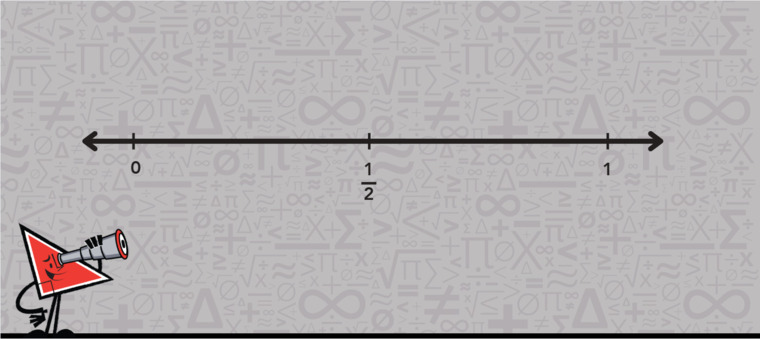
Now, let’s use these benchmarks to place \(\Large\frac{3}{10}\) on the number line:
-
The bottom number is 10, so we’re cutting something into 10 equal pieces. We have 3 of them.
-
Then, we should find out whether 3 is more or less than half of 10. Half of 10 is 5, and we only have 3. So \(\Large\frac{3}{10}\) is under \(\Large\frac{1}{2}\) and belongs to the left part of a number line.
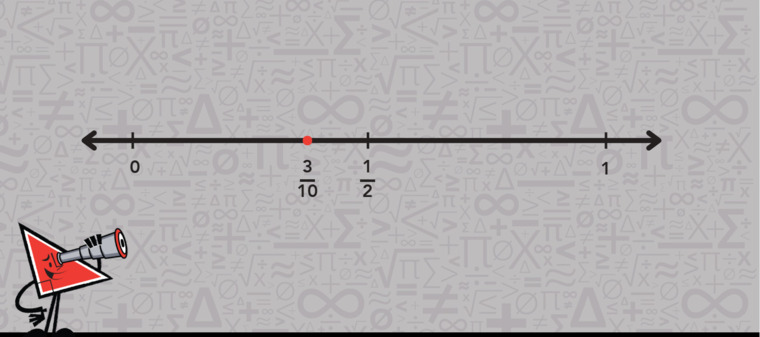
Notice that we did not find a common denominator. We only asked, "Do we have more or less than half of the pieces?" That question can usually tell us which part of the number line the fraction belongs to.
You can try this with some real objects:
These things can help you understand “more than half” and “less than half” before those ideas move onto a number line.
📕 You May Also Like: How Number Lines Improve Math Understanding in Grades 1 Through 5
How to Use ¼ and ¾ as Benchmark Fractions
With 0, \(\Large\frac{1}{2}\), and 1 in place, we can add two more signposts:
-
\(\Large\frac{1}{4}\), which sits halfway between 0 and \(\Large\frac{1}{2}\),
-
\(\Large\frac{3}{4}\), sitting halfway between \(\Large\frac{1}{2}\) and 1.
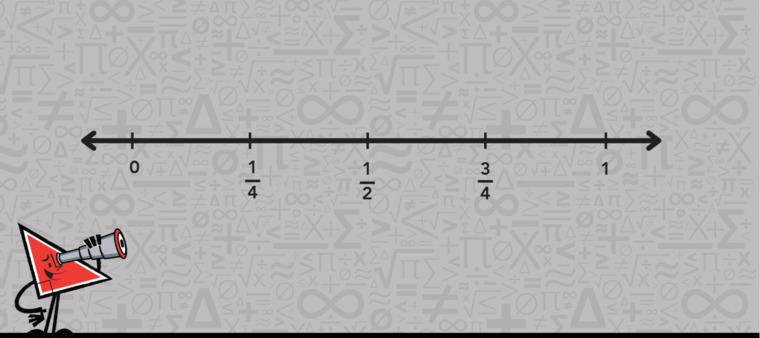
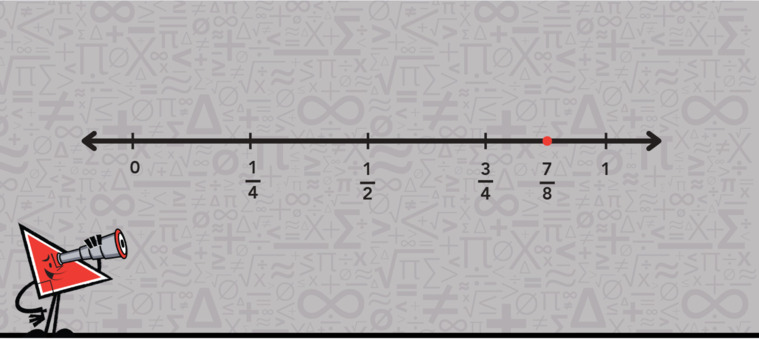
Now the number line has four parts, and we can place almost any common fraction quite accurately. Let’s take \(\Large\frac{7}{8}\) as an example:
-
The bottom number is 8, so half would be 4. We have 7, which is more than 4, so \(\Large\frac{7}{8}\) is already past the halfway point. Now, is it closer to \(\Large\frac{1}{2}\) or to 1?
-
To answer that, we need to compare it with \(\Large\frac{3}{4}\). Since \(\Large\frac{3}{4}\) and \(\Large\frac{6}{8}\) are equivalent fractions, we can see that \(\Large\frac{7}{8}\) is a little more than \(\Large\frac{3}{4}\). That puts \(\Large\frac{7}{8}\) between \(\Large\frac{3}{4}\) and 1.
Here, we’ll look at \(\Large\frac{3}{16}\):
-
Half of 16 is 8. We only have 3, which is well under half, so \(\Large\frac{3}{16}\) is somewhere in the left part of the line. Is it closer to 0 or to \(\Large\frac{1}{2}\)?
-
To figure that out, we’ll compare it with \(\Large\frac{1}{4}\). One-fourth of 16 is 4. We have 3, which is just a little under that. So \(\Large\frac{3}{16}\) sits just to the left of the \(\Large\frac{1}{4}\) signpost.
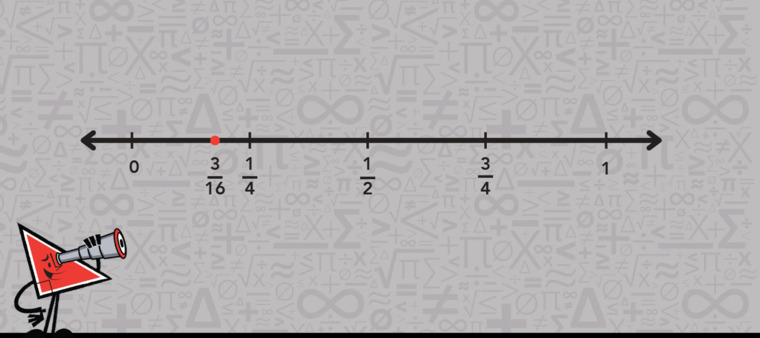
The same two-step process works every time. Find the half first, then decide whether to zoom in on the left or right part of the line using \(\Large\frac{1}{4}\) or \(\Large\frac{3}{4}\). That is the power of benchmark fractions. They help us see where a fraction belongs before calculating.
📕 You May Also Like: Equivalent Fractions Explained: A Kid-Friendly Guide
How to Compare Any Two Fractions Using Benchmarks
Benchmark fractions are useful for estimating where a fraction sits on a number line. The real advantage comes when we use them to compare two fractions directly, without finding a common denominator first.
Here is how we compare any two fractions using benchmarks:
-
Step 1: Compare each fraction to \(\Large\frac{1}{2}\). Check whether the numerator is more or less than half the denominator.
-
Step 2: If the two fractions land on opposite sides of \(\Large\frac{1}{2}\), the one past the halfway point is greater.
-
Step 3: If both fractions land on the same side of \(\Large\frac{1}{2}\), zoom in using \(\Large\frac{1}{4}\) or \(\Large\frac{3}{4}\) to see which one is farther along the number line.
At Mathnasium, we love teaching concepts through examples, so let's take a look at two and see how these steps play out in practice.
Easy Case: When Two Fractions Are on Opposite Sides of the ½ Benchmark
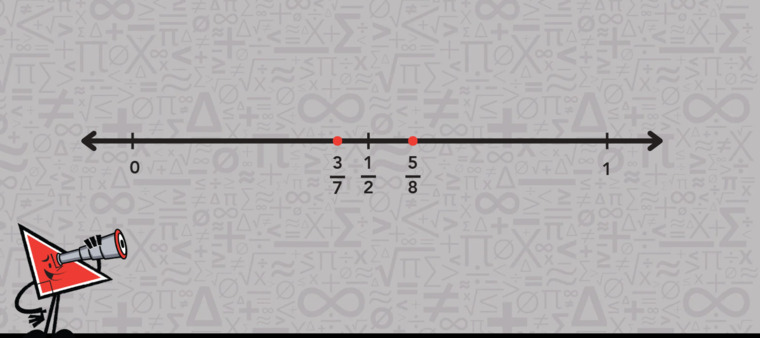
Let’s compare \(\Large\frac{3}{7}\) and \(\Large\frac{5}{8}\).
-
Start with \(\Large\frac{3}{7}\). Half of 7 is 3.5, which can also be expressed as a mixed number 3\(\Large\frac{1}{2}\). We have 3, which is a little less than half, so \(\Large\frac{3}{7}\) sits just to the left of \(\Large\frac{1}{2}\).
-
Now look at \(\Large\frac{5}{8}\). Half of 8 is 4. We have 5, which is more than half, so \(\Large\frac{5}{8}\) sits to the right of \(\Large\frac{1}{2}\).
-
So far, we figured out that \(\Large\frac{3}{7}\) is less than \(\Large\frac{1}{2}\), and \(\Large\frac{5}{8}\) is greater than \(\Large\frac{1}{2}\). So, \(\Large\frac{5}{8}\) > \(\Large\frac{3}{7}\). We used \(\Large\frac{1}{2}\) as the benchmark and avoided finding a common denominator.
Harder Case: When Both Fractions Are on the Same Side of the ½ Benchmark
Now, we’ll compare \(\Large\frac{2}{9}\) and \(\Large\frac{3}{7}\).
-
First, we’ll place \(\Large\frac{2}{9}\) on a number line. Half of 9 is 4.5, which we can also write as 4\(\Large\frac{1}{2}\). We have 2, which is clearly less than 4\(\Large\frac{1}{2}\), so \(\Large\frac{2}{9}\) is less than \(\Large\frac{1}{2}\) but not quite close to it.
-
Now look at \(\Large\frac{3}{7}\). Half of 7 is 3\(\Large\frac{1}{2}\). We have 3, which is just under 3\(\Large\frac{1}{2}\), so \(\Large\frac{3}{7}\) is also less than \(\Large\frac{1}{2}\), but it is very close to a half signpost.
-
Both fractions are under \(\Large\frac{1}{2}\), but they are not equally close to it. From here, we can judge which fraction is greater by seeing how close each one is to the \(\Large\frac{1}{2}\) benchmark. But to be sure, we can also compare them to the \(\Large\frac{1}{4}\) signpost.
-
To compare \(\Large\frac{2}{9}\) with \(\Large\frac{1}{4}\), divide 9 by 4 to find one quarter. 9 ÷ 4 = 2.25, or 2\(\Large\frac{1}{4}\). In \(\Large\frac{2}{9}\) we only have 2 at the top, which is under 2\(\Large\frac{1}{4}\). So \(\Large\frac{2}{9}\) sits just to the left of the \(\Large\frac{1}{4}\) signpost.
-
To compare \(\Large\frac{3}{7}\) with \(\Large\frac{1}{4}\), divide 7 by 4. 7 ÷ 4 = 1.25. In our fraction of \(\Large\frac{3}{7}\) we have 3 at the top, which is well past 1.25. This means \(\Large\frac{3}{7}\) sits between \(\Large\frac{1}{4}\) and \(\Large\frac{1}{2}\).
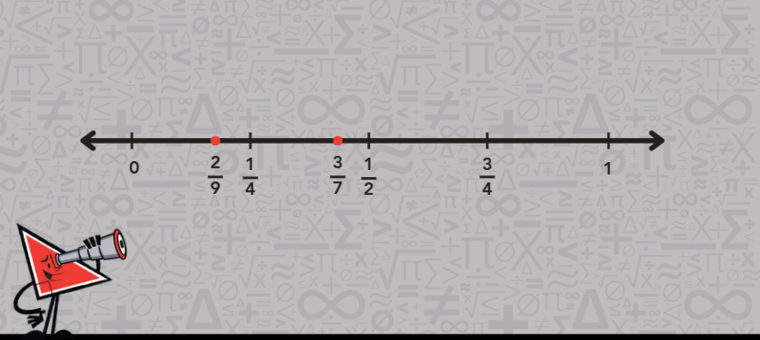
Both fractions are under \(\Large\frac{1}{2}\), but they're in different parts of the left half of the line. \(\Large\frac{2}{9}\) is near \(\Large\frac{1}{4}\), and \(\Large\frac{3}{7}\) is closer to \(\Large\frac{1}{2}\). That tells us \(\Large\frac{2}{9}\) < \(\Large\frac{3}{7}\) without finding a common denominator.
Your Turn! Compare Fractions Using Benchmarks
For each pair below, use benchmark fractions to decide which fraction is greater. You can check your answers at the bottom of the page.
-
\(\Large\frac{4}{9}\) and \(\Large\frac{7}{8}\)
-
\(\Large\frac{5}{11}\) and \(\Large\frac{3}{7}\)
-
\(\Large\frac{1}{6}\) and \(\Large\frac{2}{7}\)
-
\(\Large\frac{7}{12}\) and \(\Large\frac{5}{9}\)
-
\(\Large\frac{3}{8}\) and \(\Large\frac{5}{7}\)
 Mathnasium's specially trained tutors guide students through benchmark fractions in a supportive, engaging environment.
How Mathnasium Can Help With Benchmark Fractions (and Any Other Math Topic)
Mathnasium is a math-only learning center that works with students of all skill levels to learn and master any math topic, including benchmark fractions.
We use our proprietary teaching method, the Mathnasium Method™, which, among other things, includes verbal, visual, tactile, and written techniques that make abstract concepts like fractions feel concrete.
To unlock each student’s math potential, our approach also relies on:
-
Personalized learning plans: Each student begins with a diagnostic assessment that identifies their strengths, knowledge gaps, and how they approach math. From there, our specially trained tutors follow a personalized learning plan built around what that student actually needs.
-
Caring group environment: Students work in a fun and caring group environment where they feel comfortable asking questions, making mistakes, and trying again.
-
Independent problem-solving: Each session gives students time to work through problems on their own, building the critical thinking skills they can apply across topics and grade levels.
-
Math-only focus: We are dedicated to math and math only. This singular focus on math allows us to dive deeper into how students best learn, absorb, and retain math skills.
-
Building confidence: We often hear students say our sessions don’t feel like lessons at all. That’s by design. Our approach includes game-based activities and plenty of rewards to keep students motivated and engaged.
And the results speak for themselves:
-
94% of parents report an improvement in their child's math skills and understanding
-
93% of parents report their child's improved attitude toward math after attending Mathnasium
-
90% of students saw an improvement in their school grades
With over 1,100 centers, Mathnasium brings top-rated instruction close to your home.
If you are in or near Little Elm, TX, Mathnasium of Aubrey is a trusted local center with years of experience helping students excel in math.
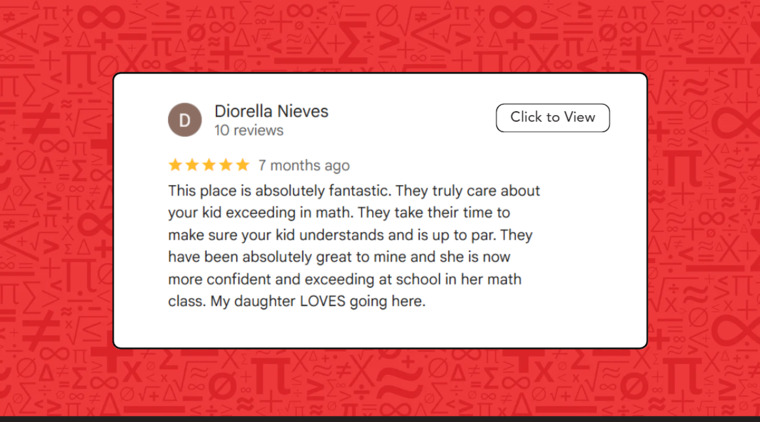
Our community recognizes our dedication to student success, honoring us with many five-star Google reviews.
Here’s what one parent had to say about Mathnasium of Aubrey.
If your child is hitting a wall with benchmark fractions or any other math topic, a free diagnostic assessment is the right first step.
📅 Schedule a Free Diagnostic Assessment at Mathnasium of Aubrey
Not near Little Elm?
📍 Find a Mathnasium Learning Center Near You
Pssst! Check Your Answers Here
If you worked through the practice problems, here are the answers:
-
\(\Large\frac{4}{9}\) < \(\Large\frac{7}{8}\)
-
\(\Large\frac{5}{11}\) > \(\Large\frac{3}{7}\)
-
\(\Large\frac{1}{6}\) < \(\Large\frac{2}{7}\)
-
\(\Large\frac{7}{12}\) > \(\Large\frac{5}{9}\)
-
\(\Large\frac{3}{8}\) < \(\Large\frac{5}{7}\)
How did you do?


 (214) 801-4995