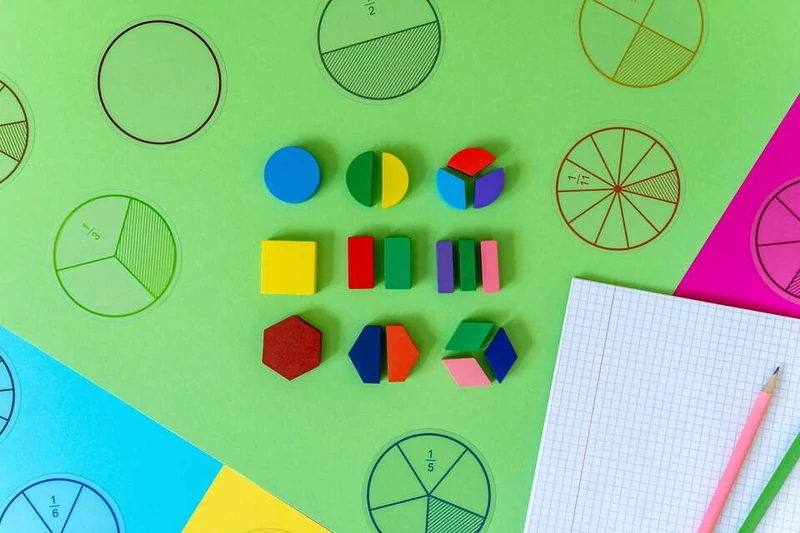
Four quarters make a dollar. So do 10 dimes. The coins look different, and the numbers are different, but the value is the same.
That's exactly the idea behind equivalent fractions. \(\Large\frac{1}{2}\) and \(\Large\frac{2}{4}\) look different on paper, but they represent the same amount.
Today, our tutors break down what equivalent fractions are, how to find them, and where they show up in everyday life, with practice problems and answers to the most common student questions along the way.

What Are Equivalent Fractions?
Equivalent fractions are fractions that represent the same value, even though their numerators and denominators look different.
In other words, they describe the same part of a whole, just written in a different way.
Does that make sense? Here's something to make it more concrete.
Find a rectangular piece of paper and fold it in half. You get 2 equal sections, right? Either one of them is \(\Large\frac{1}{2}\).
Next, fold it in half one more time. Now you have 4 equal sections. Take 2 of them, that's \(\Large\frac{2}{4}\).
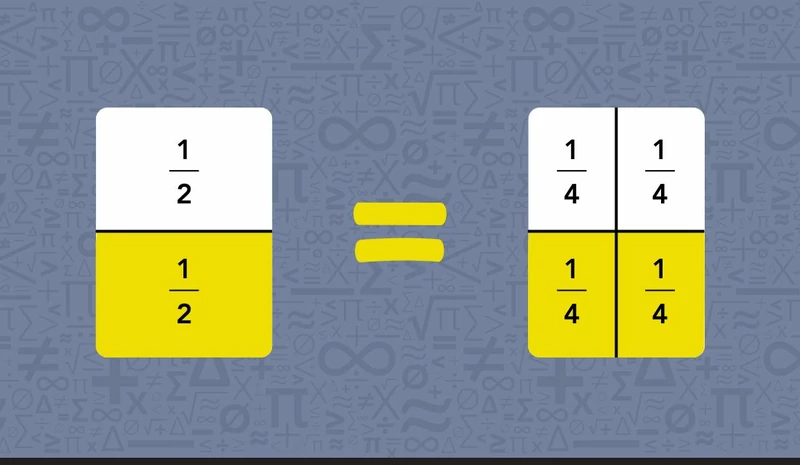
Look at both parts. \(\Large\frac{1}{2}\) and \(\Large\frac{2}{4}\) take up the exact same space on the paper. That's what equivalent fractions are!
Two Ways to Find Equivalent Fractions
There are two reliable methods for finding equivalent fractions: multiplication and division. Both work by changing the numbers in a fraction without changing its value.
1. Multiplication
To use this method, we need to multiply both the numerator and the denominator of a fraction by the same number. Any number works, as long as you do it to both.
Let's try it with \(\Large\frac{2}{5}\). We'll multiply both parts by 2 to keep things simple:
\(\Large\frac{2}{5}\) × \(\Large\frac{2}{2}\) = \(\Large\frac{4}{10}\)
So \(\Large\frac{2}{5}\) and \(\Large\frac{4}{10}\) are equivalent. Since fractions are just division, we can double-check by dividing the numerator by the denominator in each one. If both give the same result, the fractions are equivalent.
\(\Large\frac{2}{5}\) = 2 ÷ 5 = 0.4
\(\Large\frac{4}{10}\) = 4 ÷ 10 = 0.4
They are the same!
📕 You May Also Like: 9 Tips to Help Your Child Master Multiplication Facts
2. Division
To find an equivalent fraction using division, we divide both the numerator and the denominator by the same number.
For example, with \(\Large\frac{4}{8}\), both 4 and 8 can be divided by 2. They share that number, which is called a common factor. The result is a simpler fraction that represents exactly the same value.
\(\Large\frac{4}{8}\) ÷ \(\Large\frac{2}{2}\) = \(\Large\frac{2}{4}\)
Now, let's go one step further. With \(\Large\frac{4}{8}\), both parts of the fraction can also be divided by 4.
Both 2 and 4 work, which makes them common factors. You may remember that the largest one, in this case 4, is called the Greatest Common Factor (GCF).
Dividing by the GCF gets us to the simplest form in a single step. This is called simplifying a fraction.
\(\Large\frac{4}{8}\) ÷ \(\Large\frac{4}{4}\) = \(\Large\frac{1}{2}\)
We can also use a smaller common factor, which also works but takes an extra step. If we divide by 2 first:
\(\Large\frac{4}{8}\) ÷ \(\Large\frac{2}{2}\) = \(\Large\frac{2}{4}\)
\(\Large\frac{2}{2}\) is already an equivalent fraction of \(\Large\frac{4}{8}\). If we want to simplify further, we can divide by 2 one more time:
\(\Large\frac{2}{4}\) ÷ \(\Large\frac{2}{2}\) = \(\Large\frac{1}{2}\)
Regardless of the path we take, we get equivalent fractions. \(\Large\frac{2}{4}\) and \(\Large\frac{1}{2}\) are both equivalent to \(\Large\frac{4}{8}\).
Dividing by the GCF simply gets us to the simplest form in one step.
📕 You May Also Like: Multiplying and Dividing Fractions: The Why Behind the How
3 Examples of Equivalent Fractions in Real Life
Equivalent fractions show up in real life all the time, and the more you practice them, the more you'll start spotting them everywhere!
1. Time
Equivalent fractions show up on the clock, too.
An hour has 60 minutes. When 30 minutes go by, that's \(\Large\frac{30}{60}\). But no one says that; we all say half an hour, or \(\Large\frac{1}{2}\). Those are two different fractions, but one amount of time.
2. Food
And now something we all like, pizza.
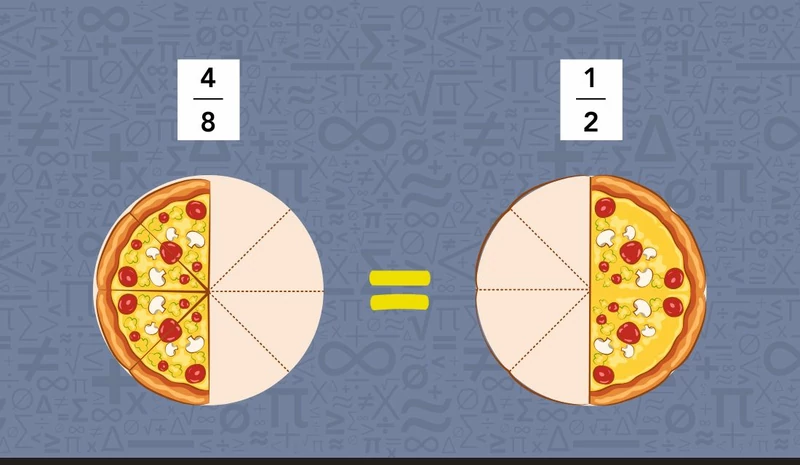
Most of the time, the ones we order are cut into 8 equal slices. Say you ate 4 out of 8, that's \(\Large\frac{4}{8}\) of the pizza. If you look at what's left, you'll notice that exactly half the pizza is gone. In other words, \(\Large\frac{1}{2}\). So \(\Large\frac{4}{8}\) and \(\Large\frac{1}{2}\) are equivalent fractions.
3. Basketball
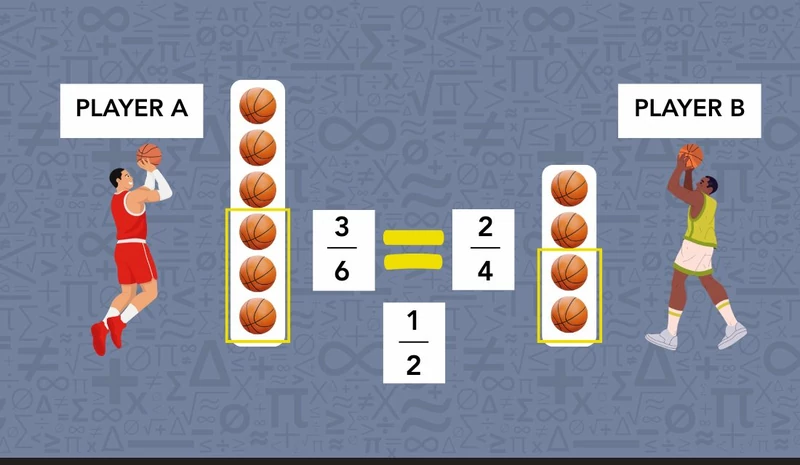
Imagine two players comparing their performance after a game.
If you just look at the whole numbers, it's easy to assume player A did better. After all, 3 is greater than 2.
But those numbers don't tell the whole story. To make a fair comparison, you need to look at how many shots each player made out of their total attempts.
Equivalent fractions make that possible.
We can express their results as fractions:
When you simplify both, \(\Large\frac{3}{6}\) and \(\Large\frac{2}{4}\) both equal \(\Large\frac{1}{2}\), meaning both players made exactly half of their attempts.
Without equivalent fractions, the numbers look different, and the comparison feels unfair. With them, you can see the full picture clearly.
📕 You May Also Like: How to Help Your Child Make Sense of Wholes and Fractions
Quiz: Test Your Equivalent Fractions Skills
Now that you know how equivalent fractions work, put your skills to the test. Try to answer each question on your own before moving on.
1. True or False:
\(\Large\frac{2}{3}\) is the same as \(\Large\frac{4}{6}\).
2. Which fraction is equivalent to \(\Large\frac{2}{5}\)?
-
\(\Large\frac{3}{8}\)
-
\(\Large\frac{4}{10}\)
-
\(\Large\frac{5}{12}\)
3. Fill in the blank:
If \(\Large\frac{3}{4}\) = \(\Large\frac{6}{?}\), what is the missing number?
4. True or False:
Maya says that \(\Large\frac{5}{10}\) is an equivalent fraction of \(\Large\frac{1}{2}\). Is she right?
5. Which of these fractions is already in its simplest form?
-
\(\Large\frac{4}{8}\)
-
\(\Large\frac{3}{9}\)
-
\(\Large\frac{5}{7}\)
When you are done, scroll to the bottom of the page to check your answers.
Frequently Asked Questions About Equivalent Fractions
Here are some follow-up questions our students most commonly ask at Mathnasium centers.
1. When do students start learning about equivalent fractions?
Fractions are introduced as early as grades 1 and 2, but equivalent fractions are formally taught in 3rd grade. From there, they become a building block for more advanced topics like adding and subtracting fractions, ratios, and algebra.
2. Why are equivalent fractions important?
Equivalent fractions help students compare, simplify, and work with fractions across many areas of math. They also come up naturally in everyday situations, from splitting food evenly to reading measurements in a recipe.
3. Which other areas of math use equivalent fractions?
Equivalent fractions connect to several topics students will encounter as they progress:
-
Adding and subtracting fractions: When fractions have different denominators, equivalent fractions are used to rewrite them with a matching denominator before calculating.
-
Decimals and percentages: Knowing that \(\Large\frac{1}{4}\) equals \(\Large\frac{25}{100}\) makes it straightforward to express it as 0.25 or 25%.
-
Geometry: Equivalent fractions appear in scale factors and proportions when working with similar shapes.
-
Algebra: Simplifying expressions with fractions relies on the same logic used to find equivalent fractions.
📕 You May Also Like: How to Turn a Fraction into a Percent: A Kid-Friendly Guide
4. How many equivalent fractions can one fraction have?
Every fraction has an unlimited number of equivalent fractions. Using the multiplication method covered earlier, you can keep multiplying the numerator and denominator by different numbers to generate as many as you need.
Take \(\Large\frac{1}{2}\) as an example:
\(\Large\frac{1}{2}\) = \(\Large\frac{2}{4}\) = \(\Large\frac{3}{6}\) = \(\Large\frac{4}{8}\) = \(\Large\frac{5}{10}\) ...and so on.
Each one is found by multiplying both the numerator and denominator of \(\Large\frac{1}{2}\) by the same number: 2, 3, 4, 5, and so on. The numbers change, but the value stays the same.
All of these represent the same value. In practice, the most useful equivalent fraction is usually the simplest one, which is why simplifying with the division method matters just as much as generating new ones.

Mathnasium uses personalized learning plans and interactive teaching techniques to build a deep understanding of fractions.
How Mathnasium Helps Students Master Equivalent Fractions
Mathnasium is a math-only learning center helping K-12 students catch up, keep up, and get ahead in math.
When students come to us needing support with fractions, we teach for true understanding, not rote drills or memorization. To do that, we use a proprietary teaching approach called the Mathnasium Method™.
Here's how it works.
Each student's journey begins with a diagnostic assessment that reveals their current skills, knowledge gaps, and goals. From there, we build a personalized learning plan tailored to their needs, whether that means mastering equivalent fractions or building confidence across all areas of math.
With the plan in place, our specially trained tutors follow it closely, teaching math face-to-face in a supportive and confidence-building environment.
When students get stuck on something like equivalent fractions, we break it down into manageable parts and use a mix of verbal, visual, mental, tactile, and written techniques to make the concept truly land.
Fun is a major part of our approach. We use game-based activities and give students a chance to earn rewards along the way, keeping them engaged and aware of their progress. We celebrate every step of success, big or small, so confidence grows with every session.
The results speak for themselves:
-
94% of parents report an improvement in their child's math skills and understanding
-
93% of parents report their child's improved attitude toward math after attending Mathnasium
-
90% of students saw an improvement in their school grades
With over 1,100 centers, we bring the Mathnasium Method™ close to your community.
For families in or near Allen, TX, Mathnasium of Allen is a trusted local center with years of experience building confident math thinkers.
Our community recognizes our commitment to student success and has rewarded us with:
-
Over 100 five-star Google reviews reflect our parents' trust in proven results
-
Multiple Reader's Choice Awards from Living Magazine: Best Tutoring (2021–2024) and Best Early Education (2023)
-
Community Votes 2025 Best Tutor in Allen
-
Business Rate Best of 2025 Tutoring Service for Allen
If your child is ready to build a solid foundation in fractions and beyond, our team is here to help.
📅 Schedule a Free Diagnostic Assessment at Mathnasium of Allen
Not near Allen?
📍 Find a Mathnasium Learning Center Near You
Psst! Check Your Quiz Answers
If you’ve given our exercises a try, check your answers below:
-
True
-
B (\(\Large\frac{4}{10}\))
-
8
-
Yes, Maya is right.
-
C (\(\Large\frac{5}{7}\))
How did you do?


 (469) 361-2277
 (469) 361-2277