Conditional statements usually show up in grade 8 or 9, right in the middle of a geometry or logic unit, and they tend to arrive with a whole family of related terms at once: converse, inverse, contrapositive.
If that sounds like a lot, don't worry. The converse is actually the most intuitive of the four, and once you see how it works, the others fall into place a lot more naturally.
We'll walk you through the definition, show you how to form one, and give you plenty of examples and practice problems along the way.

What Is a Conditional Statement?
Before we can explain what a converse is, we need to understand conditional statements.
Put simply, a conditional statement is an if-then statement made up of two parts:
In formal notation, the hypothesis is labeled with p, and the conclusion with q.
Therefore, the entire conditional statement can be written as:
p → q
But it’s important to note that the letters p and q are just labels for the two parts. So, don’t confuse them with variables from an equation.
Here are two examples of what this looks like in practice:
-
"If a shape is a square, then it has four equal sides."
-
"If it is Friday, then there is no school tomorrow."
In both cases, the hypothesis comes after "if" and the conclusion comes after "then."
Simple enough. But why do we need conditional statements, and what does this have to do with converse statements?
Well, as you will see in a bit, from each conditional statement, we can form three related statements that all affect the logic of the sentence. A converse statement is simply one of these options.
📕 You May Also Like: 10 Geometry Concepts Students Should Master Before 10th Grade
What Is the Converse of a Statement?
The converse of a conditional statement is formed by swapping the hypothesis and the conclusion.
So, going back to that shorthand we just mentioned, p → q, the converse is q → p.
That’s all there is to it.
But let’s go back to our two examples to get an even better picture. Swapping the hypothesis and conclusion, we’d get the sentences:
-
"If a shape has four equal sides, then it is a square."
-
"If there is no school tomorrow, then it is Friday."
Mechanically, we’ve done the task of turning a conditional statement into a converse statement. However, if we look at these two sentences more closely, we can come to an important realization:
A converse statement is not automatically true just because the original statement is true.
Look at the first example. The original is true. Every square does have four equal sides. But the converse? A rhombus also has four equal sides, and it is not a square. That one example is enough to prove the converse is false.
In math, we call this a counterexample.
The second converse is also false. There is no school on Saturday either, so "no school tomorrow" does not guarantee it’s Friday.
So, if the problem has you determine the validity of a converse statement, ask yourself: Can I find even one situation where the hypothesis is true but the conclusion is false? If yes, the converse is false. If no situation like that exists, the converse is true.
📕 You May Also Like: 4 Reasons Why Students Fall Behind in Middle School
How Converse, Inverse, and Contrapositive Relate
As we’ve mentioned, a converse statement is only one out of three "options." The other two are inverse statements and contrapositive statements.
So, while we won’t go into too much detail here, here is how our initial example would look across all four statement forms.
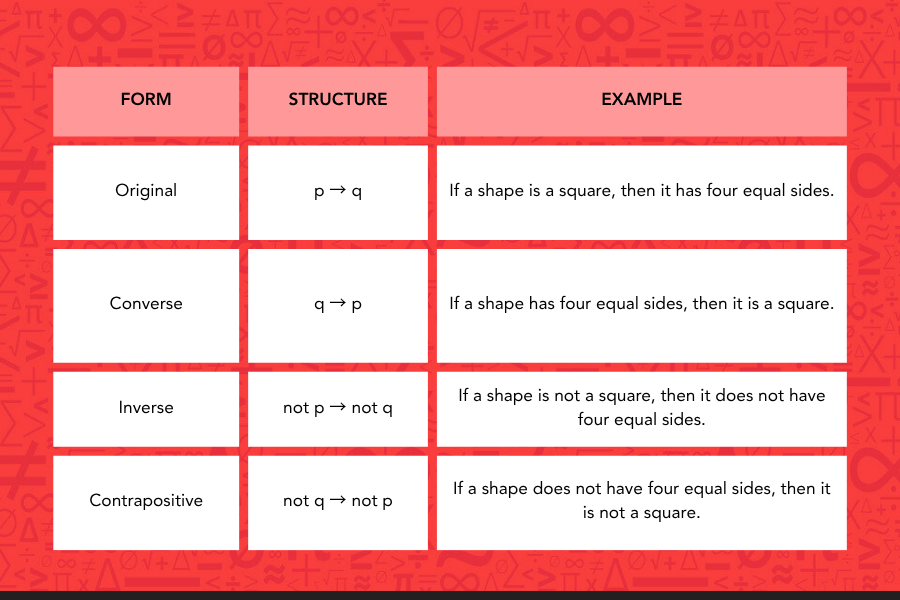
The most important takeaway?
The contrapositive is always logically equivalent to the original statement. If the original is true, the contrapositive is guaranteed to be true as well.
The converse and inverse are equivalent to each other, but not to the original. So if you know the original is true, you cannot assume the converse is true without testing it separately.
This distinction comes up regularly in geometry proofs and assessments, so it is worth locking in before moving on.
📕 You May Also Like: Guide to Understanding the Surface Area of a Rectangular Prism
Solved Examples of Converse Statements
With the theoretical framework in place, let’s now go over a few worked examples.
Example 1
"If a number is even, then it is divisible by 2."
-
Hypothesis: a number is even
-
Conclusion: it is divisible by 2
-
Converse: "If a number is divisible by 2, then it is even."
Is the converse true? Yes. Being divisible by 2 is exactly what it means to be even. No counterexample exists, so the converse is true.
Example 2
"If an animal is a dog, then it has four legs."
-
Hypothesis: an animal is a dog
-
Conclusion: it has four legs
-
Converse: "If an animal has four legs, then it is a dog."
Is the converse true? No. A cat has four legs and is not a dog. That counterexample is enough to show the converse statement is false.
Example 3
"If you study for the test, then you will pass."
-
Hypothesis: You study for the test
-
Conclusion: You will pass
-
Converse: "If you pass the test, then you studied for it."
Is the converse true? Not necessarily. Someone might pass without studying, perhaps because the material was already familiar. The converse is false.
📕 You May Also Like: Is Algebra 2 Hard? Everything You Need to Know
Practice Time: Form and Evaluate the Converse
For each statement below, write the converse and decide whether it is true or false. If it is false, give a counterexample.
-
"If a polygon is a triangle, then it has three sides."
-
"If it is snowing, then the temperature is below freezing."
-
"If a number is divisible by 4, then it is divisible by 2."
-
"If you live in Paris, then you live in France."
-
Rewrite this sentence as a conditional statement, then write its converse: "All rectangles have four right angles."
Check your answers at the bottom of the page!
FAQs About Converse Statements
Learning about converse statements tends to raise a few questions. Here are the ones we hear most often at our centers, with answers to clear up any confusion.
1. Is the converse of a true statement always true?
No, and this is the most common misconception about converse statements. The converse can be true, but it has to be tested separately.
The original statement "If a shape is a square, then it has four equal sides" is true, but its converse is false because a rhombus also has four equal sides without being a square. Always look for a counterexample before assuming the converse is true.
2. What is the difference between the converse and the contrapositive?
The converse only swaps the hypothesis and conclusion (q → p). The contrapositive swaps them and also negates both parts (not q → not p).
The contrapositive is always logically equivalent to the original statement, which means if the original is true, the contrapositive is guaranteed to be true. The converse has no such guarantee.
3. How do I write a converse if the original statement is not in if-then form?
Use this two-step process. First, rewrite the original as a formal if-then statement by identifying what the hypothesis and conclusion are.
For example, "All squares have four equal sides" becomes "If a shape is a square, then it has four equal sides." Then swap the two parts to form the converse: "If a shape has four equal sides, then it is a square."

Mathnasium’s specially trained math tutors help students close their knowledge gaps, using proven teaching techniques and introducing new concepts in manageable steps.
Build Mathematical Reasoning With Mathnasium
Converse statements can feel frustrating when the formal language gets in the way, but once the underlying concept clicks, the rest follows naturally.
At Mathnasium, we specialize in making those moments of clarity happen.
Our approach, the Mathnasium Method™, is proprietary, personalized, and designed to build understanding at every level.
Each student starts with a diagnostic assessment that identifies their strengths and knowledge gaps. From there, our tutors follow a personalized learning plan, working face-to-face in a caring and fun group environment at a pace matched to each student's needs.
Because we focus exclusively on math, everything we do is built around how students best absorb and retain mathematical concepts, from foundational arithmetic through high school geometry and beyond.
And the results speak for themselves:
-
94% of parents report an improvement in their child's math skills and understanding
-
93% of parents report an improved attitude toward math after attending Mathnasium
-
90% of students saw an improvement in their school grades
With over 1,100 centers, we bring the Mathnasium Method™ close to your community.
For families in or near Blue Ash, OH, Mathnasium of Blue Ash is a trusted local center with years of experience transforming how students think and feel about math. We're proud to have been recognized as:
If your middle schooler is ready to catch up, build stronger geometry basics, or prepare for 8th grade with confidence, our team is here to help.
📅 Schedule a Free Diagnostic Assessment at Mathnasium of Blue Ash
Not located near Blue Ash?
📍 Find a Mathnasium Learning Center Near You
Pssst! Check Your Answers Here
-
Converse: "If a polygon has three sides, then it is a triangle." True.
-
Converse: "If the temperature is below freezing, then it is snowing." False. The temperature can be below freezing without snow falling.
-
Converse: "If a number is divisible by 2, then it is divisible by 4." False. 6 is divisible by 2 but not by 4.
-
Converse: "If you live in France, then you live in Paris." False. You could live in Lyon, Marseille, or any other city in France.
-
Conditional: "If a shape is a rectangle, then it has four right angles." Converse: "If a shape has four right angles, then it is a rectangle." True (remember, squares are also rectangles!).


 (513) 984-1212
 (513) 984-1212