Reaching for more practice when test results aren't improving is a reasonable instinct, and for many skills it's the right move. In math, though, it's a little more complicated.
Research published by the Hammill Institute for Disabilities emphasizes that independent practice is only effective when built upon an accurate conceptual foundation. Without it, repetitive drills run the risk of practicing and reinforcing the exact mistake or misconception
So if your child has been working on a math topic for weeks and still isn't getting it, the problem probably isn't the amount of practice.
Something in their math understanding hasn't come together yet, and until it does, more of the same work won't move them forward.
Our education specialists used research-backed evidence to help parents understand what's really going on and what to do about it.

5 Reasons Why More Math Practice Isn't Helping Your Child
The causes of persistent math struggle tend to fall into a few recognizable patterns. Each one requires a different kind of response.
1. Gaps in Previous Skills
Math is one of the few subjects where something your child learned two or three years ago can derail what they're working on today.
In math, a foundational gap doesn't disappear when the class moves on. It travels with your child into the next topic, and the one after that, because each new concept builds on a previous one.
The homework is showing you this year's problem, but the real gap could be sitting two grade levels back, making everything built on top of it feel unstable, no matter how much your child practices the current material.
📕 You May Also Like: Is My Child “Bad at Math” or Missing Foundational Skills?
2. Weak Number Sense
Some children can follow the steps their teacher showed them and get the right answer, but ask them to solve the same problem a slightly different way, and they're completely lost. Ask them if their answer makes sense, and they don't know how to check its accuracy.
That's weak number sense, and it's one of the most common reasons math practice stops working.
Children who haven't developed number sense can still get through math by memorizing procedures, but only for so long. As the math gets harder and less predictable, there's nothing to fall back on when the memorized steps don't fit the problem in front of them.
📕 You May Also Like: What Is Number Sense & Why It Matters in Early Math Education
3. Procedure Without Understanding
If your child can multiply fractions perfectly when the problem looks like the ones from class, but has no idea what to do the moment that same skill shows up inside a word problem or gets combined with something else, they likely know the steps without understanding what those steps actually mean.
The National Mathematics Advisory Panel confirms that conceptual understanding and procedural fluency are mutually reinforcing, along with automatic recall of facts. Practicing a procedure your child doesn't understand just makes them faster at steps that will eventually stop working.
This is what happens when math gets taught as a sequence of moves to memorize rather than a set of ideas to understand. The procedure works until something changes, and in math, something always eventually changes.
4. Math Anxiety
The American Psychological Association estimates that around 20% to 25% of children experience real math anxiety, which interferes with the thinking they need to do the math work.
Math anxiety interferes with working memory, which is the mental resource your child needs to hold information in mind while solving a math problem.
Think of working memory as the brain's scratchpad. When anxiety takes up space on that scratchpad, there is less room left for the actual math. The problem becomes harder in that moment, because their brain is carrying too much information at once.
This is why more practice might be the wrong practice approach to math anxiety. Sitting an anxious child down for another hour of drills adds more pressure to a situation that already has too much of it.
Timed tests and high-stakes repetition tend to make anxiety significantly worse over time, reinforcing the belief that math is something to fear rather than something that can be understood.
5. Dyscalculia
Dyscalculia is a learning difference that affects how the brain processes numbers. Children with dyscalculia struggle with math because numbers don't work the same way for them as for other kids.
Basic math facts that other children pick up naturally, like knowing that 6 plus 4 is 10 without having to count, take much longer. Numbers feel hard to explain, and the same concepts have to be re-taught again and again without ever fully taking hold.
Dyscalculia affects around 3% to 7% of children, according to a study by Haberstroh & Schulte-Körne, which means there's a reasonable chance your child's class has at least one student dealing with it right now.
If your child has been practising for a long time and nothing seems to be working, it's worth talking to a specialist.

The right kind of support looks different depending on what's actually blocking your child's progress.
What Effective Support Looks Like
Not all math support is the same, and what works for one child can do very little for another.
Once you know what's blocking your child's progress, the right kind of help becomes a lot clearer.
1. For Gaps in Previous Skills
The most important thing here is to go back to where the topic understanding actually broke down. Continuing to work on this year's material when last year's foundation is missing just adds more confusion on top of confusion.
And yes, it can feel counterintuitive. Going back might seem like falling further behind.
But patching over a gap that hasn't been properly addressed is why so many children feel like they're always just barely keeping up, no matter how hard they practice.
2. For Weak Number Sense
Number sense develops through experiences that give your child room to think about numbers in different ways.
Games, real-world problems, estimation, and activities that encourage flexible thinking are what build it over time.
If math at home and at school has mostly been about following steps and getting answers, mix in activities that encourage your child to reason and explore.
📕 You May Also Like: 7 Active Math Games That Make Learning Fun at Home
3. For Procedure Without Understanding
The priority here is to slow down and go back to the why behind the steps.
Why does this method work? What does it actually mean?
Your child doesn't need more practice with the procedure. They need someone to explain the concept behind it in a way that makes sense to them, using real-world examples and visual tools that make the math feel concrete rather than abstract.
📕 You May Also Like: Math Skills You Can Teach in the Kitchen
4. For Math Anxiety
What helps most with math anxiety is giving your child a chance to feel successful before anything else. That means starting with math problems they can actually do, taking speed completely out of the equation, and letting their confidence build gradually.
Timed drills and high-pressure practice tend to make anxiety worse. Your child needs to first sit with math in a low-pressure setting and experience what it feels like to get a math problem right.
📕 You May Also Like: Understanding Math Anxiety and How to Overcome It
5. For Dyscalculia
Children with dyscalculia need instruction that engages multiple senses at once, seeing, hearing, and physically working with math concepts together, rather than relying on a single approach.
Progress with dyscalculia may look slower than it does with other types of math struggle, but slower progress with the right support is far more valuable than fast progress with the wrong kind.
Working with a math educator trained in learning differences, like the tutors at Mathnasium, means the instruction is matched to how your child actually processes information.
📕 You May Also Like: 5 Reasons Why Students Lose Interest in Math (+ Solutions)
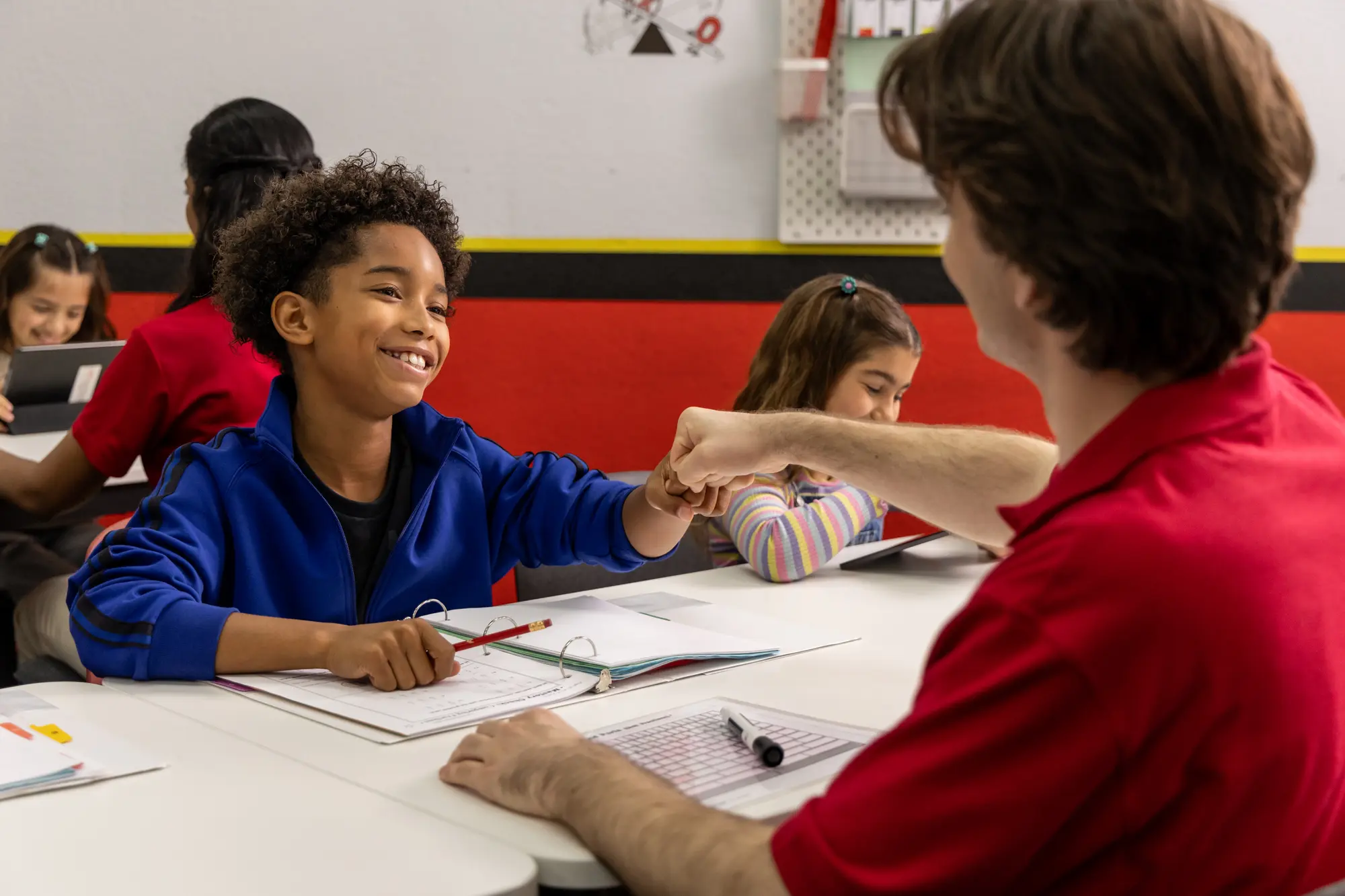
Mathnasium education specialists use a diagnostic assessment to pinpoint exactly where a student's understanding breaks down, so support can start from the right place.
How Mathnasium Helps Students With Math
Mathnasium is a math-only learning center dedicated to empowering K-12 students of all skill levels to excel in math.
Students who come to us after months of practice with no progress often arrive frustrated, discouraged, and convinced that math simply isn't for them. Some are dealing with foundational gaps that have been quietly compounding for years or carrying math anxiety that makes every session harder than it needs to be. Others have learned procedures without the understanding underneath them.
Because no two students arrive with the same struggle, the support they receive shouldn't be the same either.
That's why at Mathnasium we use the Mathnasium Method™, a proprietary teaching approach designed around each student's individual strengths, knowledge gaps, and pace.
Every student starts with a diagnostic assessment that tells us exactly where their understanding is solid and where the real gaps are forming, whether that's a missing prerequisite skill, a conceptual gap underneath a procedural struggle, or a pattern that points toward anxiety.
With those insights, we build a personalized learning plan that targets the right things from the start, and our specially trained tutors deliver face-to-face instruction guided by it.
We use simple language to explain math concepts and draw on a mix of verbal, visual, mental, tactile, and written techniques, which is especially valuable for students who process information differently, including those with dyscalculia, to make each concept make sense.
Students also have time during each session to work through problems independently before reconnecting with their educator to check their reasoning. That back-and-forth builds the problem-solving habits and critical thinking that help students trust their own mathematical thinking.
The results speak for themselves:
-
94% of parents report improvement in their child's math skills and understanding
-
93% of parents report an improved attitude toward math after attending Mathnasium
-
90% of students saw improvement in their school grades
With over 1,100 learning centers across North America, there is likely a Mathnasium close to you.
Families across Cape Coral, Entrada, Coral Lakes, and Sandoval trust Mathnasium of Cape Coral to help their children build a more positive experience with math.
If your child is feeling math pressure, whatever the source, our team is ready to help.
📅 Schedule a Free Assessment at Mathnasium of Cape Coral
Not near Cape Coral?
📍 Find a Mathnasium Learning Center Near You


 (239) 540-6284