Knowing how to measure the distance around a shape comes in handy more often than you would think. Say your family wants to figure out how much fencing the backyard needs, or you are trying to calculate the distance around a running track — both of those are perimeter problems.
Today, we will explain the general rule that works for any shape, then walk through simple shortcuts for squares, rectangles, triangles, and circles, so you can pick the right approach no matter what you are working with.

What Is Perimeter?
Perimeter is the total distance around the outside edge of a shape.
If we walk along every edge of a playground, tracing each side from start to finish until we end up back where we began, the total distance we'd walk is the perimeter of that playground.
This idea applies to any shape.
That shape can have four sides, five sides, or a curved edge like a circle. As long as it has a boundary, it has a perimeter, and that perimeter can always be measured by tracing the outside edge all the way around.
Some students confuse perimeter with area, but they measure two different things, so this is where we should be careful. Perimeter is the distance around a shape, while area is the space inside it.
Understanding this distinction early makes the formulas ahead much easier to follow, since each one builds on this same core idea.
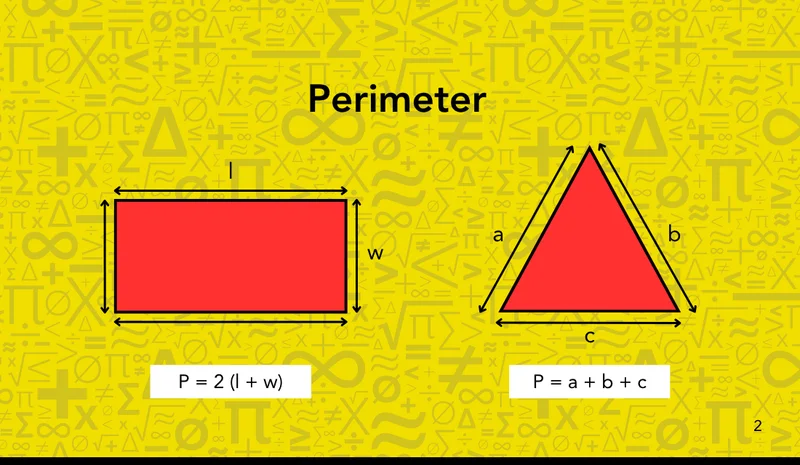
The Basic Perimeter Formula: Add Up the Sides
To find the perimeter of any shape, we simply add the length of every side.
This rule works no matter how many sides a shape has or whether those sides are the same length. There's no special formula required, just simple addition.
Let's say we’re measuring an irregular garden shaped like a five-sided pentagon, with sides measuring 4 feet, 6 feet, 3 feet, 5 feet, and 7 feet. To find the perimeter, we add each side together:
4 + 6 + 3 + 5 + 7 = 25 feet
That's it. The garden's perimeter is 25 feet, no matter how oddly shaped it looks.
This is what makes perimeter such a flexible concept. Whether a shape has three sides or eight, whether it's perfectly symmetrical or completely irregular, the same rule applies every time: add up all the sides, and the total is the perimeter.
The shortcuts covered next make this process faster for shapes with equal sides, but they all come from this same basic idea.
Perimeter Formulas for 4 Common Shapes
While the "add up the sides" rule always works, common shapes like squares, rectangles, triangles, and circles each have their own shortcut formula.
1. Square
A square has four equal sides, so instead of adding the same number four times, we can multiply one side by 4.
Formula: 4 × side
Let's say a square has sides measuring 6 inches each:
4 × 6 = 24 inches
The perimeter of the square is 24 inches.
2. Rectangle
A rectangle has two pairs of equal sides, so instead of adding all four sides individually, we can add the length and width together, then double the total.
Formula: 2 × (length + width)
Let's say a rectangle has a length of 8 inches and a width of 5 inches:
2 × (8 + 5) = 2 × 13 = 26 inches
The perimeter of the rectangle is 26 inches.
3. Triangle
Triangles don't have a multiplication shortcut, since their three sides aren't automatically equal.
To find the perimeter, we simply add up all three side lengths.
Let's say a triangle has sides measuring 5 inches, 7 inches, and 9 inches:
5 + 7 + 9 = 21 inches
The perimeter of the triangle is 21 inches.
However, if all three sides happen to be equal, like in an equilateral triangle, we can use a shortcut similar to the square, which is to multiply one side by 3.
Let's say an equilateral triangle has sides measuring 6 inches each:
3 × 6 = 18 inches
The perimeter of that equilateral triangle is 18 inches.
4. Circle (Perimeter's Circular Cousin)
Circles are a little different from the other shapes because they don't have any straight sides to add up. Instead of "perimeter," the distance around a circle has its own special name: circumference.
Even though the name is different, it measures the same thing: the total distance around the outside edge of the shape.
To find the circumference, we need two things:
Pi might sound mysterious, but it's really just a number, approximately 3.14, that shows up every time we're working with circles.
Formula: 2 × π × radius
Let's say a circle has a radius of 4 inches. To find the circumference, multiply 2 by pi, then multiply that by the radius:
2 × 3.14 × 4 = 25.12 inches
The circumference of the circle is about 25.12 inches.
So even though a circle looks nothing like a square or rectangle, finding the distance around it still follows the same basic idea: some kind of measurement, multiplied to get the total distance around the edge.
📕 You May Also Like: What Is Area in Math? A Complete & Kid-Friendly Guide
Perimeter vs. Area Common Mix-Up
Perimeter measures the distance around a shape, while area measures the space inside it.
Students often mix these two up since both involve measuring a shape, but they answer different questions.
Perimeter tells us how far we'd walk if we traced the outside edge.
Area tells us how much space is inside that shape, like how much carpet would cover a floor.
Let's compare both using the same rectangle, one with a length of 8 inches and a width of 5 inches.
Perimeter: 2 × (8 + 5) = 26 inches
Area: 8 × 5 = 40 square inches
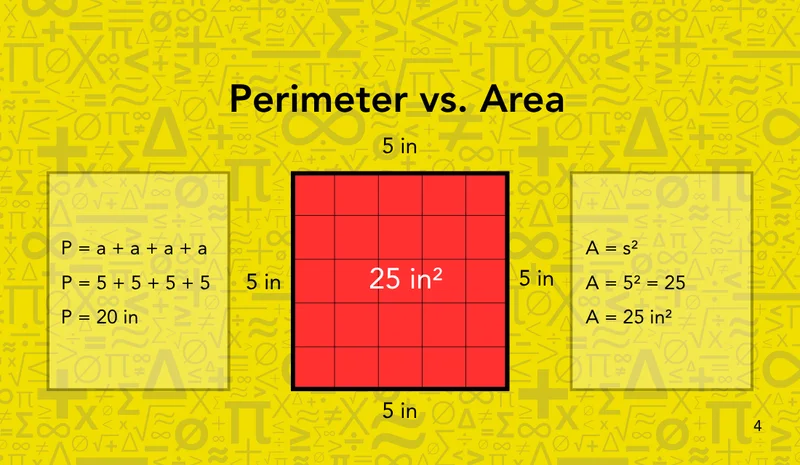
Notice that perimeter is measured in a single unit, like inches or feet, since it's a distance.
Area is measured in square units, like square inches or square feet, since it describes a two-dimensional space.
Once students see these side by side, the difference tends to click, and mixing them up becomes far less likely.
📕 You May Also Like: Perimeter vs. Area: Why Kids Mix Them Up and How to Teach the Difference

Our proprietary approach is designed to help students build a deep understanding of math concepts like area and perimeter.
How Mathnasium Helps Students Master Any Math Concept
Mathnasium is a math-only learning center dedicated to helping K-12 students of all skill levels excel in math.
Perimeter is a great example of how math builds on itself. Once a student understands the basic "add up the sides" rule, the shortcut formulas for squares, rectangles, and circles start to make sense instead of feeling like something to memorize.
That's the idea behind the the Mathnasium Method™, our proprietary teaching approach. Here is how it works:
-
Assessment and Personalized Learning Plans: Each student starts with a diagnostic assessment that identifies current skills, strengths, and gaps. From those findings, we build a personalized learning plan tailored to their goals, whether that means strengthening reading comprehension around math language, building translation fluency, or reducing working memory load through structured step-by-step practice.
-
Teaching for Understanding: Word problems combine reading, reasoning, and computation, so students often benefit from more than one explanation. Our specially trained tutors use natural language and a mix of verbal, visual, mental, tactile, and written techniques so each concept lands before we move forward.
-
Problem-Solving and Critical Thinking: Our tutors know when to offer support and when to let students work through a problem on their own. That balance is what builds lasting independence.
-
An Engaging and Fun Learning Environment: Sessions include games, earned rewards, and consistent celebration of progress. Students build confidence alongside fluency, and many develop a more positive relationship with math over time.
The results speak for themselves:
-
94% of parents report an improvement in their child's math skills and understanding
-
93% of parents report improved attitude toward math after attending Mathnasium
-
90% of students saw an improvement in their school grades
With over 1,100 learning centers across North America, there is likely a Mathnasium close to you.
Families across Cary, Fox River Grove, Oakwood Hills, Trout Valley, Prairie Grove, Crystal Lake, and Barrington trust Mathnasium of Cary IL to help their children build real math confidence at every level.
If word problems or any other math concept are giving your child trouble, our team is ready to help.
📅 Schedule a Free Assessment at Mathnasium of Cary IL
Not near Cary?
📍 Find a Mathnasium Learning Center Near You


 (224) 357-0975
 (224) 357-0975