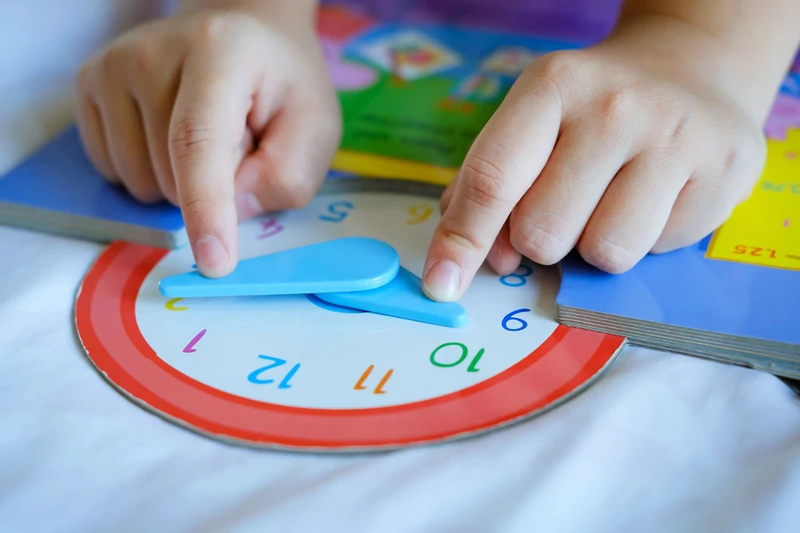
What if one of the best tools for teaching math has been hanging on your wall this whole time?
Analog clocks do more than tell time. They’re powerful tools for teaching math concepts such as fractions, skip counting, and problem-solving.
Our team has put together 9 ways to use analog clocks to help your child learn both time and fractions.
The Connection Between Clocks and Math
Analog clocks are one of the most practical tools for helping kids connect math to the real world.
Everything on the clock face has meaning, and everything moves in predictable patterns, which makes it an excellent visual model for learning.
Think of it this way:
-
Parts of a Whole: Each number on the clock represents one twelfth of the whole, allowing you to introduce fractions in a way that feels natural.
-
Angles: The shifting positions of the hour and minute hands create clear, measurable angles, giving students a visual way to explore geometry and understand how angles work.
-
Skip Counting: As the hands rotate, they follow predictable patterns that help students practice skip counting and recognize mathematical sequences.
-
Number Sense: Reading the minute marks also reinforces place value and strengthens number sense. In many ways, the clock functions like a circular number line.
When students use clocks to solve math problems, they also sharpen their problem-solving skills by calculating elapsed time or figuring out when an event will start or end.
And the list goes on!
Hopefully, now you can see just how effective a learning tool a simple analog clock can be. They allow kids to apply math in context, using visual reasoning with multi-step thinking.
📕 You May Also Like: 7 Traits of a Successful Math Student to Cultivate Early
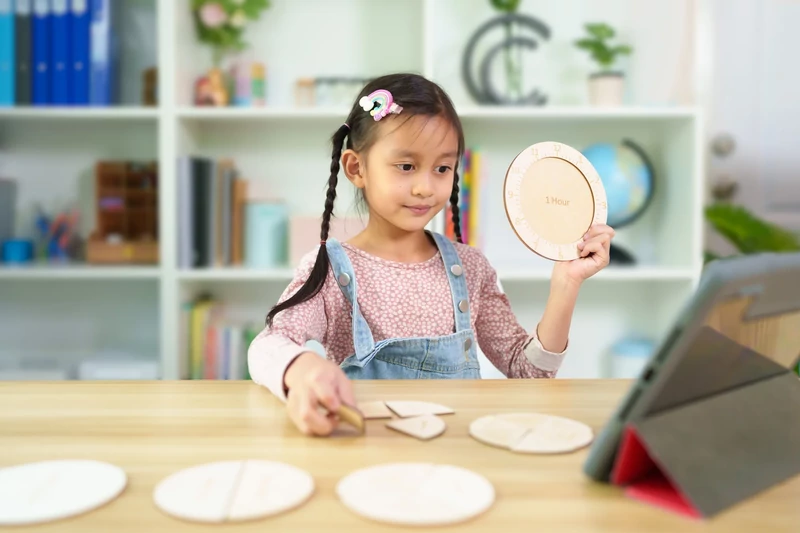
9 Ways to Turn a Clock Into a Math Tool at Home
Now that we’ve seen how analog clocks naturally support fractions, let’s explore some of the most effective ways to put them into action.
Here are nine engaging strategies, from our tutors for you, that show how analog clocks can help your child truly understand both time and fractions.
1. Visualizing Time as a Circle
We’ve already touched on how the analog clock can help children understand the concept of a whole. Let’s build on the idea:
There are 12 numbers marked around the clock face, and together they represent one full cycle or 12 hours. So when kids see the hour hand move from one number to the next, they’re seeing 1 out of 12 equal parts of that cycle.
This means one hour is \(\Large\frac{1}{12}\) of a full 12-hour rotation. And since a full day has 24 hours, one full spin around the clock shows \(\Large\frac{1}{2}\) of the day.
This kind of visual time learning for kids lays the foundation for understanding fractions and measurement.
2. Breaking Down Hours into Fractions
Once your child understands that a full hour is made up of 12 equal parts on the clock face, you can take the next step, breaking that hour into familiar fractions.
A clock naturally shows how time can be divided:
-
Half an hour = 30 minutes
-
A quarter of an hour = 15 minutes
-
A third of an hour = 20 minutes
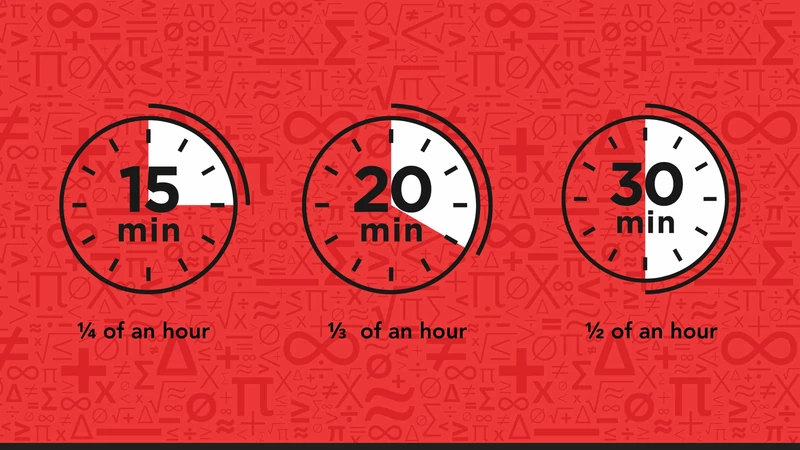
These are real-life examples of fractions that your child uses in school and now sees in action every day.
Try using time-related phrases in conversation, like “We’ll leave in a quarter of an hour,” or “You have half an hour to play.”
This kind of everyday language helps children connect abstract math to something they understand and experience regularly, so fractions feel less confusing and a lot more real.
3. Hands-On Clock Manipulatives
Math manipulatives, like toy or paper clocks, can help visual and kinesthetic learners grasp math concepts much better and faster.
If your child learns best with hands-on activities, give a paper clock a try!
Instead of just being told that 20 minutes is \(\Large\frac{1}{3}\) of an hour, your child can move the minute hand and see it for themselves.
It turns math into something they can play with and learn through trial and error.
4. Counting by 5s for Minutes
Every number on the clock stands for 5 minutes, so reading time becomes a built-in skip-counting exercise.
As your child counts 5, 10, 15, 20 around the clock, they’re practicing skip counting by 5s, an important early step toward learning multiplication. Each number on the clock represents a 5-minute interval, so moving from one number to the next mirrors counting in multiples of 5.
This repetitive pattern helps children see how multiplication works.
For example:
-
The 3 on the clock represents 3 × 5 = 15 minutes.
-
The 6 means 6 × 5 = 30 minutes.
-
The 12 means 12 × 5 = 60 minutes (a full hour).
When they connect these positions on the clock with real time, kids start to understand that multiplication is just repeated addition.
They also start to notice patterns, like how the minute hand lands on 5, 10, 15, which reinforces math fluency and prepares them for more advanced concepts like factors, multiples, and even fractions.
And, going back to fractions, counting by 5 is another great way to show kids that 5 minutes is \(\Large\frac{1}{12}\) of an hour, helping them connect time to fractions naturally.
5. Comparing Analog and Digital Time
Most kids are used to seeing digital clocks on phones, tablets, microwaves, and just about everywhere else. But analog clocks give kids a special way to see how time works, something digital clocks don’t really offer.
Reading an analog clock helps children visualize how time passes. They begin to understand that 3:15 is quarter past three. And 6:30? That’s half past six.
These phrases introduce fraction vocabulary in a natural, everyday way.
Learning to read both digital and analog formats also strengthens number sense and supports classroom flexibility, especially during lessons that involve angles or fractions.
6. Real-Life Application of Time Fractions
When your child sees that a quarter of an hour means 15 minutes on the clock, or that “half past” means 30 minutes, they start to understand fractions as something they use every day.
This kind of visual, hands-on learning makes fractions more relatable and easier to grasp.
Try asking questions like:
-
“It’s 4:00 now. If practice starts in a quarter of an hour, what time is that?”
-
“Dinner is in half an hour. What time will it be then?”
These mini math moments turn telling time into a powerful way to build fluency and a deeper understanding of fractions while using something they already see every day.
7. Clock-Based Fraction Games
If you’re looking for fun math games for kids, clocks are a great place to start.
You can create fun activities like “Fraction Time Match,” where your child needs to match clock faces with cards that say, for example, hour \(\Large\frac{1}{2}\) or \(\Large\frac{3}{4}\) hour.
Or play “Clock Bingo,” where your child has to find clocks that show certain fractional times. These games make learning fun, help build fluency, and give students more practice using both time and fractions.
8. Storytelling with Clocks
Math becomes more memorable when you turn it into a story.
If your child loves stories, clocks can become part of the plot. You might say, “Nina arrived at the park at 2:00. She played for \(\Large\frac{1}{3}\) of an hour. What time did she leave?”
These mini story problems help kids visualize time and fractions while building vocabulary like “quarter past,” “half past,” and “third of an hour.”
It’s a simple way to make math feel less like a lesson and more like a conversation.
9. Advanced Fraction Concepts
As your child gets more comfortable with time and fractions, the clock can help introduce more complex ideas.
For example, 75 minutes is 1 hour and 15 minutes, or \(1\Large\frac{1}{4}\) hours.
You can also teach how much time has passed, elapsed time, using fractions. If a movie starts at 2:00 and ends at 3:45, how many hours have passed? Answer: \(1\Large\frac{3}{4}\) hours.
These are great ways to explore advanced fractions for kids in a way that’s still visual, hands-on, and engaging, encourage flexible thinking and lay the groundwork for algebra and problem-solving.
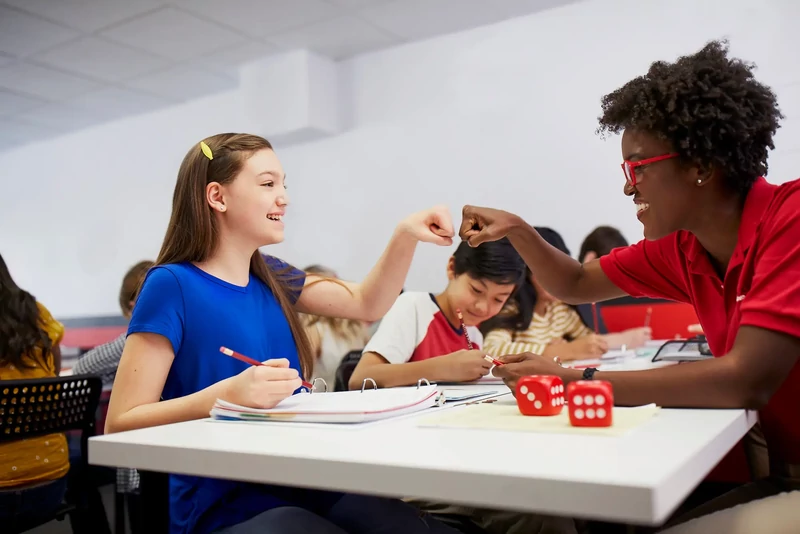
Structured support at Mathnasium gives students the personalized guidance they need to turn frustration into confidence and steady progress.
How Mathnasium Helps Students Truly Understand Fractions
Fractions are a major milestone in math and one of the most common areas where students get stuck. No matter where the challenge lies, most students need clarity, structure, and encouragement. That’s exactly what Mathnasium provides.
Mathnasium is a math-only learning center that helps students truly understand math and gain confidence in their abilities.
At Mathnasium, every student begins with a comprehensive diagnostic assessment. This allows us to pinpoint which fraction skills they’ve mastered and which ones they need support with.
From there, we create a personalized learning plan that builds fraction knowledge step by step, using clear explanations and proven strategies aligned with how students learn best.
Our approach is guided by the Mathnasium Method™—a proprietary teaching approach that combines personalized learning plans, proven strategies, and consistent face-to-face instruction in a caring, small-group environment.
Lessons happen face-to-face in a caring, small-group environment, where students feel supported and confident asking questions.
Unlike one-size-fits-all tutoring, Mathnasium provides consistent, targeted math tutoring that helps students progress steadily. Families are kept in the loop with progress updates and clear communication.
And the results speak for themselves:
-
94% of parents report an improvement in their child’s math skills and understanding
-
90% of students saw an improvement in their school grades
-
93% of parents observed a more positive attitude toward math
Whether your child needs help catching up, staying on track, or getting ahead, Mathnasium gives them the tools to set meaningful goals and the support to achieve them.
With over 1,000 locations across the U.S., Mathnasium supports students of all ages and ability levels.
For families in and around Carrollton, TX, Mathnasium of Castle Hills brings that same trusted approach to the local community.
If you're looking to strengthen your child’s skills and build lasting confidence in math, schedule a free assessment at Mathnasium of Castle Hills and see real progress take shape, session by session.
📅 Schedule a Free Assessment at Mathnasium of Castle Hills
Mathnasium of Castle Hills is not your nearest center?
📍 Find a Mathnasium Learning Center in your area


 (972) 939-6284
 (972) 939-6284