Decimal Long Division With a Decimal Number, Step 2.Long division is already a multi-step process, and adding a decimal point into the mix can make it feel twice as complicated. Decimal division relies on the same core steps as standard long division. The only extra consideration is making sure the decimal point is properly aligned in our answer.
Today, our tutors work through both decimal division cases students may run into. One case divides a decimal by a whole number, and the other divides by a decimal itself. We'll build each case step by step, the same way we would with any long division problem.

What Is Decimal Division?
Decimal division is the process of splitting a number that includes a decimal point into equal parts.
We're asking the same question we always ask when we divide. How many times does one number fit into another?
To answer that question, we rely on three parts that every division problem shares:
In decimal division, one or more of these three parts includes a decimal point instead of a whole number. That distinction gives us two situations to prepare for:
-
The dividend has a decimal point, and the divisor is a whole number, like 7.5 ÷ 5
-
The divisor also has a decimal point, like 7.5 ÷ 0.5
These two situations call for two different approaches, and we'll walk through both. The first, where we divide a decimal by a whole number, is more straightforward, so we'll start there.

How To Divide a Decimal by a Whole Number
We divide a decimal by a whole number using the exact steps of long division. The only new part is deciding where the decimal point belongs in our answer.
Let's work through 8.4 ÷ 6 together and see how that plays out.
Step 1: Set Up the Division Problem
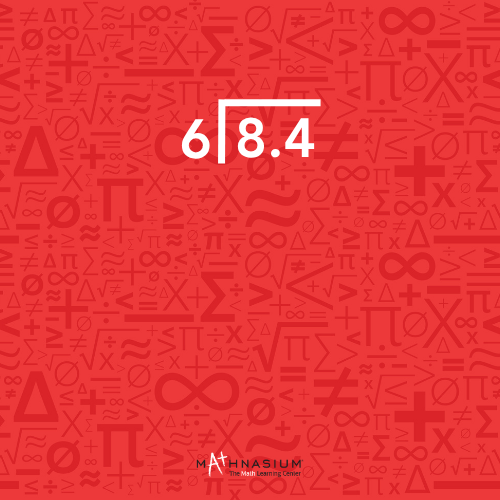
We write 8.4 as the dividend and 6 as the divisor, just as we would with any division problem.
-
The divisor, 6, goes outside the division bracket
-
The dividend, 8.4, goes inside it
Step 2: Place the Decimal Point in the Quotient
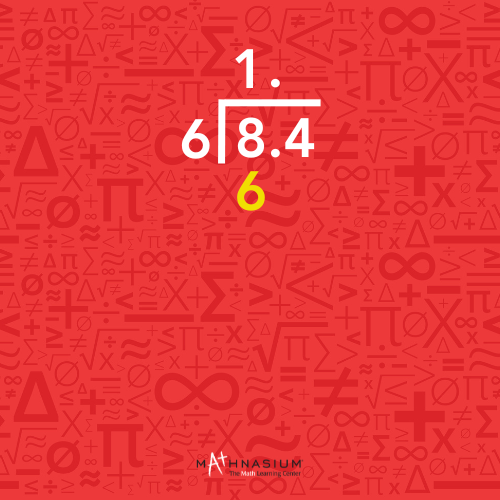
A decimal point goes in the answer, directly above the decimal point in 8.4.
We lock that spot in place first, so the point never has to move again.

Step 3: Divide
Now, we look at the first digit of the dividend, 8, since that's the digit sitting closest to the decimal point on the left.
6 fits into 8 once, because 1 × 6 = 6.
That means 1 goes above the 8.
Step 4: Multiply
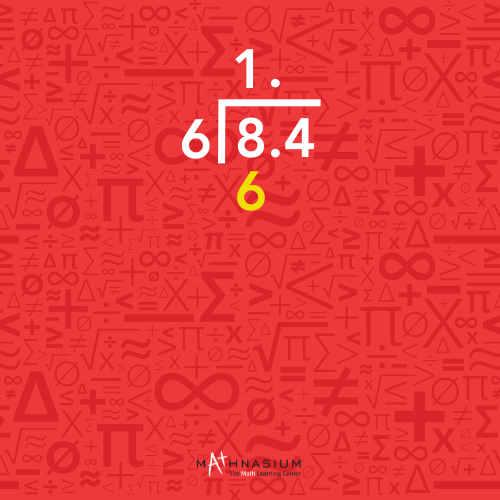
We multiply 1 by the divisor, 6, and that tells us how much of 8 we've accounted for.
1 × 6 = 6
We write that 6 directly beneath the 8.
Step 5: Subtract
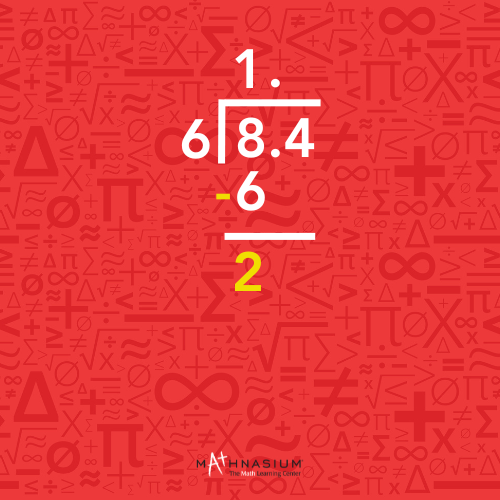
Then, we subtract 6 from 8 to find what's left over after the first round of dividing.
8 − 6 = 2
We write 2 below the line.
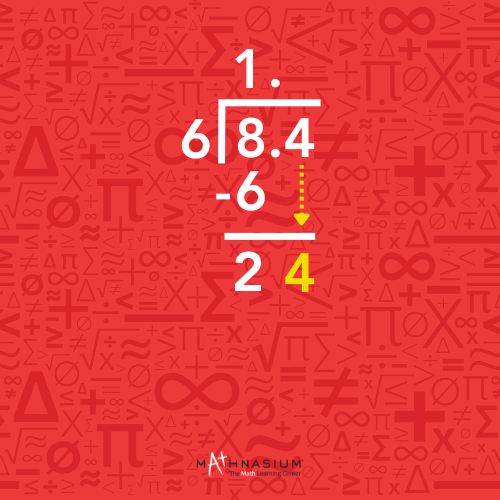
Step 6: Bring Down
2 is not enough by itself for 6 to divide into again, so we bring down the next digit from the dividend to continue the process.
The 4 from the tenths place comes down next to the 2, and together they form 24.
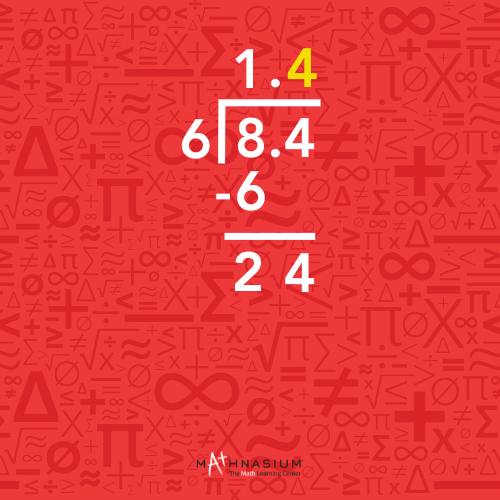
Step 7: Divide Again
Since 6 fits into 24 exactly 4 times because 4 × 6 = 24, we write 4 above the tenths place.
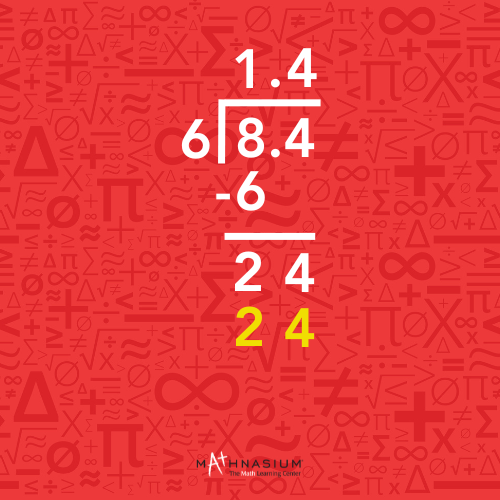
Step 8: Multiply Again
We pair 4, our newest quotient digit, with the divisor, 6.
4 × 6 = 24
We write 24 directly beneath the 24.
Step 9: Subtract Again
24 minus 24 tells us what's left over after this round.
24 − 24 = 0
We write 0 below the line.
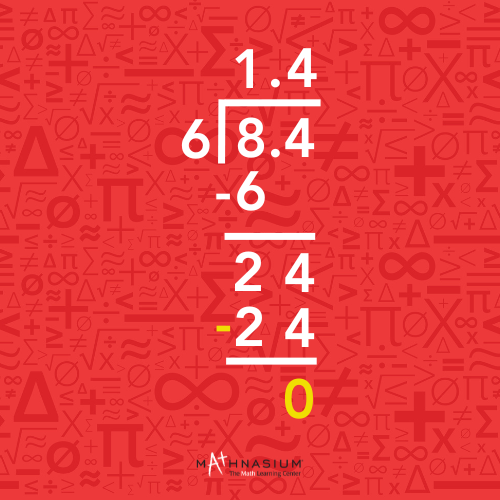
No digits remain to bring down, and nothing is left over.
Our final answer reads 1.4.
We can check the answer by multiplying it back.
1.4 × 6 = 8.4
Everything checks out!
📕 You May Also Like: How to Do Long Division with Decimals - Kid-Friendly Guide
How To Divide a Decimal by a Decimal
We divide a decimal by a decimal by first turning the divisor into a whole number. This step puts the problem in a form we already know how to solve.
Let's try and solve 8.3 ÷ 0.4.
Step 1: Set Up the Division Problem
We write 8.3 as the dividend and 0.4 as the divisor.
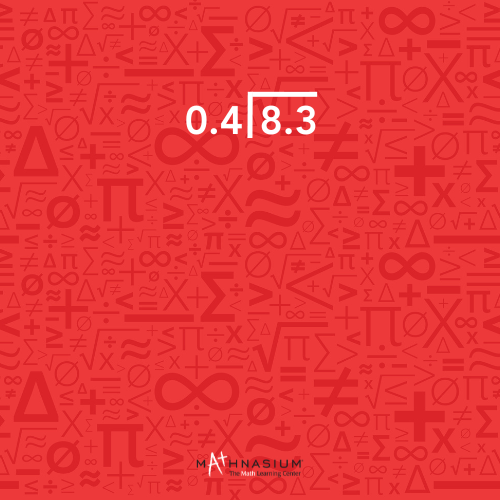
Step 2: Make the Divisor a Whole Number
For long division to work, we need our divisor to be a whole number.
0.4 is a decimal number, and we need to move its decimal point to the right somehow.
So how do we do that?
We do that by multiplying 0.4 by 10, which turns it into 4.
The dividend needs the same treatment. 10 times 8.3 gives us 83.

Step 3: Divide
We look at the first digit of the dividend, 8. Let’s see.
4 fits into 8 exactly 2 times, because 4 × 2 = 8, so 2 goes above the 8.
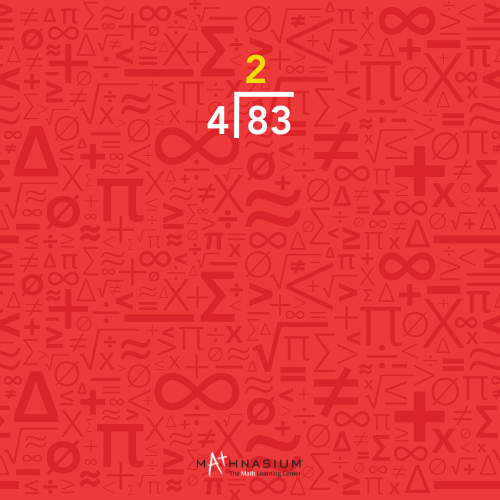
Step 4: Multiply
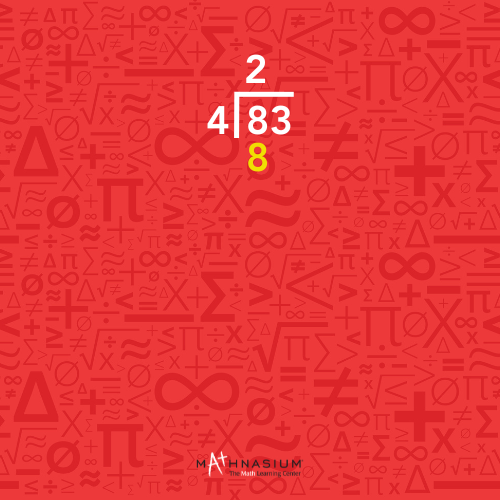
We pair 2, our new quotient digit, with the divisor, 4.
2 × 4 = 8
Then, we write 8 directly beneath the 8 in the dividend.
Step 5: Subtract
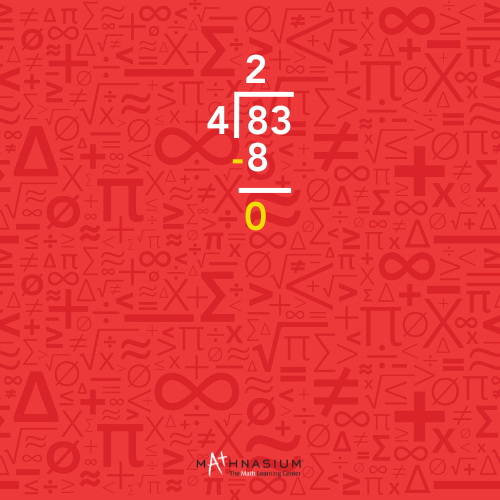
8 minus 8 tells us what's left over after this round.
8 − 8 = 0
We write 0 below the line.
Step 6: Bring Down
4 needs another digit to divide into, so we bring down the next digit from the dividend to continue the process.
The 3 comes down next to the 0, and together they form 3.
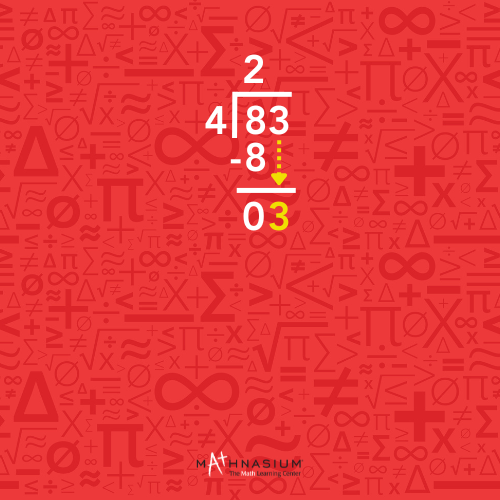
Step 7: Add a Zero
Since 4 is larger than 3, and 83 has run out of digits to bring down, we need to extend the number.
To keep dividing, we need to add a zero after it, turning 83 into 830.
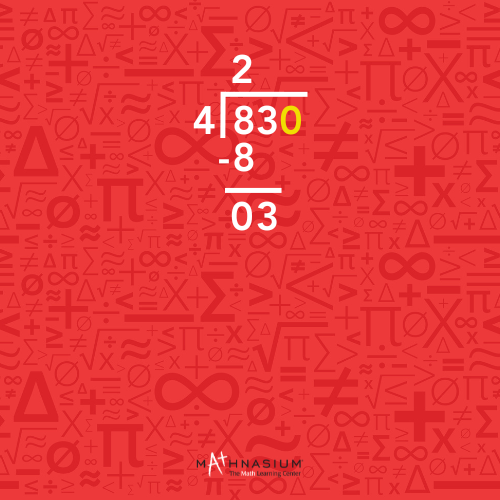
Step 8: Bring Down the Zero
The 0 comes down next to the 3, forming 30.
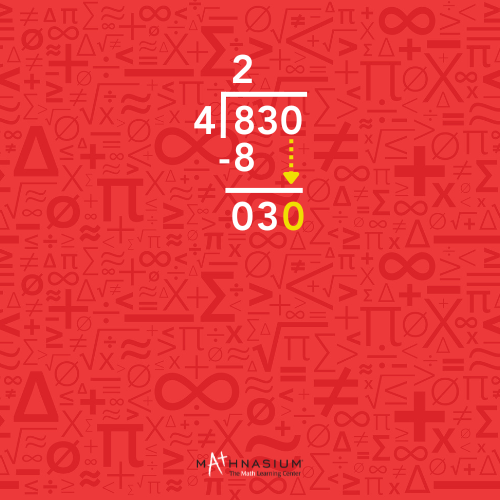
Step 9: Divide Again
4 fits into 30 exactly 7 times, because 7 × 4 = 28.
Now we write 7 above 0.
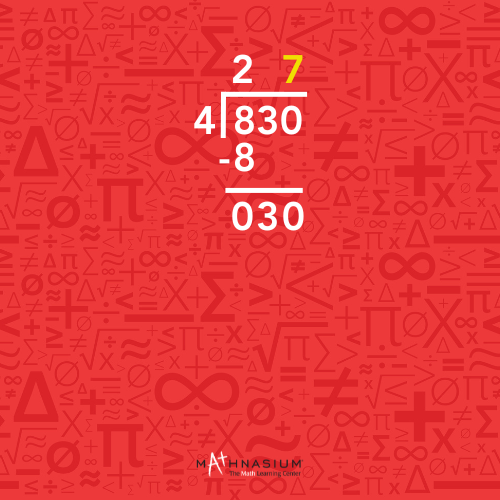
Step 10: Multiply Again
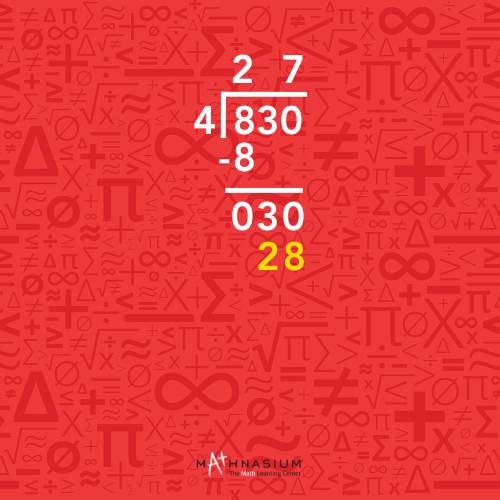
Next, we multiply 7 and 4 to get 28.
7 × 4 = 28
And we write 28 directly beneath the 30.
Step 11: Multiply Again
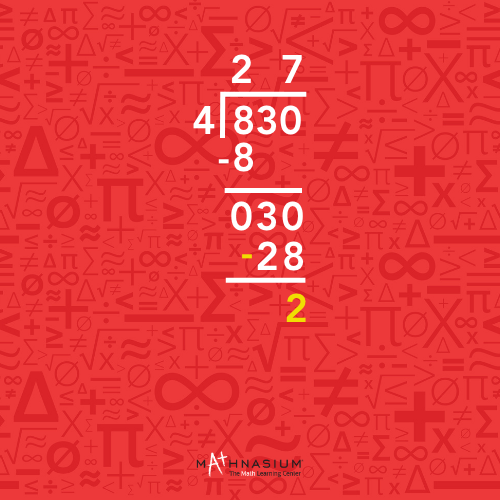
Then, we subtract 28 from 30 to get 2.
30 − 28 = 2
Which leaves us with a remainder again. We write the leftover 2 below the line.
Step 12: Add Another Zero
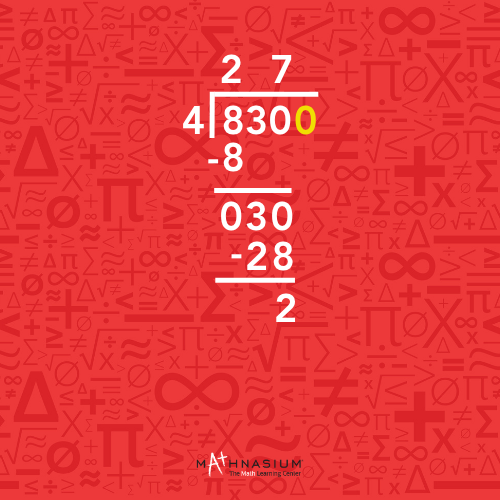
Since 2 is too small to divide by 4, we add another zero to the dividend to keep going. We bring that zero down next to the 2 to form 20.
Step 13: Bring Down the Zero
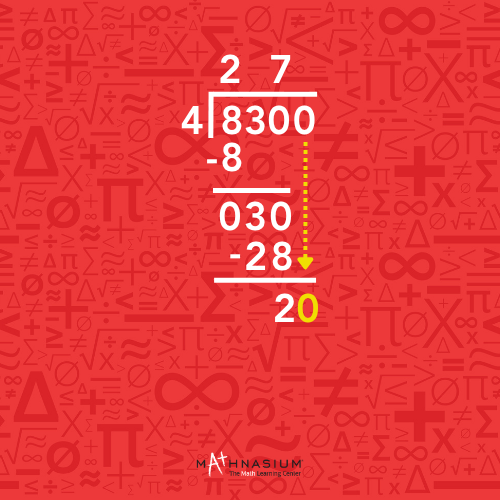
That new zero comes down next to the 2, forming 20.
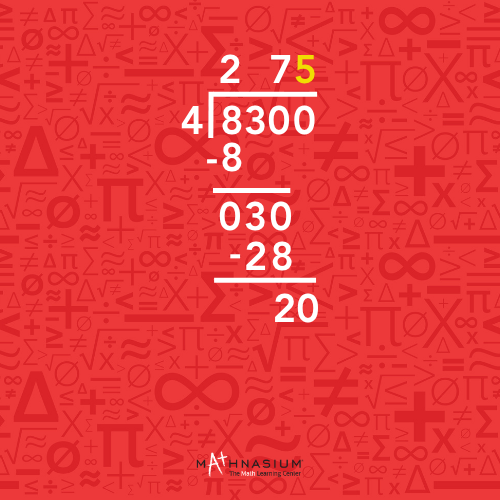
Step 14: Divide Again
4 fits into 20 exactly 5 times, because 4 × 5 = 20.
So we place 5 in the quotient directly above the zero.
Step 15: Multiply Again
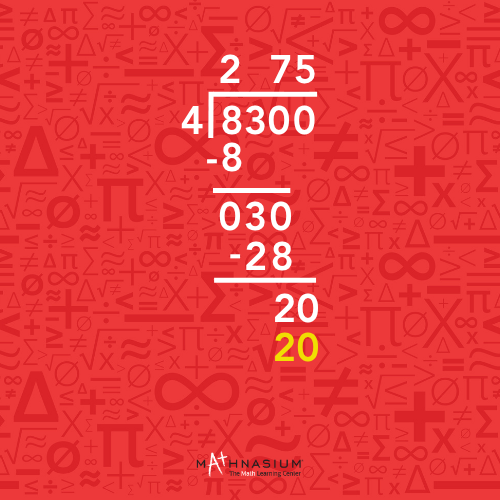
Next, we multiply 5 by 4 to get 20.
5 × 4 = 20
We write the product directly beneath the 20.
Step 16: Subtract Again
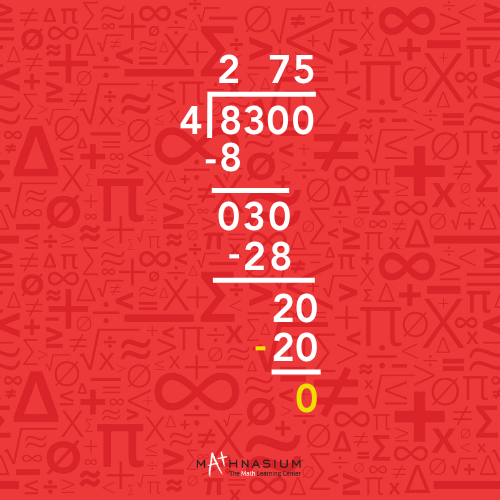
Finally, we subtract 20 from 20, which leaves us with 0.
20 − 20 = 0
We write 0 below the line.
Step 17: Place the Decimal Point
Since we moved the decimal point in 0.4 one place to the right to make it 4, we do the same in the quotient.
The decimal point goes directly above its position in the dividend, between the 2 and the 7.
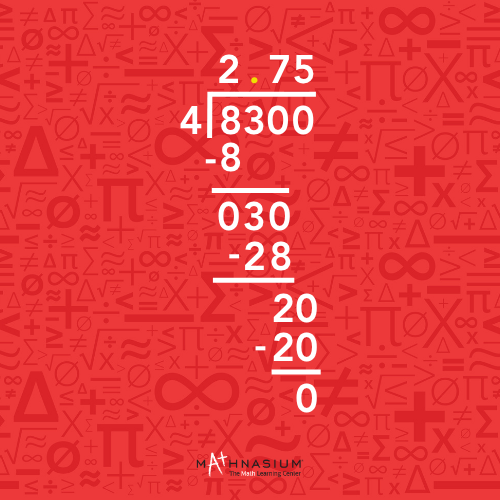
The division is complete. Nothing remains to bring down, and the remainder sits at 0. That gives us a quotient of 20.75.
To confirm, we multiply the quotient by the original divisor of 0.4, not the whole number we converted it to.
20.75 × 0.4 = 8.3
The result matches our original dividend, so 20.75 is the correct answer.
📕 You May Also Like: How to Divide Decimals: A Step-by-Step Guide
Your Turn: Can You Divide These Decimals?
Our tutors put together six problems to test what we covered today. Work through each one using the method that fits, and show every step along the way.
-
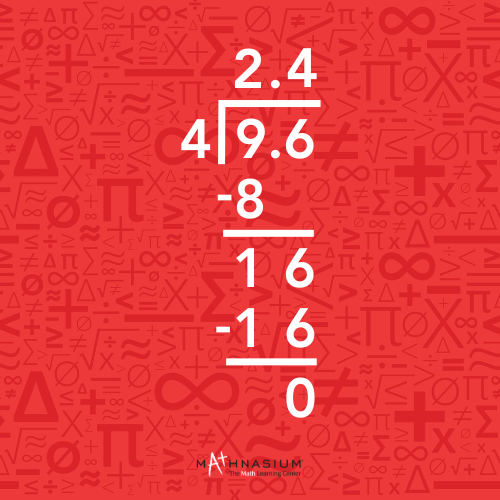
9.6 ÷ 4
-
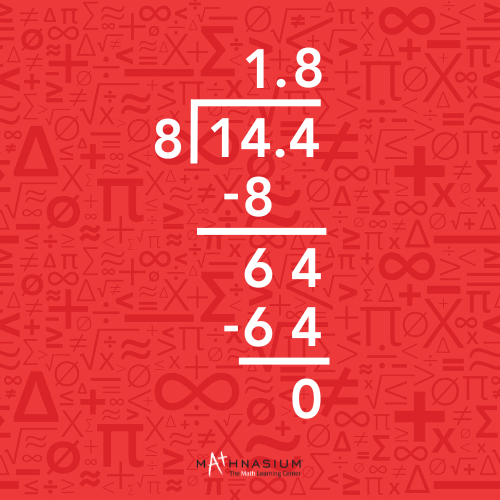
14.4 ÷ 8
-
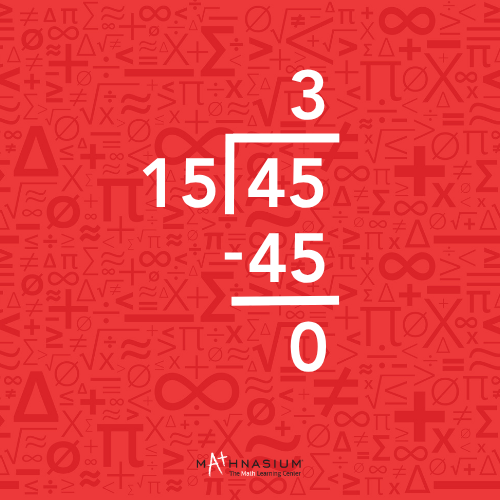
4.5 ÷ 1.5
-
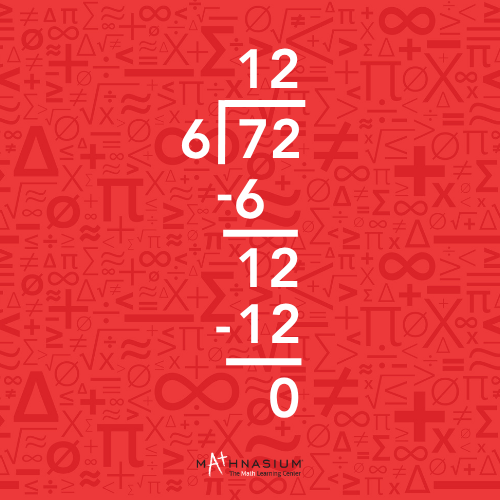
7.2 ÷ 0.6
Check your answers at the bottom of the guide.
 Mathnasium tutors work through decimal division step by step with students. Over time, that practice makes long division and decimal placement second nature.
How Mathnasium Helps Students of All Skill Levels Learn and Master Math
Mathnasium is a math-only learning center dedicated to helping K–12 students of all skill levels learn and master math.
Whether your student needs to rebuild foundational skills like place value, master decimal operations like long division, or take on advanced challenges beyond their grade level, our tutors are here to support them every step of the way.
To get there, we use a proprietary teaching approach called the Mathnasium Method™.
Here's how it works in practice:
-
Diagnostic Assessment and Personalized Learning Plans: Every student begins with a diagnostic assessment that identifies their current skill level, their learning goals, and how they learn best. From that starting point, we build a personalized learning plan tailored to their needs and goals.
-
Teaching for Understanding: Our specially trained tutors use plain, everyday language and a mix of verbal, visual, mental, tactile, and written techniques, so a concept like decimal division makes sense on its own terms instead of depending on memorized steps.
-
Problem-Solving and Critical Thinking: We break a difficult concept into manageable parts and guide students through both the how and the why. This builds the problem-solving skills and critical thinking that students use in math and in everyday life.
-
An Engaging and Fun Learning Environment: Our sessions use games and hands-on activities, and we celebrate every bit of progress. Students build confidence in their own abilities and a better relationship with math itself.
The results reflect that approach:
-
94% of parents report an improvement in their child's math skills and understanding
-
93% of parents report an improved attitude toward math after attending Mathnasium
-
90% of students saw an improvement in their school grades
We operate over 1,100 centers across North America, bringing our proven approach to communities everywhere.
Families across Chester and the surrounding area can visit Mathnasium of Chester, a trusted local center with years of experience helping students build confidence in math.
Whether your child is looking to catch up, keep up, or get ahead in math, our team is happy to help.
📅 Schedule a Free Diagnostic Assessment at Mathnasium of Chester
Not near Chester?
📍 Find a Mathnasium Learning Center Near You
Pssst! Check Your Answers Here
Here are the answers.
First, make the divisor a whole number by multiplying both numbers by 10:
4.5 × 10 = 45
1.5 × 10 = 15
We also need to convert the divisor here into a whole number.
7.2 × 10 = 72
0.6 × 10 = 6


 (804) 706-4321