Report card day. You open the envelope or click the link, scan the grades, and... what now?
Maybe you breathe a sigh of relief. Maybe you feel a knot in your stomach. Either way, you're left with the same question: What does this actually mean for my child?
That letter or number on the page is just one piece of a much bigger puzzle. It tells you how your child performed on tests and assignments during a specific window of time. But it doesn't tell you whether they truly understand what they're learning. It doesn't show you where their confidence is shaky or which skills are about to become a problem. And it definitely doesn't tell you what to do next.
Understand Your Child's Report Card
A grade is a snapshot. It captures a moment. But learning isn't a moment. It's a process.
Your child might have earned a B in math because they memorized the steps for long division just in time for the test. But can they explain why those steps work? Can they apply the same logic to a new problem? Or will they stumble the moment the format changes?
On the flip side, a lower grade doesn't always mean your child is struggling across the board. Maybe they understand the concepts but rush through problems and make careless mistakes. Maybe they freeze on tests but shine during classwork.
And here's something many parents don't consider: a string of A's doesn't always mean your child is being challenged. If math feels too easy, if they're finishing assignments in half the time it takes their classmates, they might be ready for something more. Coasting can be just as much of a problem as struggling. Both can lead to disengagement.
Grades don't capture these nuances. They can't show you persistence, curiosity, or growth.
Instead of stopping at the grade, ask deeper questions:
-
Where did my child struggle most this term?
-
What concepts are coming next, and are they ready?
-
Is my child confident in math, or are they starting to shut down?
-
If they're doing well, are they being challenged enough to grow?
These are the questions that lead to real understanding. And often, the answers are hiding in plain sight.

Decode Your Child's Report Card
Most report cards include more than just grades. There are comment sections, skill breakdowns, and phrases like "developing" or "needs improvement."
The problem? These comments can feel vague or confusing. What does "needs support with problem-solving" actually mean? What should you do when the teacher writes "struggles with multi-step problems"?
📕 You May Also Like: Why 60% of Parents Struggle with Math Homework (& What to Do About It)
Common phrases and what they might really mean:
-
"Needs improvement in problem-solving" – Your child can follow steps and get correct answers when the process is familiar. But when they encounter something new or have to think flexibly, they get stuck.
-
"Struggles with multi-step problems" – This often signals a working memory issue or a gap in foundational skills. Multi-step problems require holding several pieces of information at once and knowing which step comes next.
-
"Rushing through work" or "careless errors" – Your child likely understands the material but hasn't developed strong checking habits or attention to detail. This is a skills issue, not a knowledge issue.
-
"Difficulty with word problems" – This might be about reading comprehension, not math. Or it could mean your child hasn't learned how to translate real-world situations into mathematical thinking.
-
"Excels in computation but struggles with reasoning" – Your child can execute procedures but hasn't developed conceptual understanding. They're getting right answers without fully grasping what they're doing.
-
"Exceeds grade level expectations" or "working above grade level" – This is great news, but it also raises a question: is your child being given opportunities to work at their actual level? Are they deepening their understanding or just doing more of what they've already mastered? Without appropriate challenge, even high-achieving students can lose interest or develop shallow learning habits.
How to Talk to Kids About Report Cards
Once you've read the comments, sit down with your child. Ask them:
-
Which math topics felt easy this term? Which felt hard?
-
When you got stuck, what made it confusing?
-
Did you feel like you understood your homework, or were you just trying to get through it?
-
If math feels easy, what would make it more interesting or challenging?
Their answers will often fill in what the report card left out.
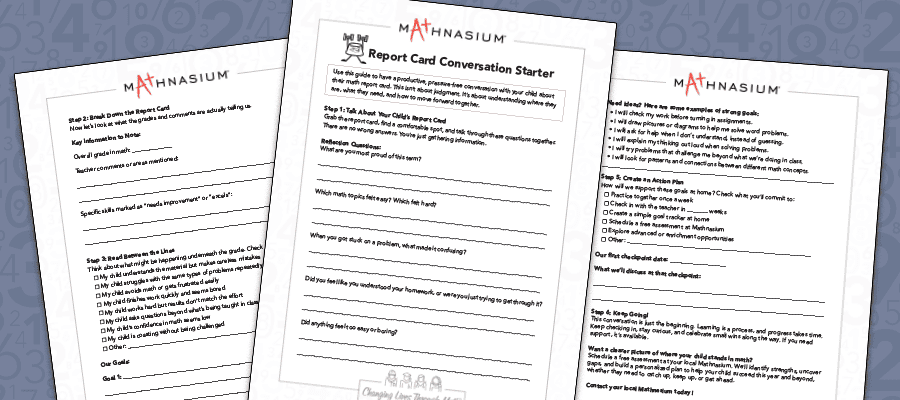
If you want a simple way to lead this conversation, download our free Report Card Conversation Starter. It includes key questions to ask, space for your child to share their thoughts, and a section for mapping out next steps together.
Turn the Report Card into a Plan
Reading between the lines is only useful if you do something with what you find. Here's a simple three-step approach to turn your child's report card into a roadmap for growth.
Step 1: Reflect
Sit down with your child and talk through the report card together. Keep it low-pressure. You're not interrogating them. You're gathering information.
Ask things like:
-
What are you most proud of this term?
-
Was there anything that felt frustrating or confusing?
-
If you could get better at one thing in math, what would it be?
-
Did anything feel too easy or boring?
Listen to not just what they say, but how they say it. Do they sound defeated? Defensive? Indifferent? Bored? Their tone will tell you a lot about their confidence and mindset.
Our Report Card Conversation Starter walks you through this reflection process step by step. Use it to capture what you're hearing and identify patterns you might otherwise miss.
Step 2: Plan
Pick one or two specific, observable goals for the next grading period. Instead of focusing on outcomes like "get an A" or "raise the grade”, focus on behaviors and skills your child can actually practice:
-
"I will check my work before turning in assignments."
-
"I will draw a picture or diagram to help me understand word problems."
-
"I will ask for help when I don't understand something, instead of guessing."
-
"I will explain my thinking out loud when solving a problem."
If your child is already doing well, goals might look different:
-
"I will try problems that push me beyond what we're doing in class."
-
"I will explore why a solution works, not just get the right answer."
-
"I will look for patterns and connections between different math concepts."
Write these down. Put them somewhere visible. Make them real.
The Report Card Conversation Starter includes a section for setting these goals together. Writing them down in a dedicated space makes them feel more concrete and gives you both something to reference later.
Step 3: Monitor
Progress doesn't happen in a straight line, and you won't see change overnight. Build in small checkpoints along the way:
-
Once a week, sit down and do a few practice problems together. Watch how your child approaches them.
-
Check in with your child's teacher after a few weeks. Are they noticing improvement?
-
Create a simple tracker where your child marks off when they meet their goal (checked their work, asked a question, explained their thinking).

Get Kids in a Good Mindset
A report card is feedback, not a label.
If your child brought home a disappointing grade, that doesn't make them "bad at math." It means they haven't mastered certain skills yet.
Skills develop with effort and strategy. Students who believe this—what researchers call a “growth mindset”—are more likely to persist when things get hard. Students who think ability is fixed are more likely to give up.
When you talk with your child about their report card, use language that emphasizes growth:
-
Instead of "You're so smart," try "I can see how much effort you put into this."
-
Instead of "You're just not a math person," try "This is hard right now, but we can figure out what you need to practice."
-
Instead of "You got a C," try "You're still building this skill. What's one thing we can work on?"
Reframe grades as information, not judgment. They tell you where your child is now. They don't predict where they'll end up.
📕 You May Also Like: How to Maintain a Positive Math Mindset
When to Get Extra Help with Report Card Grades
Sometimes, no matter how much reflection and planning you do at home, your child needs more support. How do you know when it's time?

Your child might need extra practice if:
-
They understand concepts in class but forget them quickly.
-
They make progress when someone works with them one-on-one.
-
They can do the work, but it takes them much longer than it should.

Your child might have a learning gap if:
-
They consistently struggle with the same type of problem, even after practicing.
-
Their grades have dropped steadily over the past year or two.
-
They avoid math homework or shut down when it's time to practice.
-
There's a big mismatch between how hard they work and the results they see.

Your child might benefit from enrichment if:
-
They finish classwork quickly and seem bored.
-
They ask questions that go beyond what's being taught.
-
They love puzzles and problem-solving but don't feel challenged in school.
-
Their report card shows high achievement but you suspect they're not being pushed.
-
They express interest in learning math topics that haven't been introduced yet in their grade.
📕 You May Also Like: Math Enrichment: Everything You Need to Know
If any of these sound familiar, it might be time to bring in outside support. That doesn't mean your child is failing or that you're doing something wrong. It just means they need something their current environment isn't providing, whether that's filling gaps, building confidence, or advancing to new challenges.
A structured program like Mathnasium can help meet students exactly where they are. We work with struggling students to build strong foundations, with on-level students to deepen understanding, and with advanced students to accelerate their learning and explore math beyond their grade level.
📕 You May Also Like: What to Look for in a Math Tutor

What Happens Next?
Your child's report card doesn't have to be the end of the conversation.
Use it as a starting point to understand what's really happening with your child's learning. Look beyond the grades. Ask questions. Listen. Make a plan. And most importantly, remind your child that learning is a process, not a performance.
Download our free Report Card Conversation Starter to make that first conversation easier. It gives you and your child a framework for talking through the report card together, identifying goals, and creating a plan you can both commit to.
If you're not sure where to start or you want a clearer picture of where your child stands, we can help. Schedule a free assessment at your local Mathnasium. We identify strengths, uncover gaps, and build a personalized plan to help your child succeed in math this year and beyond.


 (773) 830-6284