Billion. We hear it all the time. In reality, how many of us have stopped to ask, "How big is that number, really?"
Technically, you can count to a billion. But if you counted one number every second without stopping, it would take you roughly 31 years to get there. A million, by comparison, takes about 11.5 days.
Same act, same pace, yet the difference is staggering.
Our tutors put together this guide to help you and your child explore that question through real math concepts like place value, multiplication, and number sense. Work through it together, and you will both come away seeing large numbers very differently.

The Secret Pattern Behind Large Numbers: Groups of Three
You may have noticed that your child's math class spends a lot of time on place value. There's a good reason for that. Every time a number gains a new digit, it represents a new place value, and each place value is ten times larger than the one before it.
However, there’s a trick that makes millions and billions easier to grasp: these numbers grow in groups of three zeros.
Each time you add three zeros, you move up to the next group and multiply by 1,000. That pattern is consistent and predictable, all the way from thousands to millions to billions and beyond.
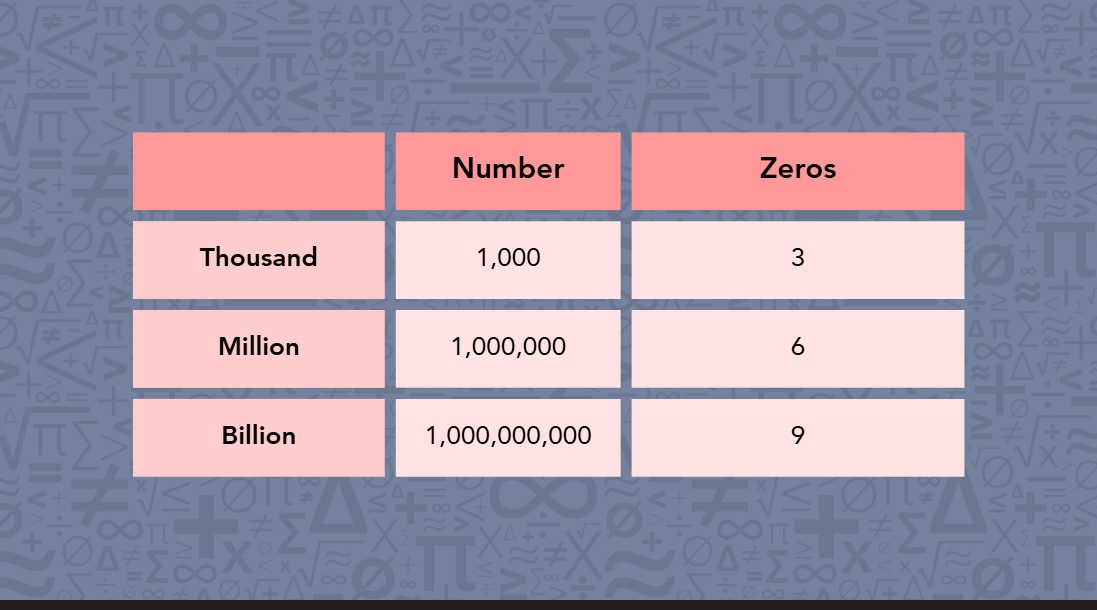
If your child can see that each jump in the table adds three zeros and one new place value, they have the core insight they need to understand how millions and billions connect.
📕 You May Also Like: Why Zero Is So Hard for Young Math Learners to Understand
How Many Millions Are in a Billion?
A million is 1 followed by 6 zeros: 1,000,000. A billion is 1 followed by 9 zeros: 1,000,000,000. That means a billion has exactly 3 more zeros than a million, and if your child remembers the groups of three pattern from above, they already know what that means.
In math, 3 extra zeros mean you multiply by 1,000. So to find how many millions fit inside a billion, we divide:
1,000,000,000 ÷ 1,000,000=1,000
There are exactly 1,000 million in a billion.
This can be double-checked with multiplication. Take 1,000 million and multiply:
1,000 × 1,000,000=1,000,000,000
Same answer, different direction. Division and multiplication are inverse operations, which means you can always use one to check the other.
📕 You May Also Like: How to Read & Write Large Numbers: Millions, Billions & More
How Much Bigger Is a Billion Than a Million? Three Real-World Comparisons
Numbers this large are easier to understand when you connect them to something familiar. Here are three examples that show just how different a million and a billion really are.
1. Time
One million seconds adds up to about 11.5 days. One billion seconds adds up to roughly 31.7 years. Same unit, same act of counting, but a billion takes a human lifetime to reach. That gap between 11.5 days and 31.7 years is exactly what 1,000 million looks like in real life.
2. Population
The United States has a population of about 340 million people. The entire world has a population of about 8 billion people.
To get from the U.S. population to the world population, you multiply by roughly 23. That's how many times you'd need to stack the entire United States to fill the planet.
3. Money
$1 every single day, it would take about 2,740 years to reach $1 million. To reach $1 billion would take 1,000 times longer, roughly 2.7 million years.
Division tells you that: 1,000,000,000 ÷ 365 =~ 2,739,726 years.
Beyond a Billion: Where the Pattern Takes You Next
A billion is 1,000 million, but numbers don't stop there.
After a billion comes a trillion, 1 followed by 12 zeros. A trillion is 1,000 billions, or 1,000,000 millions. The same group of three zeros pattern keeps going.
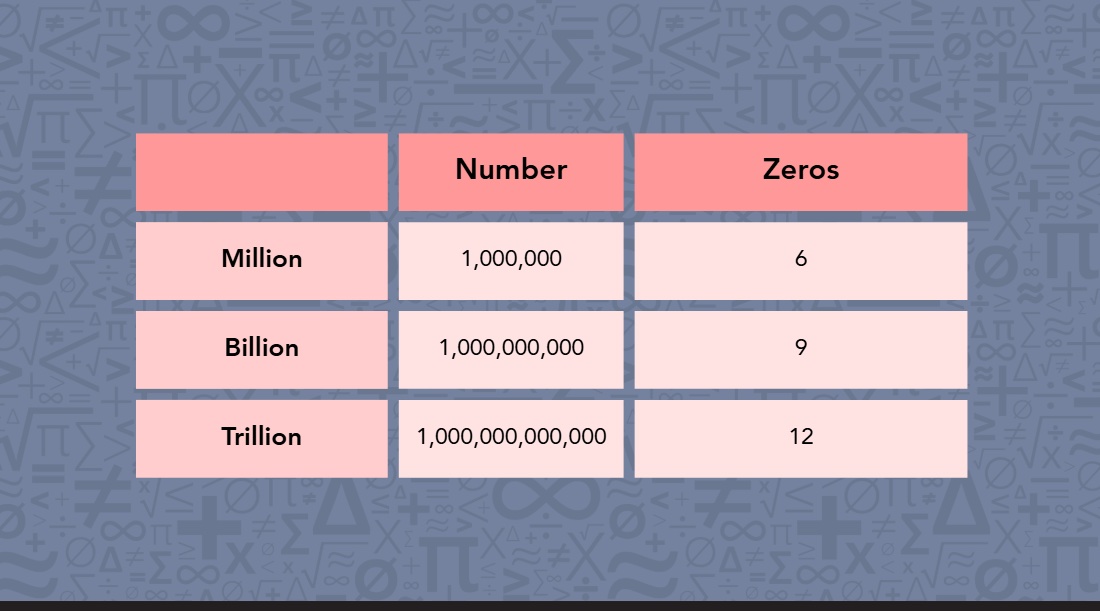
Around grade 6, your child's math class will introduce scientific notation, a shorthand way of writing these large numbers without all the zeros. A billion, for example, becomes 10⁹. A trillion becomes 10¹².
Scientists and mathematicians work with numbers even larger than trillions every day, and they use that same three-zero pattern to make sense of all of them.
📕 You May Also Like: What Is Number Sense & Why It Matters in Early Math Education

Mathnasium's specially trained instructors help students see the patterns behind large numbers from millions to billions and beyond.
How Mathnasium Helps Students Build Solid Math Foundations
Mathnasium is a math-only learning center dedicated to helping K-12 students catch up, keep up, and get ahead in math.
Large numbers like millions and billions trip up a lot of students, not because the math is too hard, but because no one slowed down to show them the pattern. The moment a student sees how place value builds from thousands to millions to billions, the confusion gives way to confidence.
That is what we focus on at Mathnasium, and at the heart of every program is the Mathnasium Method™, our proprietary teaching approach built around six core principles.
-
Personalization on a granular level: Each student begins with a diagnostic assessment that identifies their strengths, knowledge gaps, and how they approach math. Our instructors then follow personalized learning plans that guide steady, structured progress, focusing exactly where a student stands with place value and large number concepts.
-
Teaching for understanding: We explain math using clear, everyday language and support each concept with visual, verbal, written, mental, and hands-on techniques. When it comes to large numbers, that means helping students see the "groups of three zeros" pattern rather than memorizing isolated facts.
-
Caring instruction: Our instructors provide caring guidance in a fun group environment where students feel supported as they tackle challenging material, including the grade 4 and 5 topics around millions and billions that tend to cause the most difficulty.
-
Independent problem-solving and critical thinking: Each session includes time for students to work through problems on their own. Instructors guide them to understand both how and why a concept works, so a student who learns to divide a billion by a million can apply that same reasoning to any large number problem they encounter.
-
Singular focus on math: Our program spans thousands of pages and has been continuously refined over the past 20 years. That singular focus allows us to take a deep dive into how students best absorb, learn, and retain mathematical concepts, from basic place value all the way to billions and beyond.
-
Empowering, fun learning environment: Our materials are game-based, and students have the chance to earn rewards as they advance. It is an environment designed to keep kids motivated and engaged, session after session.
And the results speak for themselves:
-
94% of parents report an improvement in their child's math skills and understanding
-
93% of parents report their child's improved attitude toward math after attending Mathnasium
-
90% of students saw an improvement in their school grades
With over 1,100 centers, we bring the Mathnasium Method™ close to your community.
For families in or near Columbia, MD, Mathnasium of Columbia MD is a trusted local partner in building math skills and confidence.
If your child is ready to move from stuck and frustrated to confident and capable, we'd love to help.
📅 Schedule a Free Assessment at Mathnasium of Columbia, MD
Not near Columbia, MD?
📍 Find a Mathnasium Learning Center Near You


 (410) 997-6284