
 (815) 526-3453
 (815) 526-3453











The Division Symbol and Other Ways to Write Division
Jun 3, 2026 | Crystal Lake
Division can be written four different ways. This guide covers every notation, with examples for each.


For most children, summer means one thing: a break. It is a break from schedules, from homework, and yes, from math too!
But summer is also, as research consistently shows, the period when math skills slip more than any other, a phenomenon educators call the summer slide.
So how do you strike a balance between a deserved rest and keeping math skills from fading away? That is the question we put to our seasoned Mathnasium tutors. Here are the strategies they came up with.
The most sustainable summer math engagement is already built into your day. It lives in the moments you are already having with your child, and it asks nothing extra of you. Summer is full of these opportunities:
In the kitchen: scaling a recipe or doubling a batch brings fractions and ratios into a context that feels entirely natural
At the grocery store: estimating the total before checkout or comparing two sizes for better value builds number sense without anyone sitting down to practice
On a road trip: calculating arrival times, tracking distances, or budgeting daily spending turns travel into a math experience with no pressure attached
A question here, an observation there. Mathematical thinking stays active without feeling like work.
📕 You May Also Like: 5 Math Skills You Can Teach in the Kitchen
Summer reading is already a habit most families encourage. Math books deserve a place on that list.
A well-chosen math book builds mathematical thinking and reading comprehension at the same time.
The vocabulary of math, the language that shows up in word problems and exam questions, is something many students struggle with. Reading builds it naturally.
Our tutors recommend these titles:
The Greedy Triangle by Marilyn Burns: a fun, story-driven introduction to 2D shapes for younger readers
The Doorbell Rang by Pat Hutchins: fractions and problem-solving wrapped in a story about sharing cookies
Inch by Inch by Leo Lionni: a Caldecott Honor book that makes measurement feel like an adventure
How Much Is a Million? by David M. Schwartz: place value and large numbers made genuinely exciting
Two of Everything by Lily Toy Hong: patterns and doubling through a charming folk tale
Just One Grain of Rice by Narinder Dhami: exponential growth and patterns told through an Indian folk tale
G Is for Googol by David M. Schwartz: a broad, curiosity-driven introduction to mathematical concepts that works well for upper elementary and middle school

A good math book keeps mathematical thinking alive without feeling like school.
Some of the most effective summer math practice happens around a table with no one thinking about math at all. Board games and card games build mathematical thinking through competition, strategy, and play, and children return to them voluntarily because they are actually enjoyable.
Our favorites include:
Prime Climb (board game): players move around the board using multiplication, division, and prime numbers. The color-coded design makes number relationships visible in a way that often clicks here before it clicks in the classroom.
Equate (board game): think Scrabble, but with equations. Players build and balance math expressions on a board, developing algebraic thinking in a format that feels competitive rather than instructional.
Summing Up (board game): players place tiles to build rows and columns that sum correctly without exceeding set limits. Simple to learn, genuinely strategic, and quietly effective for addition and spatial reasoning.
24 (card game): each card shows four numbers and the goal is to use all four, with any operations, to make 24. Fast, competitive, and surprisingly addictive for children and adults alike.
Set (card game): players race to spot matching sets of cards based on shape, color, and number. Pure logic and pattern recognition, accessible across a wide age range.
Proof! (card game): players race to find equations hidden across a set of number cards, covering all four operations in a format that moves fast enough to feel like a game rather than practice.
📕 You May Also Like: 7 Multiplication Games to Build Times Tables Fluency
A sustained summer project gives your child the experience of using math purposefully over days or weeks. The math concepts feel different when they are in service of something your child truly cares about, and that is the condition under which they tend to stick.
A few ideas to explore together:
A backyard garden: calculating planting distances, tracking growth over time, and estimating yield
A lemonade stand: budgeting, pricing, and calculating profit across several days of trading
A birdhouse or simple building project: measuring, scaling, and working with spatial reasoning in a hands-on context
A summer savings goal: tracking progress, calculating how much is needed, and planning how to get there
The project your child will stick with all summer is the one they helped choose. Ownership is what keeps the math going long after the novelty wears off.
📕 You May Also Like: 9 Creative Ways to Keep Math Skills Sharp
The ideas we looked at today work best when they are part of a summer that still feels like summer.
For some children, particularly those who showed signs of summer slide last year or have gaps that need targeted attention, adding a structured program to the mix gives you something the informal ideas cannot: consistency, expertise, and measurable progress.
The right program does not take over your summer. Summer programs like ours in Crystal Lake, IL, are designed to fit around family life, using creative and engaging approaches that make math concepts come alive rather than feel like an extension of the school year.
Your child gets the structured support they need, and your family keeps the flexibility to enjoy everything else summer has to offer.
📕 You May Also Like: How Summer Math Programs Help Keep Skills Sharp During Break
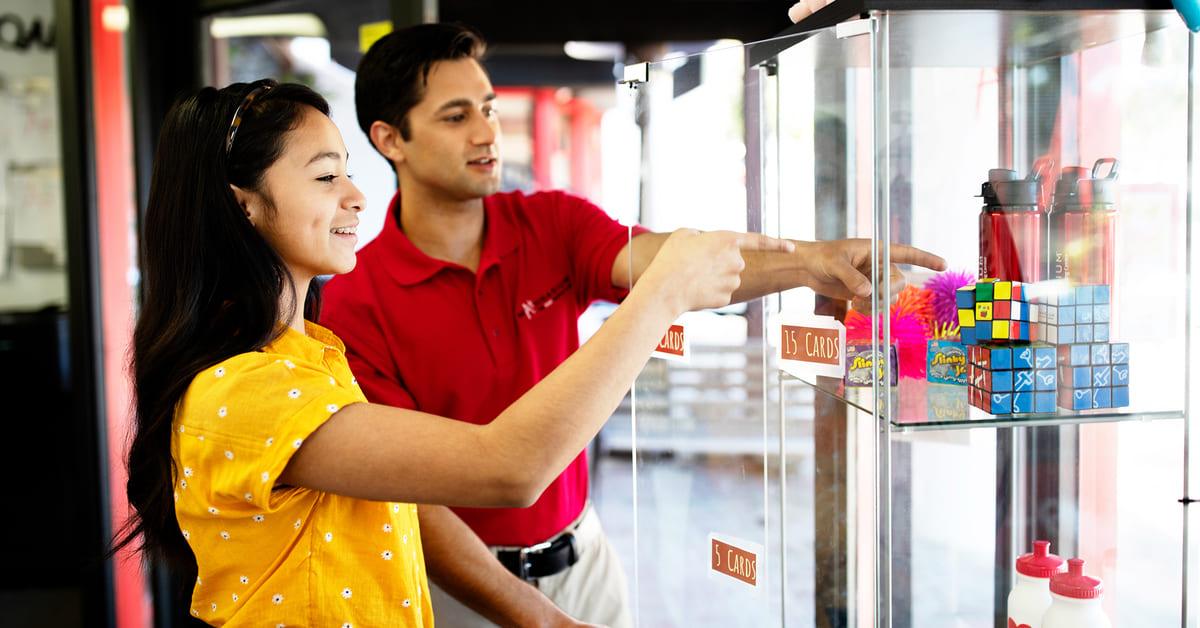
At Mathnasium, structured math support and summer fun are not mutually exclusive.
For most students, doing math over the summer can feel like just another commitment, cutting into time better spent having fun. In a space where the focus is on building skills at your child's own pace, in a fun and low-pressure environment, the experience feels very different.
That is exactly what Mathnasium's summer program is designed to be. Our summer program is powered by the Mathnasium Method™, our proprietary teaching approach built to prevent summer learning loss and build confidence for the school year ahead.
The summer program begins with a low-pressure diagnostic assessment that identifies your child's strengths and areas for growth. From those insights, we design a learning plan customized to their needs and goals.
With the plan in place, our specially trained tutors deliver personalized, face-to-face instruction in an engaging environment. We use natural, everyday language alongside a mix of verbal, visual, mental, tactile, and written techniques, adapting to how your child learns best.
We allow time for independent work during sessions, then rejoin students to check and correct their process. This helps them learn to trust their own thinking and develop independent problem-solving skills. We also guide them through both the how and the why behind each concept so they gain the critical thinking tools to use in math and in life.
We know summer is a time to have fun, and our sessions reflect that. We incorporate game-based activities that make math feel like play, use a reward system that gives students something to work toward every session, and celebrate every bit of progress along the way, big or small. Students who walk in hesitant about giving up part of their summer often leave looking forward to coming back.
The results speak for themselves:
94% of parents report an improvement in their child's math skills and understanding
93% of parents report an improved attitude towards math after attending Mathnasium
90% of students saw an improvement in their school grades
We operate over 1,100 learning centers, bringing our summer math programs close to your community.
Families in and near Crystal Lake, IL, trust the local team at Mathnasium of Crystal Lake to keep their children sharp in math over summer and set them up for a confident start to the new school year.
If you want your child to grow their math skills this summer without giving up the fun, our team is ready to help.
📅 Schedule a Free Diagnostic Assessment at Mathnasium of Crystal Lake
Not near Crystal Lake?
Mathnasium of Crystal Lake is a math-only learning center for K-12 students in Crystal Lake, IL. Trusted by over a million parents, Mathnasium uses personalized learning plans and the proprietary Mathnasium Method™ to help students catch up, keep up, and get ahead on their math journey.
Our specially trained tutors deliver face-to-face instruction in a supportive and fun small-group environment, working with students to develop a deep understanding of math, build confidence, and improve academic performance.
Schedule Assessment
