Division can be written in four different ways.
Most students learn one notation early on and then encounter the others scattered across different grades, different textbooks, and different contexts, with no one ever stopping to explain that they all mean the same thing.
Once we know every notation for what it is and understand when and why each one appears, division becomes cleaner to read across all the math that follows.
Today, we walk through all four division notations, show how each one works, and explain exactly where you will encounter them.

The Obelus: The "Divided By" Symbol (÷)
The ÷ symbol has a name a lot of students (and even adults) have never heard of: the obelus.
It is the division symbol we encounter first, usually in 2nd or 3rd grade, and it does one simple job: it tells us that the number on the left is being divided by the number on the right.
So when we write:
12 ÷ 4 = 3
We are saying: take 12, split it into 4 equal groups, and each group holds 3.
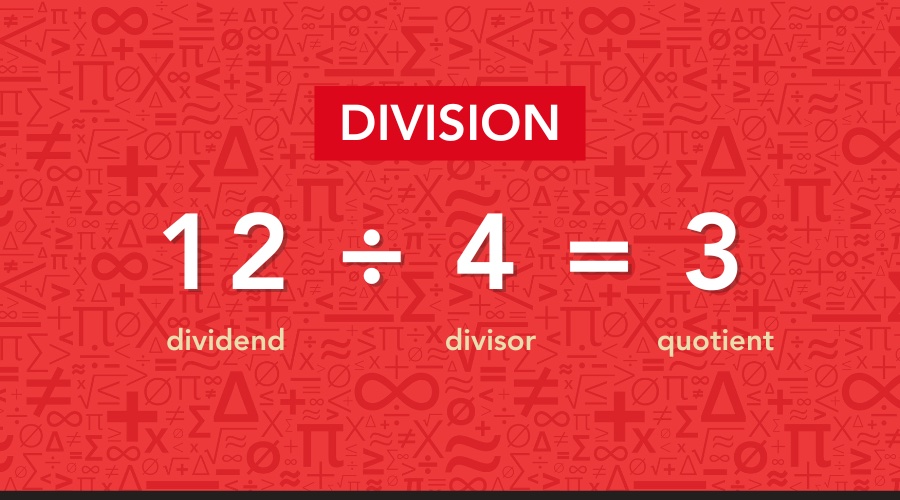
The obelus makes that relationship easy to read in a straight line, left to right, which is why it works well as a first introduction to division.
📕 You May Also Like: What Is Division in Math? A Simple & Complete Overview
Where Will You See the Obelus?
The obelus has a natural home, and knowing where helps us know what to expect.
-
Elementary math textbooks and worksheets. This is its home territory. The obelus is the standard notation for teaching division to younger students because it is straightforward and unambiguous.
-
Basic calculators. Most handheld and on-screen calculators use ÷ on the division key.
-
Everyday signage and informal use. You will occasionally see it outside the classroom, such as on packaging, price tags, or printed instructions, but it is less common than the slash in informal writing.
A quick reminder from our tutors: the obelus is rarely used past middle school. As math gets more complex, other notations take over. We will get to those shortly.
📕 You May Also Like: 3 Ways to Help Your Child Finally Understand Division
The Forward Slash (/)
The forward slash does the same job as the obelus. When we write 12 / 4 = 3, we are saying the exact same thing as 12 ÷ 4 = 3. The number on the left is divided by the number on the right.
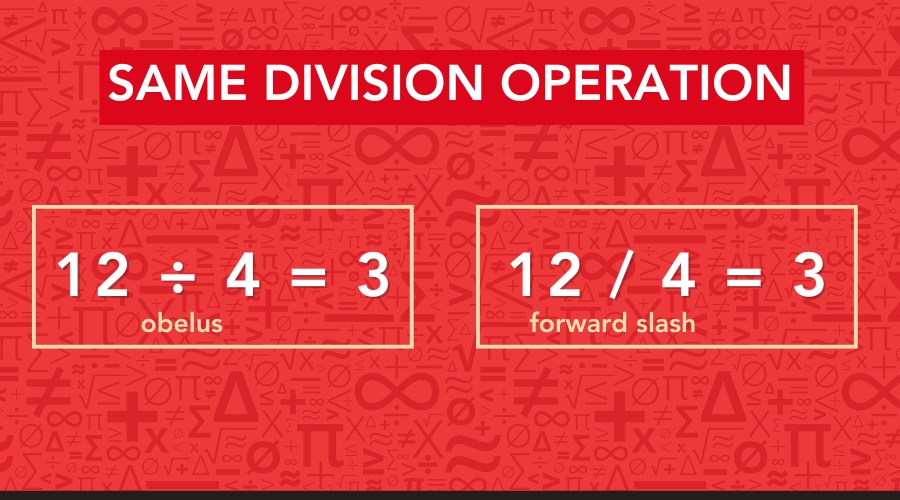
The slash is simply the more compact version, and it travels well, as it is easy to type, easy to fit into a line of text, and universally readable by both humans and computers.
📕 You May Also Like: How to Divide Whole Numbers by Fractions - A Simple Guide
Where Will You See the Slash?
The slash takes over where the obelus leaves off.
-
Calculators and computers. Every programming language and spreadsheet application uses / for division. In a formula like = B2/C2 in a spreadsheet, or 100/5 in code, the slash is doing exactly what ÷ does on paper.
-
Rates and units. When we write km/h, miles/hour, or words/minute, the slash is a division symbol. It tells us one quantity divided by another.
-
Informal everyday writing. Outside of formal math, the slash is the default. People write 1/2 or 3/4 without thinking of it as division notation, but that is exactly what it is.
One thing to keep in mind: the slash is a stepping stone. Once we write 12/4, we are already very close to writing it as a fraction. That connection becomes the foundation of the next notation.
📕 You May Also Like: What Is A Quotient: A Step-by-Step Guide for 4th Graders
The Fraction Bar
The fraction bar is the notation that carries division furthest into advanced math. When we write:
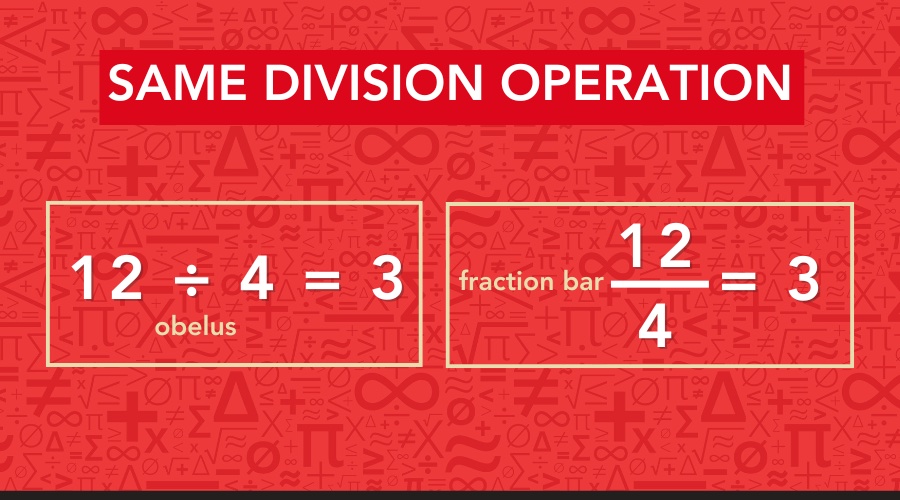
\(\Large\frac{12}{4}\) = 3
We are not writing something new. We are writing the same division as before, just arranged vertically: the number being divided on top, the number we are dividing by on the bottom, with a horizontal bar between them.
That bar is the division symbol.
Why Is This the One Notation That Changes Everything?
The fraction bar is the notation students will rely on from middle school onward, and understanding what it represents makes a significant difference.
Here is why it matters:
-
Fractions are division. When we see \(\Large\frac{3}{4}\), that is 3 divided by 4. When we see \(\Large\frac{1}{2}\), that is 1 divided by 2, which equals 0.5. The fraction bar is not a separate concept from division; it is the same concept written differently.
-
Algebra uses it constantly. In algebra, expressions like \(\Large\frac{x+2}{5}\) and \(\Large\frac{2x}{3}\) are division operations written in fraction form. Students who understand this connection can read those expressions naturally instead of treating them as unfamiliar symbols.
-
It handles complex expressions cleanly. When the numbers or expressions get longer, stacking them vertically is clearer than trying to fit everything on one line with a slash.
The Long Division Bracket
The long division bracket is the notation that looks most different from the others, but it is still expressing the same operation. Here is what it looks like:
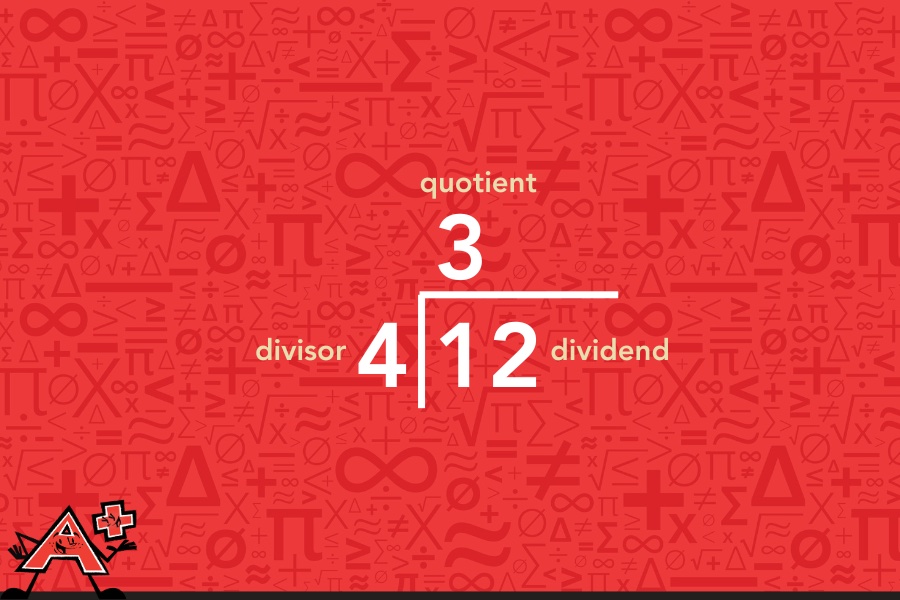
The bracket does not change what division means. It changes how we work through it, step by step, which is why it gets its own distinct layout.
3 Parts of Every Long Division Problem
No matter how large the numbers get, every long division problem has the same three components. Recognizing them makes the bracket far less intimidating.
-
The divisor sits to the left of the bracket. This is the number we are dividing by. In our example, that is 4.
-
The dividend sits inside the bracket. This is the number being divided. In our example, that is 12.
-
The quotient is written on top of the bracket as we work through the problem. This is the answer, the result of the division. In our example, that is 3.
These are the same three roles as in 12 ÷ 4 = 3. The bracket reorganizes them into a vertical workspace that makes multi-step division easier to follow and track.
All 4 Notations, Side by Side
We have now covered all four ways to write division. Before we move on, let's put them together in one place.
The problem is the same in every case: 12 divided by 4 equals 3. Only the notation changes.
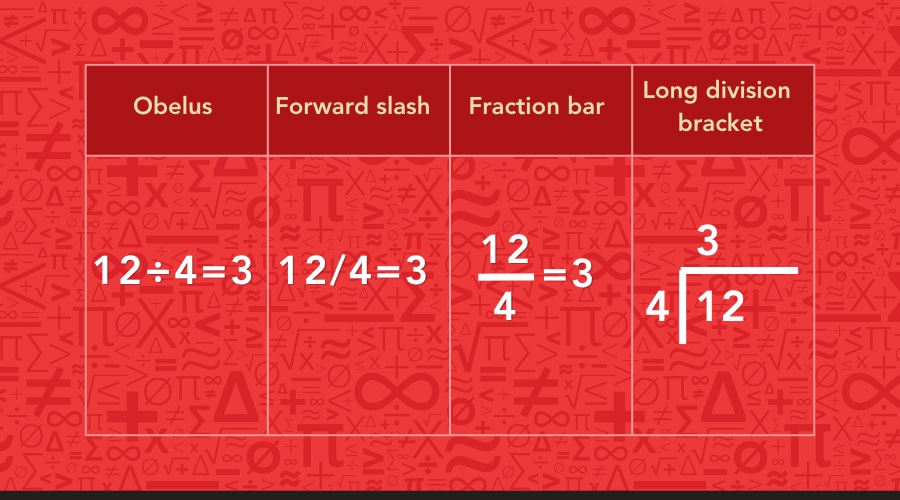
The main point is that the operation never changes. Whether we see ÷, /, a fraction bar, or a long division bracket, we are always looking at the same relationship between three numbers: a dividend, a divisor, and a quotient.
The notation we use depends on the level of math, the tool we are using, or how clearly we need to show our work. If we can recognize all four, we are never caught off guard by an unfamiliar way of writing something we already know how to do.

Mathnasium of Crystal Lake tutors work with students face-to-face, building the kind of understanding that sticks well beyond the classroom.
How Mathnasium Helps Students Master Any Math Concept
Mathnasium is a math-only learning center dedicated to helping K-12 students of all skill levels learn and master math.
Division is a foundational math skill and naturally one of the most common points of focus for our tutors.
To help students build a solid and lasting foundation of division and any other math concept, we don’t rely on a one-size-fits-all system but on the Mathnasium Method™, a proprietary teaching approach designed around each student's individual learning needs and style.
It begins with a diagnostic assessment, a relaxed interaction where we uncover your child's strengths and knowledge gaps. From those insights, we build a personalized learning plan tailored to their needs, whether that means building conceptual understanding of division from the ground up or improving fluency for a student who has the concept but needs more practice.
Our specially trained tutors follow that plan closely, teaching math face-to-face in a supportive and fun setting. We use plain, everyday language to explain concepts and draw on a mix of verbal, visual, mental, tactile, and written techniques so the math makes sense to each student.
When students get stuck, we give them space to work through it on their own first, guiding them to trust their own thinking. When we step in, we break the concept down and show both the how and the why behind the answer. Gradually, students develop the problem-solving skills and critical thinking tools they carry into math and beyond.
Fun is a major part of how we work. Sessions are often game-based, students earn rewards along the way, and every bit of progress gets celebrated. That keeps learning engaging, enjoyable, and students aware of how far they have come.
Our approach brings measurable results:
-
94% of parents report an improvement in their child's math skills and understanding
-
93% of parents report their child's improved attitude toward math after attending Mathnasium
-
90% of students saw an improvement in their school grades
With over 1,100 learning centers across North America, there is likely a Mathnasium near you.
Mathnasium of Crystal Lake is a math-only learning center serving K-12 students across Crystal Lake and the surrounding communities.
Whether your student is looking to catch up, keep up, or get ahead, our team at Mathnasium of Crystal Lake is ready to help. Start by scheduling a free diagnostic assessment with us, and we’ll build your student’s personalized plan for math mastery.
📅 Schedule a Free Diagnostic Assessment at Mathnasium of Crystal Lake
Not near Crystal Lake?
📍 Find a Mathnasium Learning Center Near You


 (815) 526-3453
 (815) 526-3453