Greater than and less than are signs we learn in first grade. They're the foundation for comparing and ordering numbers, which are skills that show up in math at every level.
So, to build them on solid ground from the start, today Mathnasium tutors walk you through what the signs mean, which way they point, how to use them with two-digit numbers, and a handy trick so you never mix them up again.

What Do Greater Than and Less Than Mean?
Greater than and less than describe the relationship between two numbers. One is bigger, one is smaller, and the signs show which is which.
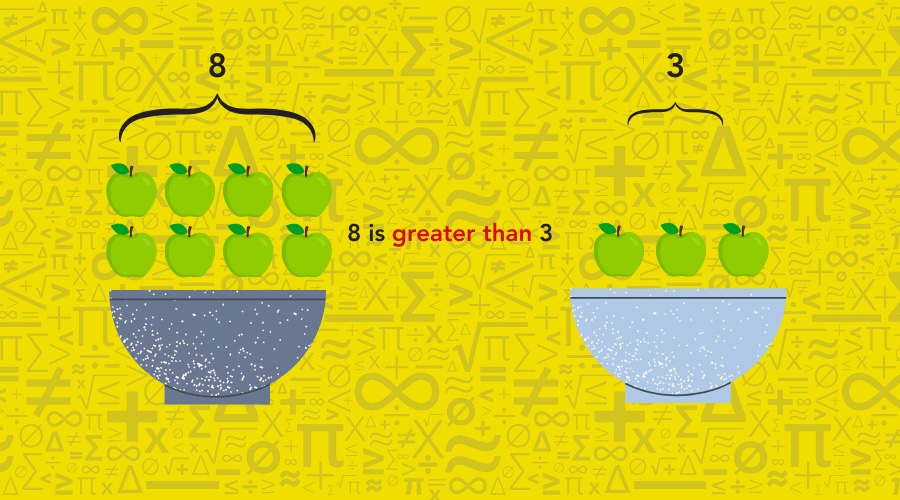
Picture two piles of apples, one with 8 and one with 3. You already know which is bigger, and that's exactly what greater than and less than are describing.
There are three terms to know:
-
Greater than: one number is bigger than the other.
-
Less than: one number is smaller than the other.
-
Equal to: both numbers are the same.
For example, 44 = 44. When two numbers are identical, neither is greater nor less. They're equal.
Equal to is already familiar from the equals sign ( = ).
Greater than and less than are what we use when two numbers aren't the same.
📕 You May Also Like: The Not Equal Sign: What ≠ Means in Math
What Does the Greater Than Sign Look Like?
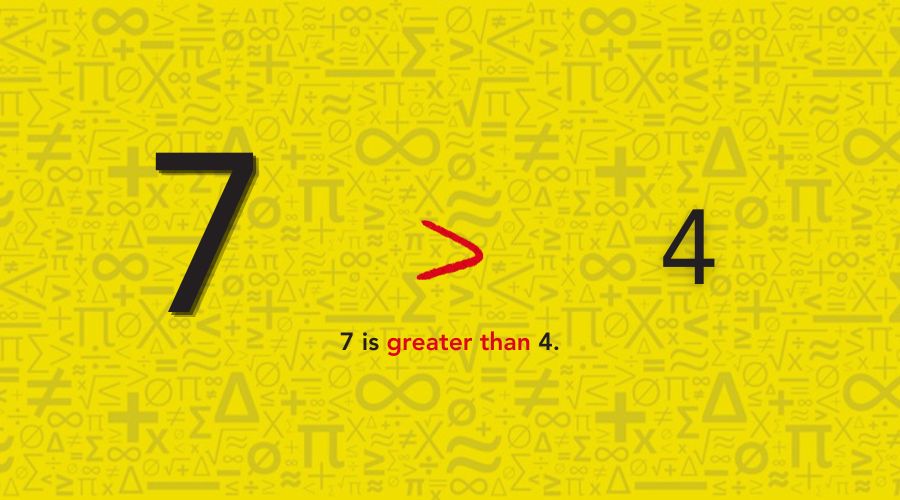
The greater than sign opens wide on the left and comes to a point on the right, like this: ( > ).
Look at this example: 7 > 4.
Which side opens wide and which side comes to a point?
-
The open side faces 7, because 7 is the bigger number.
-
The point aims at 4, because 4 is the smaller one.
That brings us to the easy rule that works for both signs:
Read it left to right like a sentence: "7 is greater than 4."
What Does the Less Than Sign Look Like?
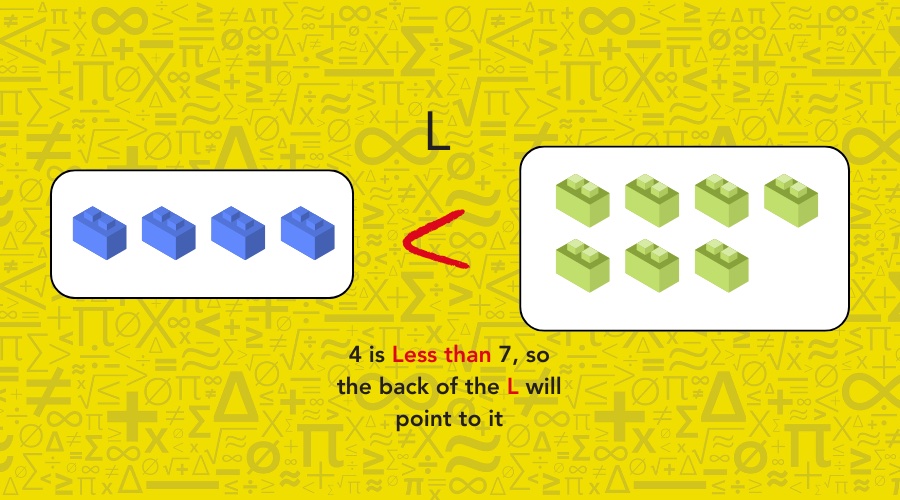
The less than sign is the mirror image of the greater than sign. It points left, and its open side faces the bigger number, like this: ( < ).
Look at this example: 4 < 7.
Read it left to right like a sentence: "4 is less than 7."
We use the same easy rule here, too. Only the direction changes.
When we read it from left to right like a sentence, we will always find the right meaning, no matter which way the sign faces.
There's a useful memory trick here, too.
The less than sign looks like a capital letter L tilted on its side. Less than starts with L, and so does the shape.
📕 You May Also Like: Greater Than and Less Than: A Simple Guide for Early Math
The Dot Trick: How to Always Get the Sign Right
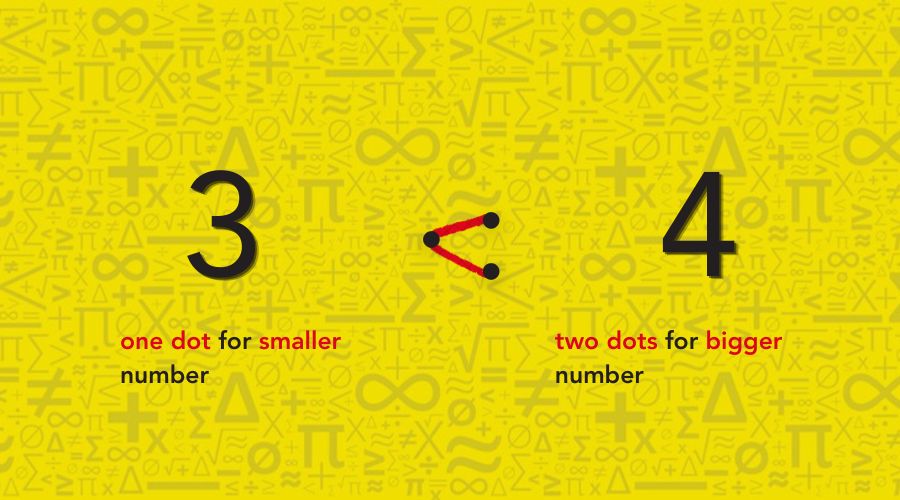
The Dot Trick builds the correct symbol from scratch, so there's no guessing which way it points.
Here's how it works:
-
Step 1: Write the two numbers being compared.
-
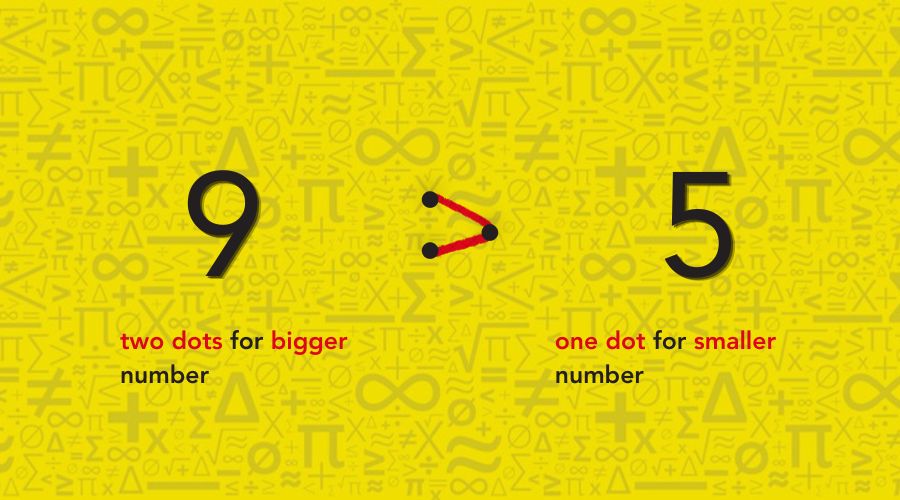
Step 2: Put two dots next to the bigger number and one dot next to the smaller number, making sure all the dots sit right between them.
-
Step 3: Connect the dots.
The shape that forms is the correct sign, automatically pointing at the smaller number.
Try it with 9 and 5.
-
9 is bigger, so it gets two dots. 5 is smaller, so it gets one dot.
-
Connect them and the result is: 9 > 5. "9 is greater than 5."
Now reverse the order. Start with 5 and 9.
-
9 is still bigger, so it still gets two dots. 5 still gets one.
-
Connect them and the result is: 5 < 9. "5 is less than 9."
The numbers switched sides. The rule stayed the same.
Now try one more.
Compare 3 and 4. Which number is bigger? Which one gets two dots?
Connect them. What sign did you get?
3 < 4. "3 is less than 4."
How to Use Greater Than and Less Than With Two-Digit Numbers
To compare two-digit numbers, start with the tens place and work left to right.
Case 1: The tens digits are different.
Case 2: The tens digits are the same.
-
Take 54 and 57.
-
Both start with 5, so the tens place doesn't give us the answer.
-
Move to the ones digit instead.
-
Since 4 is smaller than 7, 54 is less than 57. 54 < 57. "54 is less than 57."
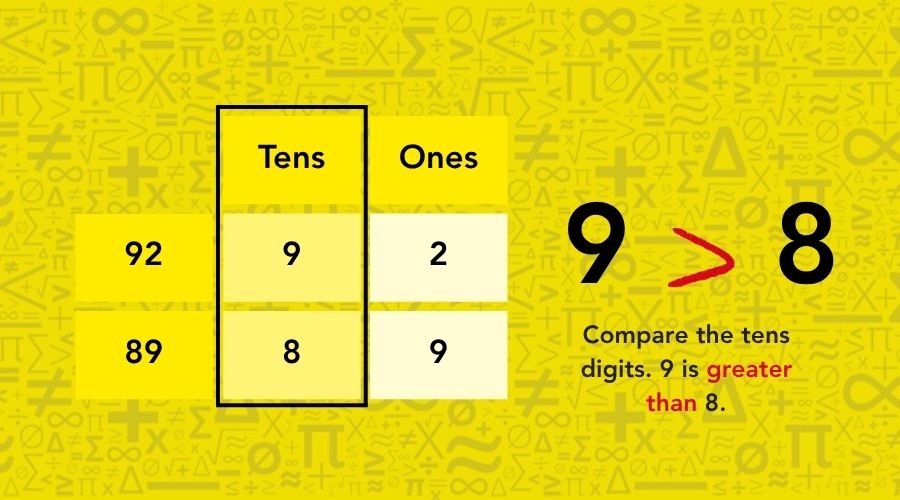
Now try one on your own. Which is greater, 92 or 89?
Think about where to start. Are the tens digits the same or different?
The tens digits are different. 9 is bigger than 8, so 92 > 89. "92 is greater than 89."
📕 You May Also Like: How to Teach Place Value Using Base-10 Blocks: A Parent’s Guide for Ages 7–8
Additional Tip:
We can use a handy chart to separate our numbers and see the digits more clearly. When we line up 92 and 89 in a table, we can split them into tens and ones columns.
We look at the boxed tens column first to compare the main digits side by side.
Since 9 is greater than 8, we know the answer right away without needing to look at the ones place.
Common Mistakes With Greater Than and Less Than Signs
These two signs trip up most first graders in the same two ways. Here's what to watch for.
Mistake 1: Flipping the sign when rewriting the statement
If 4 < 7 is written correctly, but then the numbers are switched, a common error is writing 7 < 4. That's incorrect.
When the numbers switch sides, the sign switches direction too.
The correct rewrite is 7 > 4. "7 is greater than 4."
Flip the numbers, flip the sign. The relationship between them stays the same.
Mistake 2: Forgetting the ones place
When two numbers look similar, like 63 and 68, students sometimes spot the identical 6s and assume the numbers are equal or rush into guessing the sign.
If the tens digits match, the ones place always holds the tie-breaker.
Both mistakes are easy to make and easy to fix once we spot the pattern.
📕 You May Also Like: 7 Tips to Help Your Child Build Number Sense
Quiz: Test Your Greater Than and Less Than Skills
Time to put it all together. Try these eight problems before checking the answers at the bottom of the page.
Set 1: Fill in the sign. Write >, <, or = between each pair of numbers.
-
3 ___ 9
-
15 ___ 12
-
33 ___ 33
-
71 ___ 75
Set 2: True or false. Is the comparison statement correct?
-
5 > 2 (True or False?)
-
18 < 16 (True or False?)
-
44 > 41 (True or False?)
-
62 = 62 (True or False?)

Mathnasium tutors use hands-on techniques and everyday language to help first graders make sense of math symbols and number relationships.
How Mathnasium Helps Students Master Greater Than and Less Than Signs
Greater than and less than are among the first symbolic concepts students encounter, and getting them right sets the foundation for everything that follows. At Mathnasium, we focus on helping students build a deep and lasting understanding of these early concepts.
Behind every program we offer is the Mathnasium Method™, a proprietary teaching approach designed around each student's individual learning needs and style.
It begins with a diagnostic assessment, a relaxed interaction where we uncover your child's strengths and knowledge gaps.
From those insights, we build a personalized learning plan tailored to their needs, whether that means introducing comparison symbols or strengthening place value understanding for a student who needs more practice.
Our specially trained tutors follow that plan closely, teaching math face-to-face in a caring small-group environment.
We use plain, everyday language and draw on a mix of verbal, visual, mental, tactile, and written techniques so the math truly lands.
When students get stuck, we give them space to work through it first, then step in to show both the how and the why. Over time, they develop the problem-solving skills and critical thinking tools they carry into math and beyond.
Fun is an important part of how we work. Sessions are often game-based, students earn rewards along the way, and we celebrate every bit of progress.
The results speak for themselves:
-
94% of parents report an improvement in their child's math skills and understanding.
-
93% of parents report their child's improved attitude toward math after attending Mathnasium.
-
90% of students saw an improvement in their school grades.
We operate over 1,100 centers, bringing our top-rated approach close to your community.
If you're based in or near Crystal Lake, IL, Mathnasium of Crystal Lake is a trusted local resource with years of experience helping students transform how they think and feel about math.
Whether your child needs to catch up, keep up, or get ahead, our team is happy to help.
📅 Schedule a Free Assessment at Mathnasium of Crystal Lake
Not near Crystal Lake?
📍 Find a Mathnasium Learning Center Near You
Pssst! Check Your Answers Here
Set 1:
-
3 < 9
-
15 > 12
-
33 = 33
-
71 < 75
Set 2:
-
True. 5 is greater than 2.
-
False. 18 is greater than 16.
-
True. 44 is greater than 41.
-
True. 62 is equal to 62.


 (815) 526-3453
 (815) 526-3453