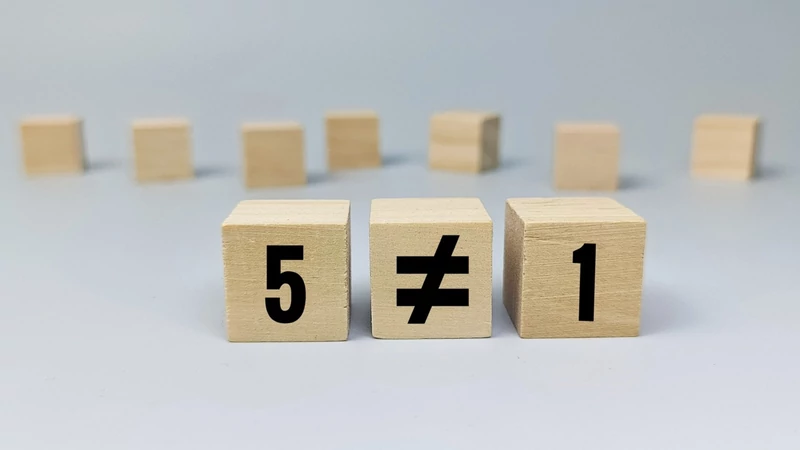
The equal sign shows up everywhere in math, telling us when two things are exactly the same. But math isn't always about things being equal, and when they're not, we have a symbol for that too.
Today, our tutors take a closer look at the not equal sign: what it means, how to use it correctly, where it fits among other comparison symbols, and how it shows up in real math problems.
What Is the Not Equal Sign?
The not equal sign, written as ≠, is a mathematical symbol that means two values or expressions are not the same. It is the direct opposite of the equal sign.
Depending on the situation, you may also hear it called the "does not equal sign," "not equal to," or simply "unequal," but they all refer to the same symbol.
Looking at it closely, the symbol is simply an equals sign with a diagonal slash through it. That slash signals negation, turning "equal" into "not equal" in one simple mark.
We read ≠ aloud as "is not equal to." So A ≠ B reads as "A is not equal to B," and 8 ≠ 3 reads as "eight is not equal to three."
For example:
-
3 ≠ 5: three is not equal to five
-
10 ≠ 7: ten is not equal to seven
-
2 + 3 ≠ 6: two plus three is not equal to six
Quite simple, isn’t it?
📕 You May Also Like: What Is an Expression in Math? A Beginner-Friendly Guide
How to Write & Check a Not Equal Statement
To write a not equal statement, we place ≠ between two values or expressions that have different results. The keyword for us is different. Both sides must actually produce different values for the statement to be correct.
Now, what if we're given a not-equal statement and need to check whether it's true or false? We work out both sides and compare.
-
5 × 6 ≠ 60 ÷ 2 — 5 × 6 = 30 and 60 ÷ 2 = 30. Both sides are equal, so this statement is false.
-
2³ ≠ 2 × 3 — 2³ = 8 and 2 × 3 = 6. The sides differ, so this statement is true.
📕 You May Also Like: What Is Inequality in Math? Everything You Need to Know
Not Equal vs. Other Comparison Symbols
The ≠ sign belongs to a wider family of comparison symbols. Here's where it sits among the others:
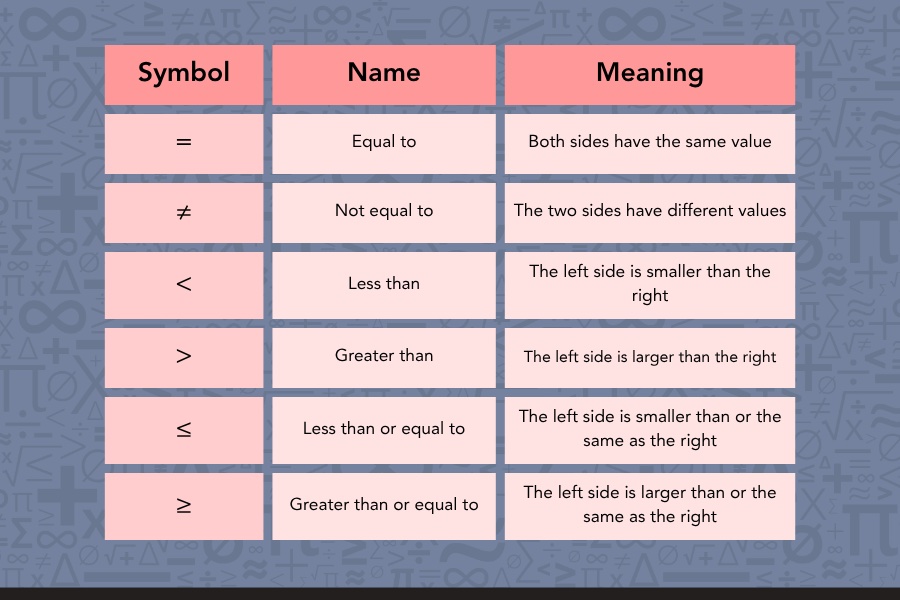
Of all six, ≠ is the broadest. It covers every case where two values differ, without saying which is larger or smaller.
📕 You May Also Like: How to Teach Your Child the Alligator Method for Greater Than and Less Than
Where Does the Not Equal Sign Show Up in Math?
The ≠ sign shows up across math in several ways. Let's walk through the most common ones.
A. Number Comparisons
This is the most basic use. We use ≠ to state that two numbers are simply different from each other.
This comes up whenever we need to confirm that two values are not equivalent, like when comparing measurements, decimals, or fractions.
-
8 ≠ 11
-
0.5 ≠ 0.05
-
1/2 ≠ 1/3
B. Expression Comparisons
Here we use ≠ to show that two expressions produce different results when worked out. This is where ≠ starts earning its place in arithmetic and early algebra.
For example:
-
3 × 4 ≠ 3 + 4 (because 12 ≠ 7)
-
5² ≠ 5 × 2 (because 25 ≠ 10)
-
10 − 3 ≠ 10 ÷ 3 (because 7 ≠ 3.33)
C. Equation Checking
When solving equations, ≠ helps us show that a particular value doesn't work as a solution. This becomes increasingly useful in grades 6 and 7 algebra.
-
If x = 3, then x + 5 ≠ 7 (because 3 + 5 = 8, not 7)
-
If x = 2, then 3x ≠ 9 (because 3 × 2 = 6, not 9)
D. Inequalities and Beyond
As math develops into inequalities, functions, and set notation, the not equal sign becomes a regular part of the toolkit. These are topics we'll encounter later in our math journey, but it's useful to know the symbol will be there waiting for us.
In inequalities, ≠ tells us a variable cannot take a specific value:
In functions, ≠ helps define restrictions or values a variable is not allowed to take:
In set notation, ≠ is used to show that two sets or elements are distinct:
Put the Not Equal Sign to Work
Work through each challenge below to see how well you understood the not equal sign. When you’re done, check your answers at the bottom of the guide.
Challenge 1: Is 3² + 7 ≠ 2 × 8 true or false?
Challenge 2: Is 48 ÷ 6 ≠ 72 ÷ 9 true or false?
Challenge 3: Choose a value for x that makes each statement true.
Challenge 4: Write a true not equal statement that contains at least one multiplication and one addition.

Mathnasium uses personalized learning plans and interactive teaching techniques to help students truly make sense of math.
How Mathnasium Helps Students Master Any Math Concept
Mathnasium is a math-only learning center empowering students of all skill levels to excel in math.
When students need support with topics like the not equal sign or the broader family of comparison symbols, mathematical reasoning, and expression work it connects to, we teach for deep understanding, not just rote memorization.
To help students achieve that level of understanding, we use the Mathnasium Method™, a proprietary teaching approach designed around how each student learns best.
Here’s how it works.
Each student begins with a diagnostic assessment, which helps us pinpoint each student’s current skills and knowledge gaps. With these insights, we create a personalized learning plan tailored to their needs and goals.
Once the plan is developed, our specially trained tutors deliver face-to-face math instruction in a supportive and fun setting.
To make math concepts clear, we use simple language and rely on a mix of verbal, visual, tactile, and written techniques. When students are stuck on a math problem, we break it down into manageable bits, showing both the how and the why behind the answer.
Working with our tutors, students gain valuable critical thinking tools and problem-solving skills they can use in math and life.
Fun is a core part of our approach. Our activities are often game-based and hands-on, keeping students engaged and making learning enjoyable. We track their progress and celebrate each win, big or small, building their confidence with every session.
The results are real and measurable:
-
94% of parents report an improvement in their child's math skills and understanding
-
93% of parents report an improved attitude toward math after attending Mathnasium
-
90% of students saw an improvement in their school grades
With more than 1,100 learning centers across North America, there is likely a Mathnasium close tyo you.
For families in the Woodbridge neighborhood of Irvine, CA, Mathnasium of Woodbridge is a trusted local center with years of experience building confident math thinkers.
Whether your learner is looking to catch up, keep up, or get ahead in math, our team is ready to help.
📅 Schedule a Free Diagnostic Assessment at Mathnasium of Woodbridge
Not near Irvine?
📍 Find a Mathnasium Learning Center Near You
Pssst! Check Your Answers Here
If you've given our challenges a go, check your results below.
Challenge 1: Is 3² + 7 ≠ 2 × 8 true or false?
3² + 7 = 9 + 7 = 16, and 2 × 8 = 16. Both sides are equal, so this statement is false.
Challenge 2: Is 48 ÷ 6 ≠ 72 ÷ 9 true or false?
48 ÷ 6 = 8, and 72 ÷ 9 = 8. Both sides are equal, so this statement is false.
Challenge 3: Choose a value for x that makes each statement true.
-
x + 4 ≠ 10 → any value of x except 6 works. For example, x = 3 gives 3 + 4 = 7 ≠ 10.
-
2x ≠ 14 → any value of x except 7 works. For example, x = 5 gives 2 × 5 = 10 ≠ 14.
Challenge 4: Write a true not equal statement that contains at least one multiplication and one addition.
Many answers are possible. Here is one example:
3 × 4 + 2 ≠ 3 × 4 + 5, because 14 ≠ 17.


 (949) 559-6284