When it comes to solving word problems, many students look for clue words like "total," "left," or "more" before they even finish reading the problem. Those clues can help, but the same word can point to different operations depending on the situation.
Instead of looking for quick hints, we need a strategy that matches what word problems ask us to do at each grade level.
Today, our Mathnasium tutors will show you three grade-band-specific word problem strategies for Grades K to 8 and explain why the approach that helps students in second grade is not the one middle school students need.

Why Word Problems Require More Than Math Skills
Word problems combine reading comprehension with mathematical reasoning, so understanding what the problem is asking is just as important as performing the calculation.
Before we choose an operation, we first need to identify the relationships between quantities, separate the information that helps answer the question from details that do not, and translate the words into a mathematical model. Only then can we decide which mathematical operation or strategy fits.
Even perfect arithmetic skills cannot produce the correct answer if we misunderstand the problem in the first place. This is not surprising because research shows that language comprehension contributes at least as much to success with word problems as arithmetic skill does, which is why students who calculate accurately can still struggle with word problems.
The strategy we use to interpret a word problem is just as important as the method we use to solve it.
📕 You May Also Like: Why Kids Struggle with Word Problems in Math (+ How to Help)
How Word Problem Demands Change Across Grade Levels
Word problems ask students to think differently as they move from Kindergarten to Grade 8, which is why the same strategy does not work equally well at every grade level.
In the early grades, students usually work with one clear action. They first need to picture what is happening before deciding whether the problem describes:
By middle school, students must process more information before deciding how to solve the problem. They are more successful when they identify the relevant information, organize it clearly, and think about how it fits into the solution.
At the same time, writing down every detail, including information that does not help answer the question, often makes the problem harder to solve because it becomes more difficult to separate what is important from what is not.
As the thinking behind word problems changes, the strategy needs to change with it.
📕 You May Also Like: A 4-Step Method for Solving Word Problems (With Examples)
Word Problem Strategies by Grade Bands
We organize word problem strategies into three grade bands because students across several grades can build on the same problem-solving framework.
While the math content and word problems become more complex from one grade to the next, the same strategy can continue to help students approach them.
Grades K to 2: Concrete Modeling
Concrete modeling helps children in Grades K to 2 picture what is happening in a word problem before they try to calculate.
Bar models, also called tape diagrams, are one of the most effective tools for this grade band. They use labeled rectangles to represent quantities and show how they relate to one another.
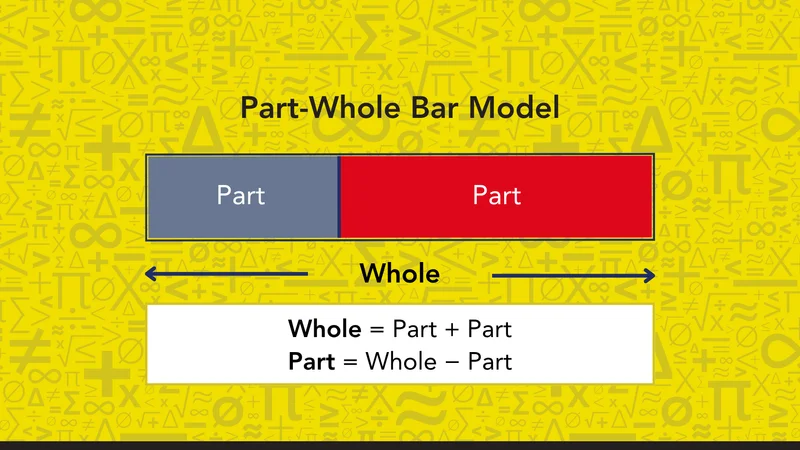
One rectangle represents the whole, while the known and unknown parts appear as separate parts of that rectangle. Children can label what they know, mark the unknown with a question mark, and then use the diagram to decide what calculation they need.
Here's the five-step framework children can follow when using a bar model.
|
Step
|
What to Do
|
|
1
|
Read the problem and identify the action (joining, separating, or comparing).
|
|
2
|
Draw one bar for the whole quantity.
|
|
3
|
Divide the bar into segments for the known and unknown parts.
|
|
4
|
Label each segment with numbers or a question mark.
|
|
5
|
Use the diagram to find the missing quantity.
|
We can see how the method works in this simple example:
Lucas has 8 toy cars. He gives 3 to a friend. How many does he have left?
Let's solve it step by step.
-
Step 1: Identify the action. Lucas starts with 8 toy cars and gives 3 away, so this is a separating problem.
-
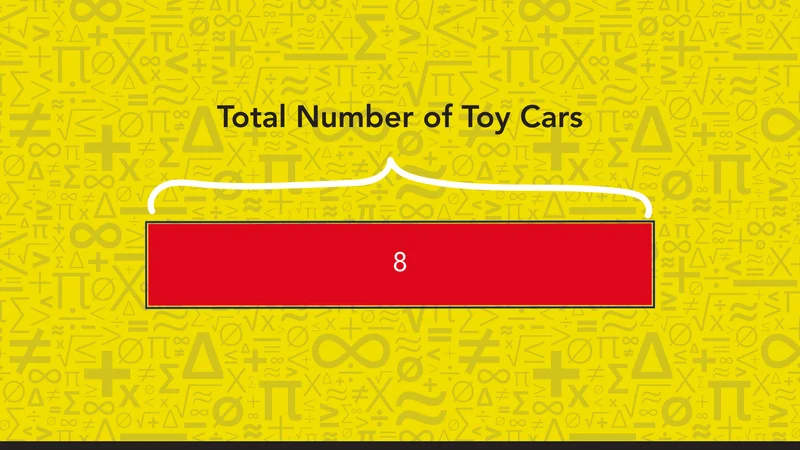
Step 2: Draw one bar to represent all 8 toy cars.
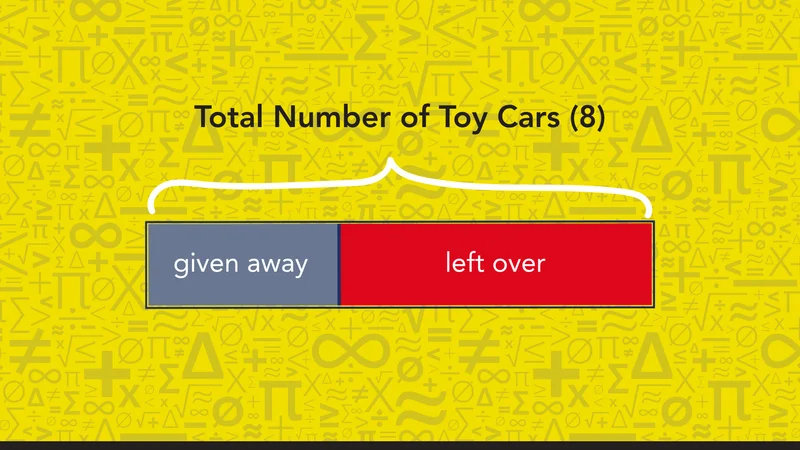
- Step 3: Divide the bar into two parts, one for the toy cars Lucas gave away and one for the unknown number left.
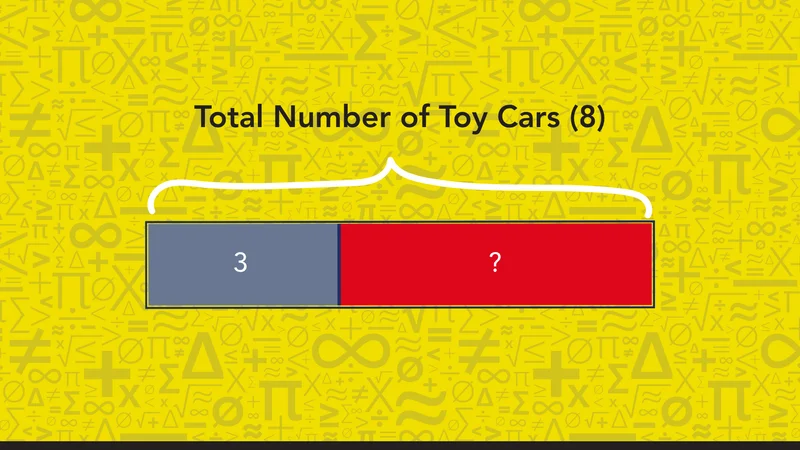
- Step 5: Use the diagram to find the missing quantity. The whole is 8; one part is 3, so the missing part is 8 − 3 = 5. Lucas has 5 toy cars left.
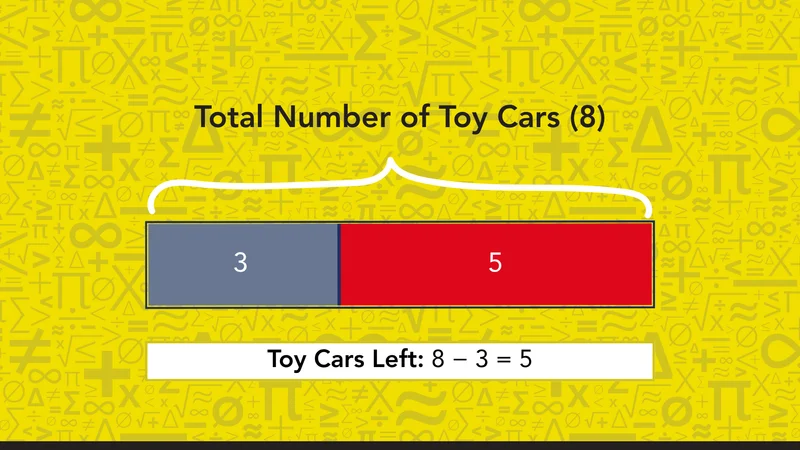
As children move from Kindergarten through Grade 2, the numbers and wording become more complex, but the bar model continues to help them see how the quantities fit together before they calculate.
📕 You May Also Like: What Is a Bar Model in Math? A Complete Overview
Grades 3 to 5: Filtering
Children in Grades 3 to 5 begin solving word problems that include multiple steps and extra information, so filtering helps them focus on what the question asks before deciding what to calculate.
The no-number summary is one of the most effective techniques at this point. Before using any numbers, we rewrite the problem in plain language so only its main idea remains.
We use the following five-step method to create a no-number summary.
|
Step
|
What to Do
|
|
1
|
Read the whole problem without touching any numbers.
|
|
2
|
Write a one-sentence plain-language summary of what is happening.
|
|
3
|
Identify the question being asked.
|
|
4
|
Cross out any detail that does not connect to that question.
|
|
5
|
Write the calculation plan in words before using numbers.
|
Here's a word problem that includes extra information:
A school is planning a field trip for 128 students. Each bus holds 32 students. Tickets cost $6 per student. The school has already collected $480 in ticket fees. The trip takes 45 minutes to drive each way. How many buses does the school need?
Let's solve it step by step using the no-number summary.
-
Step 1: Read the whole problem without focusing on the numbers.
-
Step 2: Write a one-sentence summary. For this problem, we could write: A group needs transportation. We know how many people there are, how many fit on each bus, and we need to find the number of buses required.
-
Step 3: Identify the question. Here, we need to answer “How many buses does the school need?”
-
Step 4: Cross out details that do not connect to the question. We can ignore the ticket cost ($6), collected amount ($480), and travel time (45 minutes).
-
Step 5: Finally, write the calculation plan in words before using numbers. Since each bus holds 32 students, we divide the total number of students by the number each bus can carry to find how many buses are needed. Now substitute the numbers: 128 ÷ 32 = 4 buses. So, the school needs 4 buses to transport all 128 students.
By Grade 5, word problems often involve fractions and decimals, which makes the no-number summary even more useful because children need to understand the strategy before working with more complex numbers.
📕 You May Also Like: Math Skills Every Student Should Master by Grade 5
Grades 6 to 8: Variable Mapping
Variable mapping helps students in Grades 6 to 8 define unknown quantities before turning a word problem into an equation.
We begin by writing one sentence that explains what the variable represents in the problem. That simple step helps children keep track of the unknown throughout the solution.
Now, let’s look at the variable mapping framework.
|
Step
|
What to Do
|
|
1
|
Read the problem and identify the unknown quantity.
|
|
2
|
Write "Let x equal..." and define it in plain language using the problem's context.
|
|
3
|
Translate each piece of information into an expression using x.
|
|
4
|
Write the full equation.
|
|
5
|
Solve and check that the answer matches the original definition of x.
|
Here's a word problem with an unknown quantity:
Ella earns $12 per hour babysitting. She also receives a one-time $15 bonus. After buying a book for $9, she has $54 left. How many hours did Ella babysit?
Let’s work through it using variable mapping.
-
Step 1: Identify the unknown quantity. In this problem, we need to find how many hours Ella babysat.
-
Step 2: Define the variable by writing, "Let x equal the number of hours Ella babysat."
-
Step 3: Translate each piece of information into an expression. Ella earns $12 for each hour she babysits. Since x represents the number of hours, her earnings are 12 × x, which we write as 12x. We then add the $15 bonus, subtract the $9 book purchase, and set the result equal to the $54 she has left.
-
Step 4: Write the equation. We now have 12x + 15 − 9 = 54.
-
Step 5: Solve the equation and check the answer. First, simplify it to 12x + 6 = 54. Then subtract 6 to get 12x = 48 and divide by 12 to find x = 4. Finally, check the answer: 12 × 4 + 15 − 9 = 54. So, Ella babysat for 4 hours.
By Grade 8, some word problems introduce two unknown quantities instead of one. The same strategy still works, but children begin by defining both variables before writing the equations that connect them.
📕 You May Also Like: How to Solve Two-Step Equations Using the Undo Method

At Mathnasium, we help students build the reading and reasoning skills that word problems demand at every grade level.
How Mathnasium Helps Students Master Word Problems (And Any Other Math Concept)
Mathnasium is a math-only learning center dedicated to helping K–12 students of all skill levels excel in math.
Whether students are learning to solve their first word problems or mastering algebraic ones, we can support them.
Our proprietary teaching approach, the Mathnasium Method™, is designed around each student's needs and learning style. To build a deep understanding of any math topic, word problems included, our approach uses:
-
Assessment and Personalized Learning Plans: Each student begins their Mathnasium journey with a diagnostic assessment that identifies current skills, strengths, and gaps. From those findings, we build a personalized learning plan tailored to their goals.
-
Teaching for Understanding: Our specially trained tutors use natural language and a mix of verbal, visual, mental, tactile, and written techniques so each concept lands before we move forward. Word problems combine reading, reasoning, and computation, so students often benefit from more than one explanation.
-
Problem-Solving and Critical Thinking: We give students time to work through problems independently. That productive struggle helps them learn to trust their own reasoning. When we do step in, we explain both the how and the why behind each concept, so students build problem-solving and critical thinking skills they can use in math and beyond.
-
An Engaging and Fun Learning Environment: Sessions include games, earned rewards, and consistent celebration of progress. Students build confidence alongside fluency, and many develop a more positive relationship with math over time.
The impact extends beyond the classroom:
-
94% of parents report improvement in their child's math skills and understanding
-
93% of parents report an improved attitude toward math after attending Mathnasium
-
90% of students saw improvement in their school grades
With over 1,100 learning centers across North America, there is likely a Mathnasium close to you.
Families across Woodbridge and nearby areas, including Deerfield and Laguna Altura, University Park, Oak Creek and Los Olivos, El Camino Real and Quail Hill, and Central Irvine and Stonegate, trust Mathnasium of Woodbridge to help their children build lasting confidence in math.
If word problems or any other math concept is giving your child trouble, our team is ready to help.
📅 Schedule a Free Assessment at Mathnasium of Woodbridge
Not near Woodbridge?
📍 Find a Mathnasium Learning Center Near You


 (949) 559-6284