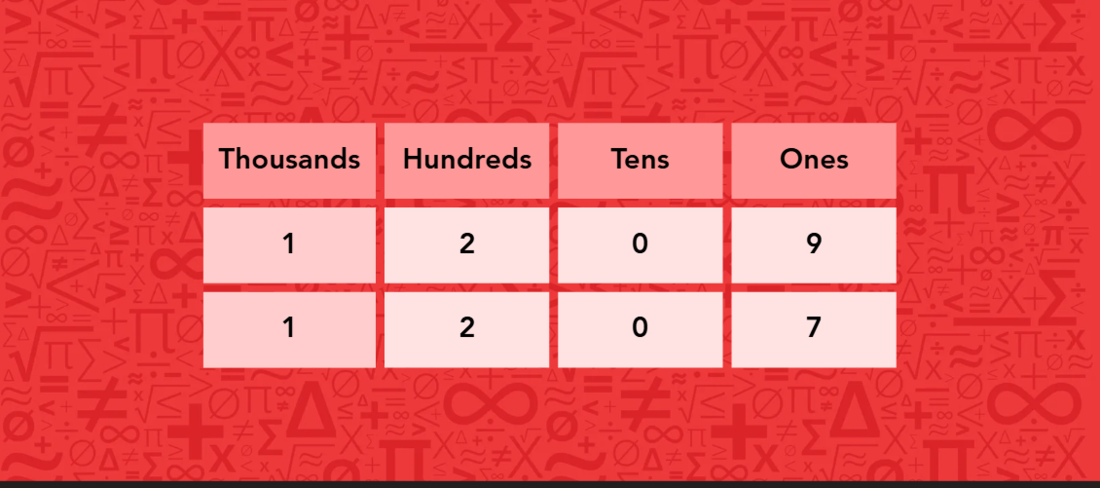
Place value is one of those math concepts that seems simple at first, but it plays a much bigger role than you may realize.
Its importance does not end after students finish the second-grade unit. Place value is the foundation for later skills such as multiplication and decimals, so gaps in understanding can lead to challenges in topics that may not seem connected to it.
Today, our Mathnasium tutors explain what place value means, how it connects to multiplication and decimals, and why it matters well beyond 2nd grade, with simple practice to help you check your knowledge.

What Is Place Value?
Place value tells us what a digit is worth depending on where it appears in a number.
Because our math system is built around powers of ten, each position in a number is 10 times greater than the place to its right.
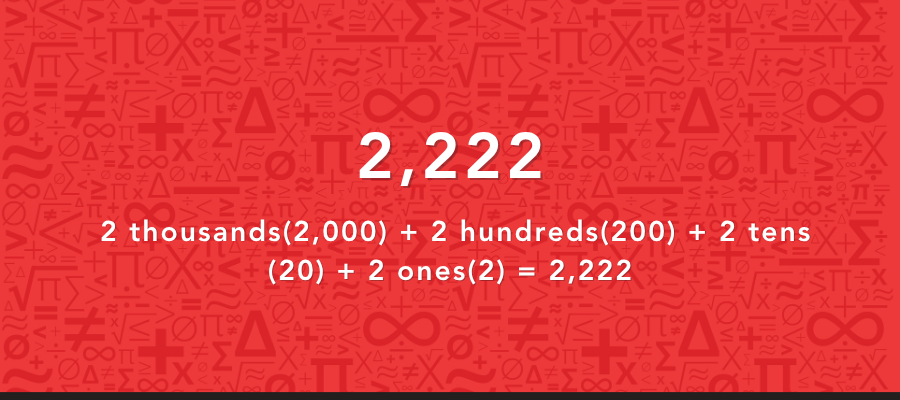
For example, in the number 2,222, the digit is always a 2, but its position changes everything:
-
The 2 on the far right is in the ones place, worth 2.
-
The 2 in the next spot is in the tens place, worth 20.
-
The 2 in the third spot is in the hundreds place, worth 200.
-
The 2 on the far left is in the thousands place, worth 2,000.
Why Place Value Matters Way Beyond 2nd Grade
Place value is a core math skill introduced in 1st and 2nd grade. While the dedicated unit wraps up in early elementary, place value continues to power math learning through upper elementary and middle school.
We'll show you a few ways place value shows up in higher grades and keeps math making sense:
A. Multi-Digit Multiplication Depends on Place Value
When we multiply larger numbers, we are really just applying place value step by step.
Take a problem like 23 × 14. To solve it, we break the numbers apart based on what each digit is worth:
-
Break 14 apart: 14 = 10 + 4
-
Multiply by the ones: 23 × 4 = 92
-
Multiply by the tens: 23 × 10 = 230
-
Add them together: 230 + 92 = 322
This process only makes sense if you understand what each digit in 23 and 14 represents.
Students who haven't fully grasped that the "2" in 23 means two tens can have difficulty seeing why the steps in multi-digit multiplication work at all. Instead of following the logic, they end up memorizing a sequence of moves, which falls apart the moment the numbers get unfamiliar.
📕 You May Also Like: What Is Number Sense & Why It Matters in Early Math Education
B. Long Division Relies on Place Value
Long division is often where math anxiety peaks, mostly because students see it as an intimidating chain of steps (Divide, Multiply, Subtract, Bring down).
But when viewed through place value, long division is simply sharing or splitting numbers by place value units, starting with the largest group.
Take 735 ÷ 3:
-
Divide the hundreds: 7 hundreds ÷ 3 = 2 hundreds in each group (6 hundreds used, 1 hundred left over).
-
Trade for tens: Convert that 1 leftover hundred into 10 tens, plus the 3 tens you already have = 13 tens.
-
Divide the tens: 13 tens ÷ 3 = 4 tens in each group (12 tens used, 1 ten left over).
-
Trade for ones: Convert that 1 leftover ten into 10 ones, plus the 5 ones you already have = 15 ones.
-
Divide the ones: 15 ones ÷ 3 = 5 ones in each group (Answer: 245).
Without place value, steps like "bringing down the next digit" can feel confusing. When we understand that we are trading 1 leftover hundred for 10 tens, long division makes a lot more sense.
📕 You May Also Like: How to Do Long Division?
C. How We Understand Decimals Depends on Place Value
Does place value work for decimals too, you might wonder?
Yes, it does! We use the exact same base-10 system when moving to the right of the decimal point, except each position becomes 10 times smaller instead of 10 times larger:
-
In 0.5, the 5 is in the tenths place (\(\Large\frac{1}{10}\)).
-
In 0.25, the 2 is in the tenths place, and the 5 is in the hundredths place (\(\Large\frac{1}{100}\)).
-
In 0.253, the 2 is in the tenths place, the 5 is in the hundredths place, and the 3 is in the thousandths place (\(\Large\frac{1}{1000}\)).
Where do students usually get tripped up here?
It's common to assume that a decimal like 0.45 is larger than 0.5 simply because 45 is bigger than 5. But when you look at position, 0.5 has 5 tenths while 0.45 only has 4 tenths. Because tenths are bigger than hundredths, 0.5 is actually the larger number.
That is why difficulties with decimals can often be traced back to place-value concepts introduced years earlier.
📕 You May Also Like: Decimal Place Value Made Easy: A Fun, Kid-Friendly Guide

5 Place Value Habits That Make Math Easier
Keep in mind that place value is not a topic you learn once and leave behind. You rely on it every time you multiply, work with decimals, or solve fractions.
Keep these practical habits in mind:
-
Read numbers out loud, slowly. Say "two hundred thirty-one" instead of "two-three-one." This helps your brain connect each digit to its actual value rather than just its name.
-
Sketch numbers into groups when they feel confusing. Break a number into hundreds, tens, and ones on paper. Visualizing the blocks makes the value clear much faster than staring at digits alone.
-
Check if the size of your answer makes sense. If you multiply two double-digit numbers and get an answer smaller than your starting numbers, a place value step likely slipped.
-
Line up decimal points before you compare or add. This step keeps tenths matched with tenths and hundredths with hundredths so your comparison stays accurate.
-
Go back to place value whenever a new topic feels hard. Multiplication, division, decimals, fractions, and algebra all rest on this single concept. Returning to the basics usually clears up the confusion.
📕 You May Also Like: What Is Regrouping in Math? A Student Guide
How Early Place Value Gaps Surface in Later Grades
At Mathnasium, our tutors see firsthand how an unaddressed place value gap surfaces as math gets more advanced:
-
Multiplication becomes memorization, instead of logic. If a student does not see that the 4 in 45 stands for four tens (40), multi-digit multiplication steps feel like random, unconnected ru
-
Decimals seem to break the rules. Students often assume 0.38 is larger than 0.4 simply because 38 is larger than 4. Position determines value, but without that foundation, that assumption seems logical to them.
-
Regrouping turns into a guessing game. Subtraction with regrouping requires an understanding that 1 ten is renamed as 10 ones. Without that concept, students make repeated calculation errors without understanding the cause.
-
Fractions and algebra lose their visual anchor. Later concepts, including fraction equivalence and algebraic terms, rely on the same proportional logic established by place value.
When older students run into a wall with higher-level math we usually find the root cause is a foundational place value gap that was never addressed.
📕 You May Also Like: 4 Elementary Math Foundations Parents Should Not Skip
Practice Time: Check What You've Learned About Place Value
Let's work through a few examples:
-
What is the value of the digit 6 in 3,642?
-
What is the value of the digit 8 in 0.84?
-
What is the value of the digit 5 in 7.253?
-
Which digit is in the tens place in 5,729?
-
Which number is greater: 0.6 or 0.56?
When you are finished, you can check your answers and explanations in the last chapter.
 At Mathnasium, we help students build the reading and reasoning skills that word problems demand at every grade level.
How Mathnasium Helps Students Master Any Math Concept
Mathnasium is a math-only learning center dedicated to helping K–12 students of all skill levels excel in math.
Whether students need help (re)building foundational concepts like place value, mastering specific operations like multi-digit multiplication, or moving into advanced coursework, we can support them.
Our proprietary teaching approach, the Mathnasium Method™, is designed around each student's needs and learning style. To build a deep understanding of any math topic, our approach uses:
-
Assessment and Personalized Learning Plans: Each student begins their Mathnasium journey with a diagnostic assessment that identifies current skills, strengths, and gaps. From those findings, we build a personalized learning plan tailored to their goals.
-
Teaching for Understanding: Our specially trained tutors use natural language and a mix of verbal, visual, mental, tactile, and written techniques so each concept lands before we move forward.
-
Problem-Solving and Critical Thinking: We give students time to work through problems independently. That productive struggle helps them learn to trust their own reasoning. When we do step in, we explain both the how and the why behind each concept, so students build problem-solving and critical thinking skills they can use in math and beyond.
-
An Engaging and Fun Learning Environment: Sessions include games, earned rewards, and consistent celebration of progress. Students build confidence alongside fluency, and many develop a more positive relationship with math over time.
The impact extends beyond the classroom:
-
94% of parents report improvement in their child's math skills and understanding
-
93% of parents report an improved attitude toward math after attending Mathnasium
-
90% of students saw improvement in their school grades
With over 1,100 learning centers across North America, there is likely a Mathnasium close to you.
Families across Woodbridge and nearby Irvine communities trust Mathnasium of Woodbridge to help their children build lasting knowledge in math.
If any math concept is giving your child trouble, our team is ready to help.
📅 Schedule a Free Assessment at Mathnasium of Woodbridge
Not near Woodbridge, Irvine?
📍 Find a Mathnasium Learning Center Near You
Pssst! Check Your Answers Here
If you've given our practice challenges a go, here are the answers.
Question 1: What is the value of the digit 6 in 3,642?
It is 600.
In 3,642, the 6 is in the hundreds place, which means it represents 6 groups of 100, so 6 × 100 = 600.
Question 2: What is the value of the digit 8 in 0.84?
The value is 0.8.
In 0.84, the 8 is the first digit after the decimal point, so it is in the tenths place and represents 8 tenths, or 0.8.
Question 3: What is the value of the digit 5 in 7.253?
Its value is 0.05.
In 7.253, the 5 is the second digit after the decimal point, so it is in the hundredths place and represents 5 hundredths, or 0.05.
Question 4: Which digit is in the tens place in 5,729?
That digit is 2.
In 5,729, start from the right: 9 is in the ones place, 2 is in the tens place, and 7 is in the hundreds place, so the digit in the tens place is 2.
Question 5: Which number is greater: 0.6 or 0.56?
It is 0.6.
To make the comparison easier, write 0.6 as 0.60; now you can see that 0.60 has 6 tenths while 0.56 has only 5 tenths, so 0.6 is greater.


 (949) 559-6284