When you hear the word "consecutive," you might think of consecutive days, consecutive seats, or consecutive rows.
"John, Jerry, and James sat in consecutive desks for four consecutive weeks in math class." What does that mean? It means they sat in desks right next to each other, four weeks in a row, with no gaps in between.
In math, numbers that follow one another in order work the same way, without gaps or skipping. We call them "consecutive numbers." As soon as you understand that simple idea, you can start to notice the patterns they create and why those patterns are so useful in math.
Today, we'll cover what consecutive numbers are, how to recognize them, and how that recognition can help us add numbers faster.

What Are Consecutive Numbers?
Consecutive numbers are whole numbers that are listed in order, where each one is the very next whole number after the one before it.
You might be wondering: does "consecutive" always mean moving one number at a time, or can it look different?
It depends on what we're counting. As long as we're counting all the whole numbers, each one is the very next whole number, so the difference between any two neighbors is always 1.
Picture climbing a staircase. If we're standing on step 6, the very next step we take is step 7, then step 8. The numbers move in order, one after another, without skipping any.
We see the same idea when counting off in a line. When four students count off one at a time, they call out 1, 2, 3, 4, each number picking up right where the last one left off.
Here's a quick way to tell if numbers are consecutive:
|
Numbers
|
Consecutive?
|
Why |
|
6, 7, 8
|
Yes
|
Each number is exactly 1 more than the last
|
|
6, 9, 12
|
No
|
Each number jumps by 3, not 1
|
|
3, 4, 5, 6
|
Yes
|
Every number follows in order, nothing is skipped
|
|
5, 6, 8
|
No
|
7 is missing, so the order breaks
|
📕 You May Also Like: How Number Sense Shapes Your Child's Problem-Solving Skills
Consecutive Even and Odd Numbers
Every example so far has moved by 1, but "consecutive" isn't locked to that gap.
Consecutive numbers can also refer to numbers within a smaller group, like all the even numbers or all the odd numbers. Within that group, each number is still the very next one in line; it's just that the "next one" is 2 whole numbers away instead of 1, because the group only includes every other whole number.
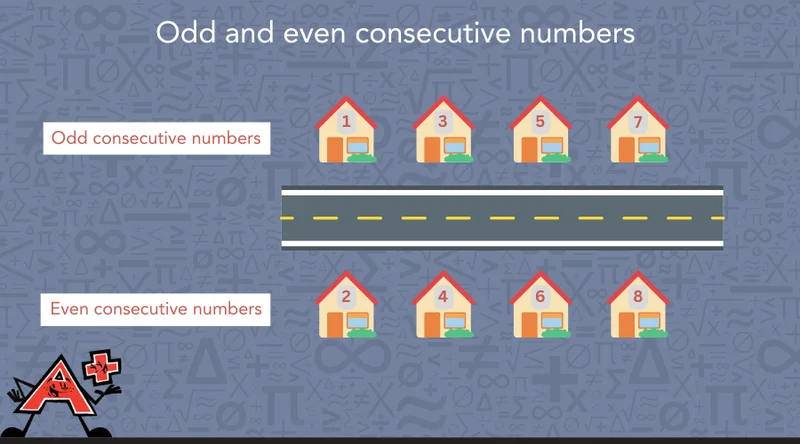
Imagine a street where the house numbers on one side are all even, 2, 4, 6, 8, while the house numbers on the other side are all odd, 1, 3, 5, 7. Each side moves forward by 2 instead of 1, but the numbers still follow a clear, steady order.
-
Consecutive even numbers might look like 10, 12, 14.
-
Consecutive odd numbers might look like 11, 13, 15.
Each set follows the same "next number in line" idea, just 2 apart instead of 1, the same way each side of the street moves forward on its own.
📕 You May Also Like: What Makes a Number Odd or Even? A Simple Guide
3 Shortcuts for Working With Consecutive Numbers
Now that we can spot consecutive numbers, we can use that fact to work with them faster.
Once you know a group of numbers is consecutive, you don't have to count or add them one at a time. Here's what makes that possible:
-
a steady gap from one number to the next
-
a shortcut for adding odd groups
-
a shortcut for adding even groups
A. The Constant Difference
The difference between any two consecutive numbers is always 1, or always 2 if we're working with consecutive evens or odds, no matter which numbers we pick. This pattern is formally called “the constant difference” or “the common difference.”
Because we know that consecutive numbers follow the constant difference pattern, we can find missing numbers or distances without counting from scratch.
-
Think about lockers in a hallway, numbered one after another. If you're standing at locker 47 and your friend is at locker 52, you can figure out how many lockers are between you without counting each one. Since the lockers are consecutive, that means there are 4 lockers between you: 48, 49, 50, and 51.
-
The same idea helps with pages in a book. When a chapter ends on page 112 and we are currently on page 98, the page numbers increase by 1 each time we turn a page. So we can count the pages after 98: 99, 100, 101, and so on, up to 112. That gives us 14 pages left in the chapter.
The constant difference helps you find distances without counting one by one. The next two shortcuts go a step further: they help you add up whole groups of consecutive numbers instantly.
B. The Middle Term Shortcut
We can use the middle term shortcut whenever we need to add an odd number of consecutive numbers quickly. It helps with mental math and quick totals, like adding up your scores from three games in a bowling night, without reaching for a calculator.
When we add up a group of consecutive numbers, and the group has an odd count of terms in it (3, 5, 7 numbers, and so on), we can find the total by multiplying the middle number by the number of terms in the group.
Here, the middle number is the one number that sits exactly in the center of the list, with the same number of terms on either side of it. In 21, 22, 23, 24, 25, for example, 23 is the middle number. Two numbers come before it, and two come after it.
How does it work?
Say we add up three consecutive numbers: 14, 15, and 16.
14 is one below the middle number, and 16 is one above it. Those two differences cancel each other out, so we're left with three copies of the middle number: 14 + 15 + 16 is the same as 15 + 15 + 15, or 3 × 15, which is 45.
Let's check if the pattern holds for five consecutive numbers. We'll try 20, 21, 22, 23, 24:
-
The middle number is 22.
-
20 is two below the middle, 24 is two above it → those cancel
-
21 is one below the middle, 23 is one above it → those cancel
-
What's left is five copies of the middle: 5 × 22 = 110
Check: 20 + 21 + 22 + 23 + 24 = 110. ✓ It holds.
This works for any group with an odd count of consecutive numbers. The numbers on either side of the middle come in balanced pairs, so each pair has the same average as the middle number. That is why we can multiply the middle number by the number of terms.
C. The Halfway Point Shortcut
The halfway point shortcut comes in handy anytime we need to add an even number of consecutive numbers quickly. It helps with mental math, estimates, and quick checks to see whether a longer answer looks reasonable.
It also connects to finding the average of two numbers, a skill we use often, from averaging two test scores or figuring out the midpoint between two prices.
When a group of consecutive numbers has an even number of terms (2, 4, or 6 numbers), there is no single middle number. We can use the two middle numbers to find the total:
-
We calculate the halfway point that sits between the two middle numbers. To do that, we add them up and divide by 2. That gives us the average of the two middle numbers.
-
Then, we multiply that average by the number of terms in the group.
Let’s look at the example to understand the idea behind this pattern. Say we add up these four consecutive numbers: 9, 10, 11, 12.
There's no single number in the middle this time. Instead, 10 and 11 sit on either side of the halfway point. To find the halfway point between them, we add them up and divide by 2: (10 + 11) ÷ 2 = 10.5.
Now that we know the halfway point is 10.5, we can pair up the numbers around it:
-
9 and 12 are each 1.5 away from it, on opposite sides, so they cancel.
-
10 and 11 are each 0.5 away from it, also on opposite sides, so they cancel too.
-
That leaves four copies of the halfway point: 4 × 10.5 = 42.
That’s why we can find the total by multiplying the halfway point by the number of terms in the group. Here's how that works out in two steps:
Step 1: Find the average of the two middle numbers
We find the halfway point, or the average: (10 + 11) 2 = 10.5
Step 2: Multiply the average by the number of terms in the group
To find the total, we multiply the average by the number of terms: 10.5 × 4 = 42.
Check: 9 + 10 + 11 + 12 = 42. ✓ We found the total correctly.
|
Pattern
|
How it works
|
Example
|
|
The constance difference
|
Consecutive numbers are always exactly 1 apart (or 2, for evens/odds)
|
Parking spaces 22, 23, and 24 each sit exactly one spot from the next
|
|
The middle term shortcut
|
A short run of consecutive numbers adds up close to the middle number times how many numbers we're adding.
|
9 + 10 + 11 = 30, which is 3 × 10 (the middle number)
|
|
The halfway point shortcut
|
For an even count of consecutive numbers, the sum equals the average of the two middle numbers times the number of terms in the group.
|
9 + 10 + 11 + 12 = 42, which is 4 × 10.5 (the halfway point)
|
📕 You May Also Like: Help Your Child Build Math Confidence Through Patterns

Mathnasium tutors help students understand any K-12 math topic through clear examples and step-by-step instruction.
How Mathnasium Helps Students With Consecutive Numbers (and Any Other Math Topic)
A math-only learning center, Mathnasium helps K–12 students of all skill levels excel in math, but developing a deep understanding of foundational concepts like consecutive numbers and gradually expanding their mathematical thinking.
We use a proprietary teaching approach, the Mathnasium Method™, to transform how students think and feel about math. Our approach begins with a diagnostic assessment that helps us understand what they know, how they think, and where they are ready to grow next.
From there, we create a personalized learning plan focused on the skills the student needs most, including number sense, pattern recognition, arithmetic fluency, and problem-solving confidence.
Our specially trained tutors explain math in clear, everyday language, using visual, verbal, tactile, and written techniques to help students make sense of concepts like consecutive numbers.
We give students space to work through challenges on their own, then rejoin them to check their reasoning. Instead of simply giving them the next step, we help them understand the how and why. This helps students develop problem-solving skills and critical thinking tools they can use across math topics.
Many of our activities are hands-on or game-based. We use reward systems and consistent encouragement to keep students engaged as they build confidence with patterns, numbers, and problem-solving. And we celebrate progress because confidence grows with every win.
The results? True, measurable progress:
-
94% of parents report improvement in their child’s math skills and understanding
-
93% of parents report a more positive attitude toward math after attending Mathnasium
-
90% of students saw improvement in their school grades
Mathnasium has more than 1,100 learning centers nationwide, making our proven approach accessible in communities across the country.
For families in and near Dacula, GA, Mathnasium of Dacula provides personalized math instruction designed to help students build number sense, strengthen pattern recognition, and develop the confidence they need for the math ahead.
If your child finds it hard to recognize number patterns like consecutive numbers or feels unsure about another math concept, a free diagnostic assessment is a great place to start. Using the insights, we’ll carve out a personalized learning plan that helps your child master the skills they need next.
📅 Schedule a Free Assessment at Mathnasium of Dacula
Not near Dacula?
📍 Find a Mathnasium Learning Center Near You


 (770) 273-9697