Decimals are everywhere, from prices at the store to measurements on a ruler or data in a science project. For example, if a toy costs $19.99 or a pencil is 7.5 inches long, you're already working with decimals.
In the beginning, most decimals students encounter are simple and easy to work with. They end after one or two digits. For example, 0.25 and 3.5 both come to a clear stop.
As students continue exploring math, they start to see that not all decimals behave the same way. Some decimals end neatly, while others keep going without stopping. For instance, 1 ÷ 3 = 0.333… goes on forever with no clear end.
So what makes certain decimals stop while others continue? That’s what we’re here to explore.
Today, we’ll take a closer look at one important type of decimal: the terminating decimal.
You'll find simple definitions, step-by-step explanations, helpful examples, a quick quiz to test your understanding, and answers to the most common questions students ask about terminating decimals.

Let’s Review: What Are Decimals?
Before we discuss terminating decimals, let’s take a step back and ask: What is a decimal, anyway?
At Mathnasium, we define a decimal as a number written in base 10. That means it is numbered or ordered in groups of ten.
A decimal has two parts: a whole number part and a fractional part, which are separated by a decimal point.
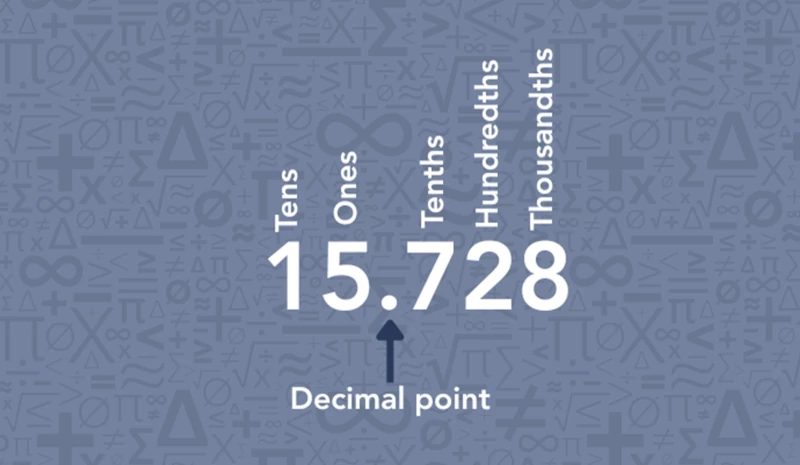
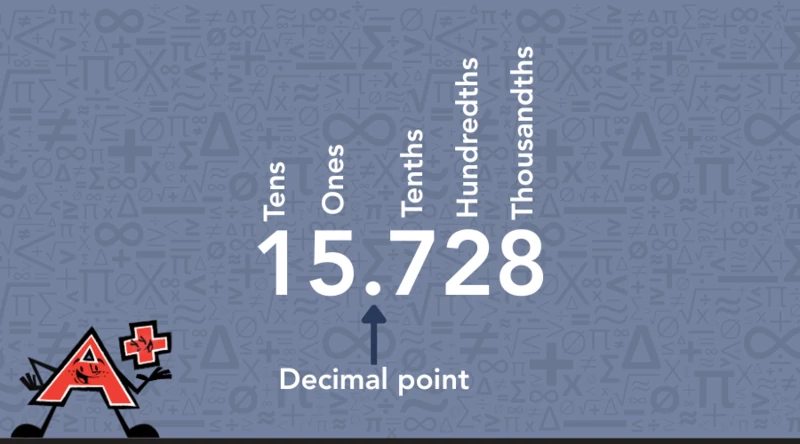
Take the number 15.728.
• The 15 is the whole number part. It tells us we have fifteen wholes.
• The .728 is the fractional part. It tells us we have 7 tenths, 2 hundredths, and 8 thousandths of another whole.
Each digit in a decimal has a place value based on powers of ten. The values increase as we move left and decrease as we move right from the decimal point.
Let’s break down the number 15.728 and see what each digit means:
• The 1 is in the tens place, so it stands for 10.
• The 5 is in the ones place, so it’s worth 5.
• The 7 comes right after the decimal. It’s in the tenths place, meaning seven-tenths or 0.7.
• The 2 is in the hundredths place, so it’s two-hundredths, or 0.02.
• The 8 is in the thousandths place, which means eight-thousandths, or 0.008.
What Is a Terminating Decimal?
A terminating decimal is a decimal that ends. It has a finite number of digits after the decimal point, with no repeating pattern and no digits that continue forever.
In the decimal 4.7:
• The 4 is the whole number part
• The 7 is in the tenths place
This number ends right there, with just one digit after the decimal point. That’s a terminating decimal.
Let’s take a closer look at more examples.
• 0.5
• 3.25
• 7.125
• 12.0
What do you notice?
Each of these decimals has a fixed number of digits after the decimal point. There are no endless sequences and no digits that repeat. These are all examples of terminating decimals.
Properties of Terminating Decimals
So, how can we be sure we’re looking at a terminating decimal?
Let’s explore some of the key characteristics that set them apart.
• They can always be written as fractions, also called rational numbers.
• Their decimal form contains a finite number of digits after the decimal point.
• They can include trailing zeroes at the end. For example, 4.500 is still a terminating decimal.
• You will often see them in everyday life, especially with money, measurements, and percentages. For example, $1.75, 2.4 inches, or 25.0 percent are all terminating decimals
📕 You May Also Like: Measurement Conversions: A Kid-Friendly Guide
What Is Not a Terminating Decimal?
Not all decimals come to an end. Some go on forever. These are called non-terminating decimals.
A non-terminating decimal is a decimal that does not have a final digit. The digits after the decimal point continue without stopping.
There are two types of non-terminating decimals:
1. Repeating, Non-Terminating Decimals
These decimals go on forever, but follow a pattern. One or more digits repeat over and over.
Even though they don’t end, repeating decimals are predictable, and they can always be written as fractions (rational numbers).
To show that a decimal repeats, we place a bar over the digits that repeat. For example, 0.333... becomes \(0.\overline{3}\) and 0.636363... becomes \(0.\overline{63}\).
Repeating decimals can be pure or partial, depending on how the repeating digits appear.
a) Pure Repeating Decimals
In a pure repeating decimal, all digits after the decimal point repeat.
For example:
• \(\Large\frac{1}{3}\) = 0.3333... The digit 3 repeats forever, so we write \(0.\overline{3}\).
• \(\Large\frac{4}{11}\) = 0.363636... The pattern 36 repeats forever, so we write \(0.\overline{36}\).
• \(\Large\frac{1}{7}\) = 0.142857142857... The pattern 142857 repeats forever, so we write \(0.\overline{142857}\).
b) Partially Repeating Decimals
In a partially repeating decimal, some digits do not repeat, but then a repeating pattern begins.
For example:
• \(\Large\frac{1}{12}\) = 0.08333... The digit 3 repeats forever, so we write \(0.08\overline{3}\).
•\(\Large\frac{7}{30}\) = 0.2333... The digit 3 repeats forever, so we write \(0.2\overline{3}\).
2. Non-Repeating, Non-Terminating Decimals
These decimals go on forever without any repeating pattern. There is no final digit and no digits that repeat.
For example:
• π (pi) = 3.14159265…
• √2 = 1.4142135…
These decimals are not predictable and cannot be written as fractions. They are called irrational numbers.
📕 You May Also Like: 7 Amazing Facts About PI Every Math Student Should Know
How Do We Know If a Decimal Will Terminate?
If you're looking at a decimal like 0.5 or 0.333…, it's easy to tell whether it terminates. One ends, the other doesn't. But what if you're starting with a fraction, like \(\Large\frac{3}{4}\) or \(\Large\frac{1}{6}\)?
How do you know whether the decimal form will stop or go on forever?
Let’s explore three methods students can use to find out.
Try dividing the numerator by the denominator. If the decimal ends, it’s terminating. If the digits repeat or continue, it’s not.
Let’s try with \(\Large\frac{1}{4}\).
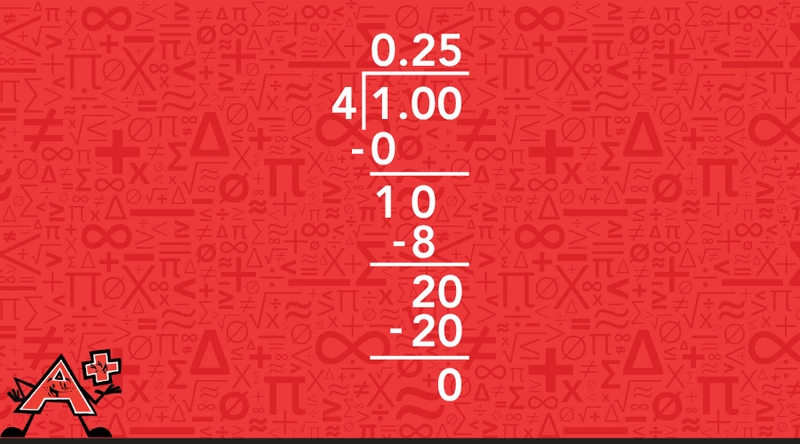
There’s no remainder, and the digits stop at 0.25, so we know the decimal terminates.
Now, let’s do the same for \(\Large\frac{1}{3}\).
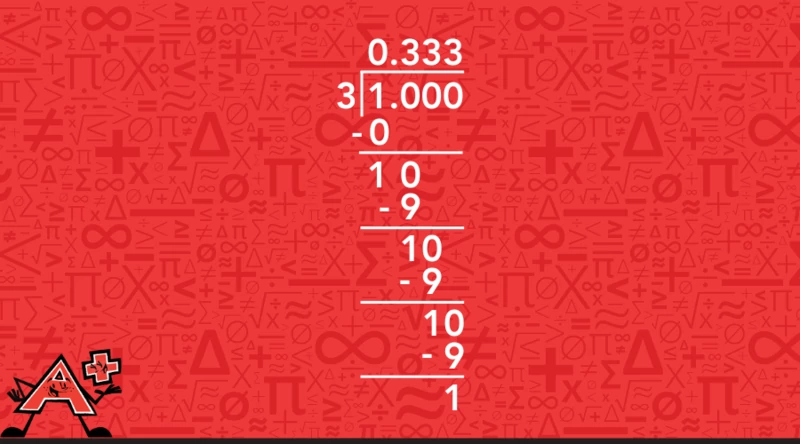
We can see that the division never ends. Each step leaves a remainder of 1, and the digit 3 keeps repeating, giving us 0.333…
We write that as:
\(\Large\frac{1}{3}\) = \(0.\overline{3}\)
So, \(\Large\frac{1}{3}\) results in a repeating, non-terminating decimal.
Method 2: Check the Denominator
Another way to tell if a fraction will result in a terminating decimal is to look at the denominator (the number on the bottom of the fraction).
If the denominator divides evenly into a power of 10, like 10, 100, or 1000, then the decimal will terminate.
To confirm this, let’s look at a few examples:
Example 1: For \(\Large\frac{1}{5}\), 5 is the denominator.
We ask ourselves, does 5 go into 10 evenly?
Yes, because 10 ÷ 5 = 2.
1 ÷ 5 = 0.2 → This is a terminating decimal.
Example 2: For \(\Large\frac{3}{20}\), 20 is the denominator.
Does 20 go into 100 evenly?
Yes, because 100 ÷ 20 = 5.
3 ÷ 20 = 0.15 → Another terminating decimal.
Example 3: For \(\Large\frac{1}{6}\), 6 is the denominator.
Does 6 go evenly into 10, 100, or 1000?
No, it leaves a remainder.
1 ÷ 6 = 0.1666… or \(0.1\overline{6}\) → This is a non-terminating, repeating decimal.
Method 3: Use Prime Factorization (Grade 6 and up)
This method is based on a mathematical theorem about terminating decimals.
A fraction will have a terminating decimal only if, after simplifying it, the denominator is made up of only the prime factors 2 and/or 5.
That means:
• If you factor the denominator and find only 2s or 5s (or both), the decimal will terminate.
• If you find any other prime number (like 3, 7, or 11), the decimal will not terminate.
Let’s test how this works and see if \(\Large\frac{6}{30}\) is a terminating decimal.
First, we simplify the fraction.
What’s the greatest common factor (GCF) of 6 and 30? That would be 6!
So we divide both the top and bottom by 6:
\(\Large\frac{6}{30}\) ÷ \(\Large\frac{6}{6}\) = \(\Large\frac{1}{5}\)
Now that we have \(\Large\frac{1}{5}\), we check the denominator. 5 is a prime number, and it’s one of the “special two” we’re allowed: just 2s and 5s. That means this decimal will terminate.
Want proof?
Let’s divide it out:
6 ÷ 30 = 0.2
This confirms our theorem.
Let’s try another one: will \(\Large\frac{4}{27}\) terminate?
First, take a look at the fraction. Can we simplify it?
Well, 4 and 27 don’t share any common factors (besides 1), so this one’s already in its simplest form.
Now let’s look at the denominator: 27. If we factor it, we get:
27 = 3 × 3 × 3
Hmm, only 3s? That’s a red flag. Remember our rule: only the prime numbers 2 and 5 are allowed in the denominator if we want the decimal to end.
Since 3 isn’t on that list, this decimal won’t terminate. Let’s check with division:
4 ÷ 27 = 0.148148… or \(0.\overline{148}\), and the digits repeat.
It just keeps going, and the digits 148 repeat over and over. So, \(\Large\frac{4}{27}\) gives us \(0.\overline{148}\), which is a non-terminating, repeating decimal.
Flash Quiz: Test Your Understanding of Terminating Decimals
Practice makes perfect! Try our flash quiz to test how well you understood the terminating decimals.
Good luck!
1. A terminating decimal is a decimal that…
A. repeats the same digits forever
B. has no digits after the decimal point
C. goes on without ending or following a pattern
D. ends after a certain number of digits with no repetition
2. Which decimal is an example of a terminating decimal?
A. 0.727272...
B. 0.9
C. 0.444...
D. 1.151515…
3. Which of the following is not a property of terminating decimals?
A. They can always be written as fractions
B. They contain a limited number of digits after the decimal point
C. They often appear in real-life situations like money and measurements
D. They always end in a non-zero digit
4. Which of the following fractions will result in a terminating decimal?
A. \(\Large\frac{7}{18}\)
B. \(\Large\frac{11}{30}\)
C. \(\Large\frac{5}{8}\)
D. \(\Large\frac{9}{14}\)
5. Which of the following correctly names the two types of non-terminating decimals?
A. Repeating and non-repeating
B. Rational and irrational
C. Decimal and fractional
D. Finite and infinite
FAQs About Terminating Decimals
When students learn about terminating decimals, a few questions almost always come up. Here are some of the most common ones we hear at Mathnasium, along with clear answers to help build confidence and understanding.
1. When do students learn about terminating decimals?
Students are usually introduced to decimals in upper elementary grades, often around Grade 4 or Grade 5. At first, they learn how to read, write, and compare decimals, including recognizing when a decimal ends.
In middle school and beyond, students explore decimals more deeply, understanding their connection to fractions and when decimals terminate or repeat.
2. If a decimal ends in zeros, is it always terminating?
Yes! Trailing zeros (like in 4.500) don’t make a decimal infinite. A decimal still ends even if it has one or more zeros at the end. So 4.5, 4.50, and 4.500 are all examples of terminating decimals.
3. Can two different fractions have the exact same terminating decimal?
Yes! Fractions that are equivalent can have the same decimal form. For example:
\(\Large\frac{1}{2}\) = 0.5 and \(\Large\frac{2}{4}\) = 0.5
Even though the fractions look different, they simplify to the same value, so they have the same terminating decimal.
4. Is every decimal a terminating or repeating decimal?
No. Some decimals are non-terminating and non-repeating, like π or √2. These decimals go on forever without any pattern. They are called irrational numbers and cannot be written as fractions.

At Mathnasium, we encourage students to ask questions, think critically, and explore math concepts in a supportive group environment.
Master Decimals with Top-Rated Math Tutors at Mathnasium
Mathnasium is a math-only learning center dedicated to helping K–12 students of all skill levels truly understand and enjoy math.
Rather than relying on a fixed curriculum, we use the Mathnasium Method™, a proprietary teaching approach that combines personalized learning plans with proven teaching techniques.
Our specially trained tutors teach for understanding and use a combination of direct teaching and Socratic questioning to help students master any math class and topic, including terminating decimals, typically covered in Grade 4 or Grade 5.
We help students see the connection between fractions and decimals. By exploring place value, patterns, and division, they discover not just that some decimals terminate, but why. This builds lasting number sense and confidence.
Whether your student is looking to catch up, keep up, or get ahead in math, find a Mathnasium Learning Center near you and schedule a free diagnostic assessment today!

Check Your Answers!
1. D
2. B
3. D
4. C
5. A


 (720) 524-4763
 (720) 524-4763