By Chloe, Instructor
No matter how good your teachers are, online schooling will be challenging for children. If you’re like most parents, you’re looking for ways to get a little extra help in, or for ways to make sure the learning sticks. Whether you’re homeschooling, enlisting a private math tutor, or enrolling in an outside learning center, there are always a few extra things you can try to get a little more math practice in.
Here are five ways to utilize math skills that don’t feel like homework.
-
Play games—and let the kids keep score! 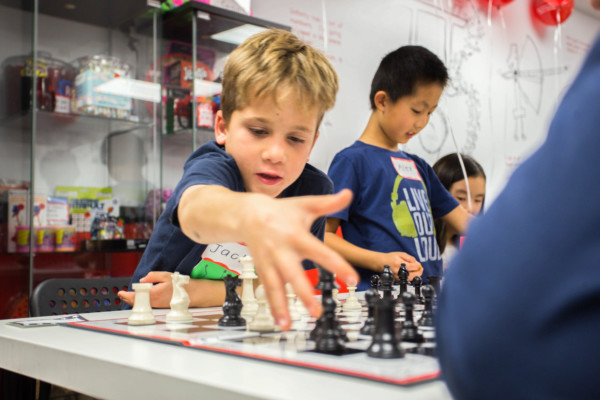
Most board or card games involve numbers, and usually, at least require adding or subtracting. Card games like Euchre, Cribbage, or Blackjack can be fun distractions while also frequently utilizing basic math skills like addition or subtraction. If regular 52-card decks aren’t your thing, games like Life, Dominos, or Monopoly can be a great way to practice math skills. If your child is too young to be the banker, you can always test their knowledge with questions like, “How much change should I give you back?” in-between turns.
-
Create math challenges in everyday life .JPG)
Math is everywhere. Whether we’re filling the car with gas, calculating how long before something happens, or adding a tip to the Doordasher who brought our food, we’re surrounded by math problems. When it’s appropriate, you can ask your kids to help you solve a “problem” you’re having. “If gas is about $3 / gallon, and the car needs 10 more gallons, how much will it cost to fill the tank?” is a simple multiplication problem that might not feel like a math problem at all. “Your appointment starts at 4:30. If it’s 2:15 now, how long will it be before your appointment?” is another simple question that keeps your child engaged in using math to help them navigate life.
-
Promote Athleticism 
“Wait!” you might be thinking, “I thought this article was about math!” It is! Math is all around us—even in our sports! Basketball counts up in increments of 2, and football scores increase by 6 or 7. Playing in your backyard or at a local park can bring math concepts to the forefront without it feeling like math is happening. You can also create intentional math challenges, like measuring out a specific distance, timing how fast your kids can run that distance, and then asking how fast they were moving. Most kids will want to beat their own speed, which means they’ll keep going over and over until they’ve improved their performance, giving them exercise and math practice at the same time.
-
Create works of art 
Drawing and painting may not seem like they use much math inherently, but geometry is just as much a part of math as adding and subtracting. How many sides does an octagon have? What’s the difference between a right triangle and an equilateral one? Challenging your kids to use specific shapes or use a certain number of objects in their painting can spark creativity & critical thinking, and make the process of creating even more fun! For another layer, you can do some art on your own and ask questions about the pieces together. “There are three birds in your picture, and five in mine… how many birds are there altogether?”
-
Come up with your own math teaching tool 
No matter how many ideas I come up with, you probably have an idea or two of your own that I never would have considered! We’re all learning from each other, and one of the best ways to learn is to talk to each other about what’s working (and what isn’t!). Every child is unique, and these learning tools may not work for everyone. If you have a tried and true method of teaching, or if you come up with something that works really well, share it online! You can post it in the Mathnasium Facebook group or on a parent page. If we all share our lessons and experiences together, surviving this year will be a whole lot easier.
Good luck! Hopefully, this article was helpful in making math learning more accessible for you and your kids.
Schedule a FREE math skills assessment for your child!


 (323) 474-6136
 (323) 601-0909










.JPG)


