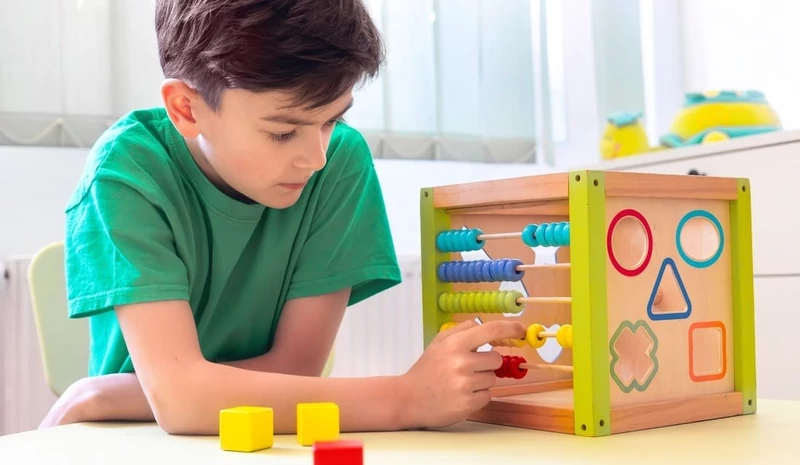
Long before children solve equations or memorize multiplication tables, they begin building an understanding of numbers through activities like sorting toys or even noticing how many fingers are held up.
In those early years, some children start to recognize how many objects are in front of them almost instantly, while others still rely on counting one by one.
This difference may seem small, but it reflects an early skill called subitizing.
Today, we’ll explore what subitizing is, how it supports early math development, how to practice at home, and how Mathnasium can be a partner in building solid math foundations for your child.

What Is Subitizing?
Subitizing is the ability to recognize small quantities instantly, without counting one by one.
For instance, when a child sees three dots on a die and knows it’s “three” without thinking, that’s subitizing.
The term comes from the Latin word subitus, meaning “sudden,” and was first introduced into mathematical psychology by E.L. Kaufman and colleagues in the 1940s.
There are two types of subitizing, and both play a role in early number sense:
-
Perceptual subitizing is the immediate recognition of small quantities, typically up to four or five, when they’re spaced clearly. That earlier example, recognizing three dots on a die without counting, is a perfect illustration.
-
Conceptual subitizing means seeing a whole number as groups. A child might glance at eight blocks and say, “four and four,” instead of counting each one.
Most children begin to master perceptual subitizing between ages 3 and 4. As they enter the early school years, many begin to show conceptual subitizing as their grouping and working memory skills develop.
At our learning centers, we often see this shift in real time, especially as students begin to recognize patterns, combine quantities flexibly, and move away from one-by-one counting.
Unlike counting, subitizing is visual and immediate. It helps children build a natural sense of how numbers relate to each other, often before they fully grasp written numerals or formal math rules.

Subitizing helps children see numbers instantly, not by counting, but by recognizing quantities and groups at a glance.
How Subitizing Shapes Math Learning
While subitizing starts as the quick recognition of small numbers, studies and practical work consistently show it also supports both foundational and deeper math skills children develop as they step into formal learning.
1. Number Sense: The Foundation
Number sense is a child’s intuitive feel for numbers or their understanding of what a quantity means, how amounts compare, and how numbers can be broken into parts and put back together.
A classroom-based study showed that when teachers used subitizing activities, children improved in key early number sense skills such as recognizing quantities at a glance, linking number words to exact amounts, noticing part–whole relationships, and spotting number patterns.
For example, a child who sees a pile of eight toy cars and quickly groups them as “four and four” could eventually grasp that the whole can be split evenly into two equal parts.
2. Arithmetic and Mental Math Skills
Once children build a sense of numbers as quantities and parts, they begin to use that understanding for actual calculations.
Research has shown that subitizing supports this shift. A developmental study found that children who performed well in subitizing tasks later showed stronger calculation fluency, number processing, and arithmetic skills.
Here’s a simple case: a child looking at a set of dots arranged as four rows of three and immediately seeing “four groups of three” could eventually use that recognition to solve 4 × 3.
3. Broader Cognitive Math Skills
Subitizing also reaches into broader math abilities that go beyond number sense and simple calculations.
A curriculum-focused analysis found that conceptual subitizing supports children’s ability to recognize patterns and organize numbers spatially, which are key for advanced math.
Furthermore, a developmental review showed that subitizing nurtures flexible reasoning, a skill closely tied to mathematical problem solving.
For example, consider this: a child who can look at 12 objects and see them not only as “three groups of four” but also as “10 and 2” is beginning to reason in the same way algebra requires. Later, that same flexible view of numbers allows them to understand why 3 × (4 + 2) gives the same result as (3 × 4) + (3 × 2).
What began as quick recognition in early subitizing tasks grows into problem solving and algebraic thinking.
Practical Activities to Strengthen Subitizing at Home
Our tutors find that subitizing develops most effectively when children practice it often in short, playful ways. Parents don’t need special tools or long lessons. A few minutes each day with familiar objects can make a real difference.
The activities below are ones we frequently recommend. They’re simple to set up, easy to run, and designed to strengthen both perceptual and conceptual subitizing through hands-on practice.
1. Dot Card Flash
Dot cards are one of the most effective ways to practice subitizing.
Take index cards and draw dots in different arrangements, starting with one to five. Place the dots in familiar layouts, such as two and two for four, but also vary the patterns so your child learns to see totals in more than one way.
Show a card quickly, for no more than two seconds, and ask, “How many?” The goal is for them to recognize the number without counting. If they hesitate, prompt with, “What groups do you see?” A short session with 10 to 15 flashes is enough.
📕 You May Also Like: How to Use Math Manipulatives Effectively at Home
2. Toy Grouping
Every household has toys scattered around, and they can be a perfect tool for subitizing.
Place a few on the floor, three cars, four blocks, or five stuffed animals, and ask your child how many they see without counting. At first, they may point and count, but with practice they will begin to see the total at once.
As they grow more confident, try grouping. Place six blocks as two groups of three, or eight as four and four. Then ask, “How did you see that number?” If they answer, “I saw three and three,” or “two groups of four,” they are moving into conceptual subitizing.
This routine shows children that numbers can be broken apart and put back together, a step toward addition and multiplication.

3. Snack Time Subitizing
Snack time can double as math practice. Before handing your child their snack, place a few pieces on a plate in a clear arrangement. You might set down six grapes as two rows of three or four crackers as two and two. Ask, “How many do you see?” and pause for their quick response.
If your child answers “six” right away, they are using perceptual subitizing. If they say, “I saw three and three,” they are practicing conceptual subitizing. Either way, the simple act of arranging food this way turns an everyday routine into a chance to strengthen number sense.
📕 You May Also Like: 7 Fun Preschool Math Activities to Try at Home
4. Dice Games
Dice are a classic tool because their dot patterns are easy to recognize. Start with one die and ask your child to name the number without counting. Once they succeed regularly, move to two dice and ask for the total. Encourage them to explain how they saw it: “I saw four and five, so nine.”
Turning this into a family game keeps it fun while reinforcing skills. With two dice, children also begin to combine groups visually, a step toward mental addition and multiplication.

Dice help children practice seeing numbers at a glance and combining them without counting.
Building Lasting Math Foundations with Mathnasium
Math foundations begin early, often in the preschool and elementary years, when children first connect numbers to real-world quantities. Parents can encourage these skills through simple routines and activities.
Once formal schooling starts, many families look for structured support to turn early number sense into lasting success. Mathnasium is here to provide that guidance.
Mathnasium is a math-only learning center where K–12 students unlock their full potential. At the core is the Mathnasium Method™, a teaching approach built on personalized learning plans and interactive instruction.
Each child’s journey starts with a diagnostic assessment that identifies strengths and areas for growth. Our team uses these insights to design a plan tailored to how the student learns best.
Our specially trained tutors then follow that plan while adjusting in real time as the child progresses. Whether a student learns visually, verbally, or through hands-on practice, instruction adapts to meet their needs. The learning environment is structured to be engaging and fun, often with games and rewards that keep students motivated while pushing them forward.
Working with Mathnasium helps students build strong foundations, close knowledge gaps, and change how they approach math. Students who once felt frustrated discover that math can become a subject they enjoy and succeed in.
Mathnasium operates more than 1,000 learning centers across the U.S., giving families access to top-rated instructors and a proven method. For families in and around Frisco, TX, Mathnasium of Frisco East has years of experience supporting local students and building lasting confidence in math.
Take the first step today. Schedule a free diagnostic assessment at Mathnasium of Frisco East and see how your child’s skills and confidence can grow through personalized sessions.
📅 Schedule a Free Diagnostic Assessment at Mathnasium of Frisco East
Not near Frisco?
📍 Find a Mathnasium Learning Center Near You


 (972) 292-9886
 (972) 292-9886