Have you ever looked at the clock and said, “It’s about 3 o’clock,” even though it was really 2:57? Or maybe you told a friend you’d be there in “about 10 minutes” when it was actually 8 or 12. Both are examples of rounding in action!
Even though we use it all the time, especially when estimating time, distances, or prices, rounding is a math skill with rules of its own.
To help you feel confident rounding any number, we’ll explain what it means, walk through examples with whole numbers and decimals, give you a chance to practice, and answer common questions students ask about rounding at Mathnasium.

So, What Does Rounding Numbers Mean?
Rounding (also called rounding-off) is a type of estimation where we express a number to the nearest specified place within a number system, usually base 10.
In simpler terms, rounding means changing a number to one that’s close by, but easier to use.
And why do we round numbers?
We usually round to make numbers simpler to work with in everyday situations, like estimating prices, distances, or time.
Instead of using the exact value, we find a nearby number that ends in zero or has fewer decimal places.
For example:
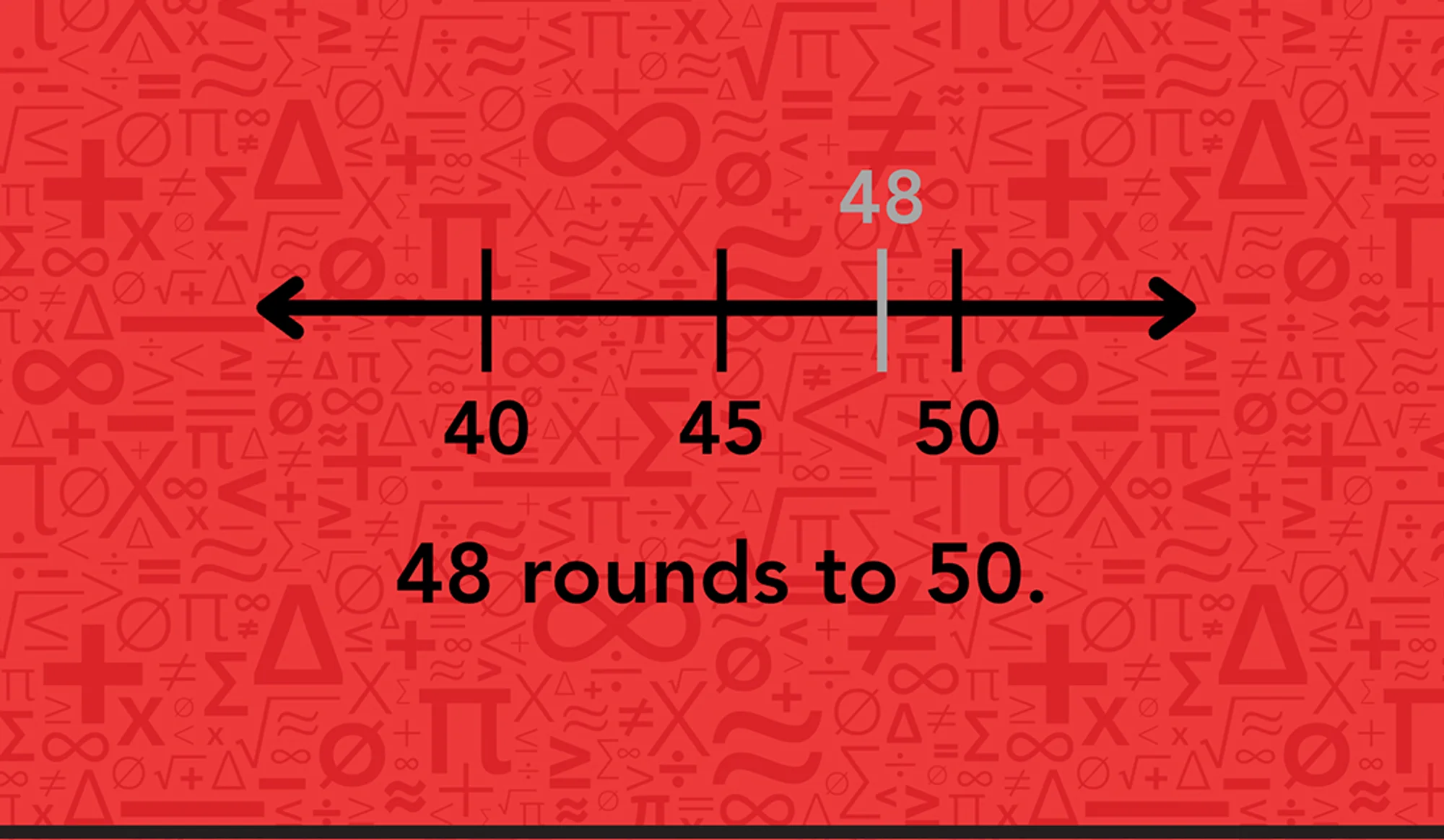
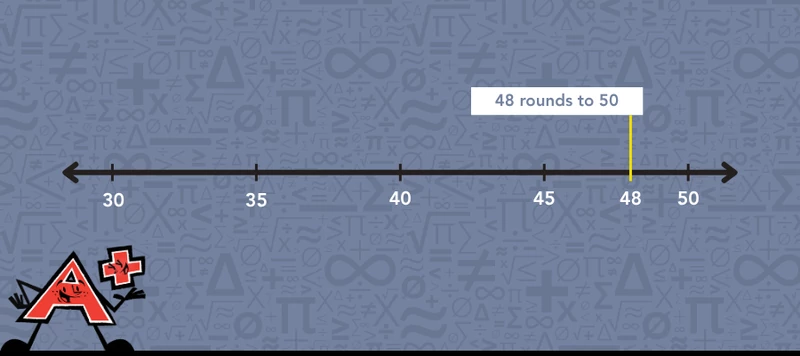
• 48 might get rounded to 50
• 123 miles might get rounded to 120 miles
• $8.92 might get rounded to $9
How Do We Round Whole Numbers?
When we round whole numbers, we can round to different places, like the nearest ten, hundred, or thousand, depending on how big the number is.
Each type of rounding follows the same basic idea, but the steps change slightly based on the place value you're rounding to.
Let’s walk through each one with clear steps and examples.
Rounding to the Nearest Ten
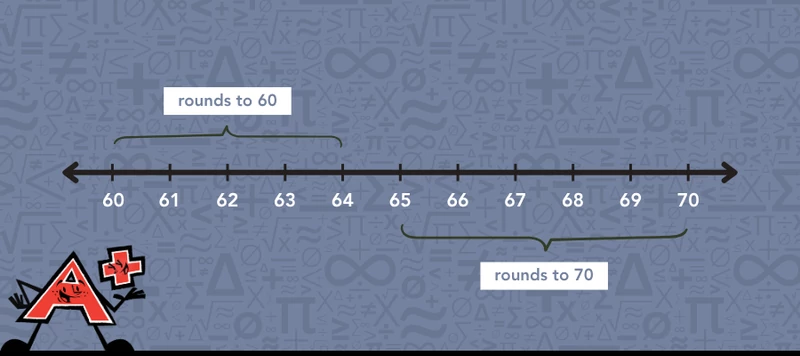
To round a number to the nearest ten, we look at the digit in the ones place (the number all the way to the right).
We ask ourselves:
Is the digit in the ones place closer to the ten before it or the ten after it?
• If the ones digit is 5 or more, the number is closer to the next ten, and we round up.
• If the ones digit is 4 or less, the number is closer to the lower ten, and we round down.
Let’s try it with the number 62.
The ones digit is 2, which is less than 5. That means 62 is closer to 60 than to 70.
So we round it down to 60.
Rounding to the Nearest Hundred
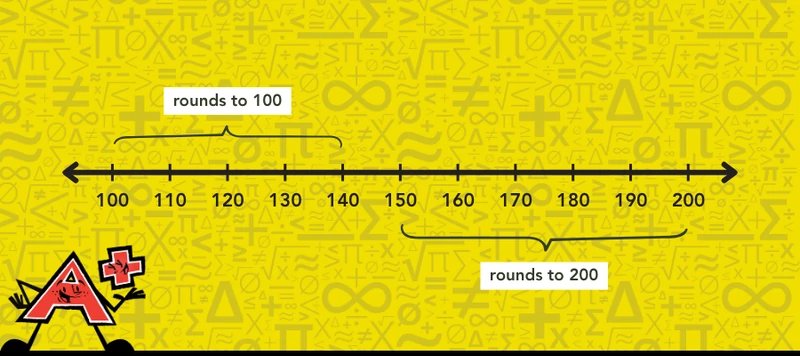
Rounding to the nearest hundred works just like rounding to the nearest ten, except now we focus on the value of the tens digit (second digit from the right).
Then we ask:
Is the digit in the tens place closer to the hundred before it or the hundred after it?
• If the number has a tens digit of 5 or more, then it's closer to the next hundred, and we round up.
• If the tens digit is 4 or less, then it's closer to the hundred before it, and we round down.
For example, let’s consider 174.
The tens digit is 7. That tells us 174 is closer to 200 than to 100.
So, we round 174 up to 200.
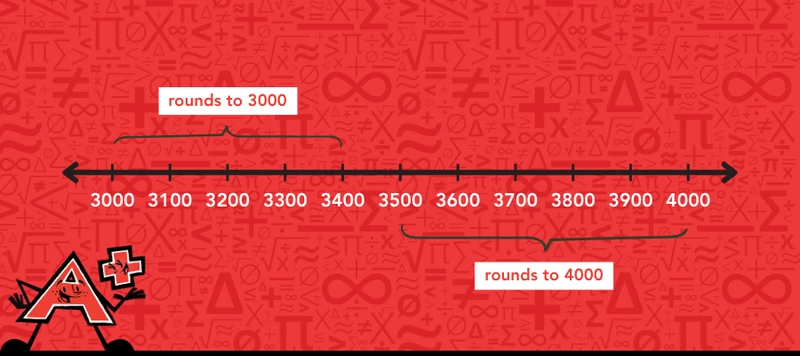
Rounding to the Nearest Thousand
Now we’re rounding to the nearest thousand, which means we look at the value of the hundreds digit (the third digit from the right).
Then we ask:
Is the digit in the hundreds place closer to the thousand before it or the thousand after it?
• If the hundreds digit is 5 or more, the number is closer to the next thousand, so we round up.
• If the hundreds digit is 4 or less, the number is closer to the thousand before it, so we round down.
Let’s take 3,642 as an example.
The hundreds digit is 6, which tells us that 3,642 is closer to 4,000 than to 3,000.
So we round it up to 4,000.
How Do We Round Decimals?
Rounding decimals follows the same thinking we used with whole numbers: we find the digit we're rounding to, look at the digit just after it, and decide whether to round up or down.
But instead of rounding to the nearest ten, hundred, or thousand, we now round to the nearest whole number, or to places after the decimal point like tenths, hundredths, or thousandths.
Let’s look at each case.
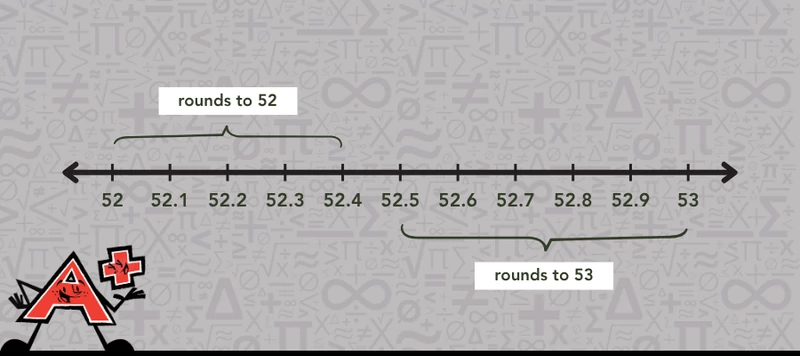
Rounding to the Nearest Whole Number
When we round a decimal to the nearest whole number, we are rounding to the ones place. We decide whether the number stays at the same whole number or goes up to the next one.
To do that, we look at the digit in the tenths place (the first digit after the decimal point).
Then we ask:
Is the digit in the tenths place closer to the whole number before it or the one after it?
• If the tenths digit is 5 or more, we round up to the next whole number.
• If it’s 4 or less, we round down and keep the whole number part the same.
Let’s take 52.364.
First, find the tenths digit. That’s the 3 right after the decimal.
Since 3 is less than 5, we round down to 52.
So, 52.364 rounded to the nearest whole number is 52.
Rounding to the Nearest Tenth
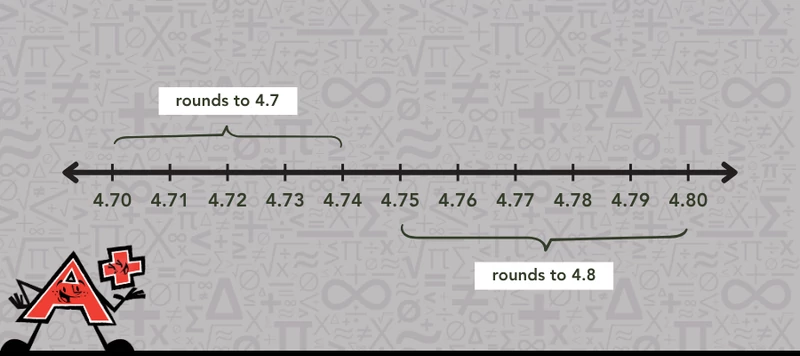
When we round to the nearest tenth, we’re deciding what the tenths digit should be (that’s the first digit after the decimal point).
To figure that out, we look at the digit in the hundredths place (the second digit after the decimal).
We ask:
Is the digit in the hundredths place closer to the tenth before it or the one after it?
• If the hundredths digit is 5 or more, we round up.
• If it’s 4 or less, we round down.
Let’s try that with 4.76.
The tenths digit is 7. The hundredths digit is 6. Since 6 is more than 5, we round up.
So 4.76 rounded to the nearest tenth is 4.8.
Rounding to the Nearest Hundredth
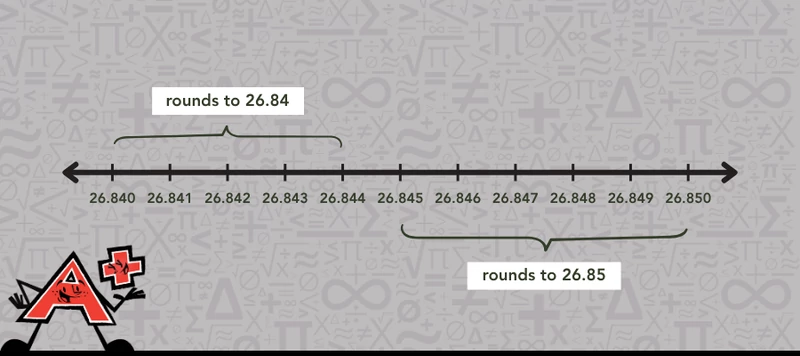
When we round to the nearest hundredth, we’re deciding what the hundredths digit (second digit after the decimal point) should be.
To figure that out, we look at the digit in the thousandths place (the third digit after the decimal).
Then we ask:
Is the digit in the thousandths place closer to the hundredth before it or the one after it?
• If the thousandths digit is 5 or more, we round up.
• If it’s 4 or less, we round down.
Let’s try that with 26.843.
The hundredths digit is 4. The thousandths digit is 3. Since 3 is less than 5, we round down.
So, 26.843 rounded to the nearest hundredth is 26.84.
Rounding to the Nearest Thousandth
When we round to the nearest thousandth, we’re deciding what the thousandths digit should be. That’s the third digit after the decimal point.
To figure that out, we look at the ten-thousandths digit, which is the fourth digit after the decimal.
Then we ask:
Is the digit in the ten-thousandths place closer to the thousandth before it or the one after it?
• If the ten-thousandths digit is 5 or more, we round up
• If it’s 4 or less, we round down
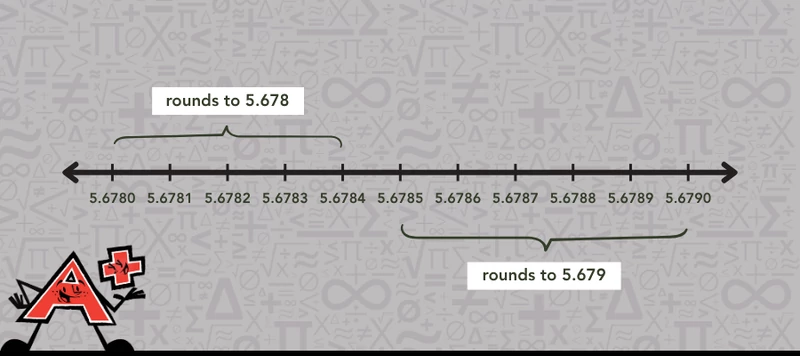
Let’s check with 5.6784:
The thousandths digit is 8. The ten-thousandths digit is 4. Since 4 is less than 5, we round down.
So, 5.6784 rounded to the nearest thousandth is 5.678.
Rounding with Regrouping
Sometimes, rounding up can change more than just one digit. This happens when the digit you're rounding is a 9.
If you round 198 to the nearest ten, you get 200. This is because 198 is closer to 200 than 190.
We regroup to change the hundreds place.
This is called rounding with regrouping.
What does this look like in action?
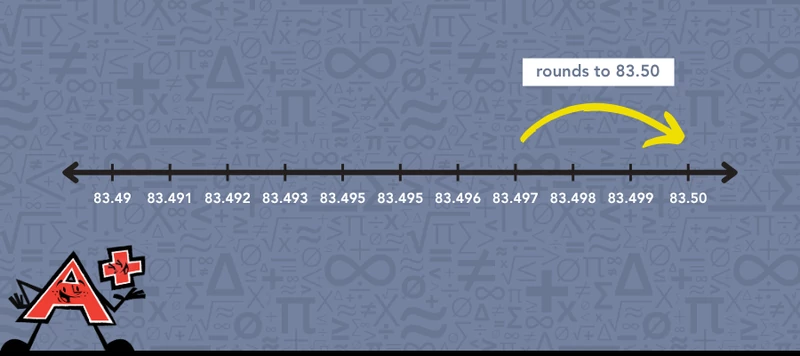
Say we want to round 83.497 to the nearest hundredth
The hundredths digit is 9. The thousandths digit is 7, so we round up.
83.497 is closer to 83.50 than 83.49.
So we:
• Put 0 in the hundredths place
• Carry 1 to the tenths place
The tenths digit was 4, and with the carry, it becomes 5.
So, 83.497 rounded to the nearest hundredth is 83.50.
Similarly, we could try rounding 56.98 to the nearest tenth.
The tenths digit is 9. The hundredths digit is 8, so we round up.
56.98 is closer to 57.0 than 59.9.
So we:
• Put 0 in the tenths place
• Carry 1 to the ones place
The ones digit was 6, and with the carry, it becomes 7.
So, 56.98 rounded to the nearest tenth is 57.0.
Practice Time: Can You Round These Numbers?
Rounding gets easier the more you use it.
These practice problems are here to help you build confidence and start using rounding without even thinking about it.
Once you’re finished, check your answers at the bottom of the guide.
Exercise 1: Round to the Nearest Ten
a) 63 ____
b) 95 ____
c) 34 ____
d) 71 ____
Exercise 2: Round to the Nearest Hundred
a) 366 ____
b) 451 ____
c) 631 ____
d) 255 ____
Exercise 3: Round to the Nearest Thousand
a) 4,682 ____
b) 1,560 ____
c) 3,121 ____
d) 5,234 ____
Exercise 4: Round the Decimals to the Nearest Whole Number
a) 35.56 ____
b) 5.984 ____
c) 12.329 ____
d) 49.65 ____
Exercise 5: Round the Decimals to the Nearest Tenth
a) 94.627 ____
b) 56.98 ____
c) 23.392 ____
d) 709.2165 ____
Exercise 6: Round the Decimals to the Nearest Hundredth
a) 60.199 ____
b) 3.8479 ____
c) 8.235 ____
d) 12.297 ____
Exercise 7: Round the Decimals to the Nearest Thousandth
a) 23.5669 ____
b) 45.3796 ____
c) 31.2899 ____
d) 62.1962 ____
FAQs About Rounding Numbers
Rounding numbers might bring up great questions and a few head-scratchers, too. At Mathnasium, we hear these all the time. So we’ve collected some of the most common ones and answered them here to help clear up any confusion.

At Mathnasium, we encourage students to ask questions because the more they ask, the more they understand.
1) When do students start learning to round numbers?
Most students begin learning to round in 2nd or 3rd grade, usually starting with rounding to the nearest ten or hundred. Later on, they round bigger numbers and decimals too. Rounding is part of estimation, and it shows up more as math gets more complex.
2) Why does 5 mean rounding up if it's in the middle?
When a number ends in 5, it’s exactly halfway between two other numbers, like 2.5 is right between 2 and 3.
To avoid confusion and keep things consistent, mathematicians agreed on a standard rule: when the digit after the place you're rounding to is 5 or higher (5, 6, 7, 8, or 9), you round up. When it's lower, specifically 0 through 4, you round down.
For example:
• 3.4 rounds down to 3.
• 3.5 rounds up to 4.
• 3.6 also rounds up to 4.
This method has been used in schools, science, and everyday math for more than a hundred years to make rounding fair and predictable.
3) Can you round negative numbers?
Yes, you can. Rounding negative numbers works the same way: you still look at the digit to the right of the place you're rounding.
For example:
• –47 rounded to the nearest ten is −50, because it's closer to −50 than to −40.
• −62 rounded to the nearest ten is −60, because it's closer to −60 than to −70.
4) Do we round before or after doing operations in word problems?
It depends on what the question is asking.
If it says “about how much” or “estimate,” you usually round before doing the operation. If it asks for the exact answer, do the operation first, then round the final result only if additional steps require it.
Master Rounding Numbers at Mathnasium
Mathnasium is a math-only learning center that helps K–12 students of all skill levels reach their full potential. At the core of how we teach is the Mathnasium Method™, our proprietary approach designed to help students truly understand and enjoy math.
It all starts with a diagnostic assessment, which helps us pinpoint what each student already knows, where they could use support, and how they learn best.
Using these insights, we create a personalized learning plan that targets their needs and moves at the right pace. We focus on filling in knowledge gaps while reinforcing what they already do well.
Our instructors use a thoughtful mix of Socratic questioning, direct instruction, and multi-modal teaching, including mental, visual, verbal, tactile, and written strategies, so concepts like rounding numbers actually make sense. We don’t teach students to memorize steps; we help them understand the why and how behind every idea.
Along the way, students get time to think, practice, and explore on their own because real progress happens when they start seeing themselves as capable problem-solvers. Our goal is to develop independent mathematical thinkers, not just students who can follow steps.
Our centers are designed to build confidence as much as skill. Our tutors are specially trained not just in math, but in how to connect with students, celebrate growth, and create a space where kids feel supported and motivated to keep going.
And the results?
• 94% of parents report improvement in their child’s math skills and understanding
• 93% say their child has a more positive attitude toward math
• 90% of students see better grades at school
If you’re looking to see your child thrive in math and build a real understanding of concepts like rounding numbers and beyond, schedule a free diagnostic assessment at your local Mathnasium center.

Pssst! Check Your Answers Here
If you’ve given our exercises a try, check your answers below.
Exercise 1: Round to the Nearest Ten
a) 63 rounds to 60
b) 95 rounds to 100
c) 34 rounds to 30
d) 71 rounds to 70
Exercise 2: Round to the Nearest Hundred
a) 366 rounds to 400
b) 451 rounds to 500
c) 631 rounds to 600
d) 255 rounds to 300
Exercise 3: Round to the Nearest Thousand
a) 4,682 rounds to 5,000
b) 1,560 rounds to 2,000
c) 3,121 rounds to 3,000
d) 5,234 rounds to 5,000
Exercise 4: Round the Decimals to the Nearest Whole Number
a) 35.56 rounds to 36
b) 5.984 rounds to 6
c) 12.329 rounds to 12
d) 49.65 rounds to 50
Exercise 5: Round the Decimals to the Nearest Tenth
a) 94.627 rounds to 94.6
b) 56.98 rounds to 57.0
c) 23.392 rounds to 23.4
d) 709.2165 rounds to 709.2
Exercise 6: Round the Decimals to the Nearest Hundredth
a) 60.199 rounds to 60.20
b) 3.8479 rounds to 3.85
c) 8.235 rounds to 8.24
d) 12.297 rounds to 12.30
Exercise 7: Round the Decimals to the Nearest Thousandth
a) 23.5669 rounds to 23.567
b) 45.3796 rounds to 45.380
c) 31.2899 rounds to 31.290
d) 62.1962 rounds to 62.196


 (845) 694-7033