The distributive property is one of those math concepts that first appears in elementary school and keeps showing up as students move into more advanced math.
For example, students in our home state of Indiana typically meet it in grades 3–4 through multiplication and area models, then return to it in grades 6–7 when algebraic expressions enter the picture.
By the time students reach Prealgebra and Algebra 1, it becomes a core tool they use almost every day.
Today, our tutors will walk you through:
-
What the distributive property is;
-
How it shows up in algebra, from simplifying expressions to solving equations;
-
Practice problems you can try on your own;
-
Answers to questions students commonly ask about the topic

What Is the Distributive Property?
The distributive property is a math rule that shows how multiplication interacts with addition and subtraction.
It tells us that multiplying a number by a group of numbers added or subtracted together gives the same result as multiplying each number individually, then adding or subtracting the results.
Let's make that concrete. Say you and two friends are each buying a snack and a drink at a school event. The snack costs $3 and the drink costs $2. We can work out the total two ways:
-
Add the cost of one snack and one drink first, then multiply by 3 people: 3 × ($3 + $2) = 3 × $5 = $15
-
Or multiply the cost of each item by 3 people separately, then add: 3 × $3 + 3 × $2 = $9 + $6 = $15
Both methods give us $15, because multiplication distributes across every term inside the parentheses. That's exactly where the name comes from.
And that gives us the distributive property written as a general rule:
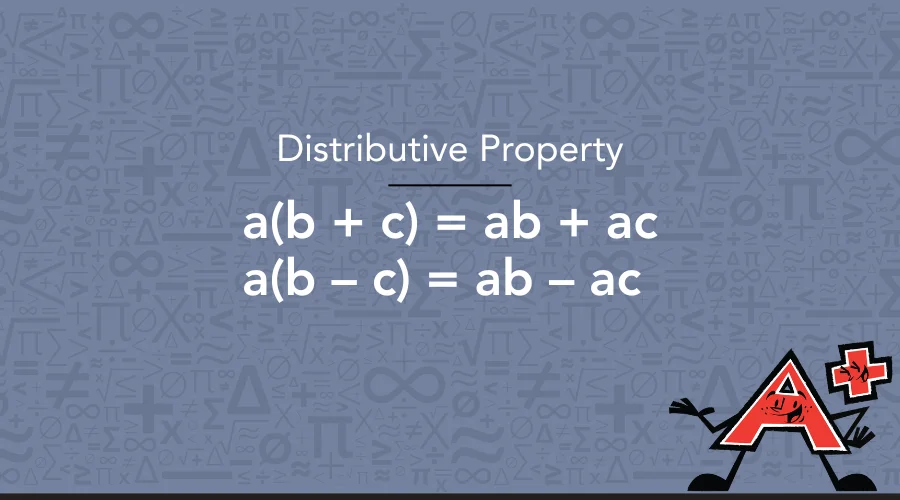
How the Distributive Property Works with Addition
Let's see the rule in action with a numerical example. Take 5(8 + 6).
We can solve this in two ways.
-
The first is to add inside the parentheses first, then multiply: 5(8 + 6) = 5 × 14 = 70
-
The second is to distribute the 5 to each term inside the parentheses, then add the results: 5(8 + 6) = (5 × 8) + (5 × 6) = 40 + 30 = 70
Both methods give us 70. The multiplication distributed evenly across both terms, each one got multiplied by 5, and the results were added together.
How the Distributive Property Works with Subtraction
Now let's try the same idea with subtraction. Take 7(12 − 5).
-
The first approach is to subtract inside the parentheses first, then multiply: 7(12 − 5) = 7 × 7 = 49
-
The second is to distribute the 7 across both terms, keeping the minus sign with the second term: 7(12 − 5) = (7 × 12) − (7 × 5) = 84 − 35 = 49
Same answer, same logic. The minus sign belongs to the second term and travels with it — 7 multiplies both 12 and 5, and the subtraction stays between the results.
How the Distributive Property Helps in Algebra
In arithmetic, the distributive property helps us calculate faster. In algebra, we use it to work with expressions and equations that have parentheses.
Without the distributive property, parentheses can stop us from simplifying an expression. Thanks to the distributive property, we can rewrite the expression in a form that is easier to simplify and solve.
A. Simplifying Expressions
One of the most common ways we use the distributive property in algebra is to expand algebraic expressions. We do this by multiplying the outside number by every term inside the parentheses, which makes the algebraic expression easier to work with.
Let's try 3(x + 4):
3(x + 4)
= (3 × x) + (3 × 4)
= 3x + 12
Now let's try one with a negative number outside the parentheses: −2(x − 5):
−2(x − 5)
= (−2 × x) + (−2 × −5)
= −2x + 10
Notice what happened in the second example: the negative outside the parentheses and the subtraction sign inside combined to give a positive result. A negative times a negative gives a positive, so −(−10) becomes +10.
📕 You May Also Like: 5 Tips for Students Struggling with Algebraic Expressions
B. Solving Equations
The distributive property also helps when we work with equations with parentheses. Before we can solve one, we usually need to distribute first. This removes the parentheses and gives us an equation that is easier to simplify, isolate the variable, and solve.
Let's try 2(x + 3) = 14:
2(x + 3) = 14
= 2x + 6 = 14
Now we can solve for x using inverse operations:
2x + 6 = 14
2x = 14 − 6
2x = 8
x = 4
We can verify by substituting x = 4 back into the original equation: 2(4 + 3) = 2 × 7 = 14. ✓
If we skip the distribution step and jump straight to inverse operations, we will either get stuck or get the wrong answer. We need to handle the parentheses first.
📕 You May Also Like: How to Solve Two-Step Equations Using the Undo Method
C. Combining Like Terms After Distributing
In algebra, distributing is often just the first step. After the parentheses are gone, we look for like terms and combine them to make the expression simpler.
Like terms are terms that have the same variable part. For example, 4x and 2x are like terms because they both have x.
Let’s try this expression:
4x + 2(x + 3)
-
We distribute the 2 to both terms inside the parentheses: = 4x + 2x + 6
-
The parentheses are gone, so we can look for like terms. The terms 4x and 2x both have x, so we can combine them: = 6x + 6
Now the expression is fully simplified.
Pay attention to the order of operations. We distribute first, then combine like terms. When we combine before distributing, we miss part of the expression because the parentheses have not been opened yet.
A quick way to spot like terms is to ask, do they have the same variable part?
📕 You May Also Like: Algebraic Reasoning: What It Is and How to Develop It
Your Turn! Put the Distributive Property to Work
Here are three sets of problems to try on your own, starting simple and building up. Check your answers at the bottom of the page.
Warm-Up: Numbers Only
Start here to make sure the mechanic is solid before moving to variables.
-
5(3 + 7)
-
6(12 − 4)
-
9(20 + 2)
Algebra: Distribute and Simplify
Now practice the steps with variables. Expand each expression and simplify where possible.
-
3(x + 5)
-
4(2x − 1)
-
−2(y + 6)
-
5(a − 3) + 2a
Equations: Use the Distributive Property to Solve
Distribute first, then use inverse operations to find the value of the variable.
-
2(x + 4) = 18
-
3(y − 1) + 2 = 17
-
5(z + 2) = 3z + 14
Real-World Problem
A student buys 4 identical supply kits for a school project. Each kit contains a notebook and a pack of markers. The notebook costs $3, and the markers cost x dollars. Write an expression for the total cost, expand it using the distributive property, and simplify.

Mathnasium uses personalized learning plans and interactive teaching techniques to help students build a solid understanding of math concepts, including the distributive property.
How Mathnasium Helps Students With the Distributive Property and Any Other Math Topic
Mathnasium is a math-only learning center that works with students of all skill levels to learn and master any math topic, including the distributive property.
Our specially trained tutors use the Mathnasium Method™, our proprietary teaching approach that combines verbal, visual, tactile, and written techniques to help students understand each concept before moving on.
Each student starts their Mathnasium journey with a diagnostic assessment that allows us to understand which skills are solid and which need support, including the foundational arithmetic and algebraic thinking the distributive property builds on.
From there, we create a personalized learning plan that builds the missing pieces step by step, using the same clear, example-led approach we used today.
Sessions usually include game-based activities and plenty of rewards to keep students motivated and engaged. Students work in a fun and caring group environment where they feel comfortable asking questions, making mistakes, and trying again.
Our tutors give students room to think through a problem before stepping in. They know when to guide, when to ask a better question, and when to let the student work through the problem. That balance helps to build critical thinking and problem-solving skills, along with lasting independence in math.
Families see measurable results:
-
94% of parents report an improvement in their child’s math skills and understanding
-
93% of parents report their child’s improved attitude toward math after attending Mathnasium
-
90% of students saw an improvement in their school grades
With over 1,100 centers, Mathnasium brings top-rated instruction close to your home.
Mathnasium of Greenwood brings that same trusted approach to families in Greenwood and the surrounding communities.
Whether your child is just learning the distributive property or has been hitting a wall with it for a while, a free diagnostic assessment is the right place to start. It helps us see exactly where their understanding stands and build from there.
📅 Schedule a Free Assessment at Mathnasium of Greenwood
Not near Greenwood?
📍 Find a Mathnasium Learning Center Near You
Pssst! Check Your Answers Here
Warm-Up: Numbers Only
Problem 1: 5(3 + 7)
-
5(3 + 7)
-
= (5 × 3) + (5 × 7)
-
= 15 + 35
-
= 50
Problem 2: 6(12 − 4)
-
6(12 − 4)
-
= (6 × 12) − (6 × 4)
-
= 72 − 24
-
= 48
Problem 3: 9(20 + 2)
-
9(20 + 2)
-
= (9 × 20) + (9 × 2)
-
= 180 + 18
-
= 198
Algebra: Distribute and Simplify
Problem 1: 3(x + 5)
-
3(x + 5)
-
= (3 × x) + (3 × 5)
-
= 3x + 15
Problem 2: 4(2x − 1)
-
4(2x − 1)
-
= (4 × 2x) − (4 × 1)
-
= 8x − 4
Problem 3: −2(y + 6)
-
−2(y + 6)
-
= (−2 × y) + (−2 × 6)
-
= −2y − 12
Problem 4: 5(a − 3) + 2a
-
5(a − 3) + 2a
-
= (5 × a) − (5 × 3) + 2a
-
= 5a − 15 + 2a
-
= 7a − 15
Equations: Use the Distributive Property to Solve
Problem 1: 2(x + 4) = 18
-
2(x + 4) = 18
-
= 2x + 8 = 18
-
2x = 18 − 8
-
2x = 10
-
x = 5
Verify: 2(5 + 4) = 2 × 9 = 18 ✓
Problem 2: 3(y − 1) + 2 = 17
-
3(y − 1) + 2 = 17
-
= 3y − 3 + 2 = 17
-
= 3y − 1 = 17
-
3y = 17 + 1
-
3y = 18
-
y = 6
Verify: 3(6 − 1) + 2 = 3 × 5 + 2 = 15 + 2 = 17 ✓
Problem 3: 5(z + 2) = 3z + 14
-
5(z + 2) = 3z + 14
-
= 5z + 10 = 3z + 14
-
5z − 3z = 14 − 10
-
2z = 4
-
z = 2
Verify: 5(2 + 2) = 5 × 4 = 20 and 3 × 2 + 14 = 6 + 14 = 20 ✓
Real-World Problem
Each kit contains a notebook ($3) and markers (x dollars), so one kit costs (3 + x). For 4 kits:
-
4(3 + x)
-
= (4 × 3) + (4 × x)
-
= 12 + 4x
The total cost is 12 + 4x — a flat $12 for the notebooks plus 4 times the cost of the markers.
How did you do?


 (317) 733-9100