Before, it was arithmetic: add, subtract, multiply, divide. Clean numbers. Clear answers.
Now it’s distributed, combine like terms, watch for negatives, simplify. Yeah, we know; algebraic expressions tend to bring on head scratches and maybe even headaches.
This is where procedural steps and conceptual understanding have to meet. And when either one isn’t solid, things can get confusing fast.
We say that from experience. At Mathnasium, we’ve worked with plenty of students who felt lost in expressions. But there’s a way through. It takes a clear breakdown, steady practice, and the right kind of support.
Based on what we’ve seen work again and again, our tutors have outlined the most common challenges with algebraic expressions and a set of practical strategies parents can use at home to help their child make sense of them.

Where Students May Struggle with Algebraic Expressions
Working with students in upper elementary and middle school, where algebraic expressions begin to stir the pot, we frequently see the same handful of hurdles trip them up.
So what’s getting in the way? It usually has less to do with ability and more to do with layered misunderstandings that were never cleared up.
Let’s take a look at the ones that show up most.
A. Misinterpreting Variables and Terms
This breakdown appears regularly when students first begin working with algebraic expressions. While they may feel confident adding and subtracting numbers, introducing variables like x or y adds a layer of abstraction that can be hard to process at first.
It usually shows up in ways like this:
-
Writing 3x+2x as 5x², mistaking the addition of like terms for multiplication
-
Rewriting 4+y as 4y, not realizing that placing a number and a variable side by side means multiplication, not addition
-
Combining unlike terms, such as 5x+2y into 7xy, even though the variables are not the same
-
Dropping the variable altogether, for example, writing 6x – 2x as just 4.
So why do students make mistakes like these?
We find it’s usually a sign that they’re still developing a working understanding of what terms actually represent, how variables, numbers, and operations fit together in a structured way.
Without a solid grasp of those roles, students tend to make intuitive, but incorrect, leaps.
📕 You May Also Like: What Is an Expression in Math? A Beginner-Friendly Guide
B. Distributing Incorrectly
Another common sticking point shows up when students begin applying the distributive property.
Even when they remember the general rule to multiply the term outside the parentheses by what’s inside, these details tend to slip:
-
Distributing to only the first term: 2(x + 3) becomes 2x + 3
-
Dropping a negative during distribution: –4(x – 2) becomes –4x – 8 instead of –4x + 8
-
Distributing correctly but forgetting to combine like terms afterward: 3(x + 2) + x becomes 3x+6+x (no follow-through to 4x + 6)
Where does it break down?
In many cases, students are following what feels like a pattern: multiplying the first thing they see, without recognizing that the parentheses represent a full group.
If they don’t see that structure clearly, it’s easy to stop short or miss a term entirely.
📕 You May Also Like: What Are Number Properties in Math? A Complete Overview [+Quiz]
C. Struggling to Combine Like Terms
Combining like terms might seem simple until the expression includes a negative sign, a second variable, or a mismatch in exponents.
With those extra layers in play, combining gets messy, and we start to see errors like:
-
Combining different variables: 3x + 2y becomes 5xy
-
Combining mismatched exponents: x + x² becomes 2x²
-
Combining constants and variable terms: 7 + 4x becomes 11x
In arithmetic, students are taught to combine what they see, add the numbers, and move on. But algebra depends on structure.
Terms only combine when they match exactly: same variable, same exponent, same format. Until that idea settles in, students often go with what looks similar on the surface, even if it doesn’t belong together.
D. Losing Track of Negative Signs
Negative signs are tiny, but in algebra, they have main character energy. Put one in the wrong spot, and suddenly the math doesn’t mean what you thought it did.
We see this in examples like:
-
Incorrect distribution of a negative: –3(x – 2) becomes –3x – 2 instead of
-
Dropping a negative outside parentheses: –(x + 4) becomes –x + 4 instead of –x – 4
-
Misreading subtraction as a positive term: In 5x – 2x + 3, the –2x is read as +2x, leading to 7x + 3 instead of 3x + 3
Up until this point, many students have only worked with negative numbers in isolated situations, simple subtraction, and maybe number lines.
Algebra is the first time they’re expected to track negatives across multiple terms, parentheses, and operations all at once. It’s easy to focus on the numbers or variables and overlook the signs that low-key change everything.
📕 You May Also Like: How to Subtract Positive and Negative Integers?
E. Treating Expressions Like Equations
After students get familiar with solving equations, they sometimes try to apply that same approach to expressions in cases where no equals sign appears. Instead of simplifying, they look for a final answer or try to “solve” something that isn’t meant to be solved.
We see errors such as:
-
Expecting an equal sign where there isn’t one: Asking, “What’s the answer to 4x + 2x?” instead of simplifying it to 6x
-
Treating each step as a full equation: Writing 4x + 2x = 6x = x, as if each step has to carry an equals sign
Where does this confusion stem from?
Expressions and equations look similar, but they serve different roles. An expression represents a value or a process. An equation shows a relationship between two sides.
If students haven’t had much exposure to expressions on their own, they tend to fall back on habits from equation-solving, like plugging in numbers, adding equal signs, or asking for "the answer" when none is required.
📕 You May Also Like: Is Your Student Ready for Their Algebra Class? [+Quiz]
Strategies That Make Algebraic Expressions Click
Now that we’ve seen where students tend to get stuck with algebraic expressions, the next question is: how do we help them move forward?
It doesn’t have to mean digging through their textbook or relearning the steps yourself. In most cases, a few intentional moves, done consistently, can make a real difference.
1. Use Color to Visually Organize Like Terms
You know that moment when an expression looks like an alphabet soup? Color can cut through that confusion. Grab some highlighters or colored pens and help your child rewrite each expression so like terms are easier to spot.
Choose one color for each type of term:
-
x-terms in one color (e.g., blue)
-
constants in another (e.g., green)
For example, in the expression 5x + 3 – 2x + 7, it would look like this:
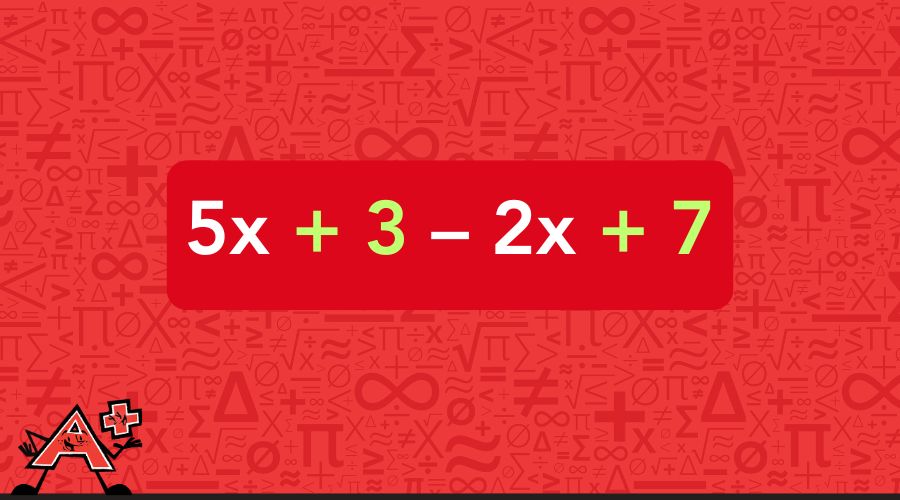
Once the terms are grouped by color, it becomes much clearer:
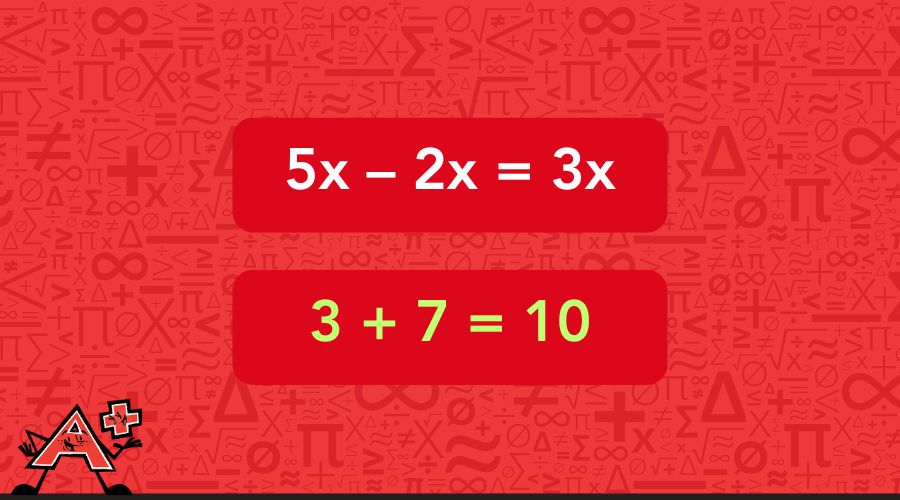
Now, the expression becomes:
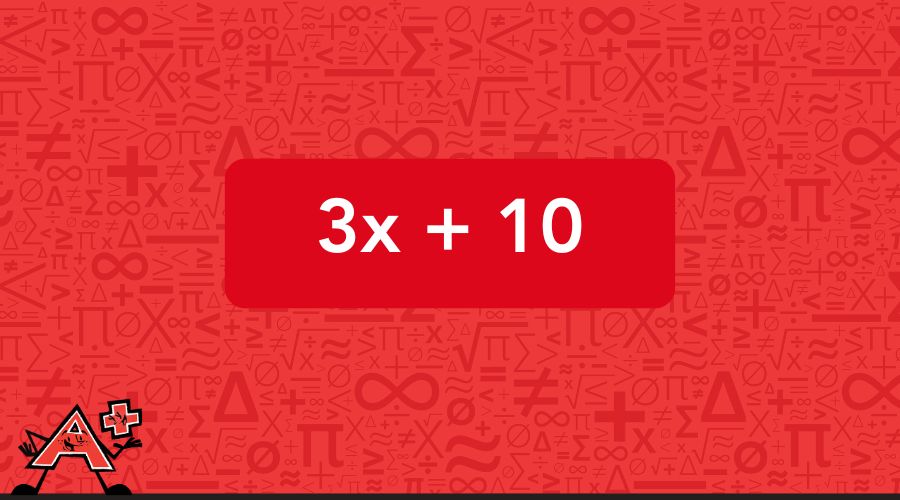
Seeing the parts visually grouped helps students slow down and process the structure before they try to simplify. It also reduces the chance of accidentally combining unlike terms or dropping a negative sign, which are two of the most common issues we see with expressions.
2. Teach Distribution Using Area Models
There are students who need to see what distribution actually does before the steps start to make sense. One way to make it visual is to use a simple rectangle to model how a term distributes across an expression inside parentheses.
Try this with your child:
To model 3(x + 4), draw a large rectangle and divide it into two smaller sections: one labeled x, the other 4. These represent the two parts inside the parentheses.
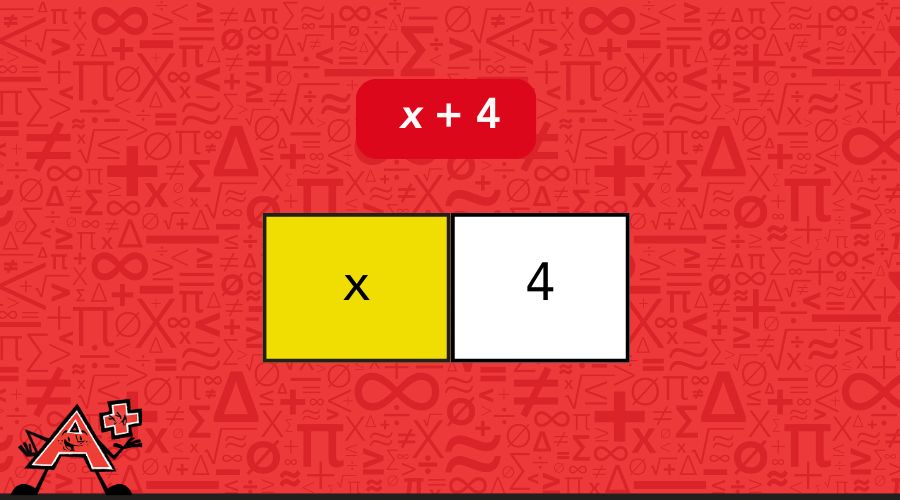
Now, draw three rows of that same split rectangle to represent multiplying by 3.
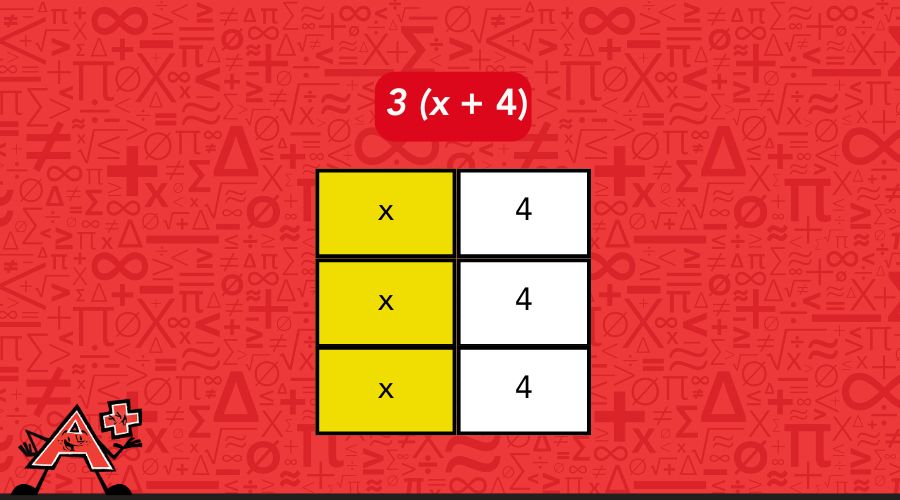
From there, have your child look at the full drawing and count what they see in each section:
-
There are three x-blocks, one in each row, so that’s 3x.
-
There are three 4s, one in each row, which makes 12.
This visual trick helps them see the math instead of memorizing it. And it builds a habit of looking at the structure first, so they are not just rushing to apply some rule.
3. Emphasize Expression ≠ Equation
Expressions and equations can look like twins, but they're really not. They serve different purposes entirely. The goal is teaching your child to spot which is which, because that changes everything about how they'll solve it.
This is a good place to bring in everyday comparisons that make the difference more obvious.
You can follow that with the shopping list vs. receipt metaphor, or swap in another that fits the child’s interests, like:
-
2x + 4 (an expression) is like a shopping list: two of something at an unknown price (x), plus one item that costs $4. You’re still building the total. Nothing to solve yet.
-
2x + 4 = 10 (an equation) is like getting the receipt. Now you know the total was $10, and you’re working backward to figure out what x must have been.
Comparing them side by side helps students understand whether the math is describing something or asking them to solve it.
Our instructors teach students to pause and ask: “Do I see an equals sign?”
-
If they don’t, they’re likely working with an expression, and the goal is to simplify, not solve.
-
If they do, that means they’re looking at an equation, and now it’s about finding the value that makes both sides equal.
4. Build It Backward from Simplified to Expanded
Sometimes the best way to understand math is to press rewind. Instead of always simplifying expressions, try flipping the script: take a finished-looking expression and ask your child what it might have looked like before it was simplified.
Start with 7x + 14 and ask, “What could this have come from?”
With a little thought, your child might recognize a common factor and say: 7(x + 2)
This back-and-forth builds two things students really need:
-
Pattern recognition, so they start to spot structure quickly
-
Reversibility, so they don’t feel locked into one direction when solving problems
5. Preview Mistakes on Purpose
Instead of waiting for your child to make a mistake, show them one and ask what’s off.
This approach helps them build a critical skill: noticing when something doesn’t quite add up, and figuring out why.
Work on this one together:
Write this expression on paper or a whiteboard: 2(x + 5) = 2x + 5
Then ask: “Can you explain what’s wrong here?”
Give them time to look it over. If they’re stuck, guide them with prompts like:
After they spot the error and realize the correct form is 2x + 10, they've actually learned to pay attention to how expressions are built. They've also gotten better at double-checking their work.
📕 You May Also Like: Why Parents Should Teach Kids to Embrace Math Mistakes

Mathnasium builds deep understanding of any math concept through personalized, face-to-face instruction.
How Mathnasium Helps Students Master Any Math Concept
Algebraic expressions mark a shift in how students engage with math. Instead of following familiar steps, they’re now expected to recognize structure, make sense of patterns, and carry more of the reasoning themselves. Supporting that kind of thinking at home can make a difference, but not every parent has the time or the kind of math fluency to jump in and help.
This is where Mathnasium comes in. We’re a math-only learning center, dedicated to helping students excel in any math skill or concept, including algebraic expressions.
When students come to us for algebra support, we don't just hand them drills and worksheets. Our approach, the Mathnasium Method™, works differently. It’s proprietary, personalized, and designed to build a deep understanding of math.
To foster true mastery, our approach relies on:
-
Personalization on a granular level: Each student begins their enrollment with a diagnostic assessment. This allows us to pinpoint their strengths, knowledge gaps, and how they approach math. From there, we create a learning plan customized to their needs, whether they’re trying to master algebra or tackling advanced math.
-
Teaching for understanding: We explain math using clear, everyday language and support each concept with a blend of visual, verbal, written, mental, and hands-on techniques. This layered instruction helps students truly make sense of what they’re learning.
-
Caring instruction: Our tutors are trained not just in math but in how to connect with students. They know how to support a child who’s feeling discouraged and how to challenge one who’s ready for more.
-
Independent problem-solving and critical thinking: During instruction, we always set aside time for students to work through problems on their own. This gives them space to test their understanding and trust their own thinking. We guide them to see both the how and the why behind each concept. By understanding both, they develop critical thinking tools they can use in math and beyond.
-
Singular focus on math: Our curriculum spans thousands of pages and has been continuously refined over the past 20 years. This singular focus on math allows us to take a deep dive into how students best absorb, learn, and retain mathematical concepts.
-
Empowering, fun learning environment: Our environment is designed to be both confidence-building and fun. Our materials are often game-based, and we give students a chance to earn rewards to keep them motivated as they continue advancing to higher levels of achievement.
The results speak volumes:
-
94% of parents report an improvement in their child's math skills and understanding
-
93% of parents report an improved attitude towards math after attending Mathnasium
-
90% of students saw an improvement in their school grades
With a network of more than 1,100 centers across the country, Mathnasium brings top-rated instruction close to your home.
For families located in or near Manhattan Beach, CA, Mathnasium of Manhattan Beach is a trusted local center with years of experience helping students excel in math.
Here’s what one parent had to share about their child’s experience at our center.
Whether your child is looking to catch up, keep up, or get ahead in math, our team is happy to assist.
Ready to get started?
📅 Schedule a Free Diagnostic Assessment at Mathnasium of Manhattan Beach
Not near Manhattan Beach?
📍 Find Mathnasium Learning Centers Near You


 (310) 905-6284