Advanced students can find themselves unchallenged by the classroom curriculum alone, even when they are performing at the top of their class.
At Mathnasium, we work with advanced students regularly, offering enrichment and challenges that go beyond the classroom and helping them reach their full mathematical potential.
Today, we're sharing our experience and research-backed insights. We'll walk through why good grades don't always signal full mathematical development, how advanced students plateau, how math competitions help, and what parents can do at home to support deeper growth.

Why Good Grades Are Not the Same as Advanced Mathematical Development
Good grades are not the same as advanced mathematical development because high classroom performance does not always require the deeper reasoning and problem-solving skills advanced learners still need to build.
Grades and test scores tend to reward procedural accuracy, the ability to follow a method reliably, and reproducing it correctly under classroom conditions.
Mathematical reasoning is a separate skill that requires your child to work through an unfamiliar problem without a clear path forward and adjust strategies until a solution emerges.
Two research findings make this distinction concrete:
-
Boaler found that procedural, rule-based math instruction can lead students to develop a fixed view of mathematical ability, where encountering difficulty feels unexpected rather than normal.
-
A Stanford PhD dissertation by Katherine Liu Sun revealed that classrooms that emphasized reasoning and multiple solution paths consistently helped students develop greater persistence and problem-solving flexibility than procedurally focused classrooms.
In other words, a student may succeed at everything school math asks while still having limited experience with the deeper reasoning skills that competition math tests directly.
📕 You May Also Like: Critical Thinking vs. Memorizing: What Really Builds Math Skills?
How Advanced Students Plateau in Math
Advanced students plateau when school math no longer feels challenging, and two specific patterns tend to develop when that happens:
-
Avoidance habits form around difficulty. Your child may start stepping back from problems that do not resolve quickly, because working through real uncertainty is a new experience rather than an expected part of the process.
-
A fixed self-concept forms around being good at math. Your child may tie mathematical identity too closely to success, which can make any struggle feel threatening rather than useful and make it harder to push into the territory where real development happens.
Research helps explain why these patterns appear.
Sweller's cognitive load research established that problem-solving skills develop when students face challenges at the right level of difficulty. When every problem resolves in under a minute by applying a method we memorized, that development stalls.
📕 You May Also Like: How Positive Math Talk Encourages a Growth Mindset at Home
The Role of Math Competitions in Advanced Mathematical Development
Math competitions give advanced learners opportunities to develop reasoning habits beyond classroom math and standard testing. Programs like AMC and MATHCOUNTS are well-known examples because they require students to approach unfamiliar problems without relying on memorized procedures.
-
MATHCOUNTS is a national competition program for grades 6 through 8, structured across four progressive levels that begin at the school level and advance to national competition. It develops problem-solving across algebra, geometry, number theory, and probability through problems that cannot be solved by applying a memorized procedure.
-
The AMC series, administered by the Mathematical Association of America, begins with the AMC 8 for middle schoolers and continues through AMC 10, AMC 12, and beyond for high schoolers.
Neither competition rewards memorization. Both require your child to work through problems they have not seen before by combining multiple concepts in unfamiliar ways. Both competitions build four specific mathematical habits:
-
Read a problem carefully before touching the numbers
-
Try an approach without certainty it will work
-
Adjust when that approach does not succeed
-
Recognize when you need a different strategy
This is the same distinction we discussed earlier between procedural performance and flexible mathematical reasoning.
Boaler's research found that students exposed to multi-dimensional mathematical tasks, those requiring multiple approaches and real reasoning rather than a single correct method, developed significantly more flexible thinking and persistence than students whose mathematical experience was primarily procedural.
📕 You May Also Like: Beyond the Classroom: Exploring Math Competitions and Challenges

Competition math develops the reasoning flexibility that grades and test scores don't always capture.
Practical Ways to Support an Advanced Math Learner at Home
Advanced math learners benefit most from deeper reasoning and opportunities to work through unfamiliar problems. Across our learning centers, we frequently see that students continue growing when home support encourages flexible thinking instead of correct answers alone.
These five strategies help families support that kind of mathematical development at home.
1. Let Your Child Stay With Difficult Problems Longer
Advanced mathematical development happens through problems that require sustained engagement rather than fast answers.
Going back to this line of research, Sun’s Stanford dissertation found that students showed greater persistence and flexibility in math when they spent time thinking through challenging problems rather than focusing only on speed and correct answers.
Encourage your child to spend time thinking through a difficult problem before stepping in with help. Advanced learners build deeper reasoning when they experience uncertainty, test ideas, and revise approaches independently.
2. Introduce Non-Routine Problems at Home
Non-routine problems develop the reasoning habits that AMC and MATHCOUNTS test directly. School math problems are typically designed for students to solve by applying the method they have just learned. AMC and MATHCOUNTS problems are specifically designed to be unfamiliar.
An AMC 8 problem might ask your child to find how many two-digit numbers have digits that sum to a prime. There is no formula to apply. The work is figuring out the approach. If your child practices this kind of problem regularly, they will build exactly the reasoning flexibility that both AMC and MATHCOUNTS reward on competition day.
3. Use Mistakes as Springboards for Learning
Mistakes are the mechanism through which advanced mathematical thinking develops. Your child may treat a wrong answer as a signal that something is wrong rather than a normal part of the process.
We are referring again to Boaler's research, which found that students who work in environments where mistakes are learning opportunities develop significantly more resilient mathematical thinking than those in environments where correctness is the primary measure of success.
Help your child identify what a mistake reveals rather than simply correcting it, because reflection is what strengthens mathematical reasoning.
4. Build Short but Consistent Problem-Solving Habits
Reasoning stamina develops through targeted and consistent practice. Rohrer found that spacing practice across multiple sessions improves retention, while interleaving (mixing different types of problems) improves students' ability to identify which approach a problem requires.
Both findings map directly onto what AMC and MATHCOUNTS demand. Twenty minutes of mixed problem-solving several times a week builds the reasoning stamina and topic flexibility that competitions reward far more effectively than long, occasional sessions.
5. Consider Structured Enrichment Beyond the Classroom
Advanced learners preparing for competition math or honors coursework benefit from working with an educator who understands both advanced mathematical content and how gifted students continue developing beyond grade-level material.
A diagnostic assessment that identifies exactly where your child is mathematically makes targeted support much more precise, which is exactly the approach we use at Mathnasium of Highland Park.
📕 You May Also Like: How to Keep Advanced Students Motivated & Challenged in Math
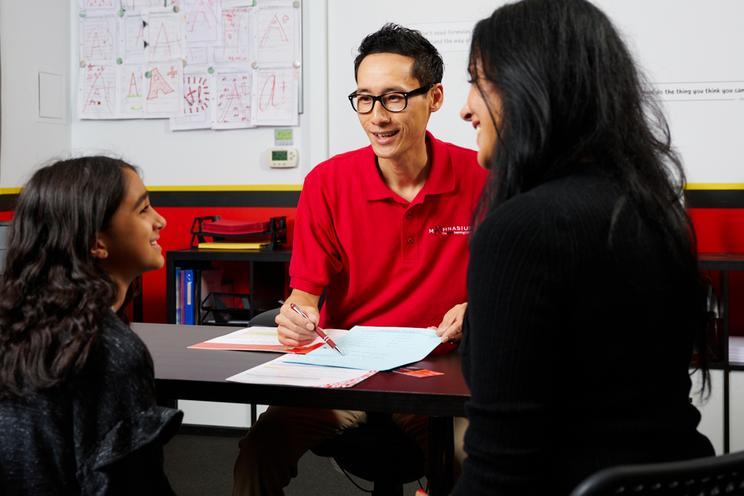
At Mathnasium of Highland Park, advanced learners strengthen the reasoning and problem-solving flexibility that school math does not always develop fully.
How Mathnasium Supports Advanced Math Students in Highland Park
Mathnasium is a math-only learning center dedicated to empowering K-12 students of all skill levels to excel in math.
For advanced learners in Highland Park who are ready to go beyond grade-level curriculum, that means building the reasoning and problem-solving flexibility they'll need for honors coursework, higher-level mathematics, and the challenges that come after the classroom.
To help advanced students reach that level of math reasoning, we use the Mathnasium Method™, our proprietary teaching approach built around each student's needs.
Our approach begins with a diagnostic assessment that identifies current skills, strengths, and goals. From there, we build a personalized learning plan tailored to their needs. For advanced learners, this may mean enrichment beyond grade-level material, preparation for honors or accelerated coursework, or focused work on the reasoning and problem-solving skills that will serve them well beyond the classroom.
With the plan in place, our specially trained tutors deliver face-to-face math instruction in a supportive and engaging environment, both in-center and online.
We teach for true understanding, using clear, everyday language to explain math concepts and backing that up with a mix of verbal, visual, mental, tactile, and written techniques so each concept lands in a way that makes sense to your child.
During sessions, our tutors break down challenging problems into manageable steps, guiding students through both the how and the why behind each answer. Over time, students build real problem-solving skills and critical thinking tools they can carry into math and beyond.
The results speak for themselves:
-
94% of parents report improvement in their child's math skills and understanding
-
93% of parents report an improved attitude toward math after attending Mathnasium
-
90% of students saw improvement in their school grades
Advanced students in and near Highland Park, TX, can choose from three dedicated enrichment programs at Mathnasium of Highland Park:
-
Elementary Math Enrichment for grades 2 to 5, focused on algebraic thinking, strategic problem-solving, and flexible number sense
-
Competition Mathematics for grades 3 to 12, preparing students for AMC, MATHCOUNTS, and Math Olympiad through advanced problem-solving strategies and creative thinking
-
Advanced Course Preparation for grades 6 to 12, supporting students in honors and accelerated coursework
Our tutors are familiar with Texas Essential Knowledge and Skills (TEKS) standards and can align instruction with STAAR preparation, TAG program pathways, and honors course placement goals.
If your child is ready to go beyond the classroom and develop real mathematical reasoning, our team is ready to help.
📅 Schedule a Free Assessment at Mathnasium of Highland Park
Not near Highland Park?
📍 Find a Mathnasium Learning Center Near You


 (972) 393-6284