Math is full of patterns. For example, we know that 3 + 5 and 5 + 3 land on the same answer, or that multiplying any number by 1 always gives back that same number. These patterns follow rules, and those rules have names.
Four of them show up constantly in addition and multiplication: the commutative, associative, identity, and distributive properties. Today, Mathnasium tutors break down what each one means, when it applies, and how knowing them can make solving problems faster and easier.

What Are Mathematical Properties?
A math property is a rule that describes how numbers behave during an operation, like addition or multiplication.
These rules hold true no matter which numbers are plugged in.
Think of it like the rules of a board game. You don't relearn how dice work every time you sit down to play Monopoly. You already know that rolling a 6 means moving six spaces, no matter whose turn it is.
Number properties work the same way. When we learn the rule, it holds true every time that operation shows up.
In this guide, we'll focus on four properties that apply to addition and multiplication:
📕 You May Also Like: Math Level Assessments For All Grades
The Commutative Property: Changing the Order
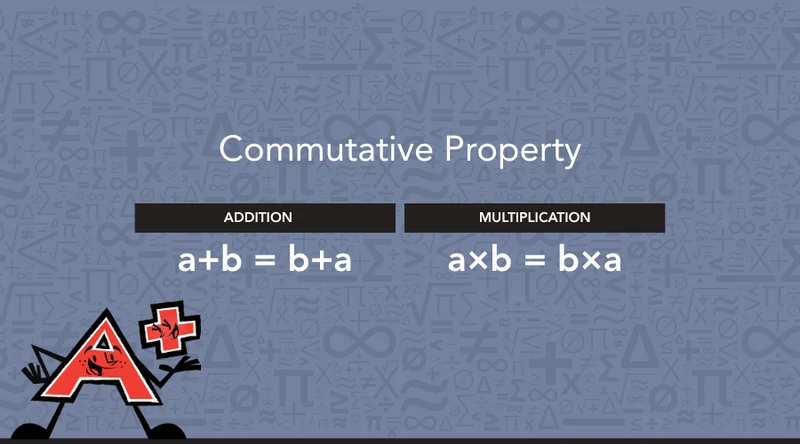
The commutative property tells us that in addition and multiplication, we can change the order of the numbers and still get the same answer.
So, why do we call it "commutative"? The word comes from "commute," which means to move back and forth. That is exactly what this property lets us do with numbers.
-
4 + 7 = 7 + 4 = 11
-
6 × 5 = 5 × 6 = 30
Here's why it works.
Picture four apples and seven oranges sitting on a table. It doesn't matter whether we count the apples first or the oranges first; the total is still eleven pieces of fruit.
The same idea holds for multiplication. Six groups of five apples is the same amount of apples as five groups of six, just arranged differently.
Subtraction and division don't follow this rule. 10 − 3 does not equal 3 − 10, so switching the order actually changes the answer.
This is important to know, since it's easy for students to assume every operation works the same way.
📕 You May Also Like: Commutative Property for Beginners - A Complete Guide
The Associative Property: Changing the Grouping
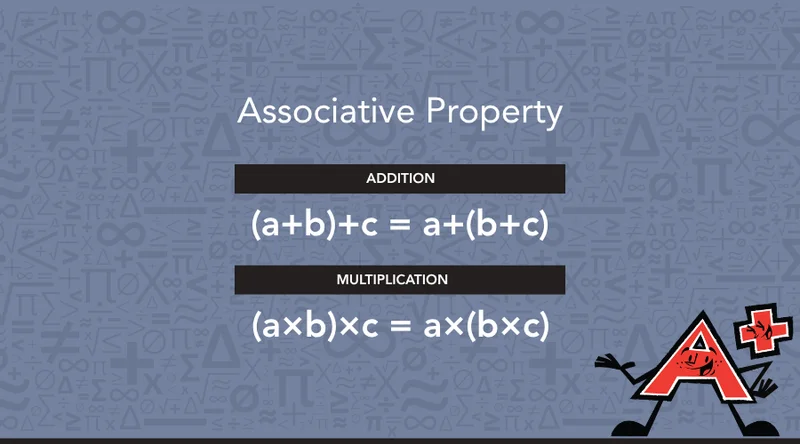
The associative property tells us that in addition and multiplication, the way we group numbers doesn't affect the answer. Regroup them however we like, the result stays the same.
The name gives it away: "associative" comes from "associate," meaning to group or connect. That's the whole idea.
The parentheses we see in examples simply show which numbers to calculate first:
In the first example, you can add 3 and 7 to get 10, then add 5 for a total of 15. Or they can add 7 and 5 first to get 12, then add 3, landing on the same 15.
Either grouping works.
This is where the associative property becomes genuinely useful for mental math.
Take 2 × 5 × 10.
Multiplying 2 × 5 first gives 10, and 10 × 10 is an easy 100 to calculate in your head.
Grouping the numbers differently would still get to 100, just with more effort along the way.
Put simply, we look for "friendly numbers," pairs that combine into a round number like 10 or 100, and group those first.
📕 You May Also Like: What Is the Associative Property of Multiplication? A Kid-Friendly Guide
The Identity Property: The Number That Leaves Everything the Same
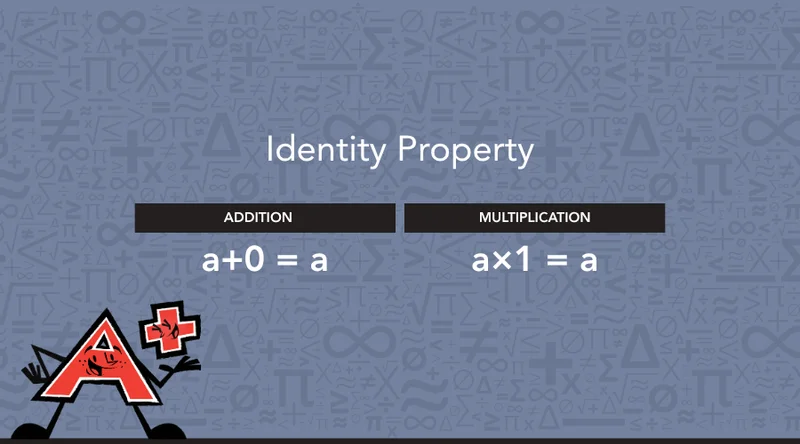
The identity property tells us that certain numbers leave other numbers unchanged when used in an operation. For addition, that number is 0. For multiplication, it's 1.
Add 0 to any number, and the number stays exactly the same:
-
15 + 0 = 15
-
132 + 0 = 132
Multiply any number by 1, and the same thing happens:
So why do we call it the "identity" property? Because these numbers let every other number keep its identity. Its value never changes, no matter how many times you apply them.
Here's a way to picture it: if you have 6 pencils and get 0 more, you still have 6. If you buy 1 bag of 6 apples, you still walk away with 6 apples.
The Distributive Property: Breaking Numbers Apart
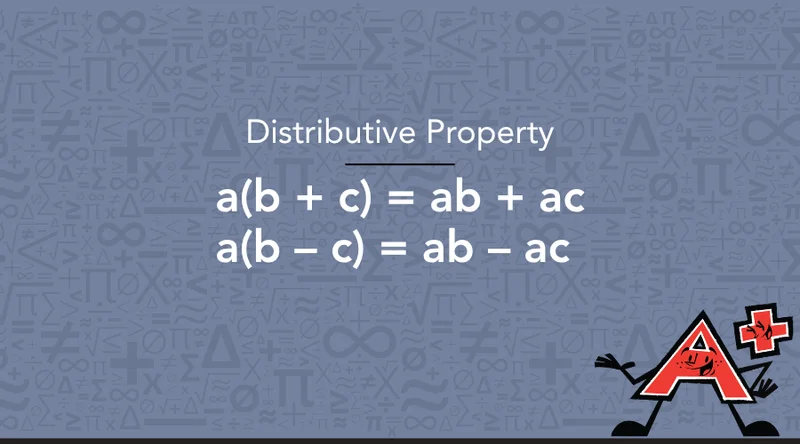
The distributive property tells us that when we multiply a number by a group of numbers being added or subtracted, we can distribute the multiplication to each term inside the parentheses and still get the same answer.
It looks like this:
-
a (b + c ) = ab + ac
-
a (b − c) = ab − ac
Let's test both cases.
With addition: Take 4 × (2 + 3):
Same answer either way.
With subtraction: Take 5 × (10 − 2):
Both paths lead to the same result.
The distributive property is especially handy for solving bigger problems in your head.
Take 6 × 47. Instead of multiplying straight through, break 47 into 40 + 7:
-
6 × 40 = 240
-
6 × 7 = 42
-
240 + 42 = 282
That's the same answer as 6 × 47, just reached through friendlier numbers.
We can use a similar mental shortcut for subtraction.
Take 5 × 98. Instead of multiplying straight through, we can rewrite 98 as (100 − 2) and distribute:
5 × (100 − 2) = (5 × 100) − (5 × 2) = 500 − 10 = 490
Much easier than working out 5 × 98 directly.
Common Mistakes Students Make With Properties
Many math properties seem alike at first glance, so it can be common for students to confuse them. Our instructors see this kind of mix-up regularly and help students learn when to use each property.
1. Confusing commutative with associative
Commutative is about order (4 + 7 = 7 + 4). Think of numbers commuting or moving to new positions. Associative is about grouping (4 + 7) + 2 = 4 + (7 + 2). Think of which numbers associate inside the parentheses.
If the numbers swapped places, it’s commutative. If only the parentheses moved while the numbers stayed in order, it’s associative.
2. Forgetting the parentheses in associative problems
Without parentheses, there is no grouping to adjust. One might write 4 + 7 + 2 and get the right total, but without parentheses showing (4 + 7) + 2 or 4 + (7 + 2), they lose track of which numbers were grouped to be calculated first.
3. Assuming subtraction and division are commutative
The commutative property only works for addition and multiplication. Flipping the order in subtraction or division completely changes the outcome:
-
Subtraction: 9 − 3 = 6, but 3 − 9 = -6
-
Division: 12 ÷ 3 = 4, but 3 ÷ 12 = 0.25
4. Mixing up the identity property with multiplying by zero
Multiplying by 1 keeps a number’s identity intact (6 × 1 = 6). Multiplying by 0 wipes it out (6 × 0 = 0). They look like simple single-digit rules, but they lead to completely opposite results.
5. Forgetting to distribute to both terms
This mistake pops up constantly when subtraction is involved. A student multiplies the first term, gets locked into the flow, and leaves the second term untouched, turning 4(x − 3) into 4x − 3 instead of 4x − 12.
Here is what is actually happening step-by-step:
The factor outside the parentheses acts like a delivery driver. It has to stop at every address inside the brackets, not just the front door.
Practice Time: Put Math Properties to Work
The best way to remember these properties is to practice recognizing them. You can use this quick test to practice at home.
Part 1: Name the property.
-
9 + 3 = 3 + 9
-
(4 + 2) + 6 = 4 + (2 + 6)
-
27 × 1 = 27
-
3(5 + 2) = 15 + 6
Part 2: Fill in the missing number.
-
8 × 5 = 5 × ___
-
(6 + 1) + 3 = 6 + (1 + ___)
-
41 + ___ = 41
-
7 × (2 + 3) = (7 × 2) + (7 × ___)
Part 3: Rewrite using a different property.
-
Rewrite 7 + 4 using the commutative property.
-
Rewrite (5 × 3) × 2 using the associative property.
-
Rewrite 4 × (6 + 2) using the distributive property
Part 4: Word problem.
Mia goes to the store and buys 3 packs of gum for 8 dollars each. Her brother buys 8 packs of gum for 3 dollars each. Which property proves they both spent the exact same total amount?
📕 You May Also Like: What Are Number Properties in Math? A Complete Overview [+Quiz]

At Mathnasium, we help students truly understand the math behind each topic, including number properties, so they can build lasting skills and confidence.
Learn & Master Number Properties at Mathnasium
Mathnasium is a math-only learning center dedicated to helping K-12 students of all skill levels excel in math.
Mathnasium’s specially trained tutors work with elementary school students to help them master any math topic, including math properties.
We build students’ skills and confidence through the Mathnasium Method™, our proprietary teaching approach.
Here’s how it works in practice.
Each student starts with a diagnostic assessment that identifies current skills, strengths, and gaps. From those findings, we build a personalized learning plan tailored to their needs.
Our tutors teach math face-to-face in a supportive environment, using clear language and a mix of verbal, visual, mental, tactile, and written techniques so each concept lands before we move forward.
Sessions are fun, too, with games, earned rewards, and consistent celebration of progress. Students build confidence alongside fluency, and many develop a more positive relationship with math over time.
-
94% of parents report an improvement in their child's math skills and understanding
-
93% of parents report their child's improved attitude toward math after attending Mathnasium
-
90% of students saw an improvement in their school grades
Whether your child is learning math properties for the first time or simply needs additional support, our team is happy to assist.
📅 Schedule a Free Assessment at Mathnasium of Highlands Ranch
Not near Highlands Ranch?
📍 Find a Mathnasium Learning Center Near You
Pssst! Check Your Answers Here
Part 1:
Answers: 1. Commutative, 2. Associative, 3. Identity, 4. Distributive
Part 2:
Answers: 1. 8, 2. 3, 3. 0, 4. 3
Part 3:
Answers: 1. 4 + 7, 2. 5 × (3 × 2), 3. (4 × 6) + (4 × 2)
Part 4:
Answer: The commutative property. It tells us that changing the order of numbers when multiplying gives the same total. Whether you multiply 3 by 8 or 8 by 3, both equal 24 dollars.
So, how did it go?


 (303) 471-7501
 (303) 471-7501