Imagine you share a video with 2 friends, and each of them shares it with 2 more people. The number of new viewers grows quickly because each round multiplies the total instead of adding the same amount. That is the basic idea behind a geometric sequence.
You may confuse it with another number pattern called an arithmetic sequence because the two are often mentioned together in math class and can look similar at first. So let’s take a closer look at what makes a sequence geometric and how we can tell it apart from an arithmetic one.

What Is a Geometric Sequence?
A geometric sequence is a sequence of numbers where we get each new term by multiplying the previous term by the same fixed number. We call that fixed number the common ratio and write it as “r.”
Take this sequence; what do you notice happening from one term to the next?
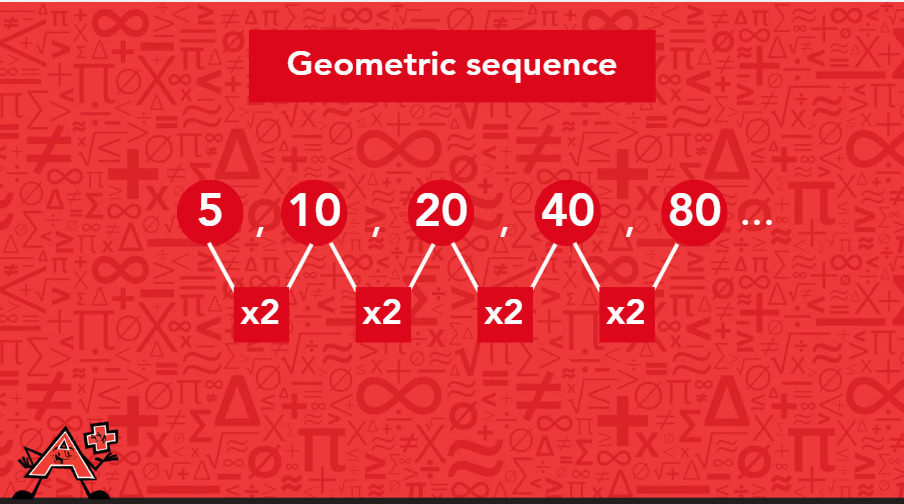
5, 10, 20, 40, 80, ...
That’s right! Each term is exactly double the one before it:
-
5 × 2 = 10
-
10 × 2 = 20
-
20 × 2 = 40
-
40 × 2 = 80
Because we multiply by the same fixed number (in this case, 2) every time, this sequence is geometric with a common ratio of 2.
We can spot other geometric sequences by checking whether each term is multiplied by the same fixed number:
-
3, 9, 27, 81, ... → each term is 3 times the previous term, so r = 3
-
1, 10, 100, 1,000, ... → each term is 10 times the previous term, so r = 10
We can spot such patterns outside of number lists too. Let’s see where geometric sequences show up in real life:
| Where you might see it |
Why it’s a geometric sequence |
| Saving money with compound interest |
Your savings grow by the same percentage over time, so the amount added can get larger each period. |
| Bacteria reproducing |
When each bacterium splits into two at regular intervals, the population doubles each time. |
| A chain message spreading |
Say each person sends the message to 3 new people. The number of new recipients can follow a pattern like 1, 3, 9, 27, 81, ... |

Geometric Sequences With Fraction and Negative Common Ratio
Geometric sequences do not always grow with positive whole-number ratios. The common ratio can also be a fraction or a negative number.
A. Fractional ratio (getting smaller each time): If the terms are positive and the common ratio is a fraction between 0 and 1, the sequence gets smaller with each step.
For example, look at this sequence: 100, 50, 25, 12.5, ...
We have r = \(\Large\frac{1}{2}\) in this geometric sequence:
-
100 × \(\Large\frac{1}{2}\) = 50
-
50 × \(\Large\frac{1}{2}\) = 25
-
25 × \(\Large\frac{1}{2}\) = 12.5
Because we multiply by \(\Large\frac{1}{2}\) each time, every new term is half the previous one, so the sequence keeps decreasing.
B. Negative ratio: When the common ratio is negative, we still multiply by the same number each time, but that negative sign changes the sign of every new term. For example:
2, −6, 18, −54, ...
Here, r = −3:
-
2 × (−3) = −6
-
−6 × (−3) = 18
-
18 × (−3) = −54
Each time we multiply by −3, the sign switches from positive to negative or from negative to positive. That is why the terms alternate signs as the sequence continues.
📕 You May Also Like: 9 Examples of the Golden Ratio in Nature + Definitions
What Is Not a Geometric Sequence
We may often come across number patterns that can look like geometric sequences at first, but they do not always follow the rule all the way through.
Take these examples:
-
1, 4, 9, 16, … : These are square numbers: 1², 2², 3², 4². If we divide the terms, the ratios will be different: 4 ÷ 1 = 4, but 9 ÷ 4 = 2.25. The ratio does not stay the same, so this sequence is not geometric.
-
2, 4, 8, 14, … : The first few terms may make this look geometric because 2 × 2 = 4 and 4 × 2 = 8. But 8 × 2 = 16, not 14. The same multiplier does not continue through the whole sequence, so this sequence is not geometric as well.
Quick Review: What Is an Arithmetic Sequence?
To better understand the difference between geometric and arithmetic sequences, let’s quickly refresh what an arithmetic sequence is.
An arithmetic sequence is a sequence of numbers where we get each new term by adding the same fixed number to the previous term. We call that number the common difference and write it as “d.”
Let’s look at this example of an arithmetic sequence:
3, 7, 11, 15, ...
In this sequence, d = +4, because every term is 4 more than the one before it.
📕 You May Also Like: What Are Arithmetic Sequences in Math? A Complete Overview
Arithmetic vs. Geometric Sequence: What’s the Difference?
The main difference between arithmetic and geometric sequences is how we move from one term to the next:
-
In an arithmetic sequence, we add the same amount each time.
-
In a geometric sequence, we multiply by the same number each time.
To see how differently those two rules affect the numbers, let’s start both sequences at 5 and use 4 as the common difference in one and the common ratio in the other:
-
Our arithmetic sequence has d = 4: 5, 9, 13, 17, 21, 25, 29, 33, 37, 41, … We add 4 each time.
-
Our geometric sequence with r = 4 looks like this: 5, 20, 80, 320, 1,280, … We multiply by 4 each time.
Now compare how quickly the values change. The arithmetic sequence does not pass 40 until the 10th term, while the geometric sequence passes 40 at the 3rd term. They begin at the same number, but their different rules produce very different patterns of growth.
If you're still trying to tell them apart, here's a quick cheat sheet to make the difference clear.
|
Arithmetic Sequence |
Geometric Sequence |
| Rule to get the next term |
Add a fixed number |
Multiply by a fixed number |
| How the terms change |
By the same amount each time |
By the same ratio each time |
| What the fixed number is called |
Common difference (d) |
Common ratio (r) |
| Can the fixed number be negative or a fraction? |
Yes. For example, d = -3 gives us 20, 17, 14, 11, ... |
Yes. For example, r = \(\Large\frac{1}{5}\) gives us 625, 125, 25, 5, ... |
Which Type of Sequence Is This?
For each sequence below, decide whether it’s arithmetic, geometric, neither, or both.
-
3, 7, 11, 15, ...
-
2, 6, 18, 54, ...
-
10, 5, 2.5, 1.25, ...
-
1, 4, 9, 16, ……
When you’re done, check your answers at the bottom of our guide.
📕 You May Also Like: 5 Ways Math Practice Impacts Brain Development + Benefits
 Mathnasium tutors use personalized learning plans and proven teaching techniques to help students make sense of math topics like geometric sequences.
How Mathnasium Helps Students Make Sense of Sequences (and Any Other Math Topic)
Mathnasium is a math-only learning center dedicated to helping K–12 students of all skill levels excel in math.
When students come to us for math support, whether that means mastering topics like geometric sequences, working with algebraic patterns, or prepping for advanced math, we make sure they build a deep understanding of math.
To help them reach that level of understanding, we use the Mathnasium Method™, our proprietary teaching approach, designed around each student’s needs. We help students make sense of concepts instead of relying on memorized rules alone.
Here’s how it works in practice.
Each student begins with a diagnostic assessment that helps us understand which skills are secure, which need more support, and how the learner thinks and feels about math.
Using these insights, we create a personalized learning plan focused on the skills the student needs most, whether that means reinforcing number patterns, building algebra readiness, or working with arithmetic and geometric sequences.
Our specially trained tutors follow the plan closely and provide live, face-to-face instruction in a caring and fun group environment. They use mental, verbal, visual, tactile, and written techniques to help students compare patterns, identify how terms change, and understand the difference between repeated addition and repeated multiplication.
Students also get room to think through problems before tutors step in. Our tutors guide them to explain their reasoning, test whether a pattern continues, and check whether their answer makes sense. This helps students build problem-solving skills, critical thinking, and greater independence in math.
Fun is an important part of the approach, too. We use game-based activities, rewards, and consistent encouragement to help students stay engaged as they spot patterns and work through increasingly complex sequences.
The results speak for themselves:
-
94% of parents report an improvement in their child's math skills and understanding
-
93% of parents report their child's improved attitude toward math after attending Mathnasium
-
90% of students saw an improvement in their school grades
With over 1,100 learning centers across North America, there is likely a Mathnasium close to you.
For families in and near Highlands Ranch, Colorado, Mathnasium of Highlands Ranch brings that same approach close to home, with specially trained tutors who help students make sense of sequences, patterns, and the algebra skills that build from them.
Whether your child needs to reinforce algebra foundations, keep up with current coursework, or get ahead, a free diagnostic assessment is a great place to start. Using what we learn, we create a personalized learning plan that helps your child build the skills they need next.
📅 Schedule a Free Assessment at Mathnasium of Highlands Ranch
Not near Highlands Ranch?
📍 Find a Mathnasium Learning Center Near You
Pssst… Check Your Answers Here!
Ready to see how you did? Here are the answers to the practice problems above:
-
Arithmetic (d = 4)
-
Geometric (r = 3)
-
Geometric (r = \(\Large\frac{1}{2}\) )
-
Neither (square numbers: 1², 2², 3², 4²)


 (303) 471-7501
 (303) 471-7501