Fifth grade is where elementary math shifts from learning procedures to applying them in multi-step, multi-topic contexts, and that shift happens quickly.
State standards, including Texas's TEKS that our students follow, converge on the same five core areas. Fractions, decimals, volume, coordinate geometry, and early algebraic thinking are what the year is built around. The specifics vary slightly from state to state, but the progression is consistent.
If your child enters 5th grade with gaps in these areas, 6th grade will feel like it's moving fast.
Why 5th Grade Math Is a Turning Point
Fifth grade is the last year of elementary math and the direct foundation for everything middle school builds on.
The curriculum assumes multiplication facts are automatic and fraction foundations are in place. Your child arrives in 5th grade, expected to use those skills.
Fifth grade also carries more forward-looking pressure than you may expect. Fraction fluency, decimal operations, coordinate geometry, and early algebraic thinking are exactly what 6th-grade builds on from day one.
Any gap in these skills follows your child directly into middle school. A 2026 EdWeek Research Center report of teachers, principals, and district leaders found widespread concern that students never mastered the foundational math skills expected in upper elementary grades.
Those gaps land in 6th grade, buried under fast-paced lessons on ratios, proportions, and pre-algebra, and the curriculum moves forward regardless.

The skills your child builds in 5th grade are the exact ones 6th grade builds on from day one.
📕 You May Also Like: What Is the Hardest Thing in 5th Grade Math? 5 Topics That Trip Students Up
The 5 Core Areas of 5th Grade Math
5th-grade math builds the bridge to middle school. Use these core areas to track your child’s progress and identify where they need support before they head into 6th grade.
1. Fractions
Fifth grade is where fractions shift from recognition to operation. By the end of the year, your child should be able to:
The key signal to watch for at home is explanation. Your child should be able to say what their answer means and describe what the fraction represents.
📕 You May Also Like: Multiplying and Dividing Fractions: The Why Behind the How
2. Decimals
Fifth-grade decimal work is an extension of place value. By the end of the year, your child should be able to:
-
Read, write, and compare decimals to the thousandths place.
-
Round decimals to any place.
-
Multiply and divide decimals.
-
Convert between a fraction and its decimal equivalent and explain the link.
The key signal to watch for at home is the fraction-decimal connection. Ask your child what 0.75 looks like as a fraction and why. Your child should be able to answer that clearly.
Repeated decimal placement errors, even after correction, usually point to a procedural gap. Sixth grade builds on those immediately.
📕 You May Also Like: How to Convert Fractions to Decimals (& Vice Versa)
3. Geometry and Volume
Volume is a new territory in the 5th grade. This is the first year your child works with three-dimensional measurement.
By the end of the year, your child should be able to:
-
Define volume as the count of unit cubes to fill a 3D shape.
-
Calculate volume using: V = l × w × h
-
Solve volume problems with two combined rectangular prisms.
-
Classify 2D shapes by their properties and explain how categories overlap.
-
Plot ordered pairs on a coordinate plane and explain the meaning of each coordinate.
The best check at home is a physical one. Hand your child a small box and ask them to reason through how many unit cubes would fill it before they apply the formula.
Your child should be able to build that picture first. The spatial reasoning is what makes the formula stick.
📕 You May Also Like: What Is Volume in Math? A Kid-Friendly Guide
4. Algebraic Thinking
Your child gets their first taste of algebraic thinking in 5th grade, and it asks something new of them.
By the end of the year, your child should be able to:
-
Write and evaluate numerical expressions with the order of operations, including parentheses and brackets.
-
Generate two number sequences with different rules and describe the relationship between them.
-
Evaluate a simple variable expression like: 5n for n = 3
One stumbling point our tutors see consistently is how students interpret the variable. Your child may try to solve for n the way they solved missing number problems in earlier grades.
In 5th grade, n is a placeholder, and the answer changes depending on what value replaces it.
📕 You May Also Like: How to Nurture Algebraic Thinking in Elementary School
5. Measurement and Data
By 5th grade, measurement problems ask your child to make real decisions before calculating. Here is what that looks like in practice.
-
Convert units within a measurement system with multiplication and division.
-
Read and interpret line plots that include fractional measurements.
-
Solve multi-step word problems with data from a graph or table.
The challenge in this domain is the reading comprehension layer sitting on top of the math. Your child needs to understand what the problem is asking before any calculation begins. Before any calculation, your child should be able to restate the problem in their own words.
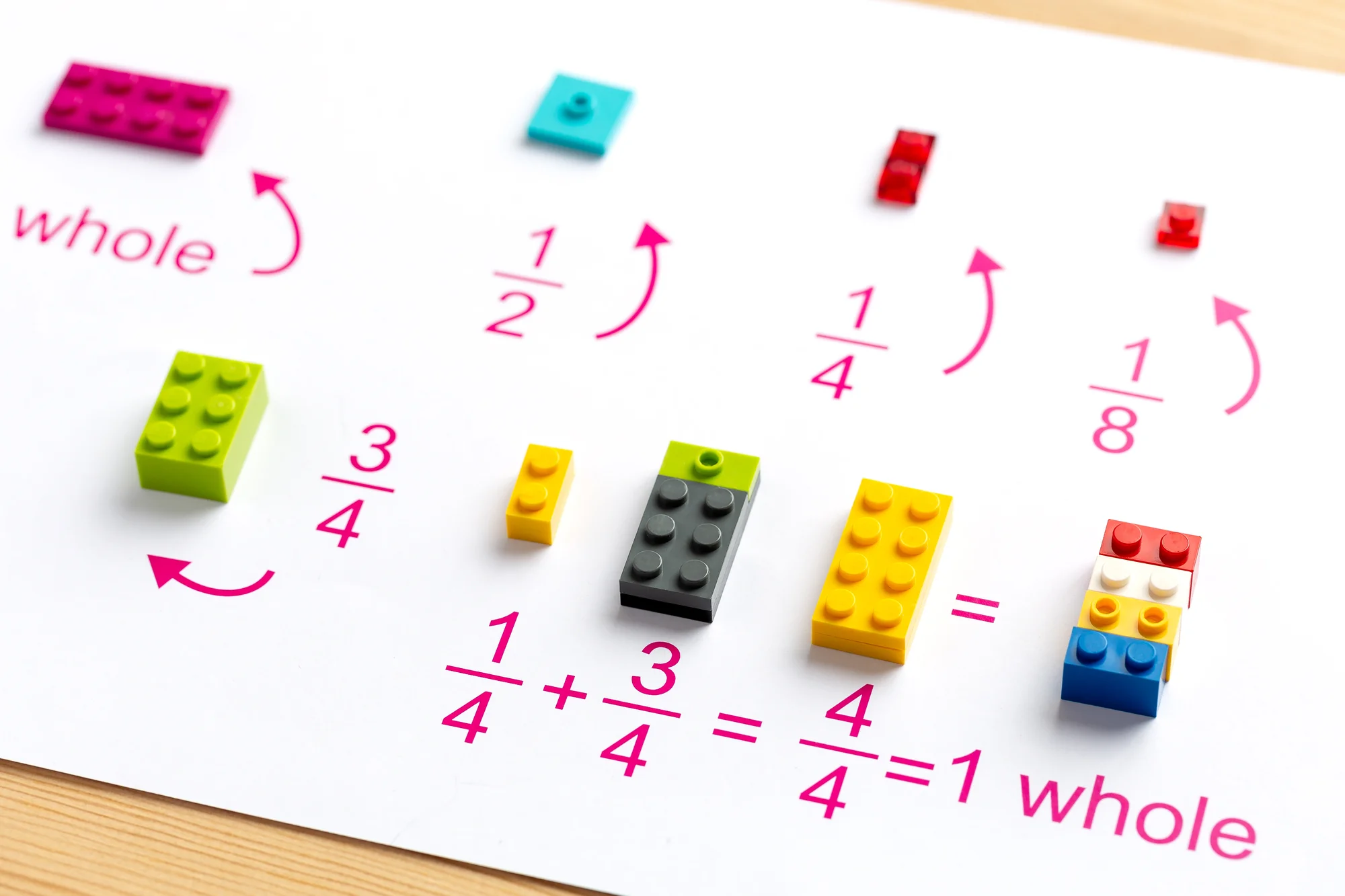
Fractions, decimals, and algebraic thinking all come together in 5th grade for the first time.
📕 You May Also Like: Measurement Conversions: A Kid-Friendly Guide
How to Read Your Child's 5th Grade Math Progress at Home
Your child's math progress shows up beyond their grades. Check whether they explain why their answers are correct, and watch how they handle the five skill areas this grade covers.
Here is what a solid understanding looks like at home:
-
They verbalize their steps: They walk you through the math and explain the "why" behind each action.
-
They see the connections: They recognize that fractions, decimals, and percents express the same relationship.
-
They plan before they act: They read a multi-step word problem, identify the goal, and map out a solution before they start to calculate.
Here is what a gap tends to look like:
-
They avoid the work: Fraction problems produce silence or a blank page.
-
They struggle with precision: Decimal placement errors reappear even after you correct them.
-
They quit too soon: Multi-step word problems get abandoned before the finish.
-
They lack context: They provide correct answers but go blank when asked to explain their logic.
These patterns are common at this level. They point to something specific and fixable, and your child has plenty of time to close these gaps before middle school.

Mathnasium's specially trained tutors help students turn specific gaps into solid foundations before middle school begins.
How Mathnasium Helps 5th Graders Build Lasting Math Skills
Mathnasium is a math-only learning center dedicated to helping K–12 students learn and master math.
Effective support starts with knowing exactly why your child is finding something difficult and meeting them there.
That is what we focus on at Mathnasium, and at the heart of every program is the Mathnasium Method™, our proprietary teaching approach built around six core principles.
-
Personalized learning: Enrollment begins with a diagnostic assessment that identifies their strengths, knowledge gaps, and how they approach math. Our instructors then follow a personalized learning plan that guides steady, structured progress.
-
Teaching for understanding: We explain math in clear, everyday language and support each concept with visual, verbal, written, mental, and hands-on techniques so your child develops a real understanding of the concepts behind each procedure.
-
Caring instruction: Our specially trained tutors provide face-to-face guidance in a supportive group environment where your child feels comfortable tackling challenging material.
-
Independent problem-solving and critical thinking: Each session includes time for your child to work through problems independently. Our tutors guide them to understand both how and why a concept works. Those reasoning tools carry into math and beyond.
-
Singular focus on math: We specialize in math and math only. Our program spans thousands of pages of materials, continuously refined around how students absorb and retain math skills.
-
A confidence-building environment: Sessions are game-based, with reward systems and consistent encouragement built in. Confidence grows with every win.
The results speak for themselves:
-
94% of parents report an improvement in their child's math skills and understanding
-
93% of parents report an improved attitude toward math after attending Mathnasium
-
90% of students saw an improvement in their school grades
With over 1,100 learning centers across the U.S., there is likely a Mathnasium close to you.
For families in and around Keller, TX, Mathnasium of Keller is a trusted local center with years of experience helping 5th graders build the math foundations they carry into middle school and beyond.
Your child's team in Keller is ready to help them catch up, keep up, or get ahead.
📅 Schedule a Free Diagnostic Assessment at Mathnasium of Keller
Not near Keller?
📍 Find a Mathnasium Learning Center Near You


 (817) 732-6284