Number Names Around the World: How Different Languages Count
May 13, 2026
| La Costa
Numbers are the same everywhere. The words for them are not.
Every language has developed its own system for naming numbers, and those systems vary far more than most of us realize: in their logic, their structure, and how much mental work they ask of the people using them.
Some are remarkably transparent. Others carry centuries of linguistic history that makes them harder to learn.
This is especially important for math. The number words children grow up with shape how easily they grasp place value, two-digit arithmetic, and number sense in the early years of school.
Today, our tutors take a close look at how different languages count, where English sits in that picture, and what students can take away from it.
Why Number Names Differ Across Languages
Numbers themselves are universal. 1, 2, 3 means the same thing whether you're in Tokyo, Cairo, or São Paulo. But the words we use for those numbers? Completely different story.
Every language built its number naming system on its own, shaped by its own history, grammar, and logic. Some count in groups of ten. Others in groups of twenty. Some build large numbers from smaller parts, almost like mini equations. A few have quirks so unusual that even native speakers occasionally trip over them.
None of this happened by accident.
Number names reflect how a culture historically thought about quantity. The base-10 system traces back to counting on fingers. Base-20 systems? Fingers and toes. The irregularities scattered across European languages are simply leftovers from older counting systems that never fully disappeared.
So why does any of this matter for learning math? The words we count with carry structure. And that structure either makes the logic of numbers easier to see or quietly hides it.
How English Counts (And Where It Gets Irregular)
English follows a base-10 system — numbers built in groups of ten. Learn the single digits, learn the tens, and you can construct most two-digit numbers on your own. Pretty straightforward.
Until it isn't.
Eleven and twelve don't follow any pattern. There's no trace of "one and ten" or "two and ten" which is exactly what a logical system would give you. They're holdovers from Old English, and they've been tripping up young learners ever since.
Thirteen through nineteen flip the order. We say the smaller digit first, fourteen, sixteen, then the ten. But from twenty-one onward, it reverses: ten first, then the unit. For a child just building number sense, that's a real stumbling block.
The tens themselves, twenty, thirty, forty, barely resemble the digits they come from. Two becomes twen-, three becomes thir-, five becomes fif-. A student has to memorize these almost as entirely new words.
Millions of children learn to count in English just fine. But these quirks do add a layer of memorization that other languages simply don't require and the next section shows exactly what that looks like.
Some languages make the structure of numbers almost impossible to miss. Mandarin Chinese is the clearest example.
In Mandarin, eleven is shí yī, literally "ten one." Twelve is shí èr, "ten two." Twenty is èr shí, "two ten." Twenty-three is èr shí sān, "two ten three."
The pattern holds without a single exception.
No equivalents of "eleven" or "twelve." No renamed tens to memorize. No order that flips halfway through. Japanese, Korean, and Turkish work the same way, fully transparent, all the way up.
Pretty elegant, right?
When number names mirror number structure, a few things get a lot easier:
Place value clicks earlier. "Two-tens-three" makes it obvious that digit position carries meaning. It's built right into the words.
Mental arithmetic feels natural. Adding 23 and 15 is easier when you're already thinking "two-ten-three" plus "one-ten-five."
Number sense develops faster. Children aren't decoding irregular labels. They're just doing the math.
Research backs this up. Studies consistently find that children learning in Mandarin, Japanese, or Korean grasp place value and two-digit arithmetic earlier than English-speaking peers simply because their language gives them a head start.
Languages Where Counting Gets Really Interesting
If English feels a little inconsistent, French takes things considerably further.
French counts normally up to sixty. Then it stops naming new tens altogether.
Seventy is soixante-dix — "sixty-ten."
Seventy-five is soixante-quinze — "sixty-fifteen."
Eighty is quatre-vingts — "four-twenties."
Ninety-three is quatre-vingt-treize — "four-twenties-thirteen."
So in French, you're not only learning number names but also doing mental arithmetic to decode them. Every time.
Danish has its own twist. Fifty is halvtreds, a contracted form of an old expression meaning "two-and-a-half times twenty." Few Danish speakers today know that. They've simply memorized the word.
Then there's Yoruba, spoken by tens of millions across West Africa, which flips the logic entirely. It uses a subtractive system: forty-five is "five from fifty," seventeen is "three from twenty." The arithmetic runs backwards.
Each of these systems has its own internal logic. But they all show the same thing: the words we count with shape the mental work that comes before the math even begins.
The connection between language and math learning is more direct than you might expect.
Researchers found that children learning in languages with regular number naming systems could count into double digits and understand place value up to a full year earlier than English-speaking peers of the same age.
So what does that mean for children learning in English?
A few small shifts can make a real difference:
Say numbers in full sometimes. When you see "23," try saying "two tens and three" alongside "twenty-three." It makes place value concrete in a way the word alone doesn't.
Spend extra time on the teen numbers. Thirteen through nineteen are where confusion tends to pile up, especially around place value. A little extra attention here pays off later.
Call out the quirks for what they are. Eleven and twelve are just odd, they don't follow the pattern. It's the language being weird, not you missing something.
Prioritize understanding over memorizing. Knowing why twenty-three comes after twenty-two is far more useful than simply knowing that it does.
None of this requires a linguistics degree. Just a little curiosity about the words you use every day and the willingness to ask "why does it work that way?" the next time a number seems a little odd.
At Mathnasium, we teach children to understand numbers from the inside out: how they work and why they are structured the way they are.
How Mathnasium Makes Math Learning Engaging & Fun
Mathnasium is a math-only learning center empowering K-12 students of all skill levels to excel in math.
No two math learners are the same. Every student has their own way of making math click: through logic, hands-on exploration, or sometimes just the right story. Our proprietary teaching approach, the Mathnasium Method™, is built around those differences.
Our approach begins the moment a student walks through our doors, with a diagnostic assessment. This relaxed interaction helps us pinpoint what they already know and where they need support. With those insights, we build a personalized learning plan tailored to their needs and goals.
With the plan in place, our specially trained tutors deliver face-to-face instruction in a warm and engaging setting. We use natural, everyday language rather than math jargon and combine verbal, visual, mental, tactile, and written techniques to help students truly make sense of what they are learning.
When students get stuck, we break concepts down into manageable steps and explain both the how and the why. Over time, they develop the critical thinking and problem-solving skills to tackle math independently in the classroom and beyond.
Fun is a core part of how we work. Whether through stories, game-based activities, or real-world exploration, learning never feels like a chore. We celebrate progress at every level, building confidence session by session.
The results speak volumes:
94% of parents report an improvement in their child's math skills and understanding
93% of parents report their child's improved attitude toward math after attending Mathnasium
90% of students saw an improvement in their school grades
With over 1,100 active learning centers, Mathnasium brings top-rated math instruction close to your community.
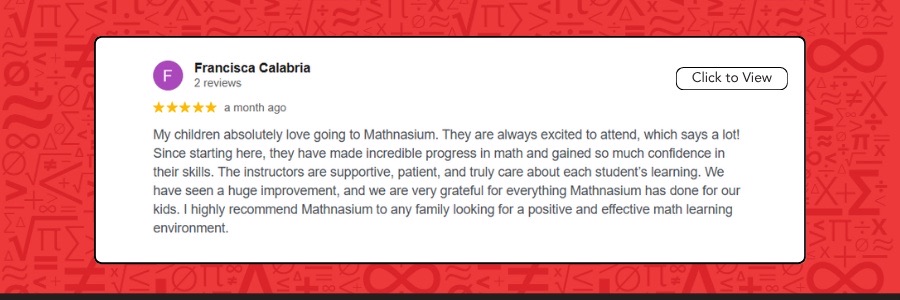
Families in and near Carlsbad, CA, trust Mathnasium of La Costa to help their children grow in math skills and confidence, season after season. They’ve awarded us with over 100 five-star reviews on Google.
Here’s what one parent had to share about our center:
Whether your child needs to catch up, keep up, or get ahead in math, our team is happy to assist.
Mathnasium of La Costa is a math-only learning center for K-12 students in Carlsbad,
CA. Trusted by over a million parents, Mathnasium uses personalized learning plans
and the proprietary Mathnasium Method™ to help students catch up, keep up, and get ahead on their math journey.
Our specially trained tutors deliver face-to-face instruction in a supportive and fun small-group environment,
working with students both in center and online to develop a deep understanding of math, build confidence,
and improve academic performance.


 (760) 452-6150
 (760) 452-6150