When your child needs extra support in math, you may wonder where to begin. Should you hire a private tutor for one-on-one help or look into a structured learning environment?
Both options can support your child, but they meet different needs.
We're a team of math educators from Carlsbad, and today we’ll look at what private math tutoring and structured math support can offer and when each choice makes sense for your child.
What Are Private Tutoring and Structured Math Support?
Before we talk about which path is right for your child, let's define what each one means so there's no confusion between the two.
-
Private math tutoring typically means you hire an independent tutor to work one-on-one or perhaps in a small group with your child. Families often book private tutors at their homes, and since we live in the digital age, online options are getting more popular.
-
Structured math support means the student follows a long-term plan for learning. These programs usually take place at a dedicated learning center or classroom space rather than at home, meeting weekly over a couple of months, through the school year, or sometimes even in the summer.
Let's take a closer look at what each one looks like in practice.
A. Private Math Tutoring
Families who choose private math tutoring usually hire an independent educator for one-on-one sessions. Since every tutor brings a unique teaching style, background, and schedule, no two experiences are quite the same.
Lesson planning and pacing also depend entirely on who you work with. Typically, private tutors focus on what your child needs right now, such as
-
Working through current schoolwork and daily assignments
-
Untangling a tricky concept or difficult unit
-
Preparing for upcoming tests or quizzes
-
Providing targeted support for specific goals
B. Structured Math Support
Structured math support takes a more organized approach to helping students learn. Instead of jumping from assignment to assignment, these programs guide students through a consistent curriculum tailored to where they are right now.
A structured math learning program may include:
-
A baseline assessment of the student’s current skill level
-
Specific learning goals built for long-term growth
-
A personalized learning plan tailored to their needs
-
Instruction that follows a logical, step-by-step sequence
-
Regular practice and reinforcement to build confidence
-
Ongoing monitoring to track how far they've come
While these programs vary by provider, they share a focus on consistency and a long-term roadmap.
Mathnasium is a math-only learning center that offers this exact kind of structured support. That support begins with a diagnostic assessment to build a personalized learning plan, followed by sessions where instructors adapt to each child's unique skills and learning style.

So, What’s the Difference?
The main difference isn't usually about whether your child gets individual attention because both models can provide that. Instead, it often comes down to the overall approach. Private tutoring may focus primarily on the student’s immediate academic needs, while structured support typically follows a longer-term plan for building math skills
📕 You May Also Like: Why Personalized Math Tutoring Makes All the Difference
 In structured math support, students follow a plan where each new skill builds on the one before it.
Which Option May Fit Your Child?
The best choice depends entirely on your child’s current needs, schedule, learning habits, and goals. Neither option is automatically better; each simply tends to work well in different situations.
When Private Tutoring May Be a Good Fit
Private tutoring can be a great choice when your child needs focused help with a specific challenge. It may work well if your child:
-
Is generally keeping up with class but is stuck on one topic, such as fractions, equations, or geometry
-
Needs short-term support before a class assessment or difficult unit
-
Benefits from one-to-one attention and a flexible schedule
-
Has a clear, immediate goal, such as improving a grade or preparing for an exam
For example, a student who understands most of Algebra 1 but struggles with factoring may benefit from a few targeted sessions with a private tutor.
Things to Consider With Private Tutoring
Private tutors vary in experience, teaching style, and approach. Some focus strictly on the homework or test a student brings to each session, while others use informal assessments to guide their time together.
Without a broader diagnostic assessment, it can be harder to identify shaky foundations from earlier grades.
For example, a student who struggles with algebra often needs more than help with a single equation; they may need to revisit earlier concepts like fractions and negative numbers that build number sense and make higher-level math easier.
Students who get frequent homework help can also struggle to work independently. They may start to rely on a tutor to get through each problem instead of gaining the confidence to solve new problems on their own.
Lastly, private tutoring is usually billed by the hour, which means costs can quietly stack up if a student ends up needing consistent, long-term support over the course of a school year.
When Structured Math Support May Be a Good Fit
Structured math support tends to be a better fit when your child needs a steady, reliable safety net over time rather than a quick fix for tonight. It may be especially helpful if your child:
-
Has foundational gaps from earlier grades that make new math topics harder than they should be
-
Needs regular practice, consistency, and a predictable routine to stay on track
-
Feels discouraged after repeated struggles or has lost confidence in math
-
Needs support with underlying number sense, not just whatever is on tonight's worksheet
-
Is looking for extra challenge to stretch their thinking beyond the standard classroom curriculum
For example, a student who consistently stumbles over fractions and multi-step equations often needs more than last-minute homework help. A structured approach can pinpoint exactly where things got bumpy and rebuild those skills step by step.
On the flip side, it's just as useful for a student who is sailing through class and ready for enrichment, providing a thoughtful roadmap that deepens their thinking while keeping their foundation rock-solid.
📕 You May Also Like: How Long Does It Take to See Math Improvement with Math Tutoring?
Things to Consider With Structured Math Support
Structured programs like Mathnasium’s often use a membership or package model rather than charging per session. That can offer great value for families who need ongoing support, but it is important to compare the cost with how often your child is likely to attend.
These programs typically require a regular routine, such as two or three set sessions per week. While consistency is what helps students build lasting skills and confidence, families will want to choose a schedule that fits comfortably alongside school, extracurriculars, and family life.
It is always a good idea to ask how a structured program handles day-to-day class demands. An efficient program will keep its eyes on long-term skill-building while still making sure your child feels supported with whatever is on their desk this week.
 Structured learning centers like Mathnasium often use a flat monthly fee that, over the long run, can be more cost-effective than paying higher hourly rates for ongoing private tutoring.
Questions to Help You Pick an Option
We’ve prepared several questions to help you compare private tutoring and structured math support based on your child’s needs and your family’s schedule.
1. Is your child struggling with this week’s unit or with math overall?
If they are stuck on one topic, such as factoring, geometry proofs, or solving equations, private tutoring sessions may provide the focused and immediate help they need. If similar difficulties keep appearing across units, a structured plan may be better for rebuilding underlying skills.
2. Has your child lost confidence in math?
A student who avoids math, gives up quickly, or says “I’m just bad at math” may benefit the most from structured support. While private tutoring may offer support and understanding, rebuilding deep-seated confidence usually requires a consistent plan focused on steady wins and visible progress over time.
3. Does your child need help before a specific test or over a longer period?
For a quiz, exam, or difficult chapter, private math sessions can address immediate needs. For ongoing struggles, a cumulative exam that covers multiple units, such as the SAT® or ACT®, or a need to rebuild foundational confidence, a longer-term plan may be a better fit.
For example, at Mathnasium, we adjust each student’s learning plan to their needs. Whether they are preparing for a cumulative test such as the SAT®, getting ready for an academic transition, or working to close foundational gaps, the plan can focus on the skills and strategies that will help them make steady progress.
4. Is your child disengaged from their current math curriculum?
Students may feel bored or disconnected from what they are learning in school because they are not being challenged enough. Disengagement can also stem from math anxiety or frustration. In either case, structured support can provide both academic challenge and emotional encouragement to help students get back on track or reach their full potential.
5. What schedule and level of commitment can your family maintain?
Private tutoring is usually billed by the hour, offering maximum schedule flexibility for families who need help on an as-needed basis. Structured support typically relies on a predictable weekly rhythm (such as visiting a center twice a week), which builds strong consistency but requires a steady, ongoing commitment in your family's calendar.
 Mathnasium’s specially trained tutors guide each student through a personalized learning plan in a caring and fun group environment.
How Mathnasium Provides Structured, Personalized Math Support
Mathnasium is a math-only learning center dedicated to helping K–12 students of all skill levels excel in math.
We know that no two students approach math in the same way. That’s why we personalize each student’s learning experience through our proprietary teaching approach, the Mathnasium Method™.
Here’s how it works.
Each student begins enrollment with a diagnostic assessment that helps us understand their current skills and identify learning gaps. These insights help us create a learning plan customized to their needs.
With the plan in place, our tutors follow it closely, teaching math face-to-face in a supportive environment. We teach for understanding, meaning we strip away unnecessary math jargon and use everyday language to explain math concepts. We also rely on a mix of verbal, visual, mental, tactile, and written techniques to help each concept click.
If a student gets stuck on a problem, we break it down into manageable steps, teaching both the how and the why behind the answer. By working with our tutors, students develop problem-solving skills and critical-thinking tools they can use in math and beyond.
Last but not least, fun is an integral part of our approach. We use game-based activities and ample rewards to help students enjoy the learning process and grow their confidence with each session.
The results speak volumes:
-
94% of parents report an improvement in their child’s math skills and understanding.
-
93% of parents report an improved attitude toward math after attending Mathnasium.
-
90% of students saw an improvement in their school grades.
With more than 1,100 active learning centers, Mathnasium brings top-rated math instruction close to your community.
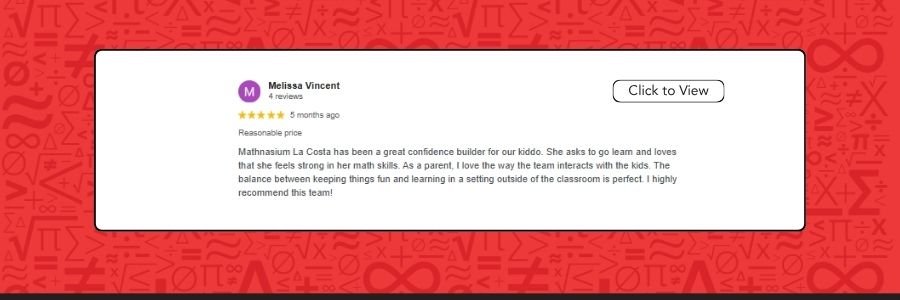
Families in and near Carlsbad, CA, trust Mathnasium of La Costa to help their children grow in math skills and confidence, season after season. They have awarded our center more than 100 five-star reviews on Google.
Here’s what one parent had to share about our center:
Whether your child needs to catch up, keep up, or get ahead in math, our team is happy to help.
📅 Schedule a Free Assessment at Mathnasium of La Costa
Not near La Costa, Carlsbad?
📍 Find a Mathnasium Learning Center Near You


 (760) 452-6150
 (760) 452-6150