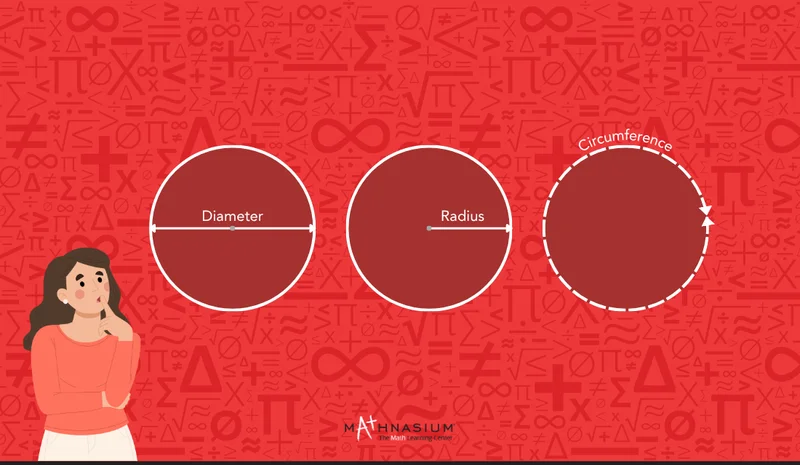
Radius, diameter, and circumference come up together a lot when students start learning about circles. What each term means and how they connect, though, isn't always as clear.
Whether you're meeting these terms for the first time or just want to finally understand how they connect, this guide is for you.
Today, Mathnasium tutors walk you through the radius, diameter, and circumference of a circle, what each one means, how they relate, and how knowing just one measurement lets you find the rest.

What Is the Radius of a Circle?
The radius of a circle is the distance from the center of the circle to any point on its edge. We label it with the letter r.
Let’s picture a bicycle wheel. The spokes run from the center hub all the way out to the rim, and each one is a radius. No matter which spoke you pick, they all cover the same distance.

That's one of the most important properties of a circle. Every radius is equal.
Here's a simple example. Let’s say a circle has a radius of 5 cm. That means every point on the edge sits exactly 5 cm away from the center, all the way around.
We use the radius of a circle constantly in geometry, from calculating area to working with circumference. And the moment we know the radius, finding the diameter takes just one simple step.
📕 You May Also Like: What Is Area in Math? A Complete & Kid-Friendly Guide
What Is the Diameter of a Circle?
The diameter of a circle is the distance straight across the circle, passing through the center. In math, we label it as d.
Let’s imagine a pizza. If we cut it straight through the middle to divide it into equal halves, that cut is the diameter. It starts at one edge, passes right through the center, and reaches the other side.
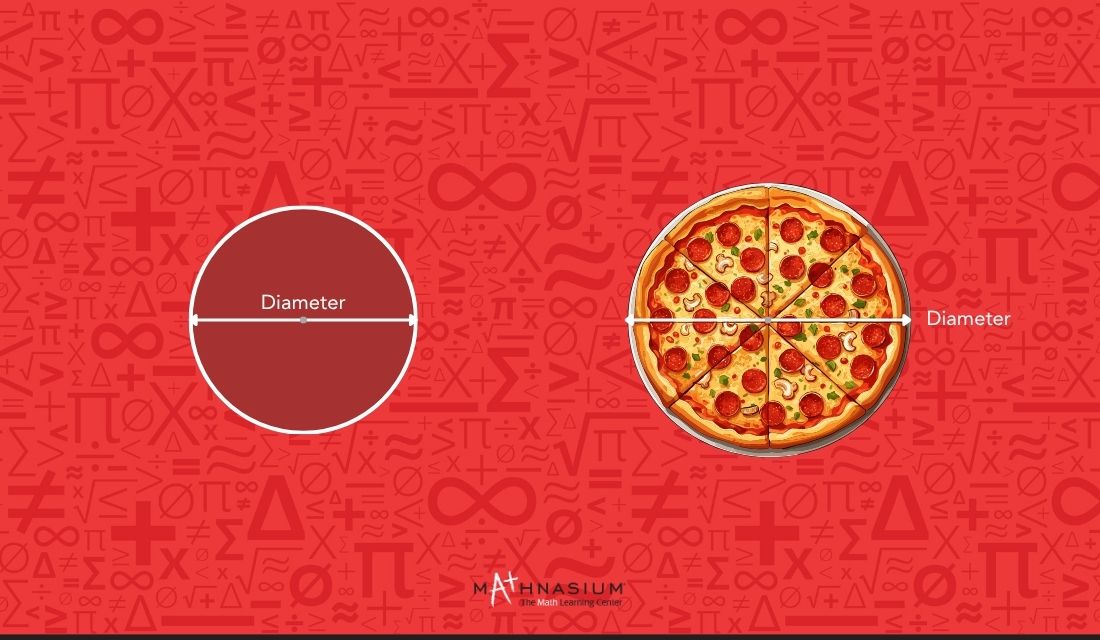
If we take a closer look at the image above, we notice that the diameter passes through the center and connects two radii going in opposite directions. That gives us our first relationship:
diameter = 2 × radius or d = 2r
Say the radius of a circle is 5 cm. The diameter is 2 × 5cm = 10 cm.
This works the other way around, as well. If you know the diameter, divide it by 2, and you have the radius. The two measurements are always linked.
Now that you have the concept, can you think of where you've seen a diameter in real life? Here are just a few:
-
The width of a cake
-
The span of a coin
-
The lid of a jar
📕 You May Also Like: What Is a Diameter & How to Measure It? A Beginner’s Guide
Radius vs. Diameter: What's the Difference?
Both the radius and the diameter measure distance across a circle, but they do it differently. Here's a quick side-by-side:
| |
Radius |
Diameter |
| What distance does it measure? |
From the center to the edge |
From one edge to the opposite edge, through the center |
| Does it pass through the center? |
Starts at the center |
Passes through the center |
| Formula |
r = d ÷ 2 |
d = 2r |
What Is the Circumference of a Circle?
The circumference of a circle is the distance all the way around it. We can think of it as the perimeter of a circle.
No matter the size of the circle, the ratio of the circumference to the diameter is always the same number.
That number is π (pi), and it’s approximately 3.14. It shows up in every circle ever measured: a coin, a Ferris wheel, a planet. Just divide any circumference by its diameter, and we always land on π.
That gives us the formula:
C = πd
Since d = 2r, we can add that into the formula above and write it as :
C = 2πr
Both formulas tell us the same thing. We use whichever one fits what we already know:
-
If we have the diameter, we use C = πd.
-
If we know what the radius is, we use C = 2πr.
Let’s try a simple example. If a circle has a diameter of 10 cm, its circumference is simply:
C = π × 10cm ≈ 3.14 × 10cm ≈ 31.4 cm
📕 You May Also Like: 7 Amazing Facts About Pi Every Math Student Should Know
Solved Examples of Radius, Diameter, and Circumference
Let’s go through a few solved examples together and see how to find any measurement if we know one already.
Example 1
For example, the radius of a circle is 4 cm. Here's what we can figure out.
Step 1: Find the diameter.
-
d = 2r
-
d = 2 × 4 = 8 cm
-
d = 8 cm
Step 2: Find the circumference.
-
C = πd
-
C = 3.14 × 8 = 25.12 cm
-
C = 25.12 cm
We started from the radius and found both the diameter and the circumference in two steps.
Example 2
If the diameter of a circle is 10 cm, let's find the other two measurements.
Step 1: Find the radius.
-
r = d ÷ 2
-
r = 10 ÷ 2 = 5 cm
Step 2: Find the circumference.
-
C = πd
-
C = 3.14 × 10 = 31.4 cm
Example 3
The circumference of a circle is 18.84 cm. To find the diameter and radius, we need to work backwards, and that's what makes it a great challenge.
Step 1: Find the diameter.
-
d = C ÷ π
-
d = 18.84 ÷ 3.14 = 6 cm
Step 2: Find the radius.
-
r = d ÷ 2
-
r = 6 ÷ 2 = 3 cm
Your Turn: Find the Missing Two Measures If You Know One Already
Ready to practice what we’ve covered? Try these challenges on your own and check your answers at the bottom of the guide.
-
A circle has a radius of 7 cm. Find the diameter and the circumference.
-
The diameter of a circle is 18 cm. What are the radius and the circumference?
-
A circle’s circumference is 43.96 cm. Can you find the diameter and the radius?
FAQs About the Radius, Diameter, and Circumference
We know that the connection between radius, diameter, and circumference can bring up a few questions, so we’ve put together clear answers to the ones students ask most often.
1. Why does the ratio of a circle's circumference to its diameter always equal the same number (pi)?
All circles have the same shape. They just come in different sizes. When a circle gets bigger, its circumference and diameter grow by the same factor, so their ratio always stays constant. Divide any circle's circumference by its diameter, and you always land on the same number: π, approximately 3.14.
-
A circle with a diameter of 5 cm has a circumference of 15.7 cm. If we divide 15.7 by 5, we get 3.14.
-
A circle with a circumference of 62.8 cm and a diameter of 20 cm. Divide 62.8 by 20, and you still get 3.14.
Different sizes, same ratio. Every single time.
2. Do I need to memorize pi?
Not exactly. The important thing to understand is what pi represents, which is the ratio of the circumference to the diameter of any circle, and that its approximate value is 3.14. If we know how to apply it, that’s far more important than memorizing every decimal.
3. How do I measure radius, diameter, and circumference on real objects?
Take a lid as an example. Measure straight across the center, and you have the diameter. Divide that number by 2, and you have the radius.
To find the circumference, wrap a piece of string around the edge, straighten it out, and measure it. If a lid measures 12 cm across, its circumference is 3.14 × 12 = 37.68 cm.
4. What is the difference between diameter and width?
These two words sometimes get used interchangeably, but in math, they mean different things.
-
The diameter of a circle is a specific measurement, the distance across a circle passing through the center.
-
Width describes how wide something is in general, and it doesn't have to pass through a center or even apply to a circle.
So while the diameter tells us the width of a circle, not every width is a diameter.

At Mathnasium, specially trained tutors help students build a deep understanding of the connection between radius, diameter, and circumference and how to find each measure, one step at a time.
Master Circles (And Any Other Math Concept) with Mathnasium
Mathnasium is a math-only learning center dedicated to helping K–12 students of all skill levels learn and master math.
Whether a student needs help (re)building foundational skills, mastering specific concepts like circles (and circle measurements), or a challenge above their curriculum level, we teach for true understanding.
To help students reach that level, our specially trained tutors use the Mathnasium Method™, a proprietary teaching approach designed around individual students’ needs and learning styles.
Each student starts their Mathnasium enrollment with a diagnostic assessment that helps us identify their current skills, knowledge gaps, and learning goals. From there, we build a personalized learning plan tailored to their needs and pace.
We use plain, everyday language and a mix of verbal, visual, mental, tactile, and written techniques so the math makes sense.
If students get stuck on any math concept, we break it down into manageable steps and teach both the how and the why behind it. Gradually, students learn to do the same independently and walk out of our centers with the problem-solving skills and critical thinking tools they can use in math and beyond.
Fun is an important part of how we work. Sessions often include game-based and hands-on activities that keep students engaged and learning enjoyable. Students earn rewards along the way, and every bit of progress gets celebrated, so confidence grows alongside mastery.
This approach brings measurable results:
-
94% of parents report an improvement in their child's math skills and understanding
-
93% of parents report their child's improved attitude toward math after attending Mathnasium
-
90% of students saw an improvement in their school grades
With more than 1,100 learning centers, Mathnasium brings top-rated math instruction close to your home.
For families in and around Lakewood, CO, Mathnasium of Lakewood is a trusted local resource, recognized by Business Rate as the Best Tutoring Services in Lakewood.
Whether your child is looking to catch up, keep up, or get ahead in math, our team is more than happy to help!
Ready to get started?
📅 Schedule a Free Diagnostic Assessment at Mathnasium of Lakewood
Not near Lakewood?
📍 Find a Mathnasium Learning Center Near You
Psst! Check Your Answers Here
Great job working through the practice problems! Here are the answers:
-
d = 2 × 7 = 14 cm
C = 3.14 × 14 = 43.96 cm
-
r = 18 ÷ 2 = 9 cm
C = 3.14 × 18 = 56.52 cm
-
d = 43.96 ÷ 3.14 = 14 cm
r = 14 ÷ 2 = 7 cm
How did you do?


 (303) 975-6159
 (303) 975-6159