When families come to Mathnasium for support, we often hear the same concern from parents of middle and high school students: the start of school feels overwhelming.
Within the first couple of weeks, students face early quizzes, placement exams, and other assessments that can leave them feeling measured before they’ve even settled into their classes. It’s no surprise that many kids begin the year anxious or even convinced they’re already behind.
At Mathnasium, we help students navigate these challenges by pinpointing where skills need reinforcement and building personalized learning plans that develop skills and restore confidence.
However, support doesn’t have to stop in our centers.
For this back-to-school season, we’ve created a parent guide that explains why these worries arise and offers practical strategies you can use at home to build your child’s resilience for the assessment-heavy start of school in grades 5–10.

Why Early Math Quizzes and Placements Feel So Tough in Grades 5–10
In the first few weeks of school, students in grades 5–10 frequently encounter quick math quizzes, “level checks,” or placement evaluations (sometimes disguised as baseline tasks).
In middle school, the assessments may cover fractions, decimal operations, integer rules, or early pre-algebra skills such as solving equations, graphing functions, or basic geometry proofs.
Regardless of the assessment format, students often experience them as high-stakes moments, especially if results influence groups or course placement.
So why do these early assessments trigger dread?
From both what we see in our learning centers and what research confirms, several factors contribute.
1. Skill Gaps Surface Quickly
Looking at the results from the 2024 NAEP Mathematics Assessment, there is evidence that math proficiency is slowly recovering nationwide, but the aftereffects of COVID disruptions still echo in students’ math performance.
Students who are now in middle or early high school spent critical years in elementary grades during those disruptions. As a result, foundational skills like fraction fluency, decimal operations, or algebra readiness weren’t always reinforced as deeply as they should have been.
When a new school year begins and teachers check for readiness, those gaps often show up quickly.
The problem is compounded by the summer slide. A well-cited 1996 meta-analysis found that, on average, students lose the equivalent of about one month of grade-level learning in math during summer break.
For students with shaky foundations, this loss adds extra pressure to early assessments. What looks like a simple skills check to a teacher can feel like proof that they are already behind.
📕 You May Also Like: Is My Child “Bad at Math” or Missing Foundational Skills?
2. The Pace Jumps Fast
In grades 5–10, math doesn’t always move forward in small increments.
In middle school, one year may end with fractions, and the next begins with ratios, percentages, and algebraic expressions that feel like a new language. In Texas, for example, pre-algebra is typically introduced by 7th grade, with geometry concepts following soon after.
By early high school, the curriculum accelerates again. Algebra I quickly extends into quadratic equations and functions, while Geometry introduces formal proofs and more abstract reasoning.
This transition can feel jarring because success now depends on new ways of thinking rather than repeated practice with familiar skills.
3. Anxiety Interferes With Thinking
When pressure mounts, cognitive performance is impaired. Research shows that test anxiety can reduce working memory capacity and make it harder to filter distractions and focus on problem steps.
Even students who know the material well may find their recall blocked by fear or worry under test conditions.
📕 You May Also Like: Understanding Math Anxiety and How to Overcome It
4. Early Results Shape Identity
First assessments can carry psychological weight far beyond the grade itself. Studies in educational psychology find that early academic labeling, whether implicit or explicit, affects academic self-concept and motivation over time.
A poor start may become a story students tell themselves: “I’m not a math person,” unless parents and teachers reframe it quickly.

Early test results can shape how students see their math ability.
5 Test-Focused Strategies to Build Resilience and Reduce Anxiety
Drawing from our experience working with students across a wide range of skill levels, we’ve compiled five practical strategies parents can use to help children face early quizzes and placement tests with greater calm and confidence.
📕 You May Also Like: Test Prep Tips: Helping Your Child Succeed on Math Exams
1. Simulate Quiz Conditions at Home
Fear eases when practice mirrors the conditions of an actual test.
Set up short, timed sessions, about 10 to 15 minutes, to mimic the rhythm of a quiz.
For a 6th grader, this could mean solving a mix of fraction problems like finding a common denominator, adding unlike fractions, and simplifying the answer.
For a 9th grader, try a quick set of geometry basics such as calculating the area of triangles, using the Pythagorean theorem, or identifying angle measures in parallel lines.
Instead of a perfect score, the goal should be to stay steady under time limits.
Afterward, go over mistakes the way our instructors do: look at what the student was thinking rather than just what went wrong. This builds confidence that mistakes can be understood and corrected, not feared.

Short, timed practice sessions at home help students get comfortable with the pressure of real quizzes while learning from mistakes in a low-stress setting.
2. Target Weak Spots with Focused Reviews
Students make the most progress when practice is concentrated on one specific area instead of spread thin across pages of problems.
Research syntheses confirm that short, focused work on a single concept, paired with having the student explain their reasoning, improves both retention and understanding.
For a 5th grader, this might mean reviewing decimal place value until it feels automatic; for an 8th grader, working through the steps of solving equations with variables.
At Mathnasium, we also recommend mixing in problems of varied difficulty rather than giving a string of identical exercises.
A few easy wins reinforce confidence, while one or two stretch problems mirror the variety of real quizzes and keep students resilient when the material feels less predictable.
3. Use Metacognitive Strategies
Educational psychology defines metacognitive strategies as the habits students use to monitor their own thinking: pausing to plan steps, check progress, and adjust if something doesn’t add up.
What does this mean for your student?
For a middle school student, this may look like sitting down to a quiz problem such as 2(3x – 4) = 10. A common misstep is to divide by 2 right away. A metacognitive pause might sound like, “What comes first here—should I divide, or should I distribute?” From that quick self-check, the student realizes the first step is distribution, not division, and avoids the error.
On a quiz problem like Solve 2x² + 5x = 3x² – 7, a student might be tempted to divide through by x right away. A metacognitive pause could sound like, “If I divide by x, what happens if x = 0? I might lose a solution. Better to move all terms to one side first.” That self-question protects them from dropping part of the answer.
4. Use Visual Tools to Strengthen Understanding
When math feels abstract, students can lose their bearings. A large meta-analysis covering thousands of learners found that adding visuals, like diagrams or models, consistently led to stronger outcomes than working with symbols alone
For a middle school student, this may look like sketching fraction bars to compare \(\Large\frac{3}{4}\) and \(\Large\frac{5}{8}\) instead of trying to calculate common denominators under pressure. The picture makes the relationship obvious and speeds up decision-making.
For an early high school student, visualization might mean graphing a linear equation like y = 2x + 3 to see how slope and intercept behave. Rather than juggling abstract numbers, they can check their work against a clear visual pattern.
5. Practice Relaxation Techniques
When psychologists studied the effect of slow, deliberate breathing on adolescents taking tests, they found it eased anxiety and improved focus
Parents can encourage a simple version: inhale for a count of four, hold briefly, exhale for a count of six. Paired with a small physical reset, like rolling the shoulders or loosening a tight pencil grip, this technique helps students settle before or during a quiz.
With regular use, even a basic routine like this becomes a trusted tool for staying composed when the stakes feel high.

How Mathnasium Helps Middle & High School Students Prepare for Tests and Beyond
Mathnasium is a math-only learning center dedicated to helping K–12 students unlock their full potential in math.
Many families come to us as the school year begins, when the first quizzes, placement exams, and classroom evaluations feel especially daunting. Others are focused on building long-term confidence.
To support every student, we use our proprietary teaching approach, the Mathnasium Method™. Since 2002, this method has reshaped how children learn math, moving away from memorization and toward true understanding.
It all starts with a diagnostic assessment. In our relaxed setting, this feels less like an evaluation and more like a conversation. We identify the skills a student already handles well, the areas where they need support, and the way they learn best, whether that’s visual, verbal, or hands-on.
From there, we design a personalized learning plan tailored to their needs. Our specially trained tutors follow this plan while working face-to-face in an engaging, small-group environment.
If a student is preparing for a placement exam, a challenging quiz, or a classroom test, tutors target the specific concepts that need strengthening while also reinforcing problem-solving and test-taking strategies. Over time, students learn not just to prepare for a single test, but to approach math with independence and confidence.
Families see measurable results:
-
94% of parents report an improvement in their child’s math skills and understanding
-
93% notice a more positive attitude toward math
-
90% of students see better grades in school

At Mathnasium, students prepare for the new school year by strengthening skills, closing gaps, and building confidence for the first round of tests.
With more than 1,100 centers nationwide, Mathnasium is close to home for many families.
For families in Plano, TX, Mathnasium of Legacy West has years of experience helping middle and high schoolers prepare for the challenges of a new school year and discover that math can be a source of confidence, not stress.
Here’s what one parent said about our center:
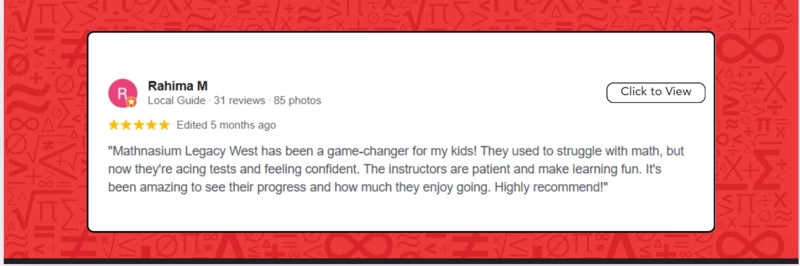
If you’re looking to help your child start strong, schedule a free diagnostic assessment. Together, we’ll carve out a personalized learning path that builds skills, confidence, and lasting success in math.
📅 Schedule a Free Diagnostic Assessment at Mathnasium of Legacy West
Not near Plano?
Find a Mathnasium Learning Center Near You


 (214) 618-0558
 (214) 618-0558