What used to be simple counting and basic facts in first-grade math now grows into something more structured in second grade.
This is the year students begin to see numbers as systems or groups of tens and hundreds that can be built, broken apart, and reasoned through. In other words, it’s the point when math becomes less about doing and more about understanding.
Still, not every math topic in second grade carries the same weight.
The Common Core standards identify a few critical areas that deserve the most time and attention. These skills form the backbone of future success in math class and in problem-solving more broadly.
So today, Mathnasium tutors will break down what core areas for 2nd-grade math are and share center-approved strategies to support them at home.
The 4 Critical Areas of 2nd Grade Math
Whether they realize it or not, students sometimes treat math as a series of isolated topics. In reality, math works more like a system where each part supports the others. The same is true for second grade. Though it's an early stage of math learning, it's foundational to everything that comes after.
Common Core identifies core focus areas as “building blocks” for all higher-level mathematics.
1. Extending Understanding of Base-Ten Notation
Second grade is when students begin to treat numbers as something more than sequences to count. They start to understand how numbers are constructed and how that structure can be used to solve problems, make comparisons, or represent the same value in different forms.
By the end of 2nd grade, students should be comfortable with:
-
Reading and writing numbers up to 1,000, like writing “six hundred thirty-two” in standard form: 632
-
Identifying place value in hundreds, tens, and ones, for example, explaining that the 4 in 245 stands for 40, not “four”
-
Writing numbers in expanded form, such as showing that 308 is made of 300 + 0 + 8
-
Comparing numbers based on place value, for instance, understanding 842 is greater than 824 because 4 tens is greater than 2 tens.
-
Counting by 5s, 10s, and 100s from any number, starting at 25 and continuing: 25, 30, 35, 40...
A well-rounded understanding of base ten gives students control over numbers.
How does this connect to the math that comes next?
Regrouping, estimating, comparing large numbers, and beginning multiplication all rely on knowing how numbers are built and how their value changes by place.
So, we can think of place value as not just a skill, but the lens that makes big numbers make sense.
📕 You May Also Like: What Is Regrouping in Math? A Student Guide
2. Building Fluency with Addition and Subtraction
Students are first introduced to addition and subtraction in first grade through number lines, counting strategies, and manipulatives like cubes or blocks.
With that foundation in place, second grade is where fluency starts to take shape. This means students will learn to recognize patterns, choose strategies efficiently, and explain how and why their methods work.
Here’s what that should look like by the end of the year:
-
Recalling sums and differences within 20 quickly, such as knowing that 7 + 6 = 13 without pausing to count
-
Using mental strategies like make-10 or doubles, for example, solving 8 + 5 by breaking it into 8 + 2 + 3
-
Solving one- and two-step word problems with larger numbers, like “Ben had 76 stickers. He gave away 29. How many does he have now?”
-
Working with numbers up to 1,000 confidently, such as solving 420 + 180 by breaking apart and regrouping
Fluent addition prepares students to work with patterns. Students who understand repeated addition, like 4 + 4 + 4, are already building the idea of multiplication, just without the symbol yet.
Being confident with subtraction helps students think in reverse. If they understand how to find what’s missing, like solving 82 – ___ = 47, they’re developing the reasoning needed for regrouping, comparisons, and early algebra.
3. Using Standard Units of Measure
Next up, and no less important, is measurement. In second grade, students move beyond estimating or comparing objects by sight. This is the year they begin measuring with purpose, using real tools and standard units to describe length precisely.
Here’s what confident measuring looks like at this level:
-
Mastering standard tools: Use rulers and yardsticks to measure length accurately in both inches and centimeters.
-
Understanding unit Iteration: Recognize that a measurement represents a specific number of equal-sized units (e.g., knowing 5 inches is exactly five 1-inch segments joined together)
-
Selecting the right scale: Determine the most efficient unit for the job, such as using centimeters for a small stamp or inches/feet for a classroom desk.
-
Calculating length differences: Compare two objects and use subtraction to determine exactly how much longer one is than the other.
We can think of measuring in 2nd grade as the bridge between basic counting and more advanced ideas like geometry, data, and multiplication. It helps students see space as measurable and units as part of a structured system.
That understanding shows up later when they calculate area, build graphs, solve word problems, or convert between inches and feet.
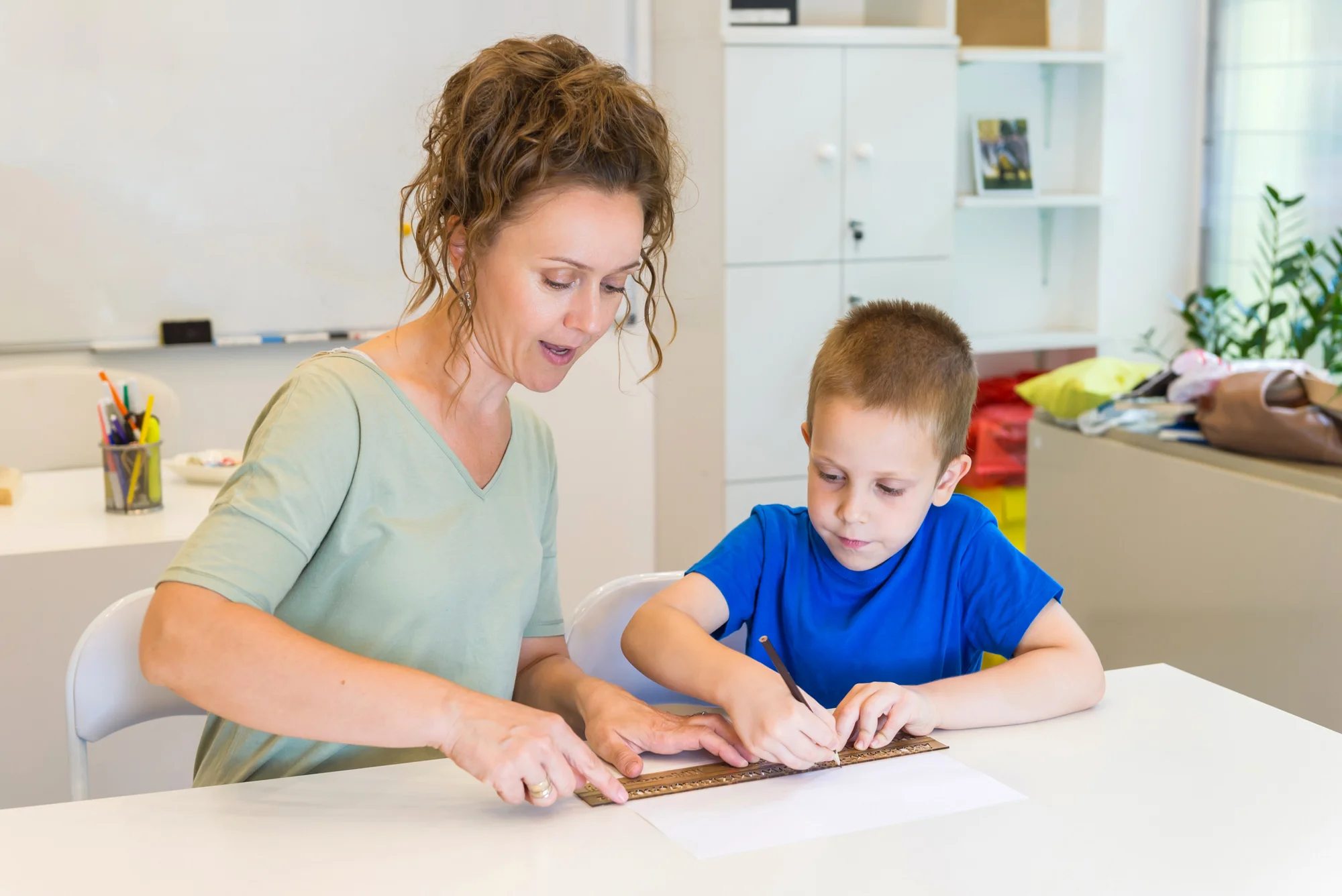
Measuring with units builds the structure students need for multiplication and geometry.
4. Describing and Analyzing Shapes
Last but not least: geometry. At this point, students begin to look at shapes by their parts — sides, angles, corners — and explore how those parts can be rearranged or combined.
It’s a visual, hands-on way to build reasoning that connects directly to the math they’ll do in later grades.
Second grade sets the stage for geometry with skills like:
-
Identifying shapes by sides and angles, like naming a figure with four equal sides and right angles as a square
-
Describing two- and three-dimensional shapes, such as explaining how a cube has six square faces
-
Partitioning shapes into equal parts, for example, dividing a rectangle into four equal pieces and labeling each as one-fourth
-
Combining and decomposing shapes, like creating a new figure by putting two triangles together, or breaking a square into smaller rectangles
A solid grasp of shapes connects directly to math that comes later:
-
Area and perimeter (Grade 3+): Students will need to break complex shapes into rectangles in order to calculate total surface space.
-
Fractions (Grade 3+): Partitioning shapes builds the concept of equal parts. Before a student can understand \(\Large\frac{1}{4}\) as a number, they need to see it as part of a shape.
-
Volume (Grade 5+): Understanding the structure of 3D shapes sets the stage for measuring how much space a solid object holds.
-
Congruence and similarity (Middle school): Analyzing sides and angles early on prepares students to later prove whether shapes are identical or scaled versions.
-
Symmetry and transformations (High school): Identifying vertices and lines helps students understand how shapes reflect, rotate, and move on a coordinate plane.
How to Help Your 2nd Grader Master These Skills
Second grade lays the groundwork for the kind of math thinking students will rely on for years. Knowing how to support your child in this formative period means you’re helping them build lasting confidence.
Here are a few tutor-backed strategies that work just as well around the kitchen table as they do in our learning center.
1. Use Base-Ten Tools to Make Place Value Visual
Place value can feel abstract until students have something they can see and touch. That’s what makes base-ten tools so efficient.
They turn number structure into something visual and even better, something students can build and break apart themselves.
For inspiration, you don’t need anything fancy. A set of base-ten blocks, a hundreds chart, or just paper squares can do the job.
Once you’ve got a few tools ready, here’s how to make them count:
-
Build a number like 372 using blocks (3 hundreds, 7 tens, 2 ones), then ask: “What changes if we add one ten?” or “What if we remove a hundred?”
-
Practice regrouping by exchanging 10 ones for one ten, or 10 tens for one hundred, helping your child actually see how the number shifts.
-
Draw and label blocks on paper if you don’t have physical tools close at hand. Visualizing 423 as 4 large squares, 2 strips, and 3 dots still reinforces the structure.
Making place value visible helps students stop guessing and start reasoning. After they see how numbers are built, the logic behind regrouping and large-number operations becomes much easier to grasp.
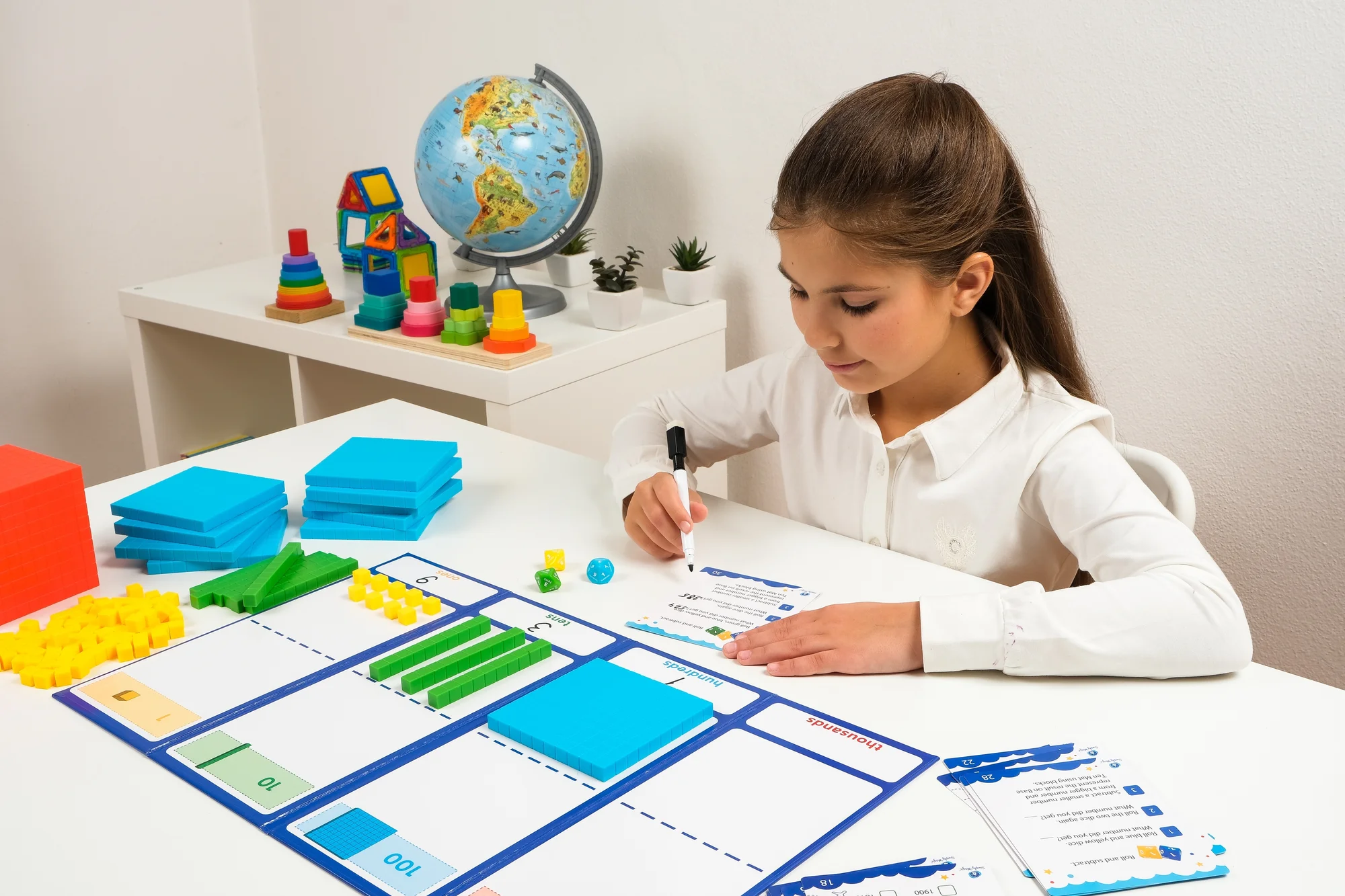
Base-ten blocks help students see how numbers are built and why each digit matters.
2. Make Addition and Subtraction Strategic
What comes to mind when we mention addition and subtraction fluency?
Coming up with answers fast? Not exactly.
Fluency means being able to make sense of numbers, spotting patterns, and using number relationships to solve efficiently.
And how do you support that kind of thinking?
With a few simple but thoughtful strategies:
-
Focus on patterns and relationships: Noticing how one problem connects to another helps students solve faster; for example, if they know 9 + 5 = 14, then 9 + 6 is just one more
-
Near doubles: Using a known double fact and adjusting slightly, like solving 7 + 8 by thinking 7 + 7 = 14, then adding 1 more to get 15
-
Make-a-10: Breaking numbers apart to create a 10 first, like turning 9 + 5 into 9 + 1 = 10, then adding the remaining 4 to make 14
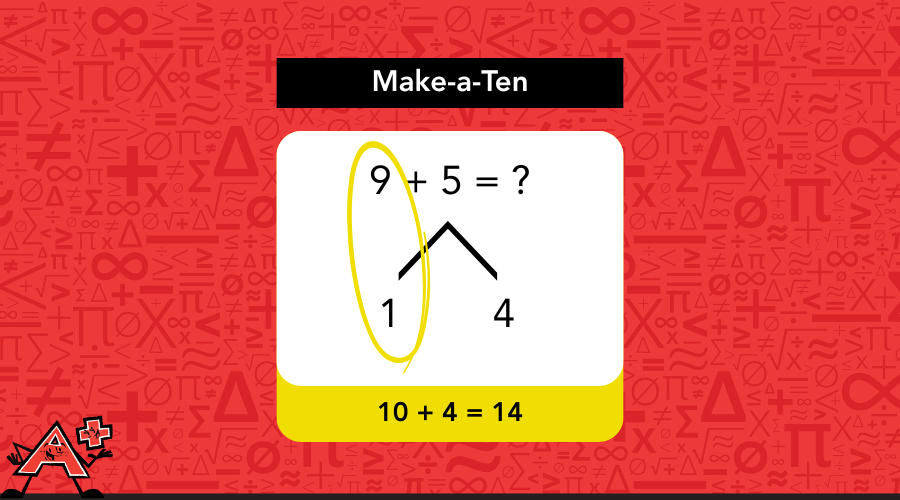
Strategies like Make-a-10 help students solve more efficiently and build number sense that supports future math.
3. Let Measurement Happen Beyond the Worksheet
If there’s one area of math that’s easier to practice than it looks, it’s measurement.
Why? Because the opportunities are everywhere.
With a little creativity and intention, everyday objects turn into tools for thinking mathematically and comparing lengths, picking the right units, and reasoning through size in a hands-on way.
To reinforce measurement at home, we recommend:
-
Measure the same object with different tools: Try using both a ruler and a measuring tape to measure a book. Ask which was easier and whether the results matched. It builds tool sense and measurement accuracy.
-
Use nonstandard units before switching to standard: Have your child measure a pencil with paper clips, then with a ruler. The “aha” moment when they see why standard units matter makes a lasting impression.
-
Talk about which unit fits best: Measure a table in inches, then again in centimeters. Have your child compare the numbers and think about why one gives a larger result. This supports flexible thinking about size and scale.
-
Compare objects and estimate differences: Hold up two toys or books. Ask which is longer and by how much, then measure and see. This turns measurement as well as subtraction into something visual and grounded.
4. Use Real Shapes to Build Real Understanding
Geometry is one of the few parts of math that students can actually hold in their hands. That’s why it makes little sense to teach it through memorization.
Instead, kids best absorb it by folding, tracing, building, and figuring out how shapes fit together. That’s when they begin to think in sides, angles, and corners.
To build that kind of understanding at home, you can:
-
Sort household items by shape: Ask your child to group objects with shared features, like four corners or round edges, and explain what makes them alike.
-
Name and describe shapes using real objects: Use cereal boxes, soup cans, or balls to talk about faces, edges, and corners. Ask questions like, “How many flat sides does this have?” or “What shape is the top?”
-
Build shapes with toothpicks or craft sticks: Have them create triangles, squares, or hexagons. Then ask, “What makes this a hexagon instead of a rectangle?”
-
Decompose and combine shapes: Cut or fold paper and see how smaller shapes fit together to make new ones. Two triangles forming a rectangle is a great starting point.
-
Partition shapes into equal parts: Fold paper circles or rectangles into halves, thirds, or fourths. Ask how many parts make the whole, and whether they’re truly equal.
📕 You May Also Like: How to Use Origami to Teach Geometry - Kid-Friendly Guide
How Mathnasium Helps 2nd Graders Excel in Math
Mathnasium is a math-only learning center dedicated to helping K-12 students of all skill levels learn and master math.
We’ve worked with thousands of early learners, including 2nd graders, to build solid math foundations that last far beyond the classroom.
At the core of that success is our proprietary approach, the Mathnasium Method™.
Designed to help each student unlock their true math potential, our approach is built on six important elements:
-
Personalization on a granular level: Each student begins their Mathnasium journey with a diagnostic assessment. This helps us pinpoint their strengths as well as knowledge gaps. Using these insights, we develop a learning plan customized to each student’s needs.
-
Teaching for understanding: We use natural, everyday language to phrase math concepts. We also employ a mix of verbal, visual, mental, tactile, and written teaching techniques to help students truly make sense of what they’re learning.
-
Caring, specially trained tutors: Besides being specially trained in math, our tutors are skilled in technical and emotional aspects of teaching. This means they know how to encourage a student who’s stuck and how to challenge one who’s ready to stretch their thinking.
-
Problem-solving and critical thinking skills: During sessions, we always allow time for productive struggle, then rejoin students to check and correct their processes. This helps them learn to rely on their own thinking. When teaching concepts, we guide students through both the how and the why behind them. This approach builds the problem-solving skills and critical thinking tools they’ll use in math and beyond.
-
A confidence-building, fun learning environment: Mathnasium sessions often don’t feel like lessons at all. Our tutors incorporate game-based activities and ample rewards to keep students motivated and engaged.
The results speak for themselves:
-
94% of parents report an improvement in their child's math skills and understanding
-
93% of parents report an improved attitude towards math after attending Mathnasium
-
90% of students saw an improvement in their school grades
With a network of over 1,100 learning centers in the U.S., Mathnasium brings our proven approach close to your community.
Whether your 2nd grader is looking to catch up, keep up, or get ahead in their math class, our specially trained tutors across the country are ready to help.
Contact your nearest center today to schedule a diagnostic assessment and get a personalized learning plan that puts them on the best path to math mastery.


 (704) 940-2997
 (704) 940-2997