Students who struggle in math often don’t lack ability; they’ve simply never been taught in a way that made sense to them.
Sometimes the pace was too fast. Other times, the explanation didn’t click. Or maybe the approach just didn’t match how they learn best.
Understanding those disconnects is the first step. At Mathnasium, we begin with a diagnostic assessment designed to do exactly that. It helps us see where students excel, where they need support, and just as importantly, how they learn best.
When students who once struggled are matched with an approach that fits their learning style, whether visual, verbal, tactile, or a combination, they begin to understand how math works. Their reasoning skills grow stronger, and they often move ahead. We’ve seen it happen time and again.
Building on that belief, our Mathnasium tutors share five proven strategies to help your student go from catching up to getting ahead in math.

1. Start With Understanding, Not Just Answers
When your child struggles with a math concept, the urge to jump in and help is completely natural.
You might revisit the steps, review the formula, or go over the procedure one more time in hopes that repetition will make it stick. This is exactly where a change in approach can make all the difference.
We’ve seen students used to memorizing rules or shortcuts who freeze when a problem looks slightly different. Memorization creates surface learning, while real progress comes from deep understanding, which means knowing how and why a concept works (Source: Journal of Education and Educational Development).
Take integers, for example. Your student may have memorized that “adding a negative means subtracting,” but not understand why.
Try showing it visually: draw a number line. To solve 4 + (–2), start at 4 and move two spaces to the left—the negative direction—landing on 2. Then compare with 4 + 2, which moves two spaces to the right. The picture makes the rule click: adding a negative simply means moving backward.
To spark similar thinking, try asking questions like:
-
“What is this problem really showing or modeling?”
-
“Can you explain it in your own words, or show it another way?”
-
“How does this connect to something you already know?”
-
“Why does that strategy work, and would it still work if the numbers changed?”
That’s what conceptual understanding looks like: connecting what math means to what it does. It’s the foundation for real progress, and for everything that comes next. Once students understand the “why,” they’re building the reasoning skills that prepare them for advanced math.
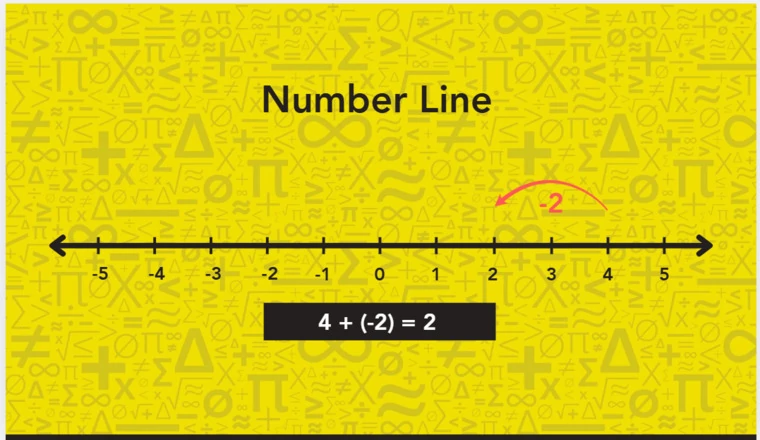
Number lines turn abstract ideas into something students can see and understand.
2. See How Your Child Learns Best
Traditional classrooms typically rely on auditory and procedural instruction, which means lots of talking and note-taking, but that approach doesn’t click for everyone. At Mathnasium, we use visual models, manipulatives, and real-world examples to make abstract concepts tangible.
This is something worth pursuing at home, too.
Let’s think of fractions. Your child might struggle to remember that \(\Large\frac{1}{2}\) is greater than \(\Large\frac{1}{4}\) until they can see it. Fold two same-sized pieces of paper, one in halves, one in quarters, and compare. Seeing that one-half covers more area than one-quarter turns memorization into understanding.
To build on this, let’s look at a few more ways to support different learning styles at home:
-
Visual learners: Encourage drawing and seeing math. Sketch number lines to show addition and subtraction, or draw shapes to explore geometry. When working with fractions, fold paper, color grids, or use area models so your child can see how numbers relate.
-
Kinesthetic learners: Let them move, build, and touch math. Use coins for counting, fraction tiles for part-whole relationships, or measuring cups for ratios and volume. The physical motion of manipulating objects helps these students connect abstract numbers to real quantities.
-
Auditory learners: Turn math into conversation. Have your child talk through their steps aloud, explain “why” something works, or even make up a short rhyme to remember a rule. Hearing and speaking reinforce understanding for auditory thinkers.
Recognizing how a child learns best changes how they think about math. As they start seeing, hearing, or building their way through problems, they develop a more flexible kind of reasoning that carries into the advanced ideas ahead.
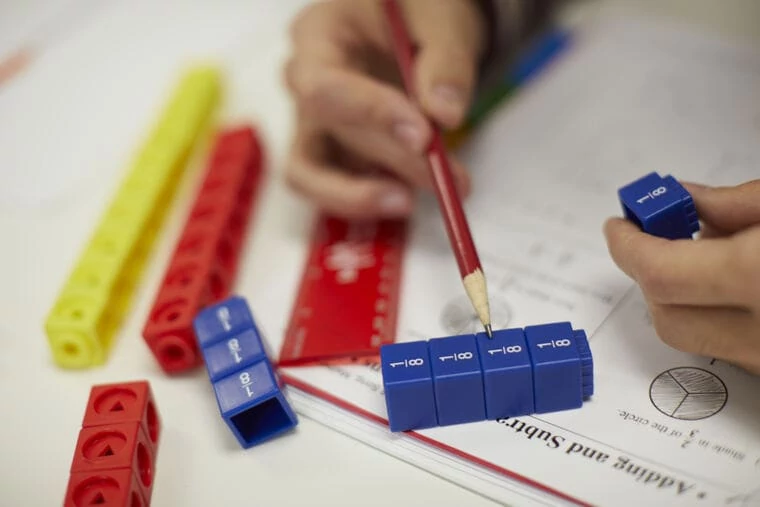
Visual and tactile tools make math tangible for every kind of learner, one of the ways we help concepts truly click.
3. Master Each Stepping Stone Before Moving Forward
Math works like a ladder; each new idea depends on the one before it. When a rung is weak or missing, students struggle to climb higher. That’s why filling gaps matters just as much as learning new material.
A shaky understanding of fractions, for example, can make algebra feel overwhelming later on.
Before moving forward, students need time to master each step, not just get it “mostly right,” but truly understand it.
Research by educational psychologist Benjamin Bloom found that learners who reach mastery at every stage progress faster and remember more in the long run. The paradox is simple: slowing down early actually speeds up future learning.
Consider how these ideas build on each other:
-
Without number sense, fractions and decimals feel like random symbols rather than parts of a whole.
-
Without understanding fractions, algebraic reasoning falters and students can’t balance equations or work with variables that represent parts.
-
Without comfort with ratios and proportions, geometry and trigonometry lose meaning; relationships between sides and angles become guesswork.
-
Without algebra, higher-level math like calculus and statistics has no foundation to rest on.
Mastery builds both knowledge and mindset. As students gain clarity, they begin to see how ideas fit together and use that insight to explore more complex reasoning.
📕You May Also Like: Parents’ Guide to Tracking Math Progress (Grades K-12)
4. Use Struggle as a Springboard
Every learner reaches a point where math feels hard. That moment often marks the beginning of real growth.
Productive struggle, purposeful effort supported with guidance, helps students move from memorizing steps to developing reasoning and understanding. It’s the stage where their thinking expands and new connections take hold (Source: International Journal of Education in Mathematics, Science, and Technology).
When parents see their child react emotionally to errors, it’s a signal to help reshape how the child views mistakes. A student who learns to embrace mistakes begins to look for causes and patterns rather than avoiding the problem.
Imagine a student solving an equation like 2x + 6 = 10 and making a slip by subtracting incorrectly. Rather than pointing out the mistake, a parent could ask, “Can we check your steps one at a time?” Working through each operation shows where the balance changed and why it matters.
The student uncovers the correction themselves and begins to understand that equations stay balanced because both sides must represent the same value. That’s a principle that carries into algebra, geometry, and even physics.
You can guide this mindset at home with prompts like:
-
“What can this mistake teach us?”
-
“How could we test your idea another way?”
-
“What pattern do you notice now?”
Students who view mistakes as part of discovery grow into analytical thinkers. This habit, examining missteps to uncover logic, forms the backbone of advanced mathematical reasoning.
📕You May Also Like: Why Parents Should Teach Kids to Embrace Math Mistakes
5. Foster Problem-Solving Skills Alongside Computation
Mathematical reasoning can grow at any level of learning. Every question, whether it involves basic arithmetic or early algebra, can boost thinking skills that carry into more advanced work.
At Mathnasium, we go beyond calculations and focus on helping students think mathematically. Parents can bring this mindset home through a few simple habits that turn practice into exploration:
-
Number Sense Games: Everyday games can sharpen intuition for numbers. Card games like War or 24 build quick thinking, comparisons, and mental arithmetic. Older students can look at game or sports stats like averages, scores, or percentages, to practice analyzing data and making predictions.
-
Multiple Solution Paths: Ask, “Could you solve it a different way?” For instance, a child adding 27 + 36 might line up the numbers vertically, or they might decompose them, adding 20 + 30 and 7 + 6, then combining the results. Seeing more than one method builds flexible, analytical thinking.
-
Real-World Applications: Use everyday examples such as money, cooking, sports, or design, to show how math explains the world.
-
‘Why’ and ‘What If’ Questions: Encourage curiosity. “Why does that work?” or “What if we changed this number?” helps students reason through cause and effect.
The National Council of Teachers of Mathematics (NCTM) identifies problem-solving, reasoning, and communication as key drivers of higher achievement.
For example, a fifth grader catching up on fractions who can relate them to real situations and explain their reasoning is already thinking like an algebra student.
Developing problem-solving alongside computation helps students see math as a system that makes sense, not a set of steps to memorize. That understanding is what ultimately carries them from catching up to getting ahead.
How Students Go From Catching Up to Getting Ahead at Mathnasium
From our experience, students who come to Mathnasium hoping to catch up in math aren’t lacking talent or ability. More often, math simply never clicked. Perhaps a learning style wasn’t recognized, or the connection between topics wasn’t clear.
We know no two students are alike. Our proprietary teaching approach, the Mathnasium Method™, was built to honor each student’s individuality. Every element of the approach is designed to meet unique learning needs and unlock each child’s full math potential.
Each learner begins with a diagnostic assessment that reveals both strengths and areas for growth, as well as how they learn best. Using these insights, we create a customized learning plan that targets gaps while stretching their abilities.
Our specially trained instructors guide students through that plan in engaging, face-to-face sessions. Using a blend of Socratic questioning and direct teaching, they help students articulate what they know, discover where they’re uncertain, and gain insight into their own thinking. Lessons integrate verbal, visual, written, mental, and tactile strategies so every learner connects with math in a way that feels natural.
We also give students time to productively struggle, stepping in at the right moment to refine their reasoning. This balance builds independence and confidence. Our focus is not only on finding the right answer, but understanding the how and why behind it. This helps develop critical thinking and problem-solving far beyond math class.
And the results speak for themselves:
-
94% of parents report an improvement in their child's math skills and understanding
-
93% of parents report an improved attitude towards math after attending Mathnasium
-
90% of students saw an improvement in their school grades

Mathnasium tutors lead students to see the meaning behind each step, understanding both the how and the why.
If your child is looking for math support, whether they’re struggling with fractions, building confidence in algebra, or ready to take on geometry or calculus, contact your nearest Mathnasium Learning Center. We’ll help them not only catch up, and keep up, but also get ahead in math.


 (804) 378-2211