You already know that -5 and 5 are different numbers. One sits to the left of zero on a number line, the other to the right. But how far is each one from zero?
The answer is the same for both, and that's the idea behind absolute value.
Today, Mathnasium tutors walk you through what absolute value means, how to find it, where it shows up in real life, and the four mistakes that trip students up most.

What Is Absolute Value?
Absolute value is the distance between a number and zero on a number line.
Let's picture a number line with zero in the middle. Positive numbers run to the right, negative numbers to the left. The number 5 sits 5 steps to the right of zero, and -5 sits 5 steps to the left.
Both are exactly 5 steps away from zero, just in opposite directions. Distance is never negative. It doesn't matter in which direction we go.
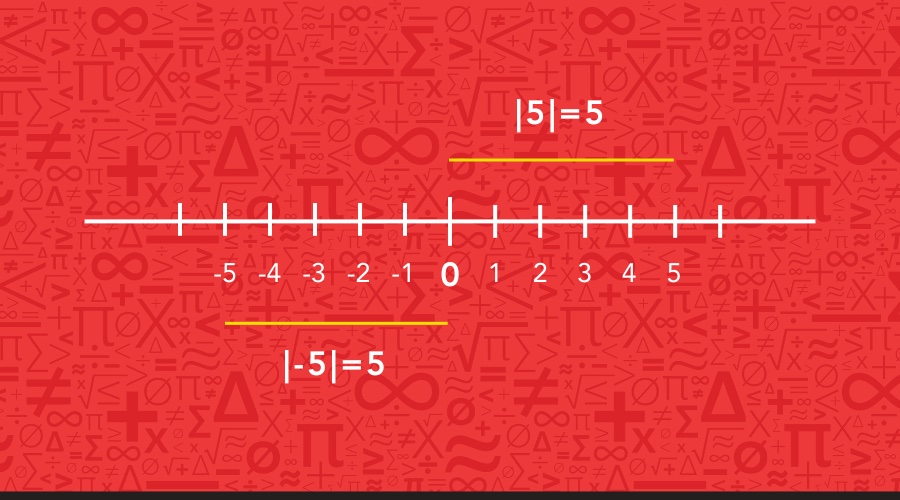
We write that distance using vertical bars.
The expression |5| is read as "the absolute value of 5," and it asks one question: how far is 5 from zero?
Let's look at these two examples:
-
|5| = 5. The number 5 is 5 steps from zero.
-
|-5| = 5. The number -5 is also 5 steps from zero. The negative sign tells you which side of zero you're on, but the distance stays the same.
-
|0| = 0. Zero is already at zero, so its distance is 0.
That's all absolute value ever asks: find the distance from zero.
📕 You May Also Like: How to Use a Number Line: Positive and Negative Numbers
How to Find Absolute Value
To find the absolute value of a number, we measure its distance from zero. The process looks a little different depending on whether we're working with a plain number or an expression inside the bars.
For any number, the absolute value is simply its distance from zero.
What happens when an expression appears inside the absolute value bars?
Take a look at this:
|3 − 8|
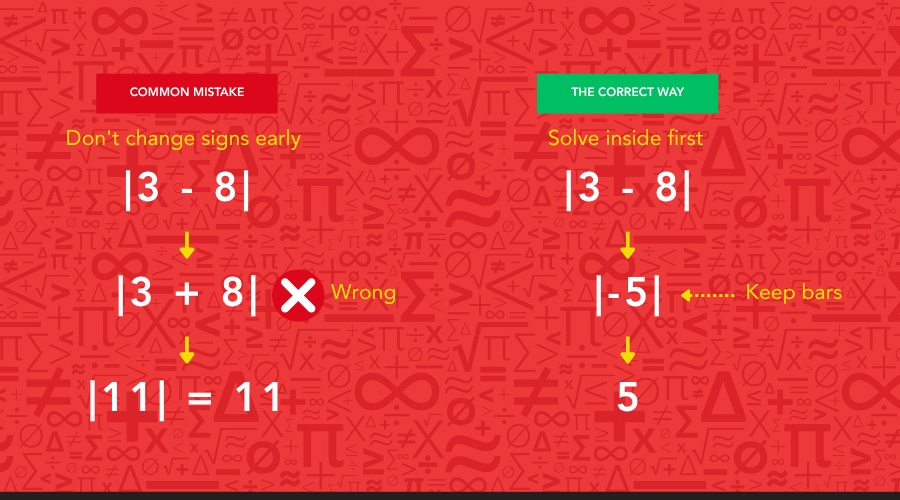
Our first instinct might be to look at that -8, flip it to a positive 8, and rewrite the problem as 3 + 8.
But absolute value measures distance, and we can't find the distance of a number before we know what that number is.
We need to simplify what’s inside the bars first:
-
Step 1: Solve the math inside the bars. 3 − 8 = -5. Now the problem looks like this: |-5|.
-
Step 2: Find the distance from zero. -5 sits 5 steps from zero, so our answer is 5.
Let's try another one together:
|-2 + 6|
📕 You May Also Like: How to Add Positive and Negative Integers: A Complete Guide
Absolute Value Outside of Math Class
Temperature, elevation, and scoring all use absolute value. In each case, direction doesn't matter. Distance does.
-
Temperature: 5° above zero and 5° below zero are on opposite sides of freezing, but both are the same distance from it. When the question is how far from freezing, not which side, absolute value gives us that distance. |-5| = |5| = 5.
-
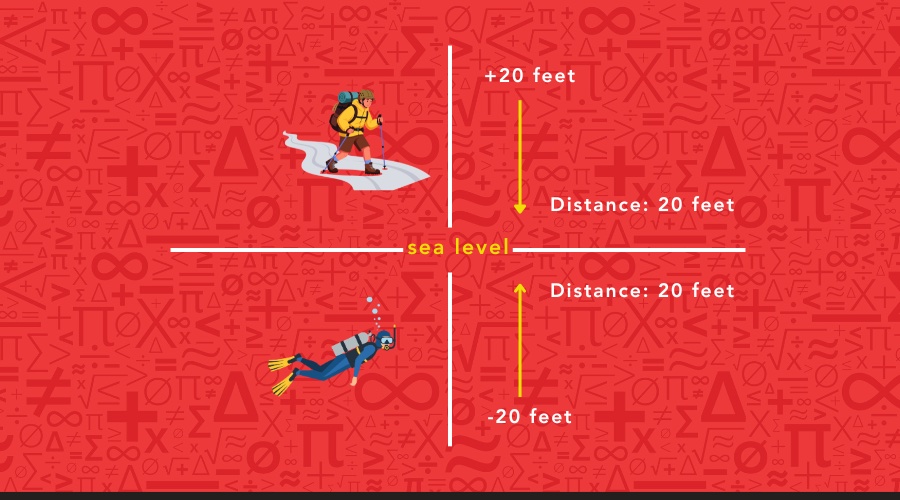
Elevation: A diver 20 feet below sea level and a hiker 20 feet above it are both 20 feet from sea level. |-20| = |20| = 20. The direction, above or below, doesn't change how far each person is from sea level.
-
Scoring: Let's say we answer 7 on a question where the correct answer is 10, and a classmate answers 13. We're both equally far off. |10 − 7| = |10 − 13| = 3. Absolute value gives both errors the same value because what matters is how far each answer is from correct, not whether it was too high or too low.
📕 You May Also Like: Why Kids Need to Learn Math Vocabulary Early + Terms & Tips
Absolute Value Mistakes and How to Fix Them
These are the four absolute value mistakes that show up most often in middle school. You'll want to know them before they show up on a test.
1. Treating Absolute Value as "Make It Positive"
This shortcut feels right on simple problems. But "make it positive" is the wrong instruction. Absolute value measures distance from zero. Distance happens to be positive, but that's not the rule.
This is where the shortcut breaks down. Let's look at this problem:
|5 − 9|
We might apply absolute value to each number individually and rewrite it as:
|5| − |9|
Solving it that way:
|5| = 5 and |9| = 9, so the problem becomes 5 − 9 = -4.
We cannot distribute absolute value bars over addition or subtraction, even if the result happens to be positive.
The bars must stay intact until everything inside has been simplified to a single number. Solve inside first, then find the distance.
-
Step 1: Solve inside the bars. 5 − 9 = -4. Now we have |-4|.
-
Step 2: Find the distance from zero. -4 sits 4 steps from zero, so our answer is 4.
2. Confusing Absolute Value with Opposites
Absolute value and opposites are two different operations. Here is where they split:
The results match for -5, which is exactly where the confusion starts.
With a positive number, the difference is clear. The opposite of 5 is -5.
The absolute value of 5 is still 5. Opposites change the sign.
Absolute value only measures distance.
3. Mixing Up |-5| and -|5|
These two expressions look nearly identical but give us different answers. The difference is where the negative sign sits.
-
|-5|: The negative sign is inside the bars. Find the distance from zero. |-5| = 5.
-
-|5|: The negative sign is outside the bars. Find the absolute value first, then apply the negative. |5| = 5, so -|5| = -5.
Same digits, opposite answers. The position of the negative sign tells us which operation comes first.
4. Expecting a Negative Answer
The answer to an absolute value problem will always be zero or positive.
For any number n: |n| ≥ 0.
A negative final answer means we forgot to apply the absolute value at the very end.
Let's say we get -3 as our final answer to |7 − 10|.
The math inside the bars is correct: 7 − 10 = -3. But that gives us |-3|, and we still need to find the distance from zero. Our answer is 3, not -3.
📕 You May Also Like: How to Help Your Child Transition from Elementary to Middle School Math
Time to Practice: Absolute Value Challenges
Here are six absolute value problems to work through. For each one, find the absolute value and write the answer.
Exercise 1: Find |-8|
Exercise 2: Find |12|
Exercise 3: Find |0|
Exercise 4: Simplify the expression, then find |7 − 10|
Exercise 5: Simplify the expression, then find |-4 + 9|
Exercise 6: Find -|6|
When you’re done with our challenges, check your answers at the bottom of the guide.

Mathnasium's specially trained tutors help middle schoolers build a real understanding of math, one concept at a time.
How Mathnasium Helps Students Master Any Math Concept
Mathnasium is a math-only learning center dedicated to helping K-12 students of all skill levels learn and master math.
Whether students need help rebuilding foundational topics like integers and number lines, want to build a deep understanding of concepts like absolute value, or are ready for a challenge beyond their current curriculum, Mathnasium offers a personalized path forward.
That path is powered by our proprietary teaching approach, the Mathnasium Method™, designed around each student's individual learning needs and style.
We start with a diagnostic assessment, a relaxed interaction where we uncover your child's strengths and knowledge gaps. From those insights, we build a personalized learning plan tailored to their needs.
Our specially trained tutors follow that plan closely, teaching math face-to-face in a supportive and fun setting.
We use plain, everyday language to explain concepts and draw on a mix of verbal, visual, mental, tactile, and written techniques so the math makes sense.
If a concept feels challenging, we break it down into manageable parts and teach both the how and the why behind it. In time, students build their own problem-solving skills and critical thinking tools they can use in math and in life.
Fun is a core part of how we teach. Our sessions are often game-based, students earn rewards along the way, and we celebrate every bit of progress, so learning stays enjoyable and confidence grows with every session.
Results are real and measurable:
-
94% of parents report an improvement in their child's math skills and understanding
-
93% of parents report their child's improved attitude toward math after attending Mathnasium
-
90% of students saw an improvement in their school grades
We operate over 1,100 centers, bringing our proven approach close to your community.
If you're based in or near Naples, Mathnasium of Naples is a trusted local resource with years of experience helping students transform not only their skills but also how they think and feel about math.
Whether your child needs to catch up, keep up, or get ahead, our team is happy to help.
📅 Schedule a Free Assessment at Mathnasium of Naples
Not near Naples?
📍 Find a Mathnasium Learning Center Near You
Pssst! Here Are Your Answers
If you've worked through the problems above, here's how your answers should look:
Exercise 1: |-8| = 8
Exercise 2: |12| = 12
Exercise 3: |0| = 0
Exercise 4: |7 − 10| = |-3| = 3
Exercise 5: |-4 + 9| = |5| = 5
Exercise 6: -|6| = -6


 (239) 455-6284