Students meet systems of equations in Grade 8 or Algebra 1, and learn two main methods for solving them: substitution and elimination.
Both methods work, but some systems are much easier to solve by substitution, and others are faster with elimination. When we choose the better method upfront, we save time, reduce mistakes, and keep the work much cleaner.
Today, we'll look at what to look for in a system of equations so we can choose the method that makes the most sense.

What Is a System of Equations?
A system of equations is two or more equations with the same variables that we solve together to find values that make all of them true at the same time.
Sometimes one equation is enough to describe a problem. But some problems give us two conditions that must hold at the same time, and we need more than one equation to express them. That is when we use a system of equations, which may look like this:
x + y = 30
8x + 5y = 210
To solve this system, we need to find one value for x and one value for y that make both equations true at the same time.
Here’s a real-world situation to help us understand this more clearly. Imagine a school event that sells adult tickets and student tickets. One piece of information tells us how many tickets were sold altogether. Another tells us how much money was collected.
In our system, x could represent the number of adult tickets and y the number of student tickets. The first equation captures the total tickets sold, and the second captures the total money collected.
There are several ways to solve a system like this. We’ll focus on the two algebraic methods students use most:
We’ll walk you through both separately.
📕 You May Also Like: How to Solve Two-Step Equations Using the Undo Method
How the Elimination Method Works for Systems of Equations
When we work with a system of equations, the tricky part is that we have two variables in two equations. One way to make the system easier to solve is to get rid of one variable first. Then we are left with a simpler equation that has only one unknown.
That is the main idea behind the elimination method:
-
We add or subtract the two equations so that one variable cancels out.
-
When one of them is gone, we can solve the remaining equation.
-
Then we use that answer to find the second variable.
Before we use elimination, we need to make sure the equations are set up properly:
-
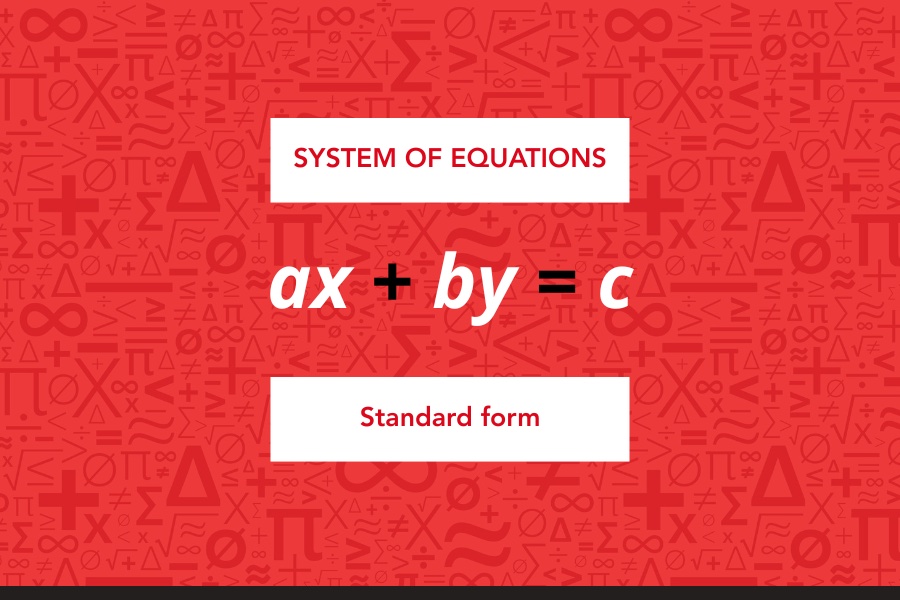
Both equations are written in standard form: ax + by = c.
-
One variable has matching or opposite coefficients before we combine the equations.
-
When the coefficients do not match yet, we multiply one or both equations by a constant first.
After the equations are lined up correctly, we can apply the elimination method. We like to explain math concepts through examples at Mathnasium, so we’ll work through the steps of elimination with this system:
2x + y = 9
Let's break down the process:
-
Arrange both equations in standard form: ax + by = c. Both equations are already written with the x-term and y-term on the left and the constant on the right.
-
Look at the coefficients of x and y. The x-coefficients are 2 and 1. The y-coefficients are 1 and −1.
-
Decide which variable to eliminate. The y-coefficients are opposites: +1 and −1. That means the y-terms will cancel if we add the equations.
-
Multiply one or both equations, if needed, so one variable has matching or opposite coefficients. We do not need to multiply equations for our example.
-
Add or subtract the equations to eliminate one variable. We add our equations, y and −y cancel, and we get: 3x = 12.
-
Solve the new one-variable equation. 3x = 12 → x = 4.
-
Substitute that value into one of the original equations to find the second variable. We substitute x in one of the original equations with 4. We’ll work with the second equation: x − y = 3 → 4 − y = 3 → y = 1
-
Check the solution in both original equations. Our solution is x = 4 and y = 1. First equation: 2(4) + 1 = 9 → 8 + 1 = 9. Second equation: 4 − 1 = 3. Both equations are true, so the solution is (4, 1).
📕 You May Also Like: How to Solve Systems of Equations: The Elimination Method
Using the Elimination Method for Solving Systems of Equations: Solved Example
Now, let’s try to solve this system of equations through the elimination method:
3x + 2y = 12
5x = 4y − 2
Step 1: Arrange in Standard Form
The first equation is already in the standard form: 3x + 2y = 12. But we need to rearrange the second equation: 5x = 4y − 2. To move 4y to the left side, we subtract 4y from both sides of the equation:
5x – 4y = 4y – 2 – 4y.
On the right side, we have no 4y left. On the left side, it appears as −4y: 5x − 4y = −2.
Now both equations are in standard form:
3x + 2y = 12
5x − 4y = −2
Step 2: Check Coefficients of the Variables
The y coefficients are 2 and 4, they are not equal or opposite, but 2 is a factor of 4. We can multiply the first equation, 3x + 2y = 12, by the constant 2, and get the opposite y coefficients:
2(3x + 2y) = 2(12)
6x + 4y = 24
Step 3: Add the Equations
The y coefficients are now +4 and −4, we can eliminate the y by adding the equations:
(6x + 4y) + (5x − 4y) = 24 + (−2)
11x = 22
Step 4: Solve the New One-Variable Equation
After elimination of y, we got the new one-variable equation: 11x = 22. To find x, we divide 22 by 11 and get 2, x = 2.
Step 5: Substitute the Value Into One of the Original Equations
We replace x in the equation, 3x + 2y = 12, with 2, and our equation now looks like this:
3(2) + 2y = 12
6 + 2y = 12
2y = 6
y = 3
Step 6: Check the Solution in Both Original Equations
Our solution is x = 2 and y = 3.
-
To check our answer, we replace x and y in the first equation with the values we found: 3(2) + 2(3) = 6 + 6 = 12 ✓
-
Then, we check the solution in the second equation: 5(2) − 4(3) = 10 − 12 = −2 ✓
Solution: (2, 3)
How the Substitution Method Works for Systems of Equations
When we solve a system of equations, we are looking for values that make both equations true at the same time. Sometimes, one equation already tells us what one variable equals. For example, it might say y = 3x + 2.
In this case, we can take that expression and use it in the other equation. Instead of working with both x and y, we replace y with an expression that means the same thing. Then the second equation has only one variable left, which makes it much easier to solve.
That is how the substitution method works:
-
Isolate one variable in one equation.
-
Substitute that expression into the other equation.
-
Solve for one variable.
-
Use the found value to find the second variable.
The substitution method fits best when one equation already has a variable by itself, or when a variable can be isolated in one quick step.
Let’s use this system of equations to work through the steps of the substitution method:
y = 2x − 1
3x + y = 14
-
Find the equation where one variable is already isolated or is easy to isolate. The first equation already tells us what y equals: y = 2x − 1. That makes this system a good fit for substitution.
-
Substitute that expression into the other equation. Since y = 2x − 1, we can replace y in the second equation with 2x − 1. We get the following equation: 3x + y = 14 → 3x + (2x − 1) = 14
-
Solve the new one-variable equation. 3x + 2x − 1 = 14 → 5x − 1 = 14 → 5x = 15 → x = 3
-
Substitute the value back into the isolated expression. Substitute x = 3 into the first equation: y = 2x − 1 → y = 2(3) − 1 → y = 6 − 1 → y = 5
-
Check the solution in both original equations. Our solution is: x = 3, y = 5. First equation: 5 = 2(3) − 1 → 5 = 6 − 1 → 5 = 5. Second equation: 3(3) + 5 = 14 → 9 + 5 = 14 → 14 = 14. Both equations are true, so the solution is (3, 5).
📕 You May Also Like: What Is the Substitution Method? A Kid-Friendly Guide
Using the Substitution Method for Solving Systems of Equations: Solved Example
Now, we’ll put the substitution method to work with this system of equations:
2y = 8x − 8
5x + y = 23
Step 1: Find the Isolated or Easy to Isolate Variable
In the first equation, 2y = 8x − 8, the y-term is already on one side of the equation. To isolate y, we need to get rid of the coefficient 2. Since every term is divisible by 2, we can divide both sides of the equation by 2:
2y ÷ 2 = 8x ÷ 2 − 8 ÷ 2.
That gives us: y = 4x − 4
Step 2: Substitute That Expression Into the Other Equation
Since y = 4x − 4, we can replace y in the second equation with 4x − 4.
5x + y = 23
5x + (4x − 4) = 23
Step 3: Solve the New One-Variable Equation
5x + 4x − 4 = 23
9x − 4 = 23
9x = 27
x = 3
Step 4: Substitute the Value Back Into the Isolated Expression
We substitute x = 3 into the first equation: 2y = 8x − 8.
2y = 8(3) − 8
2y = 24 − 8
2y = 16
y = 8
Step 5: Check the Solution in Both Original Equations
Our solution is: x = 3, y = 8. Let’s check in the first equation: 2y = 8x − 8
2(8) = 8(3) − 8
16 = 24 − 8
16 = 16
Then, we substitute the solutions in the second equation:
5(3) + 8 = 23
15 + 8 = 23
23 = 23
Both equations are true, so the solution is (3, 8).
📕 You May Also Like: Why Your 9th Grader Finds Algebra Hard & How to Help
How to Choose the Right Method for Solving a System of Equations?
Both elimination and substitution can work. But one method is often easier than the other, depending on how the system is written. Before we start solving, we can look for clues that tell us which method will save time and steps.
When to Choose the Elimination Method
When you notice one of these clues, elimination will usually be the easier method.
A. Both Equations Are in Standard Form, and Neither Variable Is Already Isolated
For example, in this system, both equations are already arranged.
3x + 2y = 14
5x − 2y = 10
Neither x nor y is isolated. Elimination is the natural starting point.
B. The Coefficients of One Variable Are Identical or Opposite
As we see in this system, the y coefficients are opposite, +3 and −3.
4x + 3y = 18
2x − 3y = 6
We can add the equations, and y disappears immediately without any extra steps.
C. Small Multiplication Step Can Create Matching or Opposite Coefficients
For this system, we can multiply the first equation by 2:
2x + 3y = 16
4x + 5y = 28
After multiplying the first equation, we get:
4x + 6y = 32
4x + 5y = 28
Now the x-coefficients match: 4 and 4. If we subtract the equations, the x-terms cancel cleanly.
D. Isolating a Variable Would Introduce Fractions
Take this system of equations:
3x + 5y = 11
2x + 3y = 7
To isolate x in the first equation, we would have to divide by 3:
x = \(\frac{11}{3} – \frac{5y}{3}\)
If we try to isolate any other variable in this system, we would have to divide by their coefficients (5, 2, or 3), which also creates fractions.
Elimination is cleaner here because we can multiply the equations by whole numbers to create matching coefficients and keep the work in whole numbers.
When to Choose the Substitution Method
When you see one of these signs, opt for the substitution rather than the elimination.
A. One Equation Already Has a Variable Isolated
Substitution may be more efficient when one equation already tells us what x or y equals. For example, in this system, y is already isolated:
y = 4x − 4
5x + y = 23
The first equation tells us that y equals 4x − 4. That means we can replace y in the second equation with 4x − 4 and solve an equation with only x.
B. One Variable Has a Coefficient of 1 or −1
If one variable has a coefficient of 1 or –1, we can isolate it in one quick step. Take this system:
x + 3y = 17
4x − 2y = 10
In the first equation, x has a coefficient of 1. That means we can isolate x without dividing: x = 17 − 3y. Once x is isolated, we substitute 17 − 3y into the other equation.
C. One Equation Is Easy to Rearrange Without Fractions
Let’s take a look at this system of equations:
2x + y = 13
3x + 4y = 31
In the first equation, y can be isolated in one step: y = 13 − 2x. That gives us a clean expression for y, with no fractions. From there, we can substitute 13 − 2x into the second equation.
Checklist for Choosing Between Substitution and Elimination
Before starting to solve any system of equations, run through this checklist to pick the easier method:
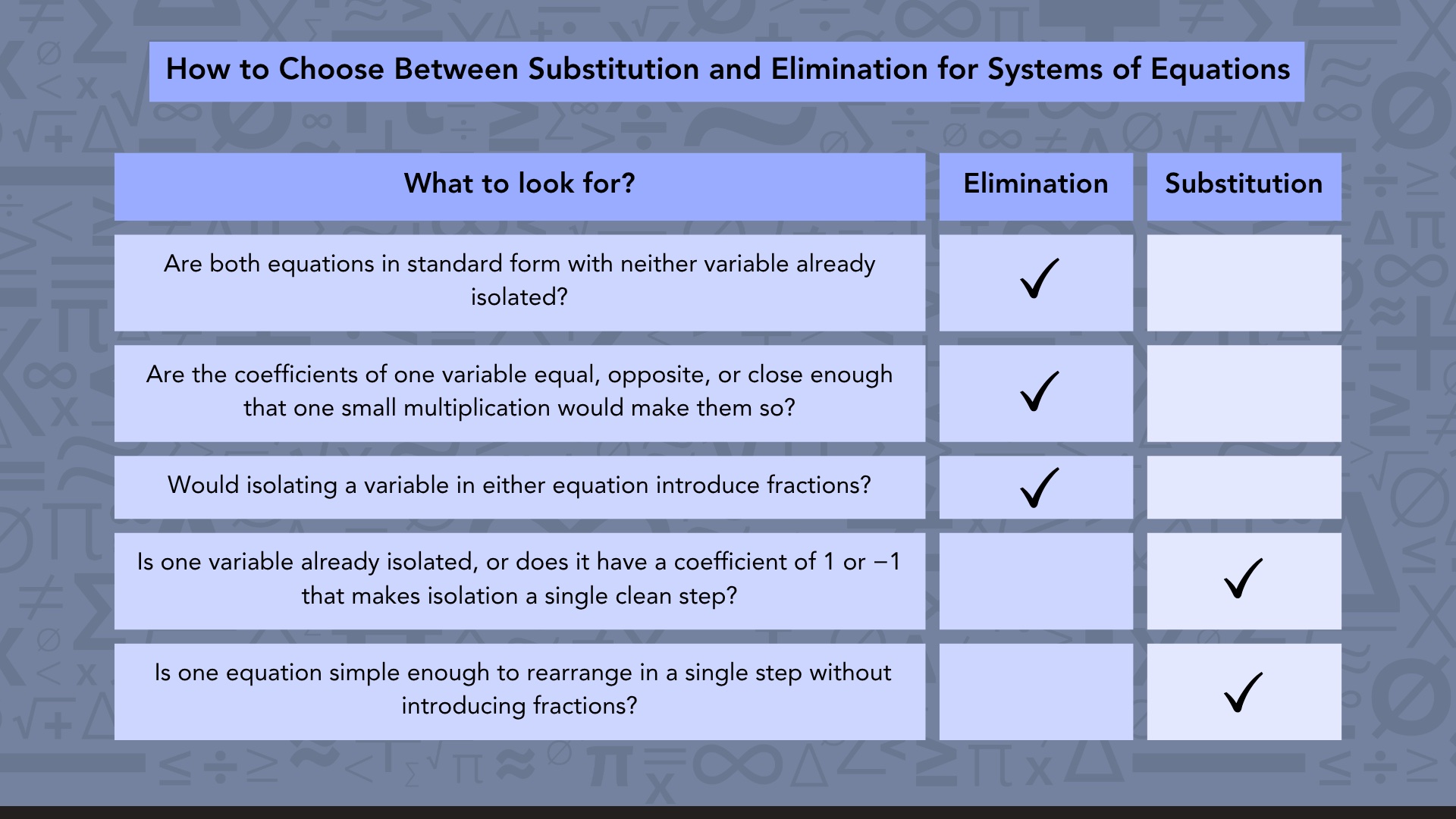
The checklist takes seconds to run through and almost always points to the more efficient method. With practice, you will learn to recognize the pattern automatically without the checklist.
When the system doesn’t visibly favor either method, choose the one you execute more confidently. Method fluency is as important as method choice.
Your Turn! Pick Up the Method and Solve the System of Equations
Try to work through these two systems of equations on your own. Before starting either one, use the checklist to decide which method fits best. You can check your answers at the bottom of the page.
Problem 1:
2x + 3y = 12
2x − 3y = 4
Problem 2:
y = 4x − 3
2x + y = 9

At Mathnasium, students build the reasoning skills they need to choose efficient strategies, like deciding when substitution or elimination is the better path for solving a system of equations.
How Mathnasium Helps Students Master Systems of Equations (and Any Other Math Topic)
Mathnasium is a math-only learning center that helps K-12 students of all skill levels excel in math.
We’ve worked with thousands of students, and we are specially trained to make math topics like systems of equations clear, approachable, and connected to the skills students need next.
Through the Mathnasium Method™, our proprietary teaching approach, our specially trained tutors meet students where they are and help them build true understanding before moving on to the next concept.
Each student begins with a diagnostic assessment that helps us identify which math skills are solid and which need support, including the equation-solving and algebraic reasoning skills behind systems of equations.
From there, we create a personalized learning plan that builds the missing pieces step by step, using the same clear, example-led approach we used today.
Our approach also includes game-based activities and plenty of rewards to keep students motivated and engaged. Students work in a fun and caring group environment where they feel comfortable asking questions, making mistakes, and trying again.
Our tutors give students room to think through a problem before stepping in. They know when to guide, when to ask a better question, and when to let the student work through the problem. That balance helps build critical thinking and problem-solving skills, along with lasting independence in math.
Families see the difference:
-
94% of parents report an improvement in their child’s math skills and understanding
-
93% of parents report their child’s improved attitude toward math after attending Mathnasium
-
90% of students saw an improvement in their school grades
With over 1,100 centers, Mathnasium brings top-rated instruction close to your home.
For families in and near New City, NY, Mathnasium of New City brings that same approach to your community, with specially trained tutors who help students build both procedural fluency and the strategic thinking algebra requires.
If systems of equations, equation solving, or the algebra foundations beneath them have been sticking points for your child, a free diagnostic assessment is the right place to start.
📅 Schedule a Free Assessment at Mathnasium of New City
Not near New City?
📍 Find a Mathnasium Learning Center Near You
Pssst! Check Your Answers Here
Here are the worked solutions to the practice problems above, including the method choice.
Problem 1
2x + 3y = 12
2x − 3y = 4
The elimination method works better here because both equations are in standard form, and the y coefficients (+3 and (–3)) are opposite.
-
(2x + 3y) + (2x − 3y) = 12 + 4
-
4x = 16 → x = 4
-
Substitute x = 4: 2(4) + 3y = 12 → 8 + 3y = 12 → 3y = 4 → y = \(\frac{4}{3}\)
-
Check: 2(4) + 3(\(\frac{4}{3}\)) = 8 + 4 = 12 ✓ and 2(4) − 3(\(\frac{4}{3}\)) = 8 − 4 = 4 ✓
Solution: (4, \(\frac{4}{3}\))
Problem 2
y = 4x − 3
2x + y = 9
We used substitution for this problem because y is already isolated in the first equation.
-
Substitute y = 4x − 3 into the second equation:
-
2x + (4x − 3) = 9 → 6x − 3 = 9 → 6x = 12 → x = 2
-
Substitute x = 2: y = 4(2) − 3 = 5
-
Check: y = 4(2) − 3 = 5 ✓ and 2(2) + 5 = 9 ✓
Solution: (2, 5)
How did you do?


 (845) 990-9019