
 (301) 468-6284
 (301) 468-6284











Sudoku and Math: What Does Solving Puzzles Have to Do With Learning Math?
Sep 8, 2026 | North Bethesda
Sudoku and Math: What Does Solving Puzzles Have to Do With Learning Math?

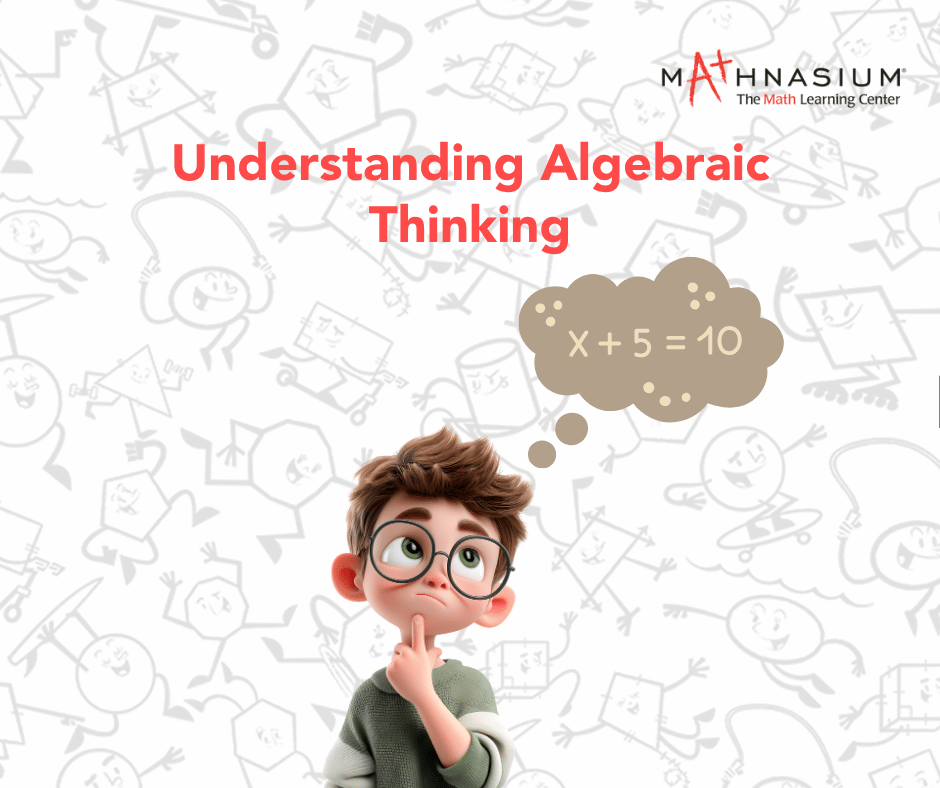
When parents hear the word “algebra,” they may picture equations filled with letters, numbers, and complicated formulas. But algebraic thinking actually begins much earlier than middle or high school. Children start developing algebraic thinking when they learn to recognize patterns, understand relationships, compare quantities, and figure out unknown values.
These skills form an important foundation for future success in mathematics.
What Is Algebraic Thinking?
Algebraic thinking is the ability to recognize mathematical relationships and use reasoning to solve problems even when an answer is unknown.
For example, imagine a child has 5 apples and receives 3 more. They can determine that they now have 8 apples.
As children develop stronger algebraic thinking skills, the problems become more complex. Instead of simply calculating 5 + 3, they might be asked:
“I have some apples. After receiving 3 more, I have 8. How many did I start with?”
The child needs to reason backward and determine that the unknown number is 5.
That is algebraic thinking.
Algebraic Thinking Starts With Patterns
Patterns are one of the earliest ways children develop algebraic reasoning.
Consider this sequence:
2, 4, 6, 8, __
A student who recognizes that each number increases by 2 can predict that the next number is 10.
Now consider a more complex pattern:
3, 6, 12, 24, __
The student needs to identify that each number is being multiplied by 2, making the next number 48.
Recognizing patterns helps students understand that numbers aren't just isolated values they can have relationships with one another.
Real-Life Examples of Algebraic Thinking
Algebraic thinking appears in everyday situations more often than you might expect.
Suppose a movie ticket costs $12. If a family buys 4 tickets, a child might calculate:
4 × $12 = $48
Now imagine the family has a coupon that takes $10 off the total. The child can reason through the relationship between the original price, the discount, and the final cost.
Or consider a recipe. If a recipe calls for 2 cups of flour for 12 cookies, how much flour would be needed for 24 cookies?
The student can recognize that doubling the number of cookies also doubles the amount of flour:
2 cups × 2 = 4 cups
These everyday examples help children see that algebra isn't simply about solving equations it is about understanding how quantities relate to one another.
Why Algebraic Thinking Matters
Strong algebraic thinking can make later math concepts easier to understand. As students progress through school, they encounter equations, functions, inequalities, graphs, and more advanced problem-solving.
For example, a student may eventually encounter:
x + 7 = 15
Instead of viewing this as a mysterious equation involving a letter, a student with strong algebraic reasoning can think:
“What number plus 7 equals 15?”
The answer is 8.
That shift from simply calculating to reasoning about an unknown is at the heart of algebra.
How Parents Can Encourage Algebraic Thinking
Parents don't need to give children formal algebra lessons to strengthen these skills. Ask questions that encourage reasoning.
Try questions such as:
“What do you notice about this pattern?”
“How did you figure that out?”
“Can you solve it another way?”
“If we changed this number, what would happen?”
“How do you know your answer is correct?”
Encouraging children to explain their thinking can be just as valuable as getting the correct answer.
Build Stronger Math Skills With Mathnasium
Algebraic thinking develops gradually through practice, problem-solving, and a strong understanding of foundational math concepts. At Mathnasium, students work on understanding why math works not simply memorizing steps.
Whether a student is building early number skills or preparing for algebra, personalized instruction can help develop the confidence and reasoning skills they need to tackle increasingly challenging math.
Ready to help your child build stronger math skills? Visit Mathnasium.com to learn more and find a Mathnasium Learning Center near you.

