What Does Slime Have to Do With Math? Actually, Quite a Lot!
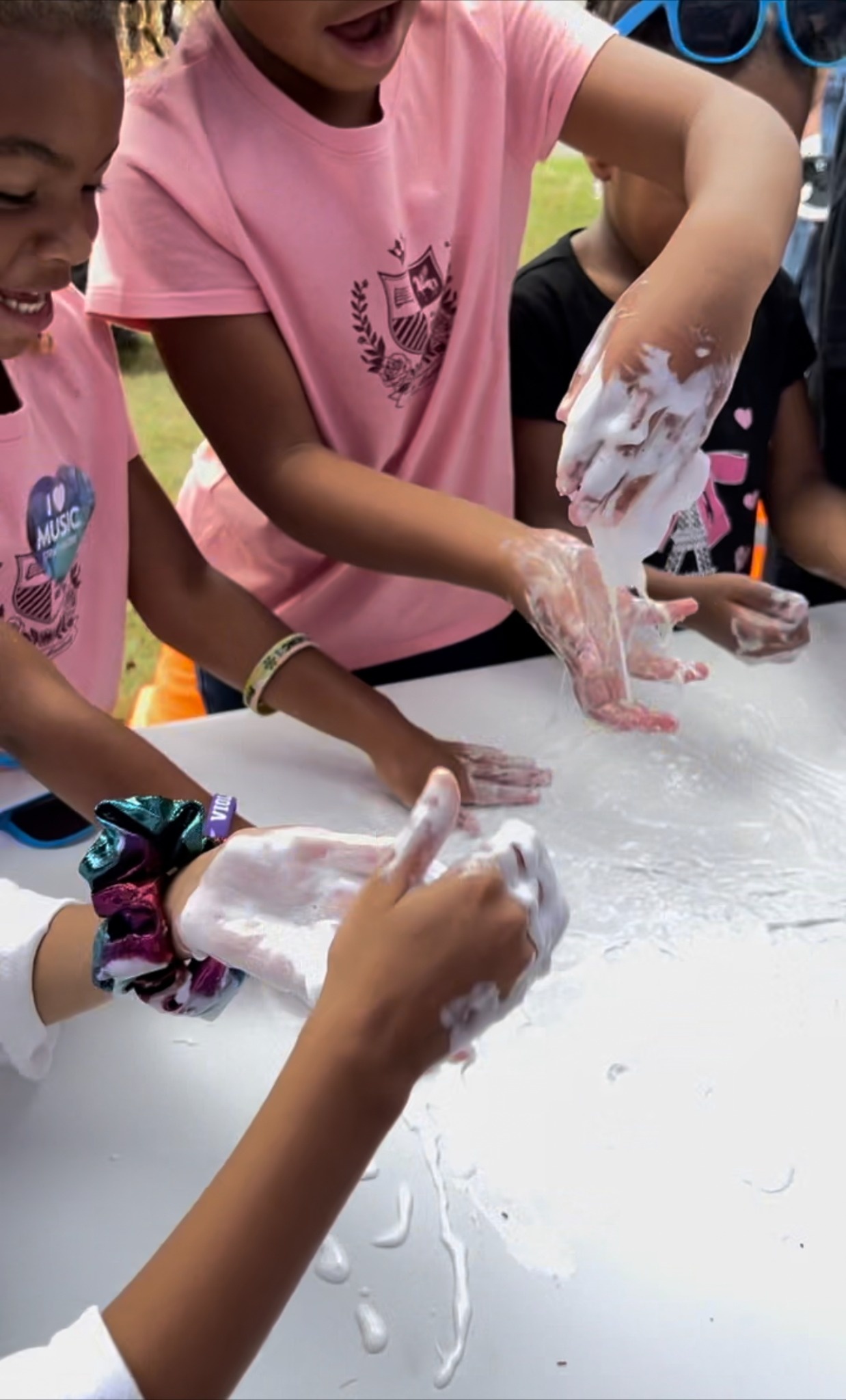
We had a great time at Burtonsville Day this weekend. There were families everywhere, kids moving from booth to booth, and lots of fun activities going on. Right next to our Mathnasium booth was a science activity that definitely got the kids’ attention. They were mixing liquid glue and dish soap, stirring everything together, and waiting to see what would happen. Of course, the kids loved it. And standing there watching them, I kept thinking: there’s actually a lot of math going on here!
Think about something as simple as measuring the ingredients. Let’s say you start with 2 spoonfuls of glue and 1 spoonful of dish soap. For a younger child, just counting and measuring those spoonfuls is already math. Two plus one makes three. Then ask, “What if we want to make twice as much?” Now we need 4 spoonfuls of glue and 2 spoonfuls of soap. Make three batches, and we’re multiplying again. Before you know it, we’re also talking about a 2:1 ratio — 2 parts glue to 1 part soap.
That’s one of the things I love about math. Something like “ratios” can sound complicated when children first see it in a textbook, but put two spoonfuls of glue and one spoonful of soap in front of them, and suddenly the idea becomes much easier to see.
Then comes the really fun part: What do you think is going to happen? Will it stay runny? Will it get thicker? Will it stretch? Or will we just end up with one big sticky mess? 😊 This is where the science comes in. Glue contains long molecules called polymers. You can think of them as very tiny, long chains. When other ingredients are added and mixed in, they can change how those chains interact, so the mixture begins to feel and behave differently.
But what happens if we change the recipe? What if we use more glue? More soap? Half as much? Now the kids have to make a prediction, measure the ingredients, try it, look at the result, compare what happened, and maybe change something and try again. Predict. Measure. Test. Compare. Try again. That’s science, but it’s also math and problem solving.
Math Doesn't Always Look Like Math
I think that was my favorite part about watching the kids at Burtonsville Day. Nobody was telling them, “Okay, now it’s time to practice math.” They were simply having fun. But they were counting, measuring, thinking about amounts, making predictions, noticing what changed, and figuring out what worked. The math was already there.
Math shows up in so many places—in cooking, sports, music, building things, shopping and games. And yes, apparently even in a bowl of goo. 😊 At Mathnasium of Northern Silver Spring – Cloverly, we want kids to see math as more than getting the right answer on a worksheet. It’s about learning how to think, notice patterns, make connections and solve problems.
So the next time your child asks, “When am I ever going to use math?” maybe just hand them a measuring spoon. 🧪
How strong is your child's math foundation?
Whether your child needs to catch up, keep up, or get ahead, a math assessment can help you understand where they are today and what they need next.
Mathnasium of Northern Silver Spring – Cloverly
K–12 Math | 732 Cloverly Street
New Hampshire Avenue at Briggs Chaney Road | 301-879-2848


 (301) 879-2848
 (240) 593-6888