Students usually begin subtracting fractions in Grade 4 by working with like denominators. In Grade 5, the work becomes more complex as unlike denominators and mixed numbers come into play.
At first, the numbers may look hard to subtract. But once we know the steps and the reasoning behind them, the problem becomes much easier to handle.
Today, Mathnasium tutors will walk you through subtracting fractions in common situations: fractions with like and unlike denominators and mixed numbers that sometimes require regrouping.

Let’s Review Quickly: What Are Fractions?
A fraction describes a part of a whole.
When we split something into equal parts and take some of them, we use a fraction to show how many parts we have out of how many there are in total. We write a fraction with two numbers separated by a line:
Say we have a chocolate bar with 8 equal squares, and we break off 3 of them. We've taken 3 out of 8 parts, and we can write that as \(\Large\frac{3}{8}\).
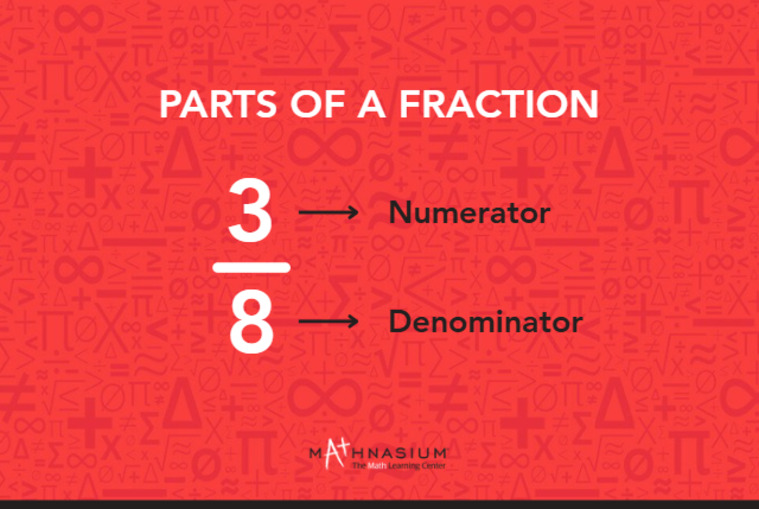
Let’s also get familiar with a few more terms we'll use today:
-
A proper fraction has a numerator smaller than its denominator: \(\Large\frac{3}{8}\), \(\Large\frac{5}{9}\), \(\Large\frac{7}{10}\).
-
A mixed number combines a whole number and a fraction: 2\(\Large\frac{3}{4}\), 4\(\Large\frac{1}{8}\).
With those in place, we're ready to subtract.
How to Subtract Fractions With Like Denominators
Imagine an egg carton with 10 equal slots. You have 7 eggs in it, and you use 3 of them for breakfast. Both amounts are measured in the same unit, tenths, so you can subtract straight away. You go from 7 eggs to 4, and the size of each slot doesn't change.
That's how fractions with like denominators work. When two fractions are already split into the same-sized parts, we subtract the numerators and keep the denominator as it is.
We can also show this visually, imagining \(\Large\frac{7}{10}\) as 7 filled slots in a 10-slot egg carton, taking away 3 of them leaves us with 4 slots or \(\Large\frac{4}{10}\).
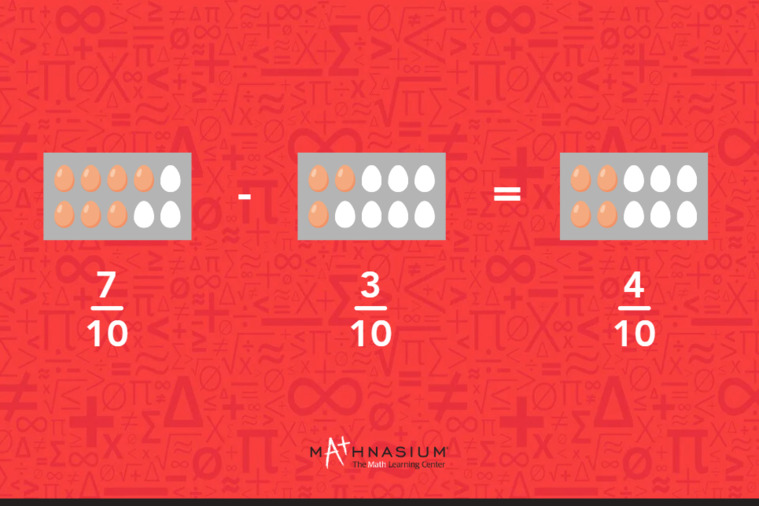
Let’s look at how to subtract proper fractions with a like denominator step-by-step: \(\Large\frac{7}{10}\) − \(\Large\frac{3}{10}\)
-
Both fractions are in tenths, so we subtract the numerators: 7 − 3 = 4
-
That gives us \(\Large\frac{4}{10}\).
-
Now we check: do the top and bottom share a common factor? Both 4 and 10 are divisible by 2, so we simplify: \(\Large\frac{4}{10}\) = \(\Large\frac{2}{5}\)
📕 You May Also Like: Adding and Subtracting Fractions with Like Denominators
How to Subtract Mixed Numbers With Like Denominators
When whole numbers enter the picture, we handle the fraction part and the whole number part separately, then put them back together.
Let’s try 4\(\Large\frac{5}{9}\) − 2\(\Large\frac{4}{9}\):
-
Subtract the fractions: \(\Large\frac{5}{9}\) − \(\Large\frac{4}{9}\) = \(\Large\frac{1}{9}\)
-
Subtract the whole numbers: 4 − 2 = 2
-
Put them together: 2\(\Large\frac{1}{9}\)
But what if the fraction part of the mixed number we’re subtracting is bigger than the one you’re starting with?
In this case, we regroup, which is quite the same as borrowing in a regular subtraction, just in a new setting. Let’s work through this example: 4\(\Large\frac{1}{8}\) − 2\(\Large\frac{5}{8}\):
-
Look at the fractions first: \(\Large\frac{1}{8}\) is smaller than \(\Large\frac{5}{8}\), so we can’t subtract yet. We borrow 1 from the whole number 4, which leaves us with 3. That borrowed 1 becomes \(\Large\frac{8}{8}\) because our denominator is 8.
-
Then we add it to the \(\Large\frac{1}{8}\) we already have: \(\Large\frac{8}{8}\) + \(\Large\frac{1}{8}\) = \(\Large\frac{9}{8}\). Now our problem looks like this: 3\(\Large\frac{9}{8}\) − 2\(\Large\frac{5}{8}\)
-
From here, we can follow the usual steps. Subtract the fractions: \(\Large\frac{9}{8}\) − \(\Large\frac{5}{8}\) = \(\Large\frac{4}{8}\) = \(\Large\frac{1}{2}\)
-
Subtract the whole numbers. But don’t forget that after regrouping, our first whole number changed from 4 to 3: 3 − 2 = 1
-
Put them together: 1\(\Large\frac{1}{2}\)
Like denominators are the straightforward case. Now we’ll look at what happens when the parts aren’t the same size.
How to Subtract Fractions With Unlike Denominators
When we subtract fractions with unlike denominators, our first step is to find the least common denominator (LCD): the smallest number that both denominators divide into evenly. It does not change the value of the fractions, but only rewrites them in the same-sized parts, so subtraction makes sense.
One way to find the LCD is prime factorization. If you need a reminder, that’s writing a number as a multiplication of prime numbers. Remember, prime numbers are whole numbers, larger than 1, and only divisible by 1 and themselves, like 2, 3, 5, and 7.
Let’s walk through how to subtract fractions with unlike denominators, step by step. Here is an example: \(\Large\frac{8}{9}\) − \(\Large\frac{5}{6}\)
1. Find the least common denominator
The denominators are 9 and 6. To find LCD, we’ll use prime factorization:
That means the LCD is 2 × 3 × 3 = 18, because 18 is the smallest number both 9 and 6 divide into evenly.
2. Rewrite the fractions
Now we change each fraction so the denominator is 18. First, we need to figure out what number turns the initial denominator into 18. To do that, we divide the LCD by the initial denominator.
After that, we multiply both the numerator and the denominator by this number, so the fraction keeps the same value.
For example, to rewrite \(\Large\frac{8}{9}\) with the least common denominator 18, we need to:
-
18 ÷ 9 = 2
-
Multiply top and bottom of the fraction by 2 → \(\Large\frac{8×2}{9×2}\) = \(\Large\frac{16}{18}\)
For \(\Large\frac{5}{6}\):
-
18 ÷ 6 = 3
-
multiply top and bottom by 3 → \(\Large\frac{5×3}{6×3}\) = \(\Large\frac{15}{18}\)
Let's see these two steps with a visual example, imagining \(\Large\frac{8}{9}\) and \(\Large\frac{5}{6}\) as parts of different-sized rectangles:
3. Subtract fractions and simplify if needed
Now, we are ready to subtract: \(\Large\frac{16}{18}\) − \(\Large\frac{15}{18}\) = \(\Large\frac{1}{18}\).
Our answer \(\Large\frac{1}{18}\) doesn’t need any simplification.
How to Subtract Mixed Numbers With Unlike Denominators
To subtract fractions with unlike denominators and whole numbers, we should start with the least common denominator. Then you can see whether regrouping is needed. Let’s try one without regrouping:
3\(\Large\frac{3}{4}\) − 1\(\Large\frac{1}{3}\)
1. Find the least common denominator
The denominators are 4 and 3. To find LCD, we’ll use prime factorization:
That means the LCD is 2 × 2 × 3 = 12, because 12 is the smallest number both 4 and 3 divide into evenly.
2. Rewrite the fractions
We’ll rewrite the fractions:
For \(\Large\frac{3}{4}\), we need to:
-
12 ÷ 4 = 3
-
Multiply top and bottom of the fraction by 3 → \(\Large\frac{3×3}{4×3}\) = \(\Large\frac{9}{12}\)
For \(\Large\frac{1}{3}\):
-
12 ÷ 3 = 4
-
Multiply top and bottom of the fraction by 4 → \(\Large\frac{1×4}{3×4}\) = \(\Large\frac{4}{12}\)
3. Subtract the fractions and simplify if needed
After rewriting the fractions with the LCD 12, our problem looks like this: 3\(\Large\frac{9}{12}\) − 1\(\Large\frac{4}{12}\).
We can subtract the fractions: \(\Large\frac{9}{12}\) − \(\Large\frac{4}{12}\) = \(\Large\frac{5}{12}\). No simplification is needed, so we leave the fraction as-is. Then, we subtract the whole numbers: 3 − 1 = 2. Put them together: 2\(\Large\frac{5}{12}\)
Subtraction with Regrouping (A Special Case)
To work through the subtraction with regrouping, we’ll solve this problem: 1\(\Large\frac{1}{2}\) - \(\Large\frac{2}{3}\)
1. Find the least common denominator
First, we find the LCD. The denominators are 2 and 3; both 2 and 3 are already prime numbers, so we can just multiply them: 2 × 3 = 6. This means that our LCD is 6.
2. Rewrite the fractions
For \(\Large\frac{1}{2}\):
-
Divide our LCD by the initial denominator of the fraction: 6 ÷ 2 = 3
-
Multiply top and bottom of the fraction by 3 → \(\Large\frac{3}{6}\) so 1\(\Large\frac{1}{2}\) becomes 1\(\Large\frac{3}{6}\)
The same steps for \(\Large\frac{2}{3}\):
-
6 ÷ 3 = 2
-
Multiply top and bottom of the fraction by 2 → \(\Large\frac{4}{6}\)
3. Regroup the fractions
If we look at the fractions, we’ll see that \(\Large\frac{3}{6}\) is smaller than \(\Large\frac{4}{6}\). This means we need to regroup. Borrow 1 from the whole number, which leaves us with 0. That borrowed 1 becomes \(\Large\frac{6}{6}\), and we add it to \(\Large\frac{3}{6}\) we already have:
\(\Large\frac{6}{6}\) + \(\Large\frac{3}{6}\) = \(\Large\frac{9}{6}\)
4. Subtract the fractions and simplify if needed
After regrouping, our problem now looks like this: 0\(\Large\frac{9}{6}\) - \(\Large\frac{4}{6}\). We can subtract the fractions: \(\Large\frac{9}{6}\) - \(\Large\frac{4}{6}\) = \(\Large\frac{5}{6}\) There are no whole numbers left to subtract. The answer is \(\Large\frac{5}{6}\), and it does not require simplifying.
📕 You May Also Like: What Is Regrouping in Math? A Student Guide
Your Turn! Subtract Fractions With Like and Unlike Denominators
Work through these five problems on your own. Use the steps from each section as your guide. You can check your answers at the bottom of the page.
-
\(\Large\frac{9}{11}\) − \(\Large\frac{4}{11}\)
-
\(\Large\frac{7}{9}\) − \(\Large\frac{2}{9}\)
-
\(\Large\frac{5}{6}\) − \(\Large\frac{3}{8}\)
-
\(\Large\frac{7}{10}\) − \(\Large\frac{2}{5}\)
-
3\(\Large\frac{1}{4}\) − 1\(\Large\frac{2}{3}\)
-
5\(\Large\frac{1}{6}\) − 2\(\Large\frac{3}{4}\)
 At Mathnasium, we break down challenging concepts into manageable steps and provide personalized support to help students truly understand math.
How Mathnasium Helps Students Master Any Math Skill
Mathnasium is a math-only learning center that works with students of all skill levels to learn and master any math topic, including subtraction of fractions with like and unlike denominators.
Our specially trained tutors use the Mathnasium Method™, our proprietary teaching approach that combines verbal, visual, tactile, and written techniques to help students understand each concept before moving on.
Students begin their Mathnasium journey with a diagnostic assessment that allows us to understand their unique strengths and knowledge gaps. Guided by assessment-based insights, we create personalized learning plans that will put them on the best path toward math excellence.
We often hear students say our sessions don’t feel like lessons at all. That’s by design. Our approach includes game-based activities and plenty of rewards to keep students motivated and engaged.
Students work in a fun and caring group environment where they feel comfortable asking questions, making mistakes, and trying again.
And the results speak volumes:
-
94% of parents report an improvement in their child's math skills and understanding
-
93% of parents report their child's improved attitude toward math after attending Mathnasium
-
90% of students saw an improvement in their school grades
With over 1,100 centers, Mathnasium brings top-rated instruction close to your home.
If you are in or near Frisco or McKinney, TX, Mathnasium of North Frisco is a trusted local center with years of experience helping students excel in math.
Whether your student is looking to catch up, keep up, or get ahead in math, our team is happy to support them!
Ready to get started?
📅 Schedule a Free Diagnostic Assessment at Mathnasium of North Frisco
Not near Frisco or McKinney?
📍 Find a Mathnasium Learning Center Near You
Pssst! Check Your Answers Here
If you worked through the practice problems, here are the answers:
-
\(\Large\frac{5}{11}\)
-
\(\Large\frac{5}{9}\)
-
\(\Large\frac{11}{24}\)
-
\(\Large\frac{3}{10}\)
-
1\(\Large\frac{7}{12}\)
-
2\(\Large\frac{5}{12}\)
How did you do?


 (469) 248-8844
 (469) 248-8844