Most of us know what it means for something to be steep. A steep ramp is harder to walk up than a gentle one, and a steep roof angles sharply instead of sitting flat.
In mathematics, we use slope to give that steepness an exact numerical value. It tells us precisely how much a line rises or falls relative to its horizontal run.
On a graph, that same slope shows how one quantity changes in response to another, like watching your savings grow over time or tracking how fuel decreases as a car travels down the highway.
Today, our Mathnasium tutors explain how slope works, how to calculate it using rise over run, and how to identify all four slope types.

What Is Slope in Math?
When we hear the word "slope," we often think of something that goes uphill or downhill, like a ramp, a roof, or a staircase. In math, slope describes that same idea on a graph.
Slope in math is a number that tells us how steep a line is and in which direction it tilts.
Picture climbing a staircase. With every step, we move forward the same distance, and we rise up the same fixed height. How quickly we reach the top depends entirely on that step height. A staircase with taller steps gets us there in fewer strides, since each one carries us further up.
The height of each step compared to how far forward it carries us is exactly what slope measures in math.
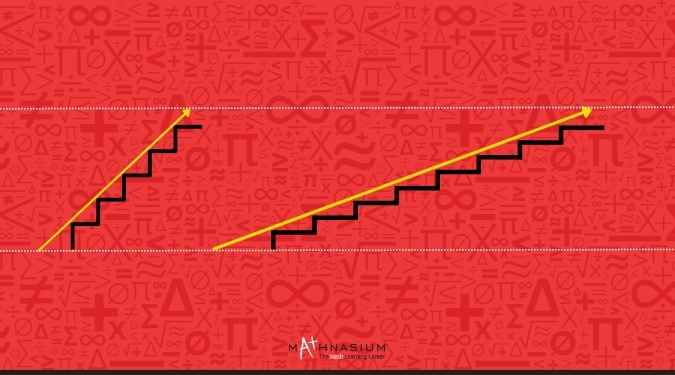
More precisely, slope describes the rate of change between two points on a line. It answers one question: “For every bit we move horizontally, how much do we move vertically?”
On a coordinate plane, we call that height the rise and that distance the run.

In math notation, we use the letter m to represent slope.
We can calculate it by comparing rise to run:
\(m = \Large\frac{rise}{run}\)
This ratio gives us a specific number to measure and compare how steep any line is.
📕 You May Also Like: Types of Lines in Math – The Ultimate Kid-Friendly Guide
How Does Rise Over Run Help Us Find Slope?
Rise over run helps us find the slope by comparing a line's vertical movement with its horizontal movement.
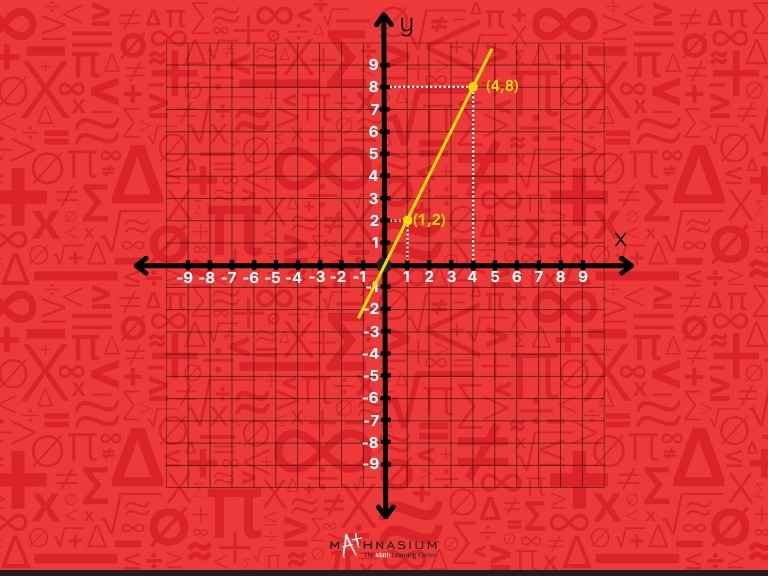
Let's put this into practice with two points on a line (1, 2) and (4, 8). To keep things simple, we picked points that land exactly on grid intersections.
We write each point as (x, y). The first number tells us how far to move along the x-axis, and the second tells us how far to move along the y-axis.
So to plot (1, 2), we move 1 unit to the right and 2 units up from the origin.
For (4, 8), we move 4 units to the right and 8 units up.
When we plot both points and connect them, our line looks like this.
Now, to find our slope, we need to compare the rise and the run. So how do we do that?
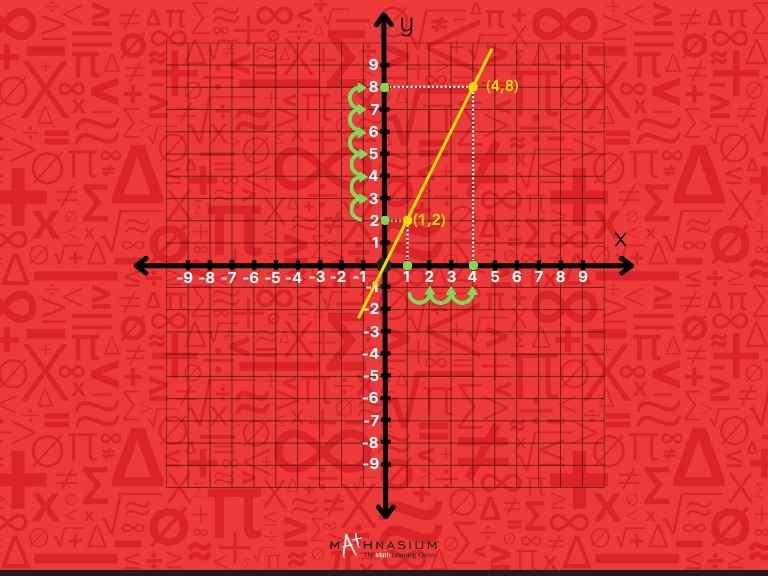
First, let's count our horizontal movement to find the run.
We start at the first point where x1 = 1 and move across to x2 = 4. By counting the spaces between them, we get 3.
That gives us a run of 3.
Now let's do the same for the rise.
We start at y1 = 2 and step up until we reach y2 = 8. That's 6 units up.
That gives us a rise of 6.
Instead of counting grid lines every time, we can calculate both values by using our coordinates:
Run = x2 - x1
Rise = y2 -y1
We just subtract our first point's coordinates from our second point's coordinates.
Now we can take our rise and run and plug them right into the slope formula:
\(m = \Large\frac{rise}{run}\)
And write it like this:
\(m = \Large\frac{y_2 - y_1}{x_2 - x_1}\)
Now that we have everything in order. Let's calculate.
Substituting our x and y values gives us:
\(m = \Large\frac{8-2}{4-1}\)
Next, we subtract our coordinates.
8 - 2 = 6
4 - 1 = 3
m = \(\Large\frac{6}{3}\)
Finally, we can simplify our fraction by dividing the numerator and denominator by 3.
m = \(\Large\frac{2}{1}\)
m = 2
Our slope is 2.
Which means that for every 1 unit we move to the right, our line rises 2 units up.

What Do Different Types of Slope Tell Us About a Line?
Different slope values tell us whether a line rises, falls, stays level, or moves straight up and down.
Once we calculate a slope, that number gives us a clear picture of how the line behaves across one of four categories.
|
Slope Type
|
Number
|
|
Positive Slope
|
m > 0
|
|
Negative Slope
|
m < 0
|
|
Zero Slope
|
m = 0
|
|
Undefined Slope
|
Run = 0 (slope undefined)
|
Let’s look at how each of these four slopes works in more detail.
1. Positive Slope
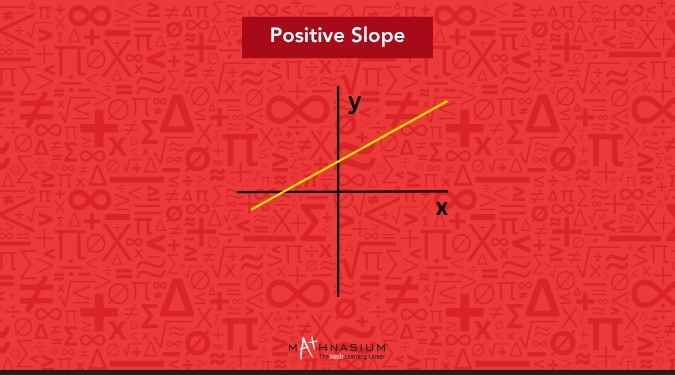
A line has a positive slope when it climbs and moves from left to right.
In mathematics, we always read graphs from left to right (just like reading a page in a book), so a positive slope means the line goes up as x increases.
In the real world, objects can move in any direction, but when we plot that movement on a graph over time, an upward path represents a positive slope.
We can see positive slopes in several common real-world scenarios:
-
A person pushes a cart up a ramp.
-
A roller coaster climbs its first big hill.
-
Total savings grow month by month.
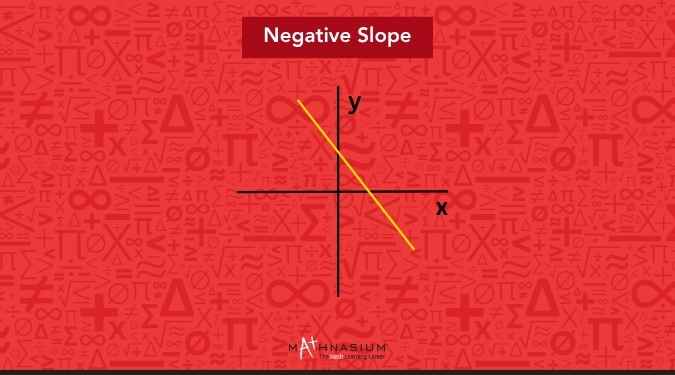
2. Negative Slope
When a line drops as we move from left to right, it has a negative slope. This downward path means that the line goes down as x increases, making the ratio between rise and run negative.
We can see negative slopes when:
-
A skier moves down a mountain.
-
A child slides down a playground slide.
-
A car's fuel level drops as distance increases.
📕 You May Also Like: Positive vs. Negative Slope — What’s the Difference?
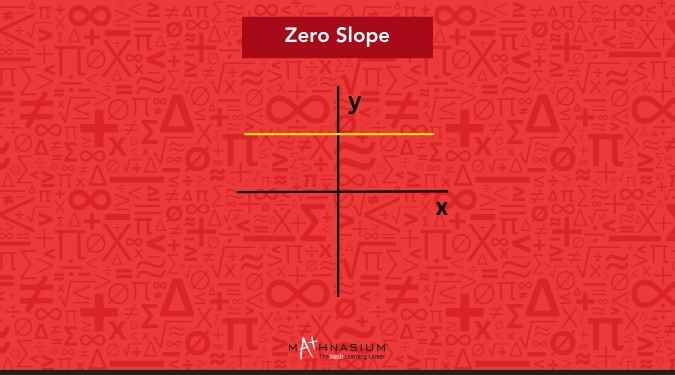
3. Zero Slope
A line has a zero slope when it is completely flat and horizontal. As we move along it, the vertical height never changes, no matter how far we travel horizontally.
Since the rise equals 0, dividing 0 by any run value always results in 0.
We see zero slopes every day when:
-
A person walks along a flat sidewalk.
-
A boat floats on calm, still water.
-
A car drives at a constant height across a flat highway.
4. Undefined Slope
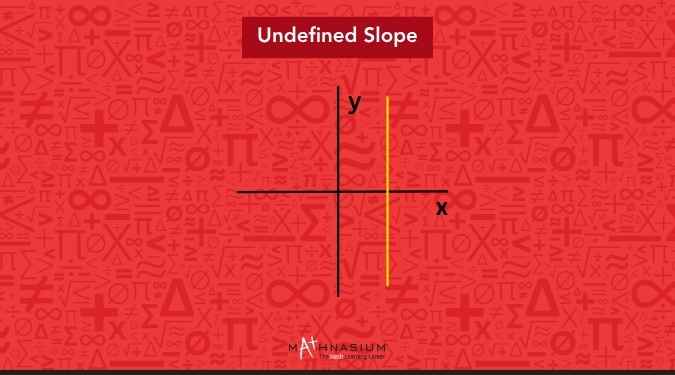
Vertical lines that go straight up and down have an undefined slope. When we move along a vertical line, we experience vertical movement, but our horizontal position never changes.
In math, slope measures how much height changes compared to how much distance changes to the side. A vertical line has zero side-to-side distance. Math cannot divide any number by zero, so a vertical line has no slope value at all.
We can see undefined slopes in several everyday situations:
-
A flagpole stands straight up from the ground.
-
A wall of a house or building.
-
A ladder rests vertically against a wall.
📕 You May Also Like: What Is an Undefined Slope? Explained for Middle Schoolers
Your Turn: Can You Find the Slope?
Our tutors at Mathnasium put together three problems to put your new skills to the test. For the best practice, grab some graph paper and plot each pair of points first.
Then, when you find the slope, identify which type of slope it represents.
-
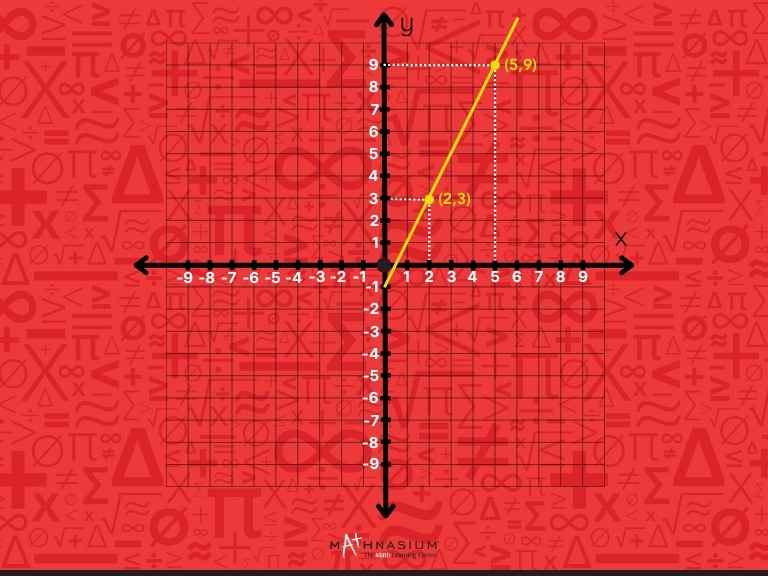
Find the slope between (2, 3) and (5, 9).
-
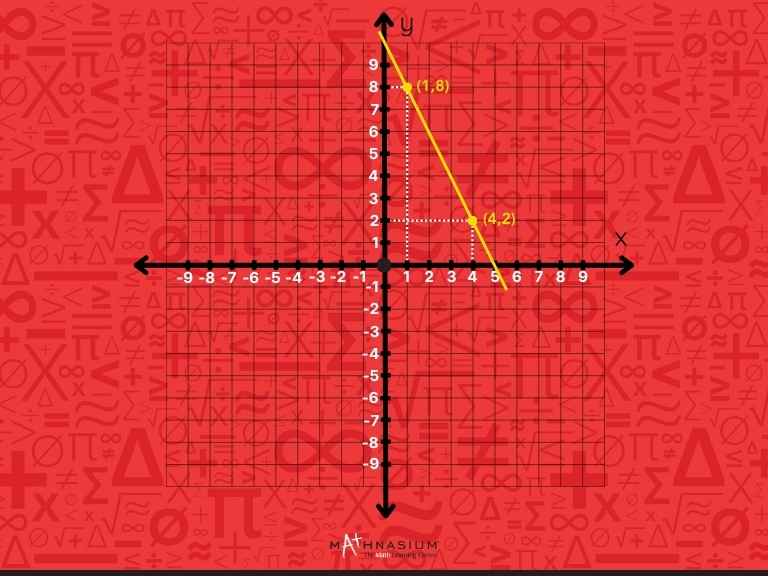
Find the slope between (1, 8) and (4, 2).
-
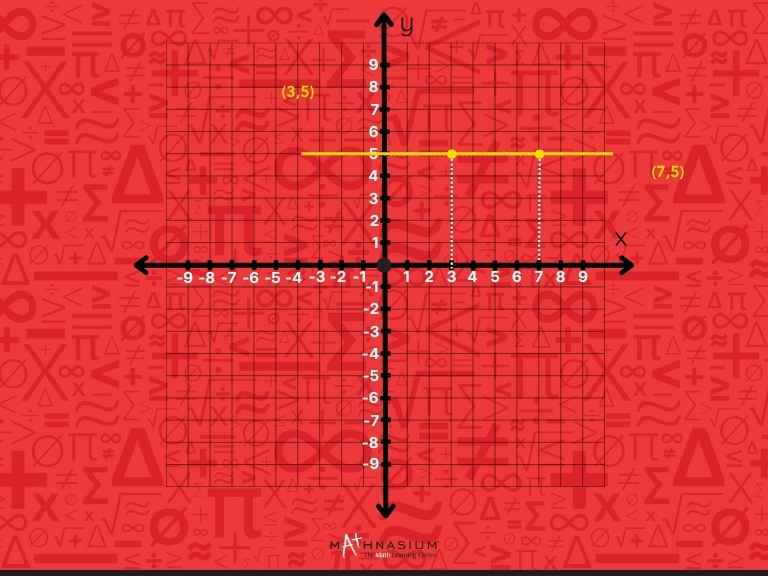
Find the slope between (3, 5) and (7, 5).
Take as much time as needed on each problem. The answers are at the bottom of the guide.

Mathnasium tutors work through slope problems alongside students, building the graphing instincts and number sense to read any line with confidence.
How Mathnasium Helps Students Master Any Math Concept
Mathnasium is a math-only learning center empowering students of all skill levels to learn and master math.
When students come to us for support, whether they need to strengthen foundational skills like reading a coordinate plane or work through a specific concept like slope, we focus on teaching for understanding.
We do that through the Mathnasium Method™, our proprietary teaching approach built around personalized learning and proven instructional techniques.
Here is what that looks like in practice:
-
Diagnostic Assessment and Personalized Learning Plans: Each student begins with a diagnostic assessment that identifies both visible skill gaps and the reasoning patterns behind them. From that starting point, we build a personalized learning plan tailored to their needs and goals, helping them build lasting math mastery at a pace that works for them.
-
Teaching for Understanding: Our specially trained tutors use plain, everyday language and a mix of verbal, visual, mental, tactile, and written techniques so concepts like slope land in a way that makes sense to each student.
-
Problem-Solving and Critical Thinking: Our tutors give students the space to work independently and trust their own reasoning. When a student gets stuck, tutors step in to guide them through the process and explain the how and why behind the answer. Over time, students develop problem-solving skills and critical-thinking tools they can rely on in math and beyond.
-
An Engaging and Fun Learning Environment: Sessions are designed to keep students motivated and enjoying the process. We celebrate every bit of progress, and that consistent recognition builds confidence with each session. Over time, students develop a more positive relationship with math and greater confidence in their own abilities.
The results reflect that approach:
-
94% of parents report improvement in their child's math skills and understanding
-
93% of parents report an improved attitude toward math after attending Mathnasium
-
90% of students saw improvement in their school grades
We operate over 1,200 centers across North America, bringing our proven approach to communities everywhere.
Families across North Johns Creek, Johns Creek, and the surrounding areas can visit Mathnasium of North Johns Creek, a trusted local center with a proven record of building confident math thinkers.
Whether your student is looking to catch up, keep up, or get ahead in math, our local team is happy to help!
📅 Schedule a Free Diagnostic Assessment at Mathnasium of North Johns Creek
Not near North Johns Creek?
📍 Find a Mathnasium Learning Center Near You
Pssst! Check Your Answers Here
Here are the answers. How did you do?
Problem 1: (2, 3) and (5, 9) → m = \(\Large\frac{9 - 3}{5 - 2} = \Large\frac{6}{3}\) = 2 This is a Positive Slope.
Problem 2: (1, 8) and (4, 2) → m = \(\Large\frac{2 - 8}{4 - 1} = \Large\frac{-6}{3}\) = -2 This is a Negative Slope.
Problem 3: (3, 5) and (7, 5) → m = \(\Large\frac{5 - 5}{7 - 3} = \Large\frac{0}{4}\) = 0 This is a Zero Slope.


 (770) 273-9697