Winter Break Activities to Keep Kids Learning Through the Holidays
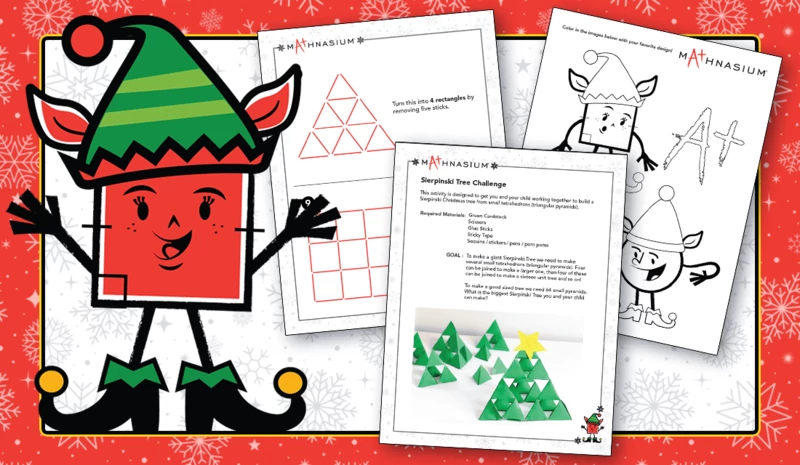
Winter break is the perfect time to step away from screens and into hands-on learning that doesn't feel like homework. These three festive math activities are designed to keep young minds active without the pressure. Grab some basic supplies — paper, crayons, popsicle sticks — and turn your kitchen table into a math adventure zone.
Perfect For: Younger learners who like creative, hands-on activities
Our festive coloring page features holiday characters that help develop fine motor skills while introducing early math concepts like shapes, patterns, and spatial awareness. It's low-pressure, high-engagement fun that builds foundational skills through art.
How to Use It:
- Print the coloring page
- Let kids color in the characters and explore the patterns
- Enjoy the creative process, there's no right or wrong way to bring these elves to life
Take It Further:
Once the coloring is complete, don't stop there! Cut out the finished characters, attach string, and hang them around the house as personalized holiday décor. Or create a winter wonderland by drawing a landscape scene on blank paper and letting kids cut and paste their colored characters into the setting. Add snowflakes, trees, presents, or anything else their imagination dreams up.

Share With Us:
We'd love to see your finished artwork! Share photos on social media and tag @Mathnasium with #Mathnasium and #MathnasiumActivities.
Perfect For: Upper elementary students ready for pattern recognition and logical thinking
What Is a Sierpinski Triangle?
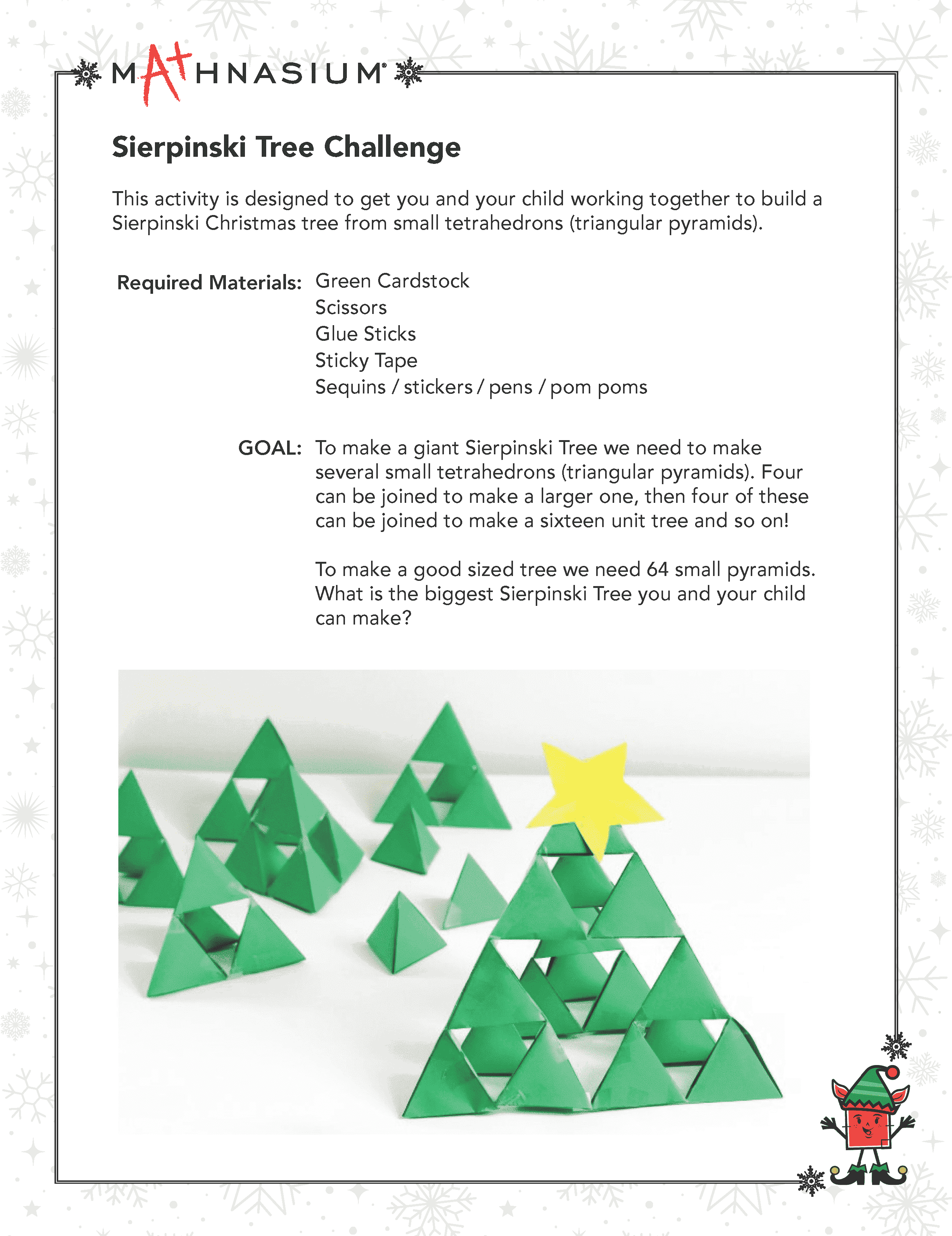
The Sierpinski triangle is a famous fractal — a geometric pattern that repeats itself at different scales. Start with a triangle, divide it into smaller triangles, and repeat. With each step, the pattern becomes more intricate while maintaining its self-similar design.
Activity Overview:
Students will build a festive "Sierpinski Tree" inspired by this mathematical pattern. As they fold and assemble triangular pyramids (tetrahedrons), they'll discover how four small units combine to create larger structures. Four pyramids become one larger unit, four of those create a 16-unit tree, and so on.
How to Do It:
Follow the step-by-step instructions to create your Sierpinski Tree using the provided templates in our activity guide. Decorate individual pyramids with markers, stickers, sequins, or glitter before assembling them into your fractal masterpiece.
Hands-On Alternative:
Don't have the templates? No problem! Recreate the Sierpinski triangle pattern using popsicle sticks, toothpicks, or paper cutouts. Lay them flat on a table to visualize the fractal pattern, or challenge yourself to build a 3D version. This tactile approach helps kids see mathematical relationships in a completely different way.
Share With Us:
Built something amazing? Show us your Sierpinski Tree designs! Tag @Mathnasium with #Mathnasium and #MathnasiumActivities on social media.
Perfect For: Middle school thinkers ready for logical challenges
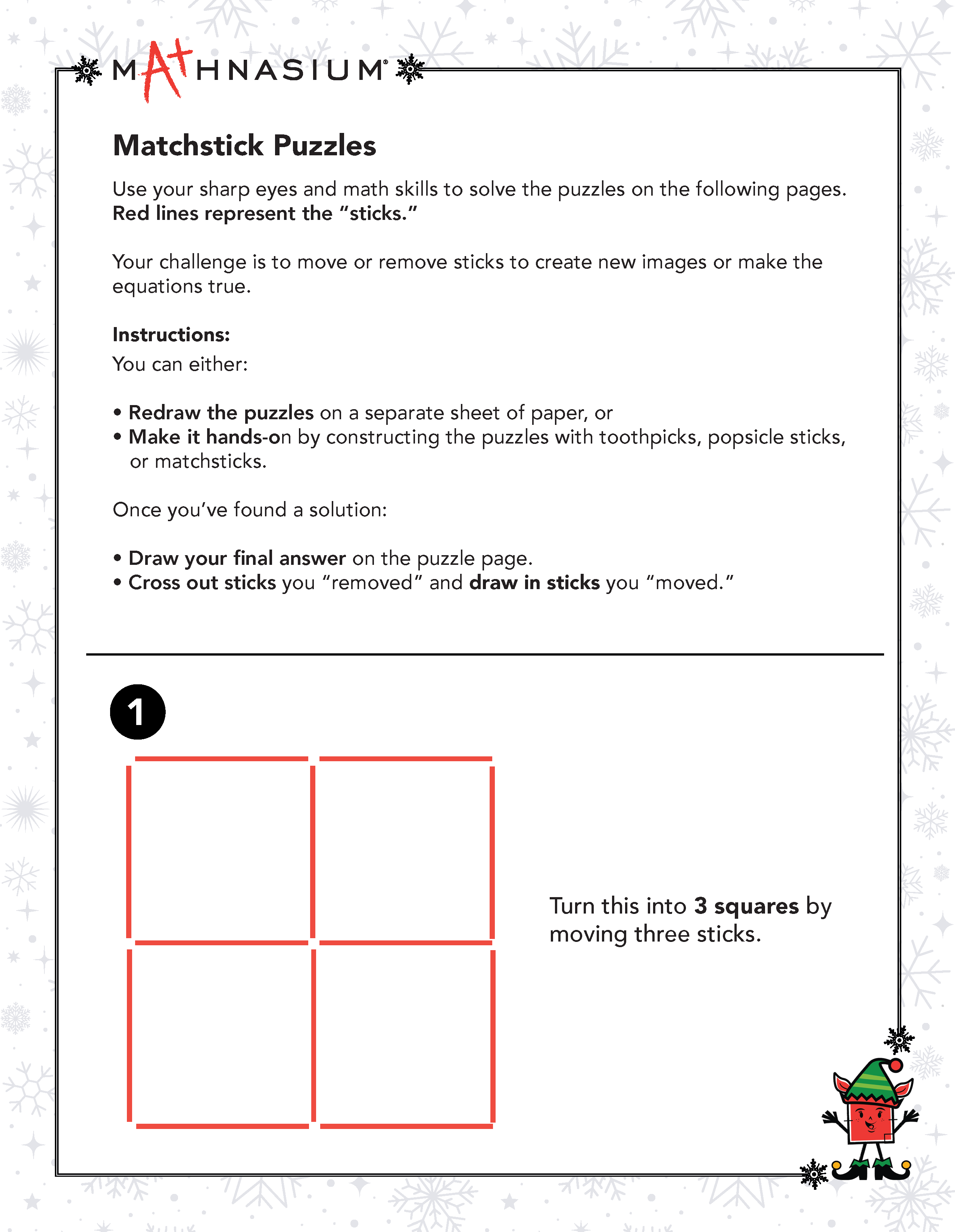
These brain-teasing puzzles turn simple matchsticks into complex problems that strengthen spatial reasoning and critical thinking. Each puzzle presents a challenge: move two sticks to form three squares, remove five to create four triangles, fix the broken equation by repositioning one stick. There are 16 different puzzles to solve, each requiring careful observation and strategic thinking.
How to Use Them:
Print the puzzle pages and solve them on paper, or bring the puzzles to life by recreating them with physical materials:
- Popsicle sticks
- Unused matchsticks
- Straws or toothpicks
- Even pretzel sticks (resist the urge to eat your puzzle!)
Working with actual objects adds a tactile element that makes the problem-solving process more engaging and helps visualize solutions more clearly.
Tips for Success:
Encourage trial-and-error. There's no penalty for testing ideas that don't work. Have students think aloud as they work through possibilities. Once they've mastered the provided puzzles, challenge them to create their own matchstick brainteasers for family members to solve.
Share With Us:
Solved a tricky puzzle or created your own? Share your solutions and custom designs by tagging @Mathnasium with #Mathnasium and #MathnasiumActivities.
Keep Learning Alive This Winter Break
These activities prove that math doesn't have to happen at a desk with a pencil and worksheet. Winter break learning can be creative, collaborative, and completely screen-free.
Print the pages, gather the supplies, and make math part of your holiday traditions this year! Whether you're coloring, building fractals, or solving puzzles, you're showing kids that learning never really stops, it just gets more fun.
Don't forget to share your creations with us! Tag @Mathnasium and use #Mathnasium and #MathnasiumActivities so we can celebrate your winter break math adventures.
Want more creative ways to keep your child's math skills sharp year-round? Find your local Mathnasium.


 (425) 699-6284