Adjacent may be a word you’ve heard in everyday life. Maybe your teacher asked you to take the seat adjacent to your classmate. Or maybe you’ve heard someone talk about a house adjacent to theirs.
The word comes from the Latin adjacere, meaning “to lie near.” In life, being adjacent simply means being close or right next to something. And since math often reflects the patterns we see in the world around us and helps us make sense of them, adjacent has a special meaning in math too.
That’s what our instructors will explore today.
Read on to discover what adjacent means in math, how it shows up in angles and shapes, how it compares to other types of angle pairs, and how to recognize it when solving problems. You’ll also get a chance to practice what you learn and clear up common student questions along the way.

What Does “Adjacent” Mean in Math?
In math, adjacent means “next to” or “sharing a boundary.” When two objects touch each other at some point, whether it’s along a side, a corner, or a point, they can be described as adjacent.
This term is particularly important in geometry. Shapes, lines, and sides can all be adjacent when they sit next to each other without anything in between.
Here are a few examples:
-
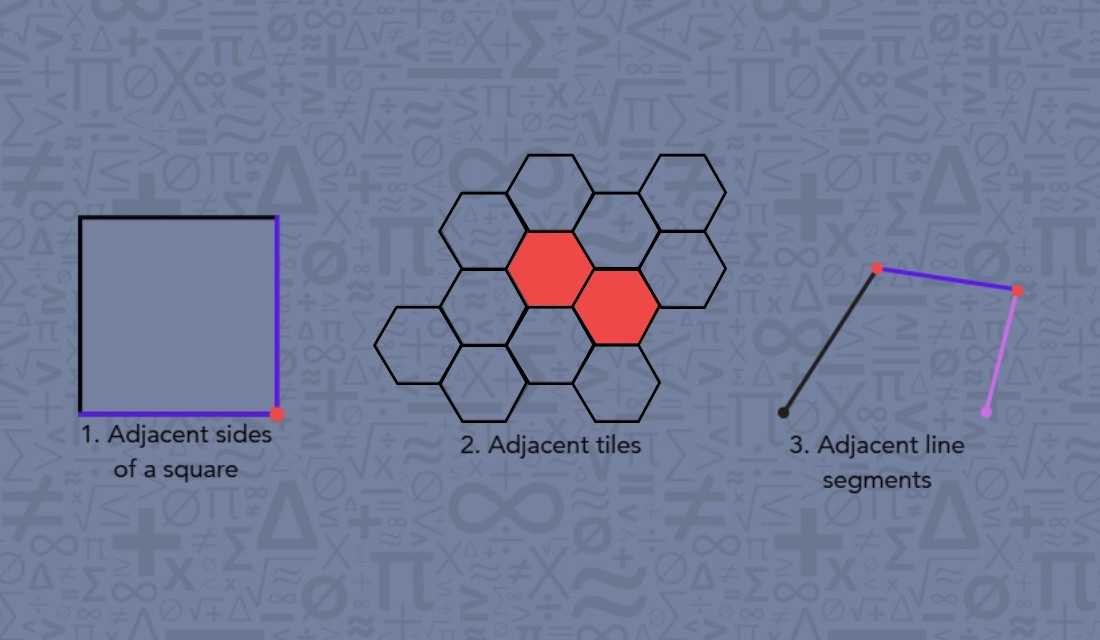
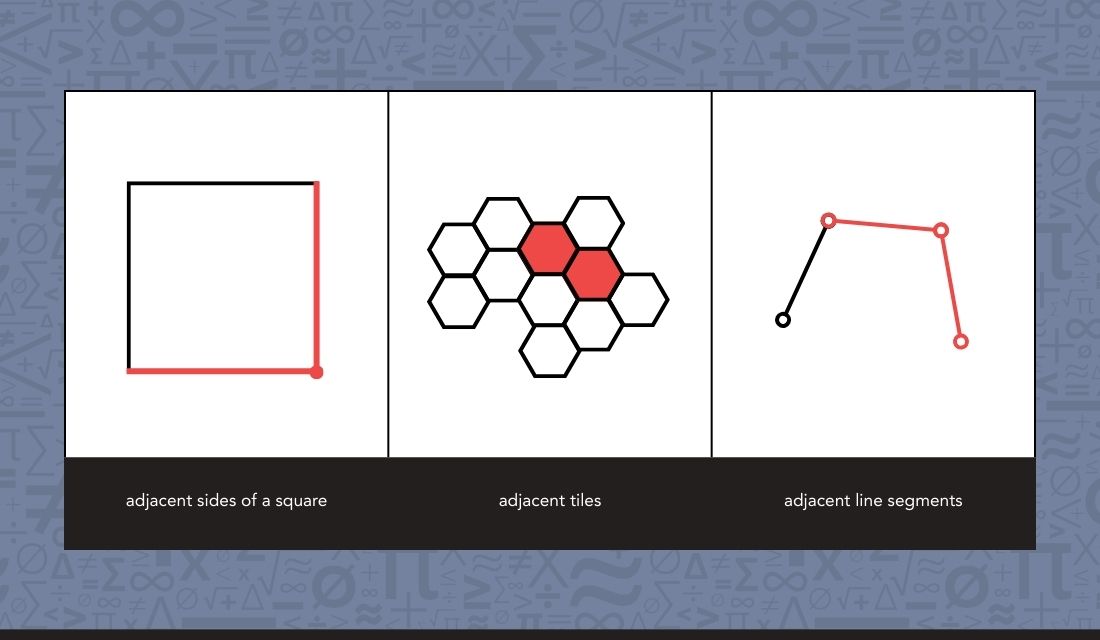
Two sides of a square that meet at a corner are adjacent; they share a side and connect at a point.
-
Tiles on a floor are often adjacent; each tile touches the one beside it along a shared edge.
-
Line segments drawn in a figure might be adjacent if they connect at the same endpoint.
In math, identifying what is adjacent helps us understand how parts of a figure relate to one another. And one place where this word becomes especially important?
Angles.
📕 You May Also Like: Is Your Student Ready for Their Geometry Class? [+Quiz]
What Are Adjacent Angles?
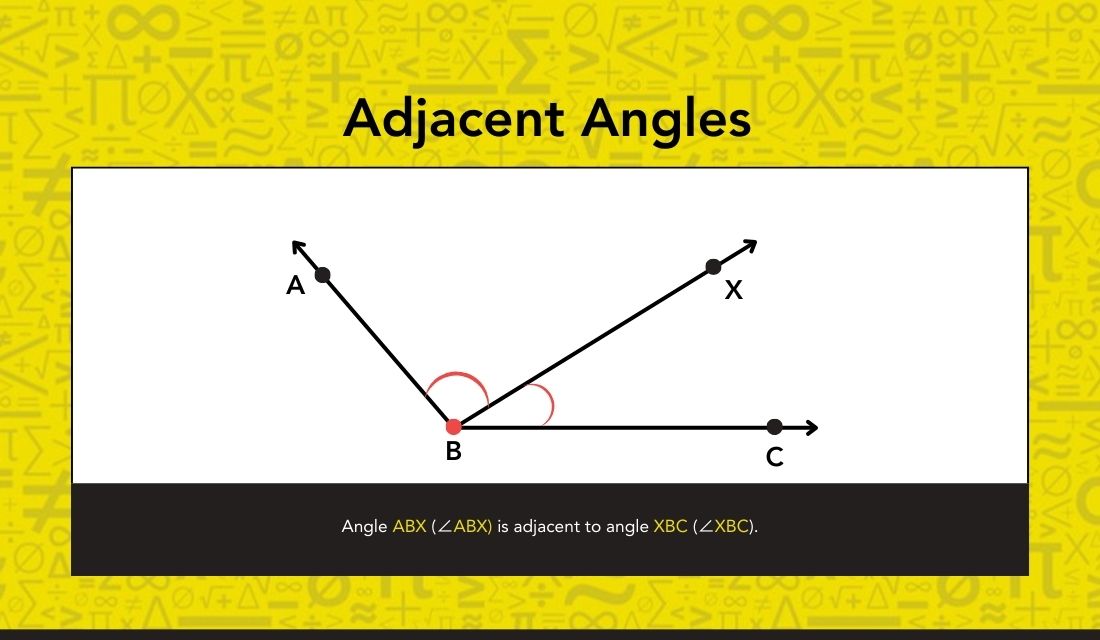
Two angles are adjacent if they are next to each other, share a common vertex and a common side, and don’t overlap.
Where might we see adjacent angles in real life?
If you thought of the hands of a clock, you’re on the right track; they meet at a point and form angles side by side.
Now think about pizza slices.
Two slices right next to each other start at the same center point and share one edge. That shared edge is like the side between two angles. Together, the slices form a real-life example of adjacent angles.

What Are Non-Adjacent Angles?
Not all angles that appear close together are adjacent.
Non-adjacent angles are angles that do not meet all the conditions for being adjacent. This can happen in a few ways:
-
They do not share a common side,
-
They do not share the same vertex, or
-
They overlap or sit apart with space in between.
Let’s look at a few examples.
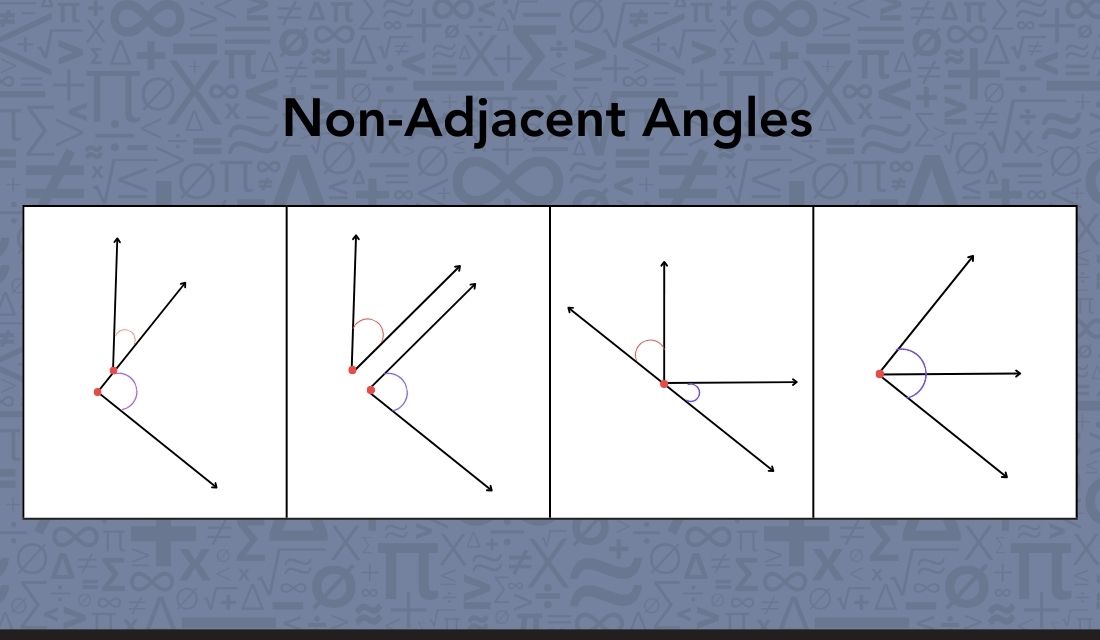
These are all examples of non-adjacent angles because:
-
In the first diagram, the angles share a side but not the same vertex.
-
In the second diagram, the angles do not share a side or a vertex.
-
In the third diagram, the angles share a vertex but not a common side.
-
In the fourth diagram, the angles share both a vertex and a side, but they overlap.
As we can see, it’s not just about being close; angles must meet all three rules to be truly adjacent. Spotting what’s missing helps us avoid common mistakes.
How Do Adjacent Angles Compare to Other Angle Types?
Adjacent angles often appear alongside other angle types, including complementary, supplementary, and vertical angles.
While they can look similar or even occur in the same diagram, these angle types describe different relationships.
Let’s see how they compare, so we can avoid mixing them up.
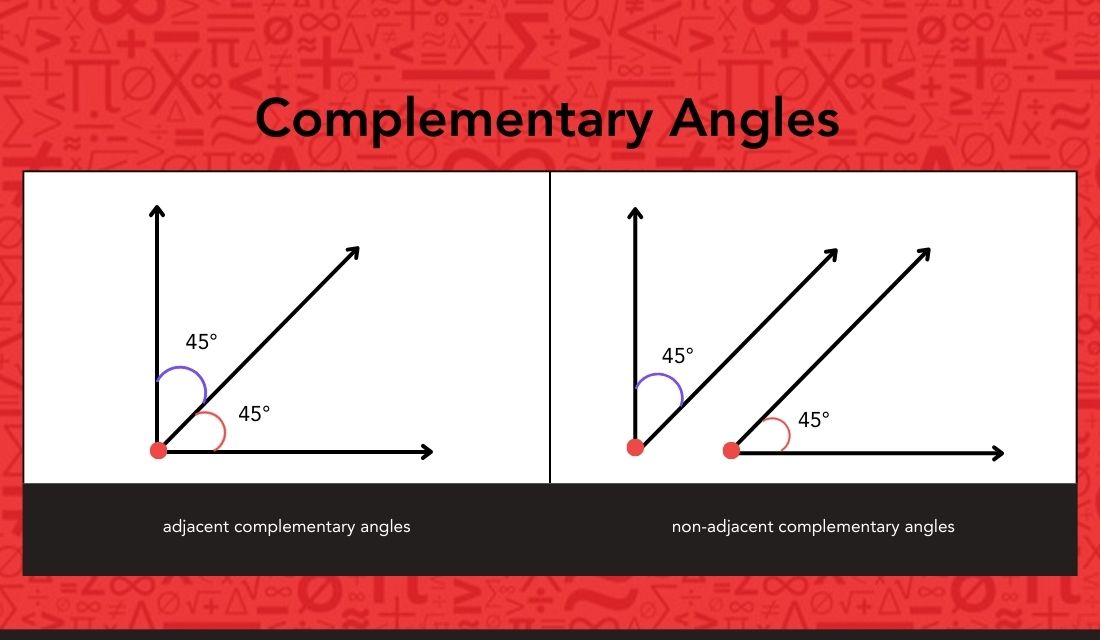
1. Complementary Angles: Two angles are complementary if their measures add up to 90°. They may or may not be adjacent. For example, they could sit side by side and add up to 90° together, or they could appear in completely different parts of a diagram.
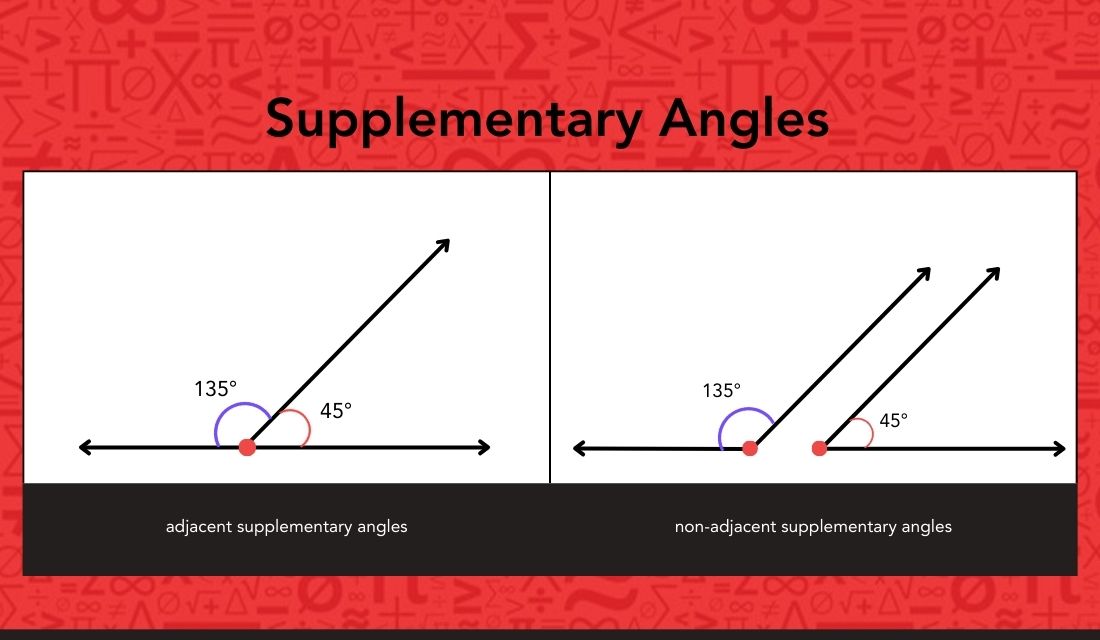
2. Supplementary Angles: Two angles are supplementary if their measures add up to 180°. They are often adjacent when they appear on a straight line, but they can also be separated in a diagram.
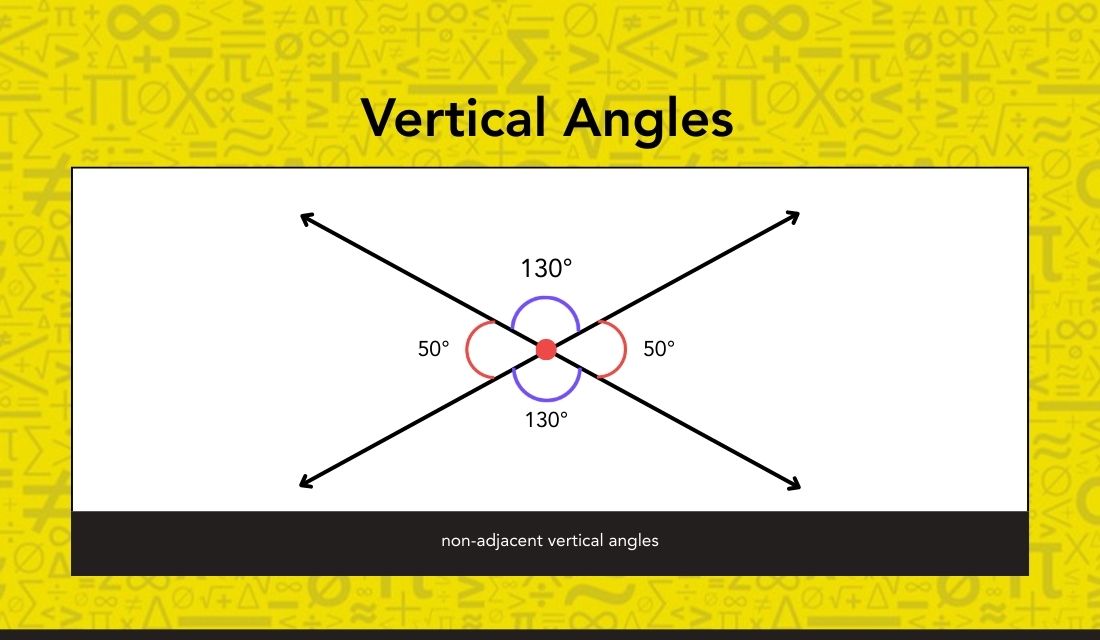
3. Vertical Angles: Vertical angles are formed when two lines intersect. They are always across from each other. Vertical angles share a vertex but not a side, so they are never adjacent.
Let’s Recap: How Do We Identify an Adjacent Angle?
With everything we’ve learned, let’s walk through how to identify an adjacent angle.
At Mathnasium, we love doing that through examples—so here’s one!
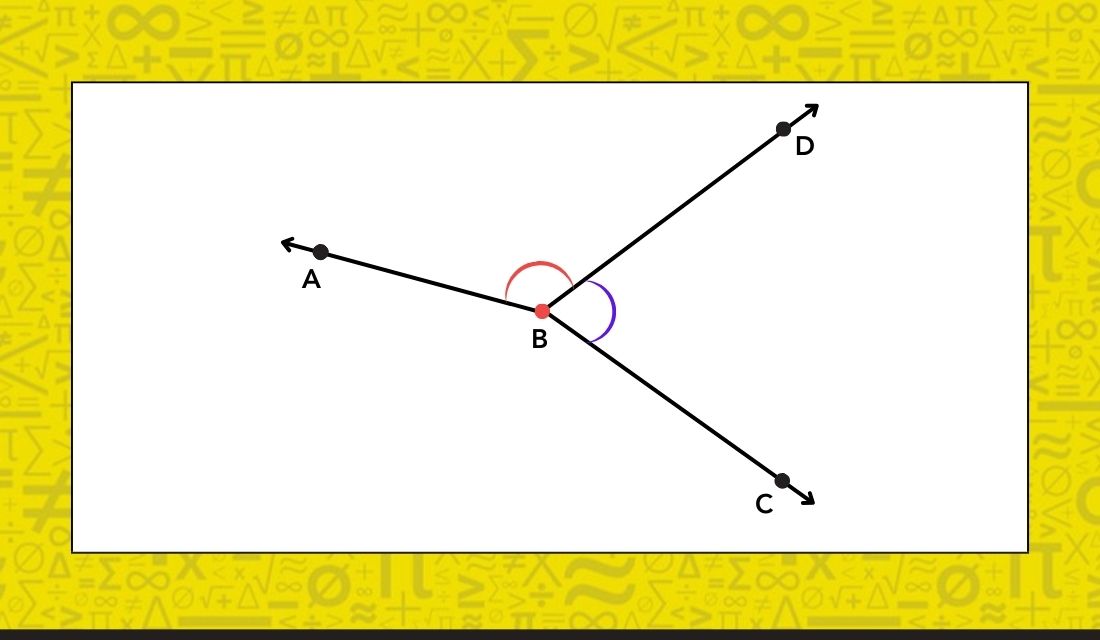
Looking at the diagram, can we tell if ∠ABD and ∠CBD are adjacent?
We ask ourselves three simple questions:
-
Do they share a vertex? Absolutely. Both angles meet at point B.
-
Do they share a common side? Yes! They both include the side BD.
-
Do they overlap? Nope. They sit side by side but don’t cover the same space.
Since they meet all three conditions, we can say:
∠ABD and ∠CBD are adjacent angles.
Here goes another one.
Are ∠ABC and ∠CBX adjacent?
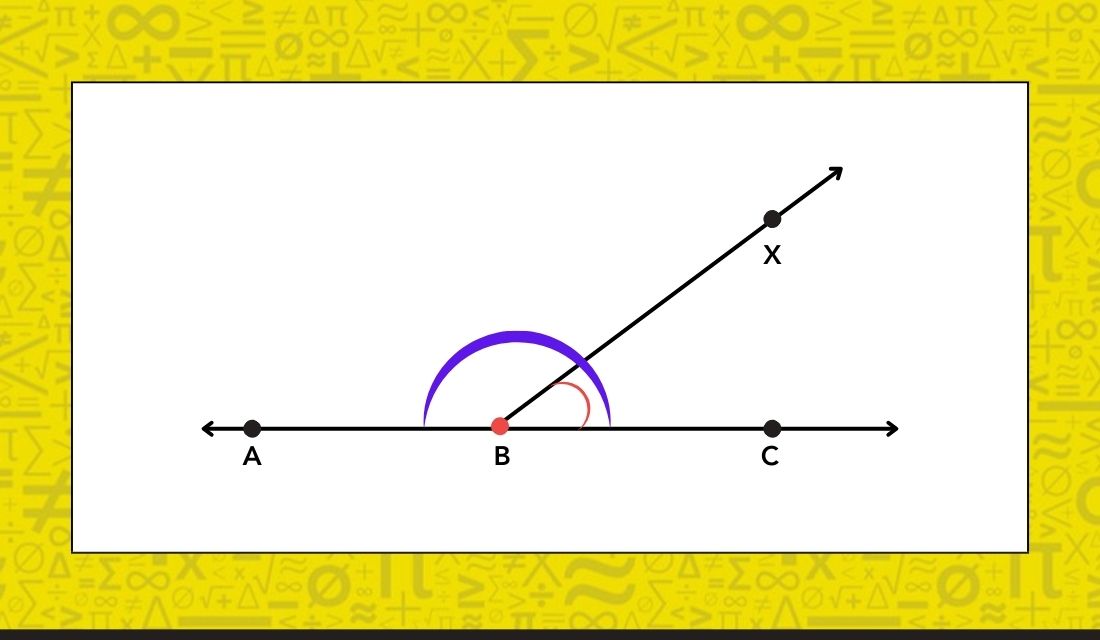
Let’s go through the same questions:
-
Do they share a vertex? Yes, both angles have B as the vertex.
-
Do they share a common side? Yes, they both include BC.
-
Do the angles overlap? Yes, ∠CBX is entirely inside ∠ABC. That means they overlap
Because they overlap, ∠ABC and ∠CBX are not adjacent.
📕 You May Also Like: Types of Angles: Acute, Right, Obtuse & Straight Explained
Quiz: What Have You Learned About Adjacent Angles?
Let’s see what you remember! Choose the best answer for each question.
Create your own user feedback survey
📕 You May Also Like: What Is Congruent in Geometry? A Complete Overview
Frequently Asked Questions About Adjacent Angles
Learning about adjacent angles doesn’t come without a few dilemmas and maybe even a head scratch or two. We’ve gathered some of the most common questions we hear at Mathnasium, along with clear answers to help you solve any lingering confusion.
1. When do students learn about adjacent angles in school?
Most students are introduced to adjacent angles in upper elementary grades, usually around 4th or 5th grade, as they start learning about geometric relationships.
They continue to work with adjacent angles in middle school, especially when exploring angle measurement, supplementary angles, and solving for unknowns in geometry.
2. Can adjacent angles be equal?
Yes, they can! Adjacent angles can have the same measurement, but they don’t have to. Whether they’re equal depends on the lines and shapes involved.
For example, if a right angle (90°) is divided into two equal parts, the two adjacent angles would each measure 45°.
3. Can three or more angles be adjacent at the same time?
Yes! As long as each pair of consecutive angles shares a side and a vertex with the next one and they sit side by side without overlapping, you can have three or more adjacent angles in a row, like slices of a pie arranged around a single center point.
4. How do adjacent angles help solve unknowns in geometry?
Adjacent angles are helpful when you know the total angle measurement (like 180° on a straight line or 90° in a corner). If you know the measure of one angle, you can subtract it from the total to find the missing angle. It’s a common strategy in solving angle puzzles and geometry problems.
Master Geometry with Top-Rated Mathnasium Tutors
Understanding terms like adjacent angles isn’t just about memorizing definitions. At Mathnasium, it is about seeing how math works, fits together, and applies to real problems. We help students truly understand geometry by making abstract ideas visual, interactive, and logical.
It’s all part of the Mathnasium Method™, a proprietary teaching approach that unlocks each student’s true math potential and transforms how they think and feel about math.
Here’s how it works.
It begins with a diagnostic assessment. This is a relaxed, interactive experience that helps us discover what a student already knows, what they could improve, and how they learn math best.
From there, we create a personalized learning plan tailored to each student’s needs—whether that means building a stronger understanding of geometry, developing spatial reasoning, improving problem-solving skills, or getting ready for more advanced math concepts.
Once the plan is ready, our specially trained instructors follow it closely and deliver face-to-face instruction in a supportive and fun environment. During sessions, we use a mix of verbal, visual, mental, tactile, and written techniques to adapt to different learning styles.
When a student gets stuck on a concept, like understanding how angles work, we break it down into clear, manageable steps. Then we go further, showing not just how it works, but why. This builds the kind of critical thinking students can use across all areas of math.
Sessions at Mathnasium often don’t feel like lessons. With hands-on activities, game-based learning, and meaningful rewards, students stay engaged and motivated.
Working with our instructors guided by the Mathnasium Method™, students see measurable results:
-
94% of parents report an improvement in their child’s math skills and understanding
-
93% of parents report improved attitude toward math after attending Mathnasium
-
90% of students saw an improvement in their school grades
Whether your student needs to catch up, keep up, or get ahead in math, your local Mathnasium Learning Center is here to help. Contact us today to schedule a diagnostic assessment, and let’s start building a personalized plan to put them on the best path toward math mastery.



 (262) 599-5815