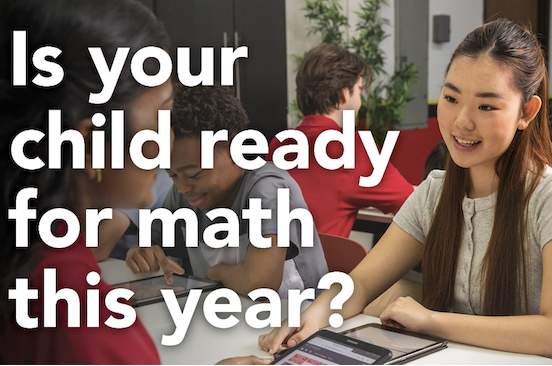
Back-to-school season is here! As summer winds down and families start thinking about school supplies, schedules, and new routines, it’s also a great time to check in on your child’s math confidence.
But you don’t need to pull out a worksheet or give your child a quiz. In fact, some of the best math conversations can happen naturally while you’re driving to soccer practice, making dinner, or enjoying one last summer adventure.
Here are 10 simple math questions to get the conversation started. There are no grades, no pressure, and no need to have every answer correct. The goal is simply to get kids thinking, explaining their ideas, and feeling comfortable talking about math.
1. “What’s a math topic you really like?”
Start with something positive! Maybe your child loves multiplication, geometry, fractions, patterns, or solving puzzles.
Ask them why they like it. Their answer can give you insight into what kinds of math activities make them feel successful and engaged.
2. “What’s a math topic that feels tricky?”
This is a great way to find out where your child may need some extra support before the school year gets busy.
Try to resist jumping in with the answer. Instead, ask:
“What makes it tricky?”
Sometimes a child knows exactly what they’re struggling with. Other times, they may simply need to rebuild confidence with a skill they haven't practiced in a while.
3. “If you had $20 and spent $7.50, how much would you have left?”
Turn everyday situations into mental math!
You can change the numbers depending on your child’s age. Younger students might work with whole dollars, while older students can tackle decimals, percentages, discounts, or even tax.
For an extra challenge: “How did you figure that out?”
The explanation is often more valuable than the answer itself.
4. “Which would you rather have: 50% of $20 or $8?”
Questions like this encourage kids to think about numbers instead of automatically reaching for a calculator.
You can follow up with:
“How do you know?”
Encouraging children to explain their reasoning helps strengthen mathematical thinking and communication.
5. “If we left home at 3:15 and got somewhere at 3:45, how long did the trip take?”
Time is everywhere—and it gives kids a chance to practice math without realizing they're practicing.
Try changing the times or adding another step:
“If we need to be there at 4:00 and it takes 25 minutes to get there, when should we leave?”
6. “Can you find something around us that has a math shape?”
Look around the house, the car, a restaurant, or wherever you happen to be.
Can your child find a rectangle? A circle? A triangle? A cylinder?
For older kids, take it further:
“What makes that shape a rectangle?”
“How could we estimate its area?”
“Where might we see symmetry?”
Math is all around us—we just have to notice it!
7. “What’s the fastest way you can figure out 25 × 4?”
This isn't about memorizing one particular trick. It's about encouraging kids to look for efficient strategies.
Maybe they know that 25 × 4 = 100. Maybe they think of 25 as a quarter of 100. Maybe they use repeated addition.
Ask:
“Is there another way you could solve it?”
There is often more than one path to the right answer.
8. “If you could teach me one math trick, what would you teach me?”
This one can be surprisingly revealing—and fun!
When children teach someone else, they have to organize their thinking and explain the steps clearly. It also gives them an opportunity to recognize just how much they already know.
And if your child says, “I don't know any math tricks,” that's okay too! You can turn it into a conversation about a strategy they learned at school.
9. “Where do you think you'll use math this year?”
Encourage your child to think beyond the classroom.
Math is used when we're shopping, cooking, playing sports, traveling, building, budgeting, measuring, telling time, and even planning a schedule.
For Park City families, you might ask:
“Where do you think you use math when you're skiing, biking, or hiking?”
You may be surprised by the answers!
10. “What’s one thing you want to feel more confident about in math this year?”
End with a goal rather than a score.
Maybe your child wants to get faster at multiplication facts. Maybe fractions feel confusing. Maybe they want to feel more comfortable raising their hand in class.
Whatever their answer, listen and encourage them.
Math confidence doesn't come from getting every problem right. It grows when kids have opportunities to practice, make mistakes, try different strategies, and experience success.
Make Math a Conversation, Not a Test
The goal of these questions isn't to determine whether your child is “ready” for school or to identify every skill they may have forgotten over the summer.
It's simply to get math back into everyday conversation.
When kids talk about how they solve problems, explain their thinking, and see math in the world around them, they're practicing important mathematical skills without sitting down for a formal lesson.
So the next time you're driving around Park City, eating dinner, or squeezing in one last summer adventure, try asking a math question.
You might just discover that math makes a great conversation starter.
Ready for a Confident Start to the School Year?
A new school year is a great opportunity to refresh foundational skills, strengthen problem-solving strategies, and build confidence in math.
At Mathnasium of Park City, we help students build their math skills through personalized instruction designed around their individual needs and goals.
Let's make this school year a great one for math!


 (435) 272-4994