If your child has made it through adding and subtracting fractions, that's a real win. But dividing a fraction by a fraction? That's where things can get tricky, even for students who've been doing well.
It's no wonder this concept trips students up.
Division is abstract on its own, and fractions are already a step removed from whole numbers. Put them together, and it's easy to hit a wall.
On top of that, the result of dividing fractions can actually be larger than what they started with, which goes against every instinct students have built around division.
So, whether your child finds fraction division confusing or just needs a little clarity, you're in the right place.
Today, Mathnasium instructors will break down what dividing fractions truly means, walk you through a visual aid, and share clear tips to help your child master the concept.

What Does Dividing a Fraction by a Fraction Really Mean?
At Mathnasium, we define division as asking, "How many of these are there inside of that?"
With whole numbers, this feels natural. If we ask 6 ÷ 2, we're simply asking, "How many 2s are there inside of 6?" Three, of course.
Now, let's bring fractions into it. When we ask \(\Large\frac{1}{2}\) ÷ \(\Large\frac{1}{4}\), we're asking the same question: “How many one-fourths are there inside of one-half?”
We know that might be a lot to take in at first. Let's make it visual.
Say we have a rectangle. Since we're checking how many one-fourths are inside of one-half, we can divide that rectangle into four equal parts. Each part represents \(\Large\frac{1}{4}\).
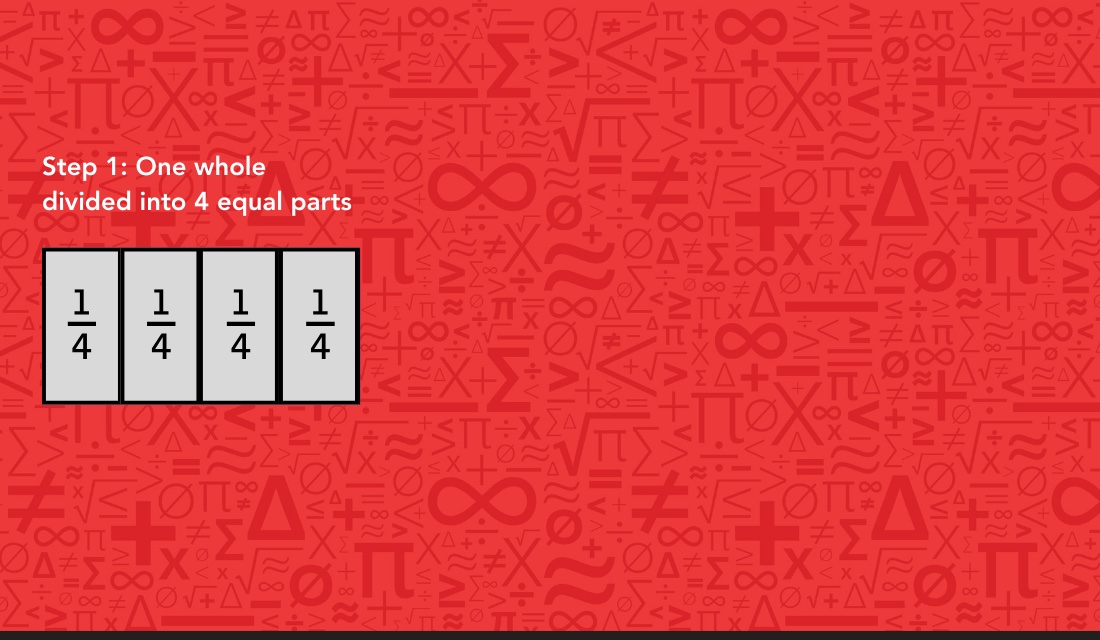
Now, we can shade \(\Large\frac{1}{2}\) of the whole; that's 2 out of the 4 parts.
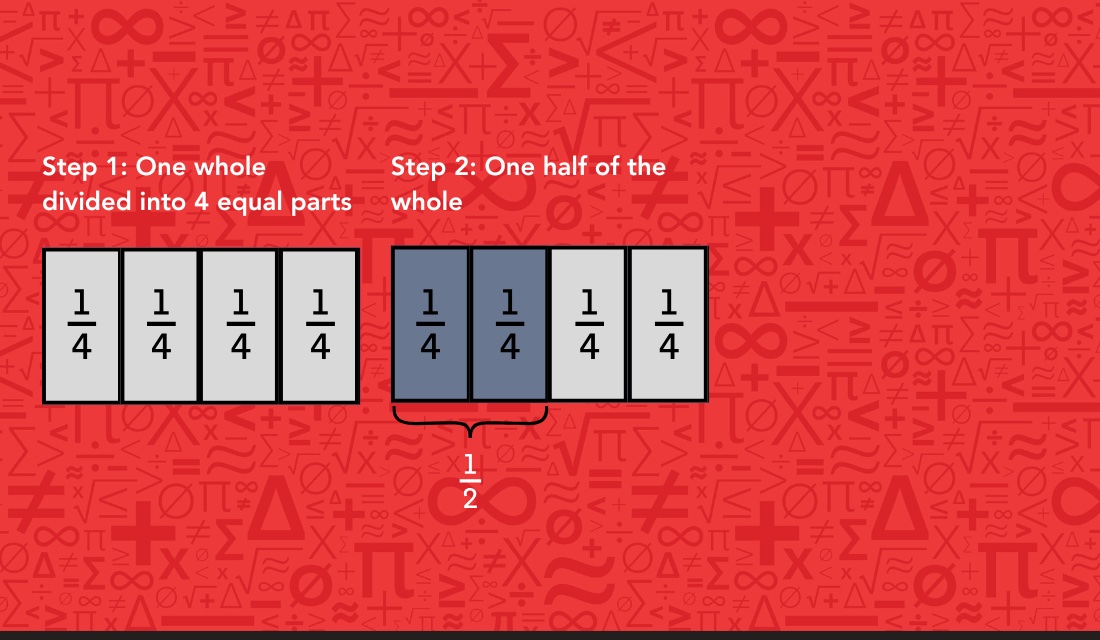
Finally, we can just count how many \(\Large\frac{1}{4}\) pieces fit inside that shaded half.
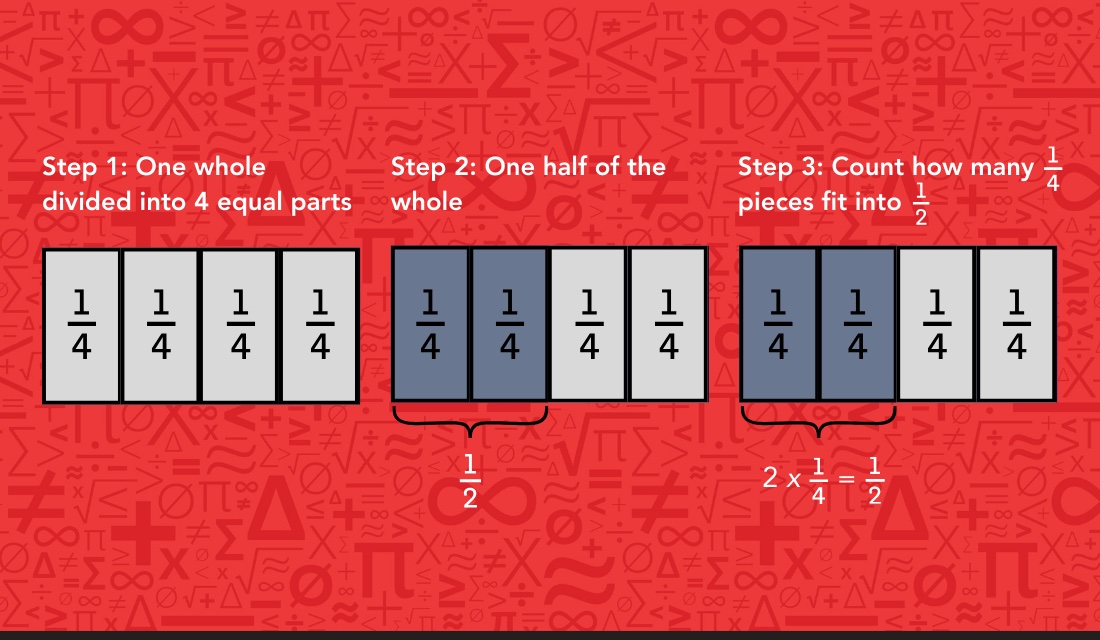
The answer is 2. Two one-fourths fit inside one-half.
So dividing a fraction by a fraction is really just asking how many times one piece of the whole fits into another piece of the whole.
Not so intimidating anymore, right?
📕 You May Also Like: What Is Division in Math? A Simple & Complete Overview
How to Divide a Fraction by a Fraction: The Method
We've seen visually that \(\Large\frac{1}{2}\) ÷ \(\Large\frac{1}{4}\) = 2. Now let's focus on the numbers.
Looking at \(\Large\frac{1}{2}\) ÷ \(\Large\frac{1}{4}\), it's not immediately obvious what to do.
Do we find a common denominator, like when adding fractions? Do we work with the numerators and denominators separately?
This is where our instructors like to remind students of something: every fraction is a division problem, and every division problem can be written as a fraction.
Let’s try that with our problem.
\(\Large\frac{\frac{1}{2}}{\frac{1}{4}}\)
Looks complex, right? That's exactly what it's called: a complex fraction.
To simplify it, we want the denominator to become 1. Why 1? Because anything over 1 is just itself. \(\Large\frac{2}{1}\) is 2. \(\Large\frac{3}{1}\) is 3.
To turn \(\Large\frac{1}{4}\) into 1, we multiply it by its reciprocal, its flipped version, \(\Large\frac{4}{1}\):
\(\Large\frac{1}{4}\) × \(\Large\frac{4}{1}\) = \(\Large\frac{4}{4}\) = 1
But multiplying only the denominator changes the value of the entire expression. To keep it equivalent, we multiply both the numerator and denominator by \(\Large\frac{4}{1}\):
\(\Large\frac{\frac{1}{2} × \frac{4}{1}}{\frac{1}{4} × \frac{4}{1}}\) = \(\Large\frac{\frac{4}{2}}{\frac{4}{4}}\) = \(\Large\frac{2}{1}\) = \(2\)
We got the same answer as before, right?
Notice what we actually did: we kept the first fraction (\(\Large\frac{1}{2}\)), and multiplied it by the reciprocal of the second fraction (we flipped \(\Large\frac{1}{4}\) to get \(\Large\frac{4}{1}\)).
That's exactly where the Keep, Flip, Multiply method (the one you've probably heard of) comes from. And since we know it works, we can use it for any fraction division problem:
-
Keep the first fraction exactly as it is.
-
Flip the second fraction (take its reciprocal).
-
Multiply the two fractions straight across.
Keep, Flip, Multiply in Action (Solved Examples)
Let's try it with a new example: \(\Large\frac{3}{4}\) ÷ \(\Large\frac{3}{8}\)
We keep \(\Large\frac{3}{4}\), flip \(\Large\frac{3}{8}\) to \(\Large\frac{8}{3}\), and multiply:
\(\Large\frac{3}{4}\) × \(\Large\frac{8}{3}\) = \(\Large\frac{24}{12}\)
Now, before we call this our final answer: Is \(\Large\frac{24}{12}\) already in its simplest form? Let's check.
The greatest common factor of 24 and 12 is 12, so we can simplify by dividing both the numerator and denominator by 12:
\(\Large\frac{24÷12}{12÷12}\) = \(\Large\frac{2}{1}\) = \(2\)
So, \(\Large\frac{3}{4}\) ÷ \(\Large\frac{3}{8}\) = 2.
Practice makes perfect! Here’s one more: \(\Large\frac{2}{3}\) ÷ \(\Large\frac{1}{5}\)
We keep \(\Large\frac{2}{3}\), flip \(\Large\frac{1}{5}\) to \(\Large\frac{5}{1}\), and multiply:
\(\Large\frac{2}{3}\) × \(\Large\frac{5}{1}\) = \(\Large\frac{10}{3}\)
Since 10 and 3 share no common factors, we can't simplify. But we can convert it to a mixed number.
To do that, we ask: how many times does 3 fit into 10? Three times, with 1 left over.
We’re working in thirds. The denominator is 3, so the leftover 1 is 1 part out of 3. We write:
\(\Large\frac{10}{3}\) = \(3\Large\frac{1}{3}\)
That’s it!
📕 You May Also Like: How to Multiply a Fraction by a Whole Number
Watch Out for These Common Fraction Division Mistakes
Now that you know what fraction division really means and where Keep, Flip, Multiply comes from, you're already ahead of the game. That said, even with the reasoning under your belt, it's easy to get tangled up in the numbers.
Here are a few things to watch out for:
-
Flipping the wrong fraction. When using Keep, Flip, Multiply, it's the second fraction that gets flipped, not the first. It's an easy mix-up, but it changes the entire answer.
-
Forgetting to simplify. Getting to an answer is great, but always check whether it can be simplified. If the numerator and denominator share a common factor, the answer isn't in its simplest form yet.
-
Multiplying without flipping. Some students see the multiplication sign and go straight across without flipping the second fraction first. Remember, the flip is what makes the whole method work.
-
Not converting mixed numbers first. If the problem includes a mixed number like \(2\Large\frac{1}{3}\), convert it to an improper fraction before doing anything else. To do that, multiply the whole number by the denominator and add the numerator, so \(2\Large\frac{1}{3}\) becomes \(\Large\frac{7}{3}\). Skipping this step leads to errors that are hard to trace back.
📕 You May Also Like: Types of Fractions—A Comprehensive, Beginner-Friendly Guide
Time to Practice: Try Dividing These Fractions
You've got the concept, you've seen the method in action, and you know what to watch out for. Now it's time to put it all together. Try these with your child, or have them work through the problems on their own and check the answers at the bottom.
-
\(\Large\frac{2}{3}\) ÷ \(\Large\frac{1}{4}\)
-
\(\Large\frac{4}{6}\) ÷ \(\Large\frac{2}{3}\)
-
\(\Large\frac{3}{4}\) ÷ \(\Large\frac{1}{2}\)
-
\(3\Large\frac{1}{2}\) ÷ \(\Large\frac{1}{2}\)
When they’re done, check how they did at the bottom of the guide.
FAQs About Dividing Fractions
Even after the concept clicks, questions tend to come up. Here are a few we hear often in our Mathnasium centers, along with clear answers to help make sense of it all.
1. Can we divide a fraction by a whole number?
Yes! Any whole number can be written as a fraction by placing it over 1. So if we’re dividing \(\Large\frac{1}{2}\) by 3, we simply rewrite 3 as \(\Large\frac{3}{1}\) and then keep, flip, and multiply as usual:
\(\Large\frac{1}{2}\) ÷ \(\Large\frac{3}{1}\) = \(\Large\frac{1}{2}\) × \(\Large\frac{1}{3}\) = \(\Large\frac{1}{6}\)
2. Does the order matter when dividing fractions?
Yes, and this is an important one. Unlike multiplication, where switching the order doesn't change the result, division is not commutative. That means \(\Large\frac{1}{2}\) ÷ \(\Large\frac{1}{4}\) and \(\Large\frac{1}{4}\) ÷ \(\Large\frac{1}{2}\) are two completely different questions, and they give two different answers.
Always make sure the fraction you're dividing into comes first.
3. Can we divide three fractions at once?
Yes, we can! We just have to work step by step rather than all at once.
Start by dividing the first two fractions using Keep, Flip, Multiply method, then take that result and divide it by the third fraction using the same method.
For example: \(\Large\frac{1}{2}\) ÷ \(\Large\frac{1}{4}\) ÷ \(\Large\frac{1}{8}\)

Through personalized learning plans and interactive techniques, Mathnasium students make sense of any math skill or concept.
How Mathnasium Helps Students Master Any Math Concept
Mathnasium is a math-only learning center empowering K-12 students of all skill levels to excel in math.
Fraction operations are actually one of the most common reasons students come to us for support. When that happens, we don't just hand them drills and call it a day; we build a deep understanding of the concept from the ground up.
To do that, we don't rely on a one-size-fits-all program. Instead, we use a personalized, proprietary teaching approach: the Mathnasium Method™.
To support a deep understanding of any math concept, our approach includes:
-
Personalized learning: Each student begins with a diagnostic assessment that reveals their strengths, gaps, and how they think through problems. Using these insights, we build a customized plan that meets them exactly where they are.
-
Teaching for understanding: Our instructors use everyday language and face-to-face instruction, supported by a mix of verbal, visual, mental, tactile, and written techniques. This helps students truly make sense of the math concepts they are learning.
-
Caring, specially trained instructors: Our instructors are skilled in both math and the emotional and technical side of teaching. They know how to support students who are struggling and challenge those who are ready to advance.
-
Independent thinking and critical problem-solving: Each session includes time for students to work independently before reviewing with their instructor. We teach both the how and the why, helping students build the reasoning and problem-solving tools they’ll use in math and beyond.
-
Singular focus on math: We specialize in math and math only. Our proprietary curriculum is built from thousands of thoughtfully developed pages, continually refined to reflect how students absorb, learn, and retain math best.
-
A confidence-building, fun environment: Parents often tell us Mathnasium sessions don’t feel like lectures. We use game-based activities, small wins, and reward systems to keep students engaged and proud of their progress.
The results speak for themselves:
-
94% of parents report improvement in their child's math skills
-
93% notice a more positive attitude toward math
-
90% of students see higher grades in school
Mathnasium operates over 1,100 centers, bringing top-rated math instruction close to your community.
For families based in or near Kansas City, MO, Mathnasium of Parkville is a trusted local center with years of experience helping students excel in math.
Whether your student needs to catch up, keep up, or get ahead in math, our team is happy to assist!
📅 Schedule a Free Math Skills Assessment at Mathnasium of Parkville
Not located near Parkville?
📍 Find a Mathnasium Learning Center Near You
Psst! Check the Answers Here
If your child gave our exercises a go, check the results below.
-
\(\Large\frac{2}{3}\) ÷ \(\Large\frac{1}{4}\) = \(\Large\frac{2}{3}\) × \(\Large\frac{4}{1}\) = \(\Large\frac{8}{3}\) = \(2\)
-
\(\Large\frac{4}{6}\) ÷ \(\Large\frac{2}{3}\) = \(\Large\frac{4}{6}\) × \(\Large\frac{3}{2}\) = \(\Large\frac{12}{12}\) = \(1\)
-
\(\Large\frac{3}{4}\) ÷ \(\Large\frac{1}{2}\) = \(\Large\frac{3}{4}\) × \(\Large\frac{2}{1}\) = \(\Large\frac{6}{4}\) = \(\Large\frac{3}{2}\) = \(1\Large\frac{1}{2}\)
-
\(3\Large\frac{1}{2}\) ÷ \(\Large\frac{1}{2}\) = \(\Large\frac{7}{2}\) ÷ \(\Large\frac{1}{2}\) = \(\Large\frac{7}{2}\) × \(\Large\frac{2}{1}\) = \(\Large\frac{14}{2}\) = \(7\)


 (913) 642-6284