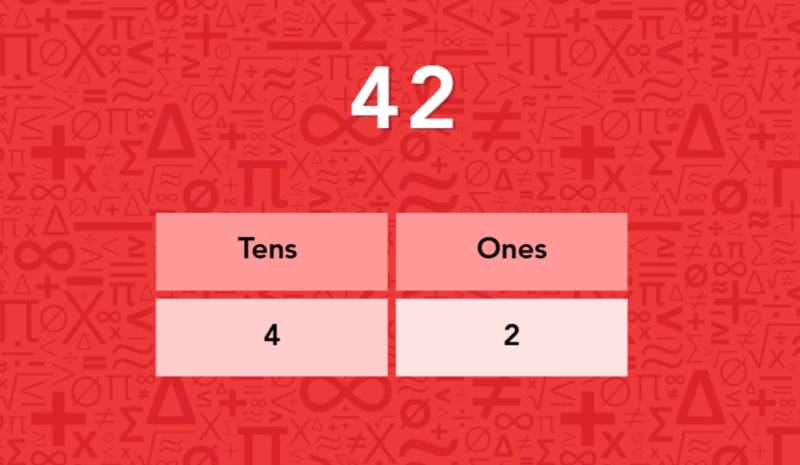
Tens and ones is the first time we encounter an idea that will run through every level of math they study: a digit's position carries meaning, not just the digit itself.
Let’s say your six-year-old can count to 100 but doesn’t have a clear picture of what the digits in a two-digit number represent. That gap is more common than it looks, and it matters more than most parents expect.
Let’s look at what tens and ones mean, walk through how to read and build two-digit numbers step by step, and practice. Teen numbers get their own section too, because they are the most common stumbling block at this stage.

What Are Tens and Ones?
Tens and ones are the two place value positions in any two-digit number.
Our number system works by bundling things into groups of ten. The digit on the right tells us how many single units we have. The digit on the left tells us how many complete groups of ten.
So 34 is not "three and four." It is three groups of ten and four leftover ones, which is 30 + 4.
Here is what that looks like broken down:
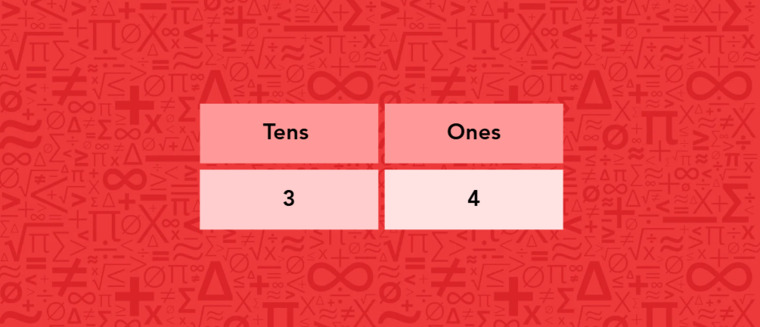
This is the core idea your child is working with. Once it clicks, two-digit numbers stop being a string of symbols and start being something they can pull apart and put back together.
📕 You May Also Like: 5 Place Value Games That Teach Ones, Tens, and Hundreds
How to Read a Two-Digit Number Using Tens and Ones
This is a three-step process. Let's walk through it exactly as we would with a student sitting across from us.
Step 1: Find the tens digit. It's the digit on the left. Multiply it by 10. That tells us how many complete groups of ten we have.
Step 2: Find the ones digit. It's the digit on the right. That number stays as it is. It tells us how many single units are left over.
Step 3: Add the two together. That's our number.
Here's how it works across a few examples:
-
52 → 5 tens (50) + 2 ones (2) = 52
-
34 → 3 tens (30) + 4 ones (4) = 34
-
10 → 1 ten (10) + 0 ones (0) = 10
-
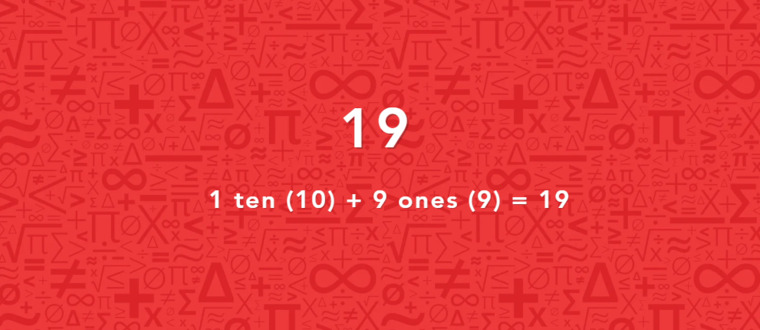
19 → 1 ten (10) + 9 ones (9) = 19
The third example deserves a closer look. Zero in the ones place trips up a lot of first graders. It doesn't mean nothing is there; it means there are no leftover units after the groups of ten are counted.
The fourth example, 19, is a teen number. We'll come back to those in a moment because they have a quirk that should be addressed separately.
How to Build a Number With Tens and Ones
We can also work backwards: start with the tens and ones and figure out what number they make.
This is just as important as reading a number. In our experience working with first and second graders, children who can only read tens and ones in one direction tend to hit a wall when regrouping arrives in second and third grade. The concept becomes solid when your child can move in both directions.
Here is the process:
Step 1: Take the number of tens. Multiply by 10.
Step 2: Take the number of ones. Keep as is.
Step 3: Add them together.
Let's work through a few examples:
-
4 tens and 7 ones → 40 + 7 = 47
-
2 tens and 0 ones → 20 + 0 = 20
-
6 tens and 3 ones → 60 + 3 = 63
Now here is a question to work through carefully: What if someone told you a number had 1 ten and 14 ones? What number would that be?
Work it through: 1 ten = 10, and 14 ones = 14, so 10 + 14 = 24.
This shows there is more than one way to break a number into tens and ones. A number can be broken into tens and ones in more than one way and still be correct. Your child will need this flexibility later, especially when addition and subtraction start involving regrouping.
📕 You May Also Like: 4 Critical Math Concepts for 2nd Grade & How to Master Them
Why Teen Numbers Are Harder to Break Apart
The numbers 11 through 19 follow the same tens-and-ones rule, but the way we say them does not make it obvious.
Most two-digit numbers announce the tens first when spoken. "Thirty-four" tells us there are three tens, then four ones. The spoken word matches the structure of the number.
Teen numbers do the opposite. "Fourteen" puts the four first. "Sixteen" sounds like it starts with six. And "eleven" and "twelve" give no clear clue at all. If your child finds teen numbers harder to break apart, that is why.
Let's work through two examples:
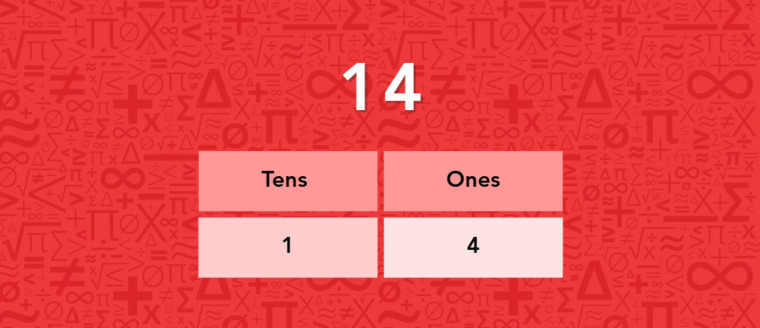
The math works exactly the same way. The English language just names these numbers in an irregular order. We tell every child we work with the same thing: the digits always tell the truth, even when the spoken word is misleading.
Once your child sees enough examples, the pattern clicks into place. So, we encourage you to do some practice with the examples below.
Your Turn: Practice Building Numbers with Tens and Ones
Try these problems with your child. Read each one together, work through it out loud, and check the answers at the bottom of the page.
-
What are the tens and ones in 45?
-
What number has 7 tens and 2 ones?
-
What are the tens and ones in 13?
-
What number has 3 tens and 0 ones?
-
What are the tens and ones in 11?
-
What number has 5 tens and 8 ones?
-
Is 2 tens and 16 ones the same as any number we know? Which one?
The last problem has a twist, so take your time with it.
(Scroll down for answers.)
 Mathnasium uses personalized learning plans and proven teaching techniques to help students quickly understand concepts like place value.
How Mathnasium Can Help With Tens and Ones
Tens and ones is one of the earliest points in a child's math journey where a small gap can compound without being obvious.
If your child can recite two-digit numbers without internalizing the grouping logic, they may find three-digit numbers harder than they should be. Add regrouping in second and third grade, and that gap becomes a real obstacle.
We see this pattern regularly at Mathnasium. A student may arrive struggling with addition, but a short conversation reveals they are not fully clear on what the digits in a two-digit number stand for. The arithmetic problem turns out to be a place value problem in disguise.
Every student at Mathnasium begins with a diagnostic assessment designed to find exactly what they understand, not just what they can answer correctly. For early learners, that means finding out whether your child can build and explain numbers, not just read and write them.
From there, our specially trained tutors use the Mathnasium Method™ to build a personalized learning plan at a pace that fits where your child is at the moment. Sessions are hands-on, conversational, and designed to build the kind of understanding that holds up as math gets harder.
The results speak for themselves:
-
94% of parents report an improvement in their child's math skills and understanding
-
93% of parents report their child's improved attitude toward math after attending Mathnasium
-
90% of students saw an improvement in their school grades
With over 1,100 centers, we bring the Mathnasium Method™ close to your community.
If you are based in Parkville or the surrounding Baltimore County communities, Mathnasium of Parkville serves local students and should be your go-to location. If your child is working through tens and ones right now, or heading into second grade, where the concept gets applied to addition and subtraction, a free assessment is a good place to start.
📅 Schedule a Free Diagnostic Assessment at Mathnasium of Parkville
Not near Parkville?
📍 Find Mathnasium Learning Centers Near You
Pssst! Check Your Answers Here
-
45 → 4 tens and 5 ones
-
7 tens and 2 ones → 72
-
13 → 1 ten and 3 ones
-
3 tens and 0 ones → 30
-
11 → 1 ten and 1 one
-
5 tens and 8 ones → 58
-
2 tens and 16 ones → 20 + 16 = 36


 (913) 642-6284