Students work closely with vertical angles in Grade 6–9 geometry and beyond. They appear in parallel line relationships, triangle proofs, polygon properties, and coordinate geometry.
They also show up consistently in the world around us, every time two straight lines cross, for example, in road intersections, scissors blades, crossed structural beams, the X-shapes in bridge trusses, and highway interchanges.
So let’s talk about these ubiquitous angles, zooming in on their unique quality: why we can always conclude with certainty that vertical angles are always equal.
Let’s begin with what vertical angles are, and end with a short guide on how to use that relationship to find missing angle measures.

Quick Review of Geometry Concepts Behind Vertical Angles
Before we look at vertical angles, let’s make sure a few geometry ideas we’ll use today are clear. For instance, what is an angle?
An angle is the shape formed by two rays that share a common endpoint. That endpoint is called a vertex.
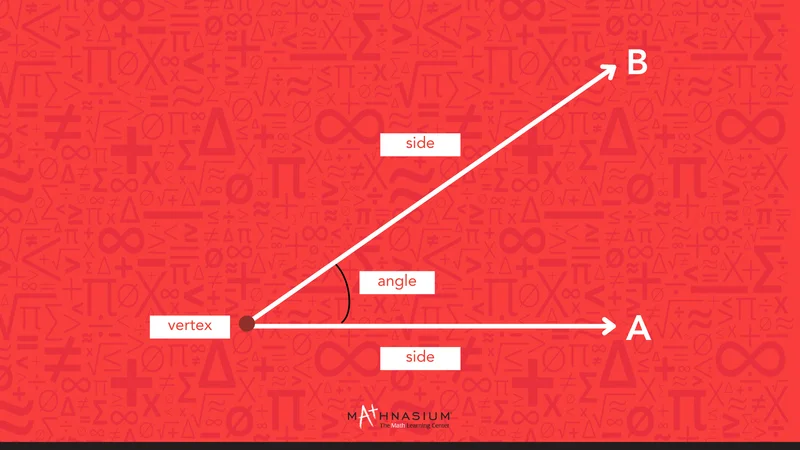
We can also think of an open book: the two covers are the rays, the spine is the vertex. The angle is the space between them.
What Are Intersecting Lines
Intersecting lines are two straight lines that cross at exactly one point. That crossing point becomes the vertex of all the angles that form there.
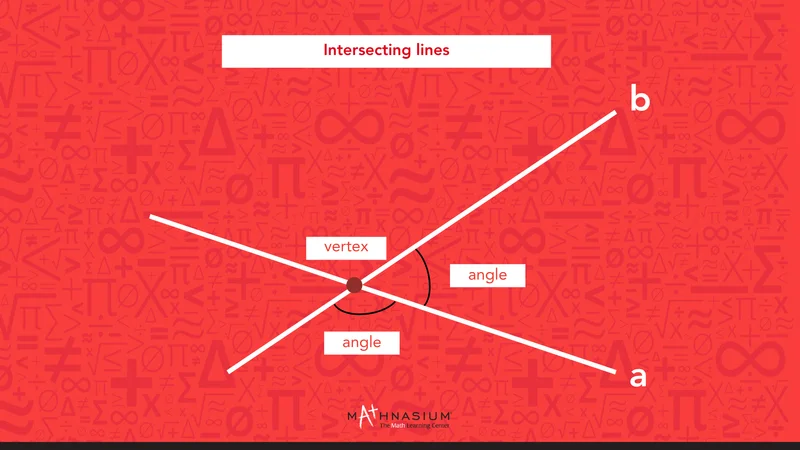
We can see this at a road intersection. The roads cross at one point, and the angles are formed around that shared point.
📕 You May Also Like: Types of Lines in Math – The Ultimate Kid-Friendly Guide
What Is a Linear Pair
A linear pair is two adjacent angles that together form a straight line. Their measures always add up to 180°.
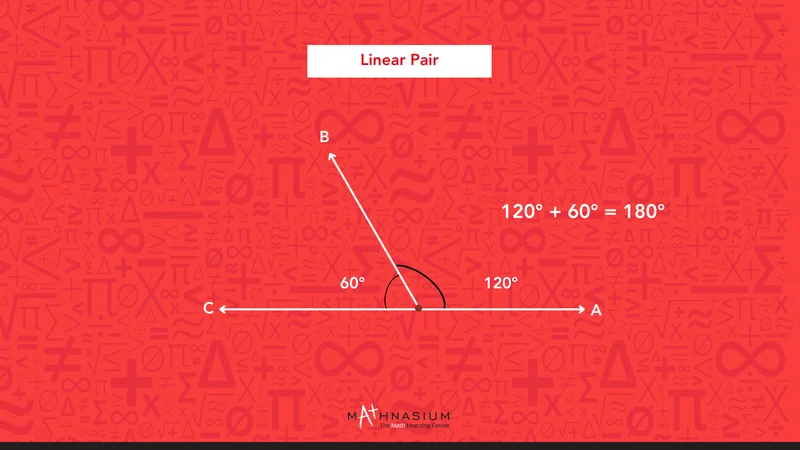
Think of an open book lying flat on a table: the two pages form a perfectly straight line, and any angle drawn up from the spine splits that straight line into two angles that together make 180°.
What Are Supplementary Angles
Supplementary angles are two angles whose measures add up to exactly 180°.
A linear pair is always supplementary because the two angles form a straight line and add up to 180°. But supplementary angles do not always have to sit side by side, they only need to add up to 180°.
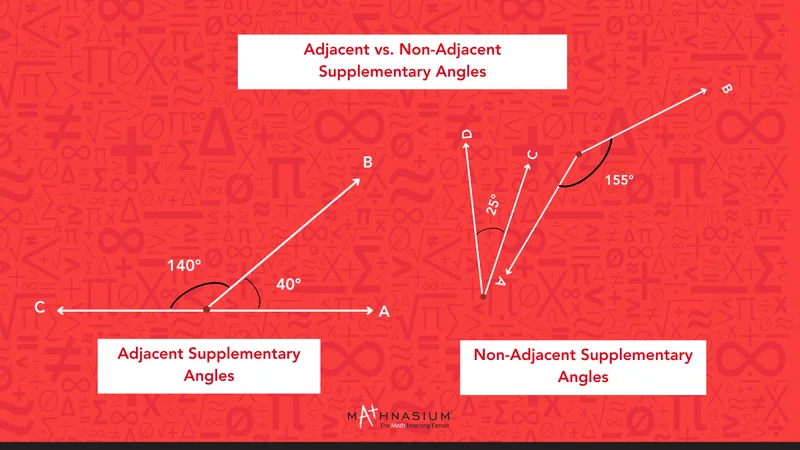
We can picture this with a straight road and a side street branching off from one point. The straight road forms 180°. The side street splits that straight angle into two smaller angles, and together they still make 180°.
📕 You May Also Like: Complementary and Supplementary Angles - A Complete Guide
What Are Vertical Angles and How to Identify Them
Vertical angles are the angles that sit directly across from each other when two straight lines cross. They share the same vertex in the middle, but they do not sit side by side or share an edge.
To identify the vertical angles, we need to look for the opposite angles formed by the crossing lines. That is why we sometimes call vertical angles opposite angles.
Let’s identify vertical angles in this visual.
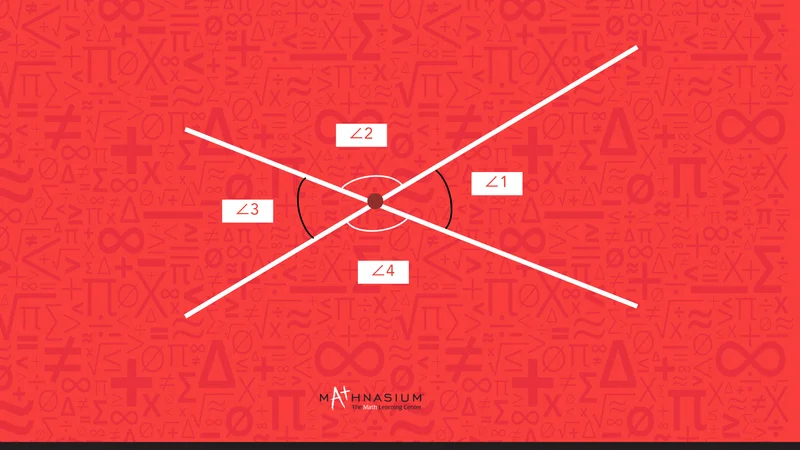
Two straight lines cross and form four angles around the same vertex. We’ll label them ∠1, ∠2, ∠3, and ∠4 so the angles across from each other are easier to spot
Here are the two vertical pairs:
We can also spot the two linear pairs here:
📕 You May Also Like: Types of Angles: Acute, Right, Obtuse & Straight Explained
Why Vertical Angles Are Always Equal
The vertical angles are always equal because each of the vertical angles is supplementary to the same angle.
How does it work?
Let’s try proving this theorem ourselves step by step. At Mathnasium, we like using examples to make abstract concepts easier to see and understand. So, we’ll work through one together.
Imagine two lines crossing, and one of the angles measures 50°.
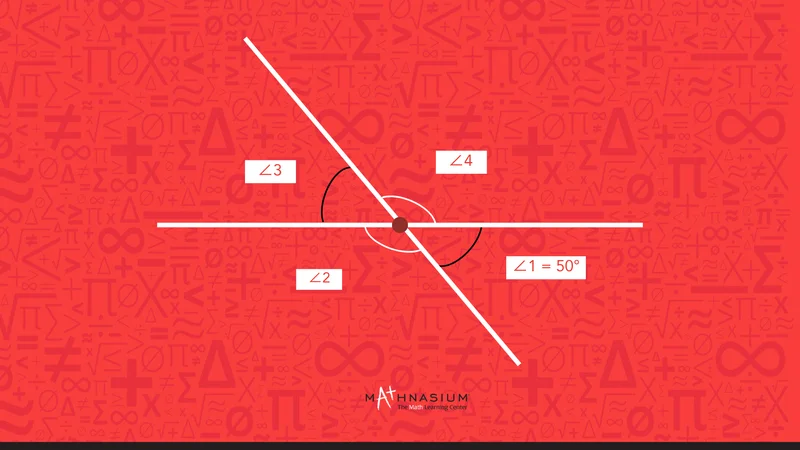
A. Find the Supplementary Angle
We know that ∠1 = 50°. ∠1 and ∠2 sit next to each other and together form a straight line, which means they are a linear pair. Linear pairs are always supplementary, they add up to 180°.
So we can use that relationship to calculate ∠2:
-
∠1 + ∠2 = 180°
-
50° + ∠2 = 180°
-
∠2 = 180° – 50° = 130°
B. Use the Supplementary Angle to Find the Vertical Angle
Now look at ∠3. It forms a linear pair with ∠2, which means they are also supplementary and add up to 180°. We already found that ∠2 = 130°, so we can use that to find ∠3:
-
∠2 + ∠3 = 180°
-
130° + ∠3 = 180°
-
∠3 = 180° – 130° = 50°
∠3 = 50°, and ∠1 = 50°. Both angles ended up equal, because both were supplementary to the same angle, ∠2. We proved that vertical angles have the same measure.
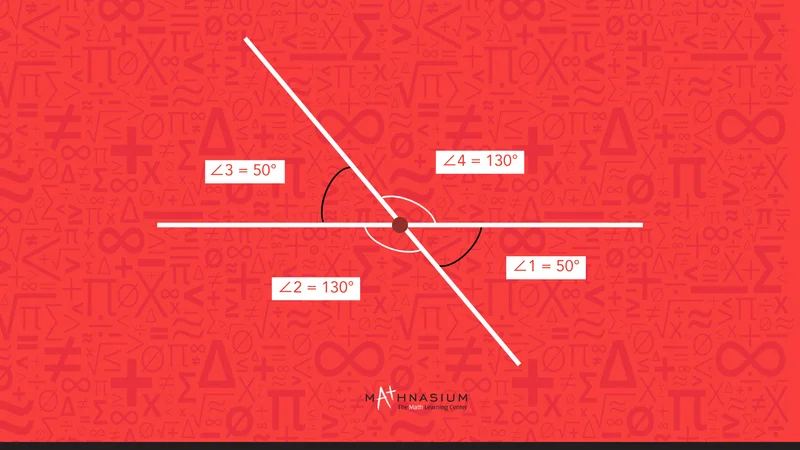
The same idea works for any vertical angle pair, because opposite angles are forced to equal the same value by the linear pair relationship they share.
How to Find Missing Angle Measures With Vertical Angles: Solved Example
Now that we understand why vertical angles are always equal, let’s use that relationship to find missing angle measures.
We’ll work through this problem. Two lines intersect, and ∠1 = 72°. We need to find all four angles.
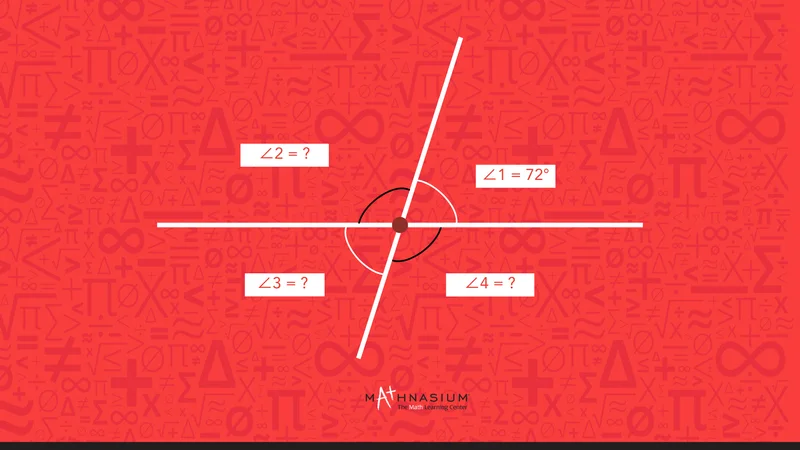
-
We know that ∠1 = 72°. ∠1 and ∠3 are vertical angles, they are equal. So, ∠3 = 72°.
-
∠1 and ∠2 add up to 180° as they form a linear pair. To find ∠2, we can subtract: 180° – 72° = 108°.
-
∠2 is an opposite angle to ∠4. That means, they are equal. ∠4 = 108°.
∠1 = 72°, ∠2 = 108°, ∠3 = 72°, ∠4 = 108°. We determined all four angles from a single given value.
📕 You May Also Like: Geometry Prep: 10 Skills to Know Before 10th Grade
Your Turn! Try These Vertical Angles Problems Yourself
Here are two vertical angle problems to try on your own. You can check your answers at the bottom of the page.
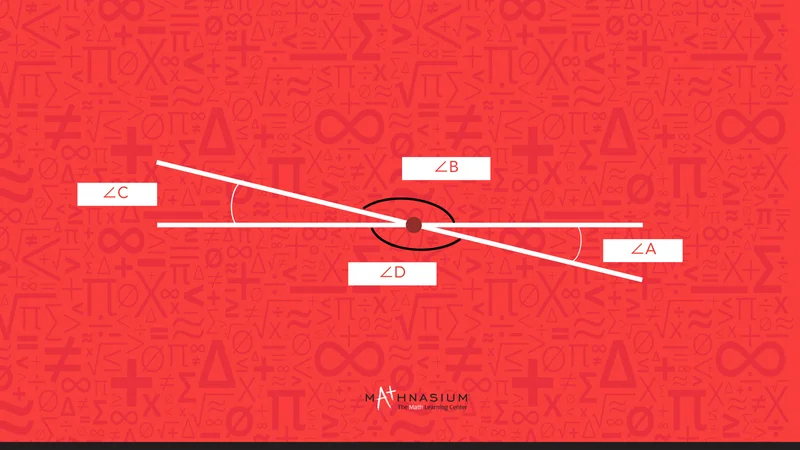
Problem 1. Two lines intersect, forming four angles labeled ∠A, ∠B, ∠C, and ∠D counterclockwise around the vertex. Identify both vertical angle pairs and all linear pairs.
Problem 2. Two lines intersect. One angle measures 63°. Find the measures of all four angles formed at the intersection, and name the relationship that justifies each answer.

Mathnasium tutors use multi-faceted teaching techniques and real-world examples to help students understand vertical angles and other geometry concepts clearly.
How Mathnasium Helps Students With Vertical Angles (And Any Other Math Topic)
Mathnasium is a math-only learning center dedicated to helping K–12 students of all skill levels excel in math. We work with students to build a solid understanding of math and geometry concepts, like vertical angles, instead of just memorizing rules and theorems.
Our specially trained tutors use a proprietary teaching approach, the Mathnasium Method™, to meet students where they are and guide them towards math mastery, step by step.
Each student begins their Mathnasium journey with a diagnostic assessment, which lets us identify their current skills, knowledge gaps, and how they think about math, including the foundational geometry, angle, and reasoning skills behind concepts like vertical angles.
Using these insights, we create a personalized learning plan focused on their specific learning needs, whether that means building confidence with geometry vocabulary, improving problem-solving skills, or preparing for more advanced math.
Our specially trained tutors follow it closely, delivering face-to-face instruction in a supportive environment, both in-center and online. We teach through a mix of verbal, visual, written, tactile, and mental techniques so each concept lands clearly.
Fun is a core part of our approach, too. We use game-based activities, let students earn rewards, and celebrate their progress together, so learning stays enjoyable and confidence grows with every session.
The results speak for themselves:
-
94% of parents report improvement in their child’s math skills and understanding
-
93% of parents report a more positive attitude toward math after attending Mathnasium
-
90% of students saw improvement in their school grades
With over 1,100 learning centers across North America, there is likely a Mathnasium close to you.
For families in Pearland East and the surrounding communities, Mathnasium of Pearland East brings that same approach close to home, with specially trained tutors who help students build the geometry reasoning and problem-solving skills they need for school and beyond.
If vertical angles, angle relationships, or any part of your child’s geometry foundation feels shaky, a free diagnostic assessment is the right place to start.
📅 Schedule a Free Assessment at Mathnasium of Pearland East
Not near Pearland?
📍 Find a Mathnasium Learning Center Near You
Psst! Check Yourself Here
Problem 1
-
Vertical pairs: ∠A and ∠C; ∠B and ∠D.
-
Linear pairs: ∠A and ∠B; ∠B and ∠C; ∠C and ∠D; ∠D and ∠A.
Problem 2

-
∠1 = 63° (given).
-
∠3 = 63°, because ∠3 and ∠1 are vertical angles.
-
As ∠2 forms a linear pair with ∠1, ∠2 equals 180° − 63° = 117°.
-
∠4 = 117°, because ∠2 and ∠4 are vertical angles.
How did you do?


 (281) 465-4990