A 2024 study by Gaye et al. found that math difficulties in children with ADHD were largely associated with working-memory and short-term-memory challenges. This means your child may understand the math ideas, but their brain has a harder time holding on to all the steps and numbers long enough to use them, especially in multi-step problems.
We've worked with thousands of students, including children with ADHD, and tested numerous strategies to improve engagement, motivation, retention, perseverance, and outcomes in math class. Today, we’ll share the ones that work.
Let’s first look at the math challenges ADHD most commonly creates and the signs parents tend to notice first.

Why Math Feels Harder for Children with ADHD
Math can feel harder for children with ADHD because it places heavy demands on attention, working memory, and step-by-step processing.
Research also suggests that math difficulties in ADHD do not always reflect a core number-processing deficit. This means math grades and test scores do not always reflect how well your child can understand math ideas.
Your child might be a capable math thinker, but the way math is usually taught and tested can make their challenges more visible. The common pressure points on a child’s math ability include:
-
Working memory overload: Multi-step problems ask children to hold several pieces of information in mind at once. For a child with ADHD, this can make it easier to lose track of steps or miss details. The Gaye et al. (2024) study found that working-memory weaknesses were closely tied to math difficulties in these children.
-
‘’Careless’’ mistakes: Your child may rush through problems or lose their place mid-calculation because attention slips under pressure.
-
Word-problem difficulty: Word problems ask a student to read, filter details, identify what’s relevant, and choose a strategy, all before calculating anything.
-
Timed fluency pressure: Timed drills and speed tests can make it harder for your child to show what they know.
📕 You May Also Like: How to Support Math Learning Without Pressure (Parent Guide)
What ADHD Math Struggles Look Like at Home
You probably noticed these signs at the kitchen table during homework time. The patterns below often show up day after day.
-
Inconsistent performance: They solve a problem one night and struggle with the same idea the next.
-
Avoidance or frustration around math homework: Your student may resist math because it feels discouraging.
-
‘’Careless-looking’’ mistakes: They rush, skip a step, or lose their place mid-problem.
-
Difficulty with multi-step problems and word problems: They start a word problem and lose the thread before finishing.
📕 You May Also Like: How to Break Down Any Math Problem Into Steps
Math Strategies That Work for Children with ADHD
Your child can learn and master math. They just need instruction that works with how their brain processes information.
Luckily, now we have quite a few studies that help us understand how different minds learn and how to best guide them. These studies inform official guidelines, like those provided by the U.S. Department of Education, which can be a valuable source for parents and educators alike.
1. Break Problems Into Smaller Chunks
Smaller steps make math more manageable for your child than tackling a full problem at once. The U.S. Department of Education's ADHD guidance recommends structured, step-by-step directions because these children struggle when they must hold too many instructions in mind at once.
At home, you can:
-
Cover part of a worksheet so only one problem is visible
-
Pause after each step before moving to the next
-
Work through a single calculation together before handing it back to your child
This works because smaller chunks make math feel manageable and give your child a better chance to show what they actually know
2. Use Visuals and Manipulatives
Visual supports and hands-on tools give your child something to see and touch before math becomes something to solve on paper.
One study found that children with ADHD improved their math word-problem solving when they used visualization strategies, whether they created their own drawings or used pre-made images.
Try introducing one of these at your next homework session:
-
Sketch a quick picture before writing an equation
-
Use a number line to track steps
-
Lay out coins or blocks to model a problem before moving to abstract symbols
Each of these tools moves math outside your child's head, where working memory pressure is lower, and understanding has room to develop.
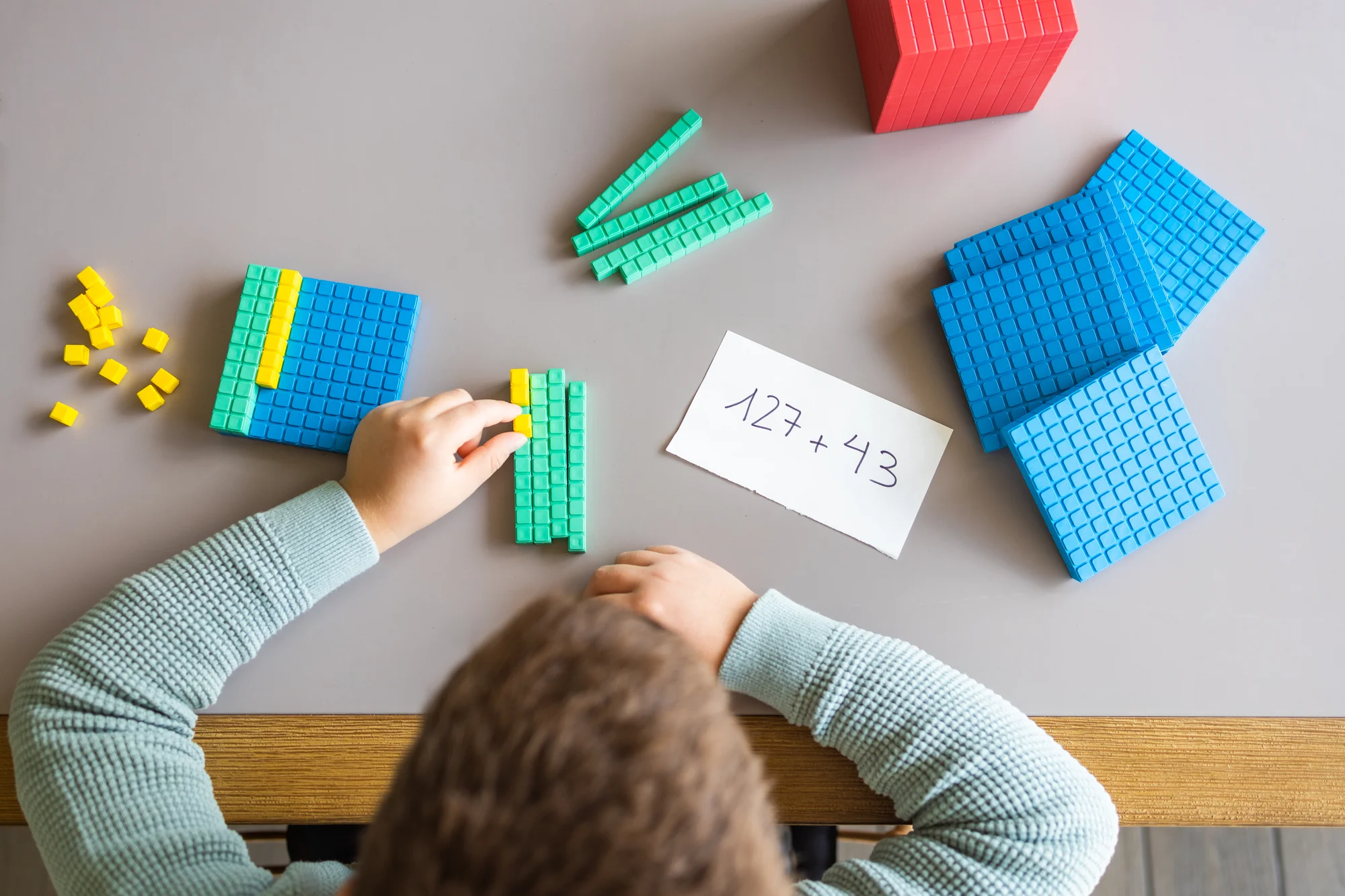
For children with ADHD, touching and seeing the math before solving it on paper is a legitimate strategy, and often the most effective one.
3. Give Clear Step-by-Step Instructions
Your child will follow math more confidently when each step is visible, explicit, and consistent. The U.S. Department of Education’s ADHD guidance, for example, emphasizes structured, step-by-step instruction and guided questioning rather than expecting children to infer the process on their own.
Next time your child gets stuck, try one of these:
-
Work through the first step together out loud
-
Keep a simple checklist of steps nearby
-
Ask "What comes next?" rather than jumping in with the answer
Each small prompt helps your child stay oriented in the problem and build confidence over time.
4. Support Word-Problem Solving
Word problems ask your child to read, filter details, identify what matters, and choose a strategy, all before calculating anything. A study on cognition and math in children with ADHD suggests that working-memory challenges can make math problem-solving especially difficult for them.
Next time your child sits down with a word problem, try walking through these steps together:
-
Read the problem aloud
-
Underline the key numbers
-
Cross out details that do not affect the answer
-
Ask "what is this problem actually asking us to find?" before writing anything down
Each of these steps can make the problem feel more manageable and give your child a clearer path to the answer.
📕 You May Also Like: How to Solve Word Problems on Math Tests (3-Step Framework)
5. Reduce Pressure and Add Structure
Your child may know more math than a timed or high-stakes session gives them the chance to show. A calm, predictable practice routine helps them access what they've learned and build on it steadily.
Next time your child sits down for math practice, try building the session around these simple anchors:
-
Set a consistent time each day; 10 to 15 minutes works well.
-
Start with a warm-up using something your child already knows.
-
Move to one new concept only.
-
Give a clear signal when the session is done.
📕 You May Also Like: How to Build an Effective 15-Minute Daily Math Routine

At Mathnasium, individualized attention in a small-group setting is how we help students with ADHD build skills and confidence at their own pace.
How Mathnasium Supports Students With ADHD
Mathnasium is a math-only learning center helping students of all skill levels learn and master math, including those with ADHD.
At Mathnasium, we offer structured, individualized math support that aligns closely with the strategies research identifies as most effective for students with ADHD.
The Mathnasium Method™, our proprietary teaching approach, is built around the same principles that help students with ADHD thrive: less pressure, more structure, and instruction paced to each child. At Mathnasium, these are built into how we work with every student:
-
Personalized, self-paced instruction: Each student begins with a diagnostic assessment that maps their current skills and identifies specific gaps. From those insights, we build a personalized learning plan tailored to their needs and pace.
-
Mastery before moving forward: We work on each concept until your child truly understands it before introducing the next one. New concepts receive plenty of practice and reinforcement before we build on them further.
-
A low-pressure, structured environment: Sessions take place in a small-group setting away from the social pressures of a classroom. Our specially trained tutors provide consistent attention, positive reinforcement, and incremental instruction that keeps students moving forward without feeling overwhelmed.
Our results speak for themselves:
-
94% of parents report an improvement in their child's math skills and understanding
-
93% of parents report their child's improved attitude toward math after attending Mathnasium
-
90% of students saw an improvement in their school grades
With over 1,100 learning centers, Mathnasium brings structured, personalized math support close to where you live.
For families in and around Pembroke Pines, FL, Mathnasium of Pembroke Pines is a trusted local center with years of experience helping students change how they think and feel about math.
If you are looking for structured, patient, and individualized math support for your child, our team is ready to assist.
📅 Schedule a Free Diagnostic Assessment at Mathnasium of Pembroke Pines
Not near Pembroke Pines?
📍 Find a Mathnasium Learning Center Near You


 (954) 441-6284