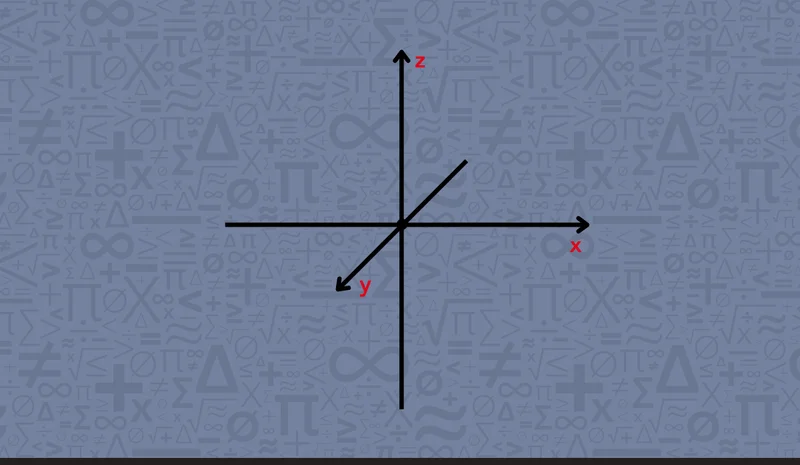
The 2D coordinate plane is built for a flat world. Two axes, two numbers, and any point on a flat surface can be located exactly. For years, that system is all students need.
At some point in advanced geometry or pre-calculus, the flat surface is no longer enough. The real world has height, depth, and elevation, and describing a point in three-dimensional space requires a third axis and a third number.
Today, our Mathnasium tutors explain how the 3D coordinate plane works, what the z-axis measures, and how to read and plot ordered triples in three-dimensional space. Let's get into it.

What Is a 3D Coordinate Plane?
A 3D coordinate plane (or 3D Cartesian plane) is a coordinate system that uses three axes, x, y, and z, to locate any point in three-dimensional space.
To visualize it, imagine laying a standard 2D sheet of graph paper flat on a table. The two axes we already know now run along the flat surface:
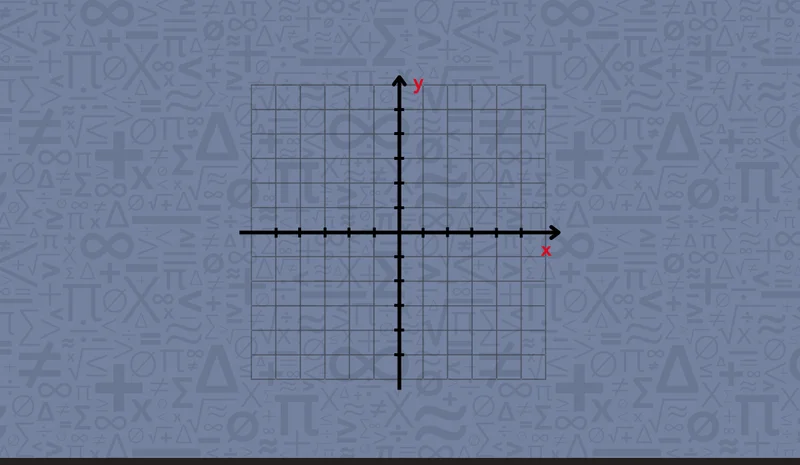
Together, they form a flat surface where we can plot any point using two numbers called an ordered pair, written as (x, y).
But what happens when a point is not on that flat surface? Two numbers can place a point anywhere on a flat surface, but a flat surface has no height. A point floating above it or sitting below it needs a third number to describe exactly where it is.
That third number comes from the z-axis. It runs perpendicular to both the x-axis and the y-axis and measures how far a point sits above or below the flat surface formed by x and y.
With all three axes in place, we no longer use ordered pairs.
We use ordered triples, written as (x, y, z):
-
The x-axis measures left and right
-
The y-axis measures forward and backward. Notice that in 2D, the y-axis ran vertically. In the 3D orientation we use here, it runs horizontally along the flat surface instead.
-
The z-axis measures up and down
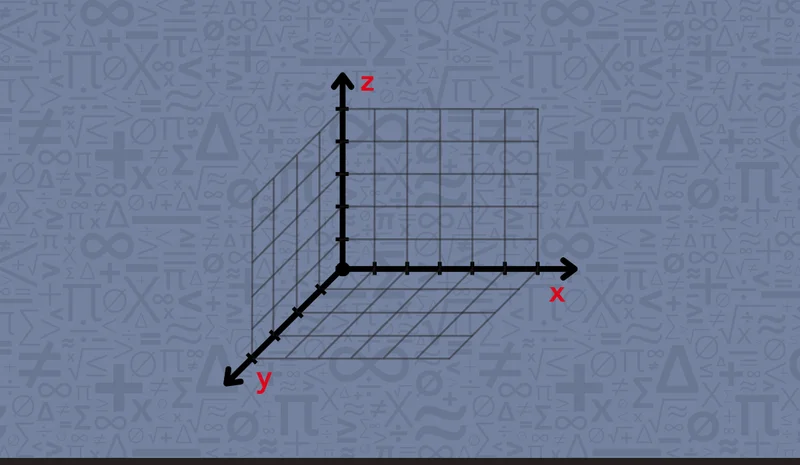
In the 3D system, the x-axis and the y-axis both lie in the same flat plane, the xy-plane, while the z-axis rises perpendicularly above and below it.
The directions we assign to each axis are orientation choices used in this article for clarity. Different textbooks and fields may orient the axes differently.
📕 You May Also Like: How the Coordinate Plane Works: A Guide for Parents And Students
How the 3D Coordinate Plane Is Divided
The 3D coordinate plane is divided into eight regions called octants, formed by the x, y, and z axes cutting through space in three directions.
To see how we get there, let's start with what we already know. In the 2D coordinate plane, the x and y axes divide the flat surface into four regions called quadrants.
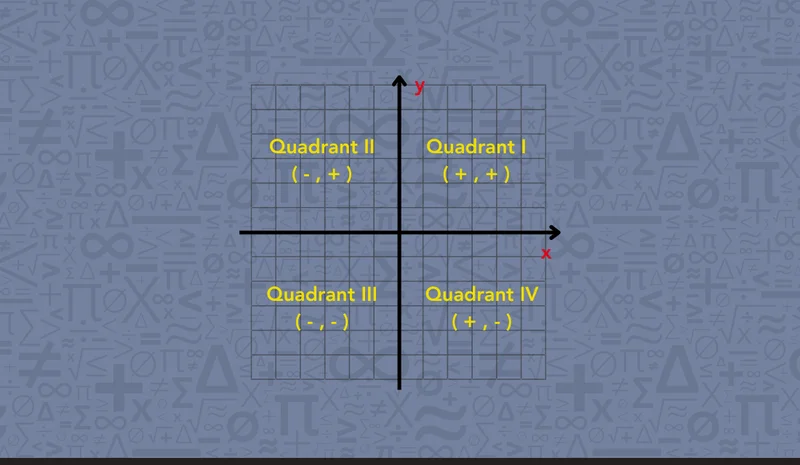
We know that Quadrant I is where both x and y are positive. Moving counterclockwise, the signs change in a predictable pattern.
So what happens to those four quadrants when we add a third axis? When we add the z-axis, each quadrant gets a top and a bottom:
-
One version above the xy-plane, where z is positive
-
One version below the xy-plane, where z is negative
That is how four quadrants become eight octants.
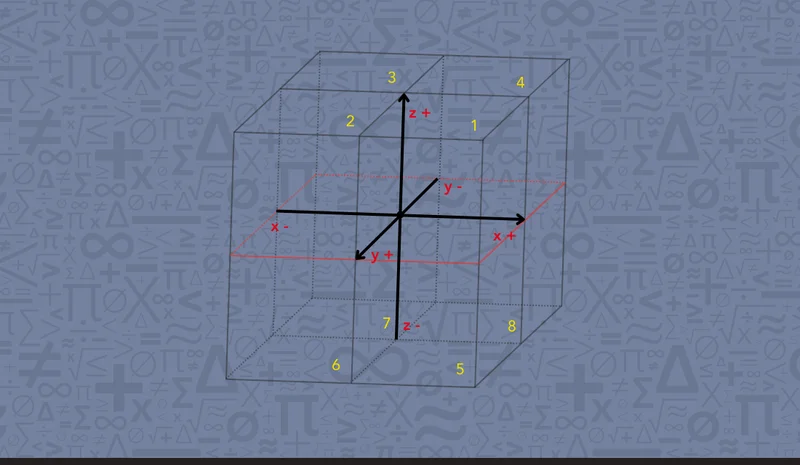
We can see that octants 1 through 4 all sit above the xy-plane.
The xy-plane acts as our reference floor, and anything above it carries a positive z-coordinate. That is why every octant in the top half of the 3D system has a positive z value.
Octants 5 through 8 sit below that floor. Anything below the xy-plane carries a negative z-coordinate, which is why every octant in the bottom half has a negative z value.
But z is only one piece of the picture. Each octant also has its own combination of positive and negative values for x and y. The sign of each coordinate simply tells us which direction we moved along that axis:
Put all three signs together, and each octant gets a unique address across x, y, and z.
The first octant, where all three coordinates are positive, is universally agreed upon. The numbering of the remaining seven octants varies across textbooks and fields.
The table below follows one common convention:
|
Octant
|
X |
Y
|
Z |
|
1
|
Positive
|
Positive
|
Positive
|
|
2
|
Negative |
Positive
|
Positive
|
| 3 |
Negative
|
Negative
|
Positive
|
|
4
|
Positive
|
Negative
|
Positive
|
|
5
|
Positive
|
Positive
|
Negative
|
|
6
|
Negative
|
Positive
|
Negative
|
|
7
|
Negative
|
Negative
|
Negative
|
|
8
|
Positive |
Negative
|
Negative
|
How to Read and Plot a Point on the 3D Coordinate Plane
To plot a point on the 3D coordinate plane, we start at the origin and move one axis at a time, using each coordinate in the ordered triple to guide us.
In 2D, we plot a point by moving along the x-axis first and then the y-axis. Take the point (4, 2) as an example.
We start at the origin, move 4 units to the right along the x-axis, then 2 units up along the y-axis, and mark the point where we land.
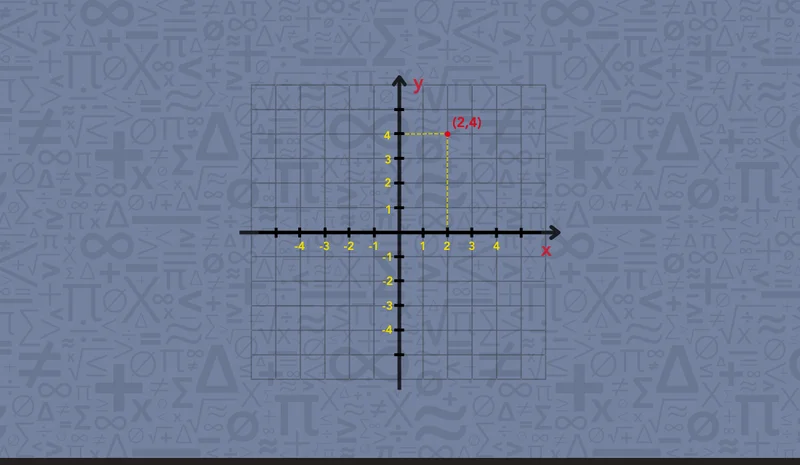
In 3D, we follow the same logic but add another move for the z-axis.
Let's work through the process together using the point (4, 2, 5).
📕 You May Also Like: What Are Ordered Pairs? A Complete Overview
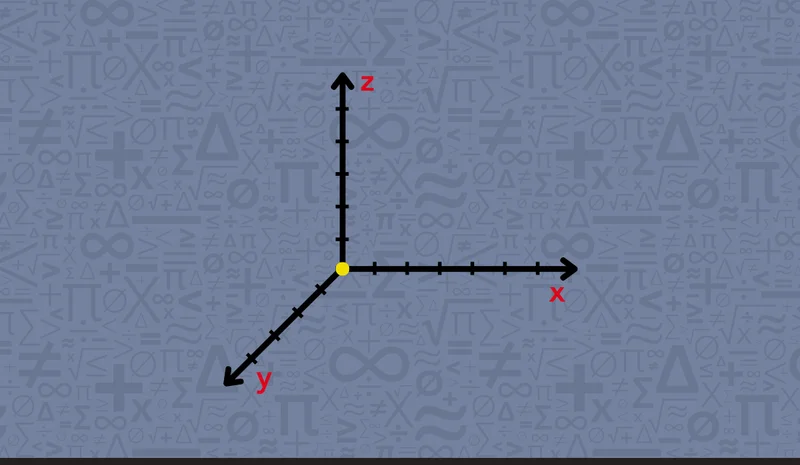
Step 1: Start at the Origin
We always begin at the origin, (0, 0, 0).
The origin is the point where all three axes meet and where x, y, and z are all equal to zero. It is our fixed reference point, and without it, our coordinates would have nothing to measure from.
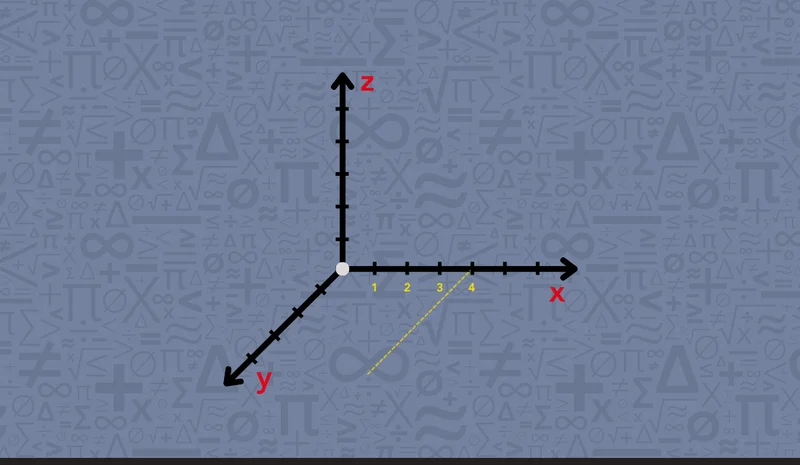
Step 2: Move Along the X-Axis
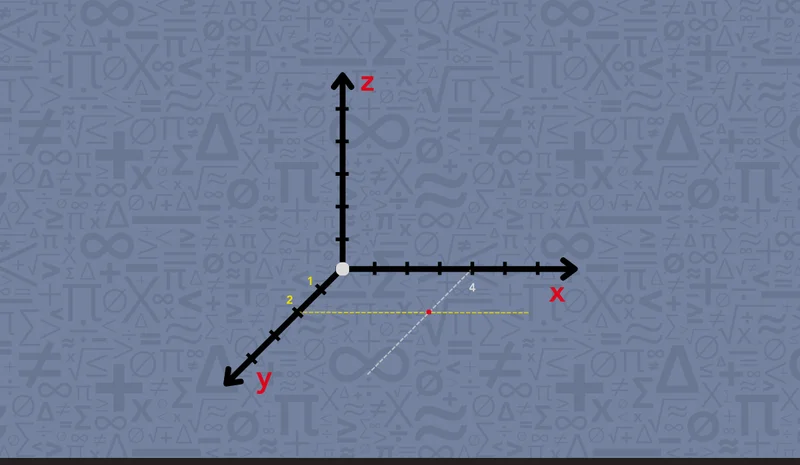
The first coordinate is 4. From the origin, we move 4 units to the right along the x-axis.
Step 3: Move Along the Y-Axis
Now we use the second coordinate, which is 2. From where we landed, we draw a line parallel to the y-axis and move 2 units forward.
The spot where our x and y movements meet is our position on the flat xy-plane.
Step 4: Move Along the Z-Axis
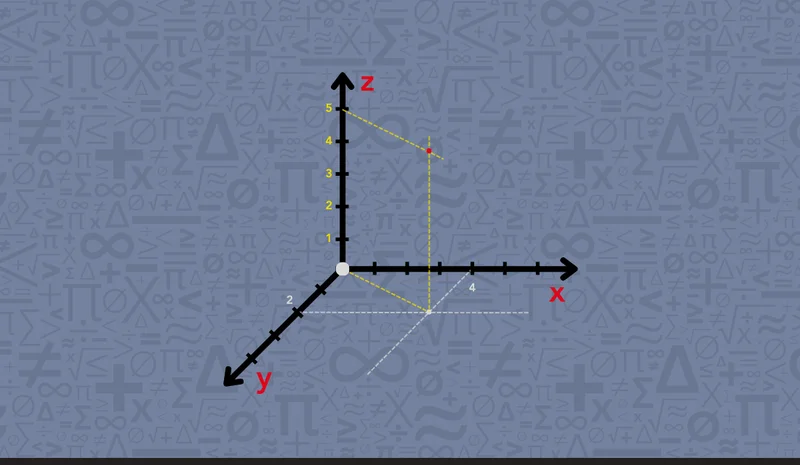
Here is where it gets interesting. The third coordinate is 5, but we cannot just move straight up from the origin to z equals 5. Doing that would ignore the x and y coordinates entirely and land us in the wrong place.
Here is what we do instead:
-
We draw a line from the origin to the xy position we found in Step 3
-
We go to z equals 5 on the z-axis and draw a line parallel to that reference line
-
Where that parallel line intersects with a vertical line rising from our xy position is where our point lives
Step 5: Mark the Point
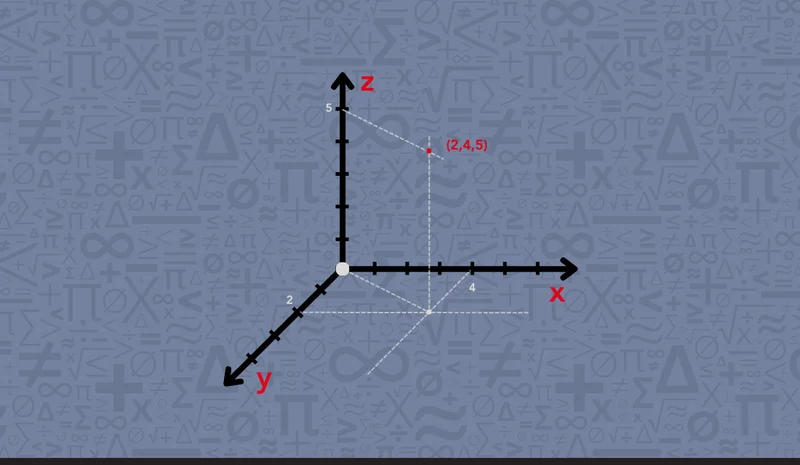
We place a dot at that intersection and label it (4, 2, 5). All three coordinates are positive, which tells us the point sits in Octant 1.
📕 You May Also Like: What Is a Line Segment? A Complete & Kid-Friendly Guide
Real-Life Applications of the 3D Coordinate Plane
The 3D coordinate plane is far more than a classroom concept. Industries like gaming, aviation, medicine, and engineering rely on three coordinates to locate objects, build structures, and navigate through space.
-
Video Games and 3D Animation: Every object, character, and camera in a three-dimensional game occupies an exact coordinate space. When players jump, the character rises along the z-axis, while running forward shifts their position along the y-axis. Animators and developers work with these ordered triples constantly to bring virtual worlds to life.
-
GPS and Aviation: GPS navigation works on a similar principle to the 3D coordinate system. Three values, longitude, latitude, and altitude, each measure position in a different direction, much like x, y, and z do in a Cartesian plane. A commercial aircraft cruising at 35,000 feet, for example, sits at a very different altitude reading than a car driving on the road below it.
-
3D Printing: A 3D printer builds physical objects one thin layer at a time. The print head glides along the x and y axes to trace a single layer before the machine steps up along the z-axis to start the next. Every point on the finished product begins as an ordered triple in a digital blueprint.
-
Architecture and Engineering: Every beam, column, and joint in a modern building model features three coordinates defining its exact spatial position. Structural engineers analyze these coordinates to calculate load distributions, check clearances, and test spatial relationships before crews ever pour concrete.
-
Medical Imaging: An MRI or CT scan generates a series of flat, 2D cross-sections stacked along the vertical z-axis. Radiologists and surgeons navigate through these precise z-levels to target specific points inside the body, assembling a complete three-dimensional map to plan complex procedures.
📕 You May Also Like: Real-Life Applications of Trigonometry
Your Turn! Practice Plotting Points on the 3D Coordinate Plane
Now it is time to try it on our own. Grab a pen and paper and plot each point on a 3D coordinate plane.
Challenge 1:
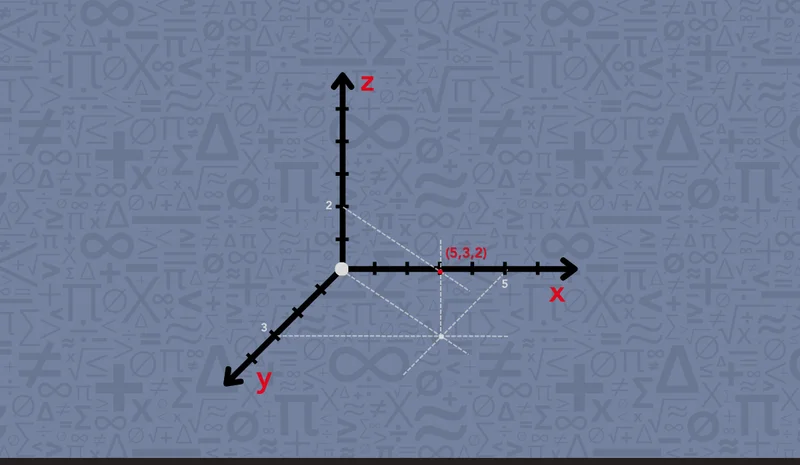
Plot the point (5, 3, 2) on a 3D coordinate plane.
Challenge 2:
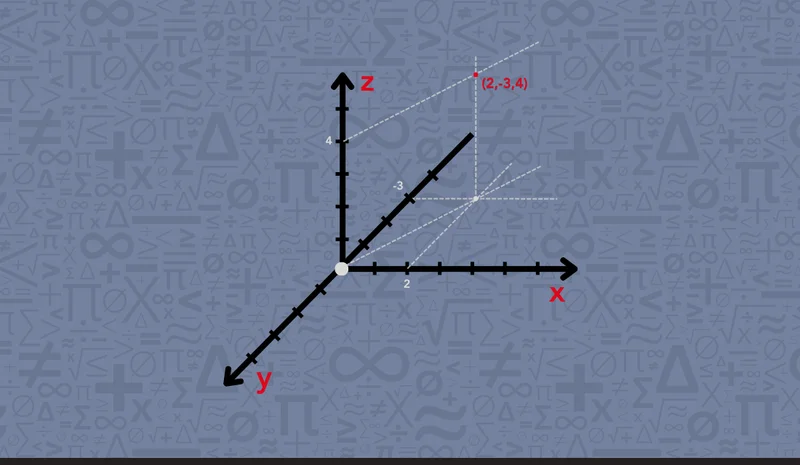
Plot the point (2, -3, 4) on a 3D coordinate plane.
Challenge 3:
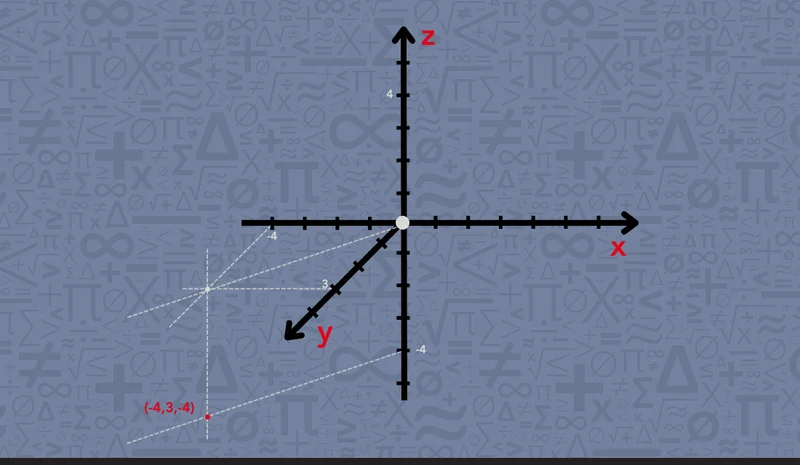
Plot the point (-4, 3, -4) on a 3D coordinate plane.
Check your answers at the bottom of the page!

At Mathnasium, specially trained tutors help students build the spatial reasoning skills they need to confidently navigate advanced geometry
How Mathnasium Helps Students Master Geometry and Beyond
Mathnasium is a math-only learning center dedicated to helping K–12 students of all skill levels learn and master math.
Whether students are working through the 3D coordinate plane for the first time, building the spatial reasoning skills that carry into pre-calculus and calculus, or looking for a challenge beyond their current curriculum, Mathnasium offers a personalized path forward.
We build that path forward through the Mathnasium Method™, our proprietary teaching approach, designed around each student's individual learning needs and style.
Here is how it works in practice:
-
Diagnostic Assessment and Personalized Learning Plans: Every student begins with a diagnostic assessment, a relaxed interaction that uncovers their strengths and knowledge gaps. From those insights, we build a personalized learning plan tailored to their needs and goals.
-
Teaching for Understanding: Our specially trained tutors follow that plan closely, teaching math face-to-face in a supportive and fun setting. We use plain, everyday language and a mix of verbal, visual, mental, tactile, and written techniques so the math makes sense.
-
Problem-Solving and Critical Thinking: When a concept feels challenging, we break it down into manageable parts and teach both the how and the why behind it. In time, students build problem-solving skills and critical thinking tools they can use in math and in life.
-
A Supportive and Fun Environment: Our sessions are often game-based, students earn rewards along the way, and we celebrate every bit of progress. Learning stays enjoyable, and confidence grows with every session.
Families see measurable results:
-
94% of parents report an improvement in their child's math skills and understanding
-
93% of parents report their child's improved attitude toward math after attending Mathnasium
-
90% of students saw an improvement in their school grades
We operate over 1,100 centers across North America, bringing our proven approach to communities everywhere.
For families in and around Pembroke Pines, FL, Mathnasium of Pembroke Pines is a trusted local center with years of experience helping advanced middle school and high school students build the mathematical foundation they need for higher-level math.
Whether your child needs to catch up, keep up, or get ahead, our team is happy to help.
📅 Schedule a Free Diagnostic Assessment at Mathnasium of Pembroke Pines
Not near Pembroke Pines?
📍 Find a Mathnasium Learning Center Near You
Pssst! Check Your Answers Here
How did you do?
Challenge 1:
Challenge 2:
Challenge 3:


 (954) 441-6284