Students first meet the coordinate plane in fifth grade under the Common Core State Standards, and in our home state of Georgia, under the equivalent Georgia Standards of Excellence.
The coordinate plane may look like a simple grid. Children learn how to plot points, read ordered pairs, and use the x-axis and y-axis.
From our work with students at Mathnasium, we know that true understanding goes deeper than placing a point in the right spot. Your child needs to understand what each coordinate means, how movement on the grid works, and how the plane shows relationships between numbers.
Today, our tutors explain what the coordinate plane is, how it works, what students need to know to use it correctly, and how to avoid common mistakes. You can read it together with your child, work through the given examples, and make sense of the concept step by step.
What the Coordinate Plane Is
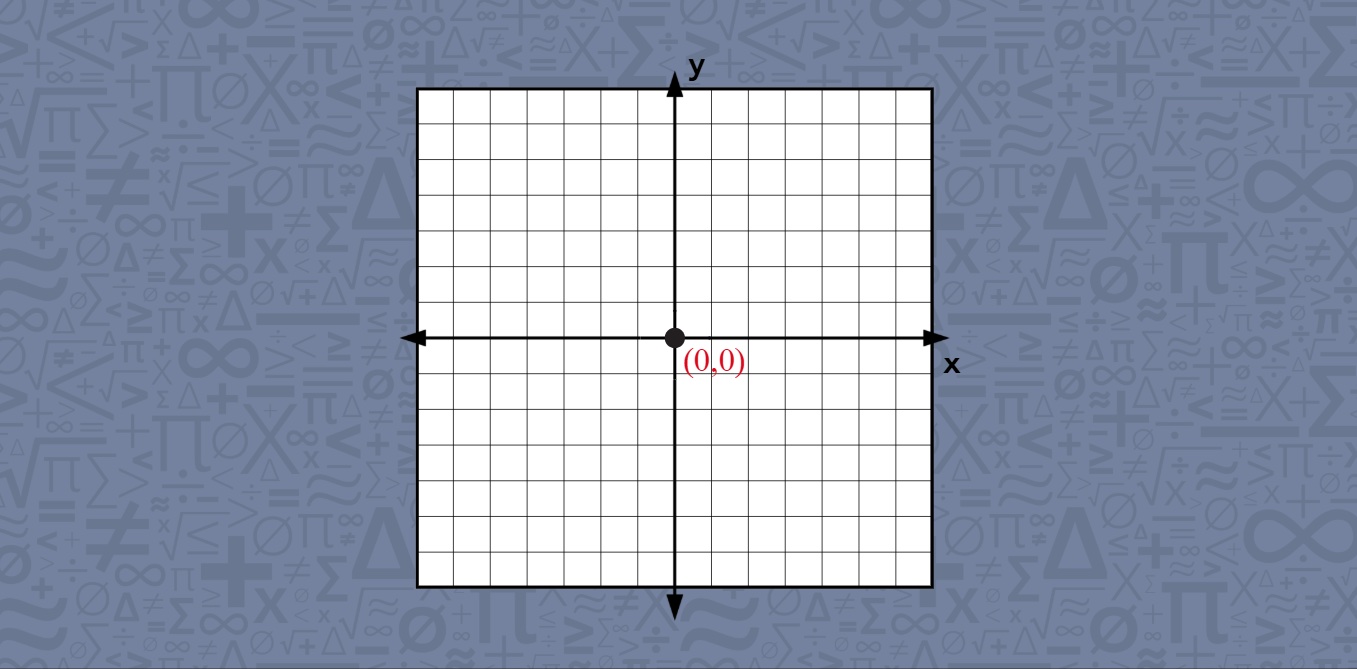
The coordinate plane is a flat surface made from two number lines that cross at a right angle.
-
The horizontal line is called the x-axis.
-
The vertical line is called the y-axis.
-
The point where the two lines meet is called the origin.
-
The origin represents 0 on both the x-axis and the y-axis, so its coordinates are written as (0, 0).
The coordinate plane gives a precise way to describe where a point is located. Instead of saying “a little to the right” or “about halfway up,” we can use two numbers to give the point an exact address.
Your child has seen this idea before in everyday life. A seating chart might use Row 3, Seat 5 to identify one specific seat. A grid map and a chessboard work in a similar way.
The coordinate plane uses the same idea in math: one direction tells us how far to move left or right, and the other tells us how far to move up or down.
As students move into later math, the coordinate plane can also show locations using whole numbers, fractions, decimals, and negative numbers.
The Four Quadrants of the Coordinate Plane
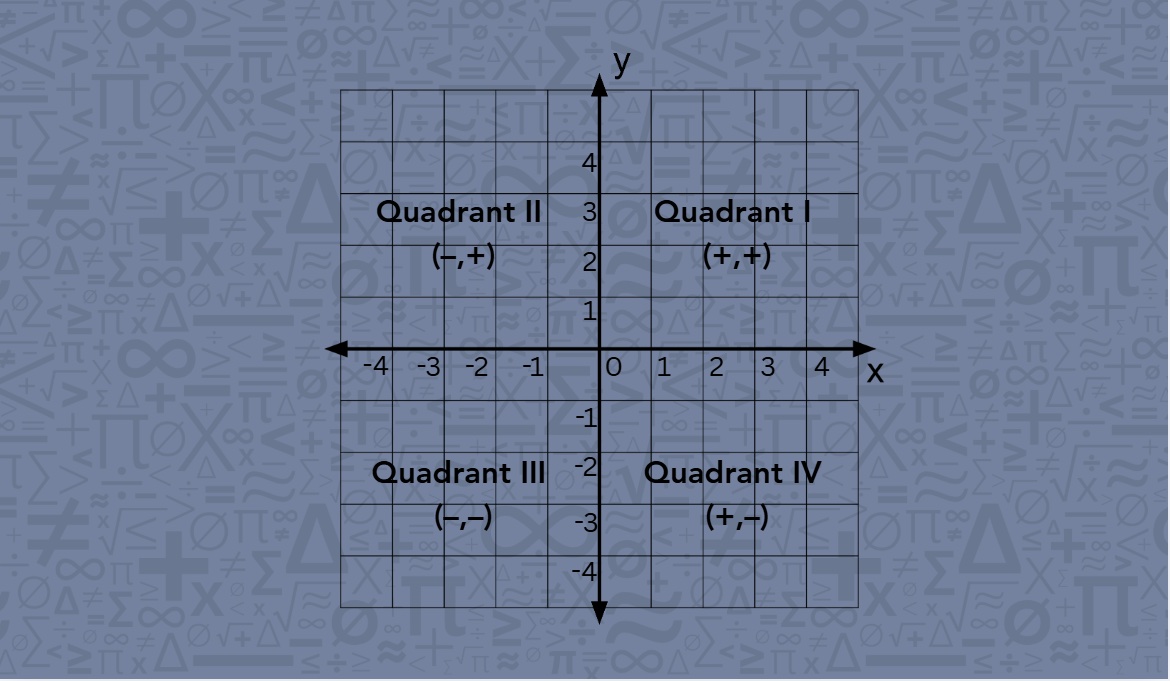
The x-axis and y-axis divide the coordinate plane into four sections called quadrants. They are numbered I through IV, starting in the upper right and moving counterclockwise.
Each quadrant has a specific combination of positive and negative values:
-
Quadrant I (upper right): both x and y are positive
-
Quadrant II (upper left): x is negative, y is positive
-
Quadrant III (lower left): both x and y are negative
-
Quadrant IV (lower right): x is positive, y is negative
At Mathnasium, we give negative coordinates extra attention because they ask students to move beyond the positive-number grid they are used to.
-
A negative x-value means the point sits to the left of the origin.
-
A negative y-value means the point sits below the origin.
-
A point in Quadrant III, where both coordinates are negative, sits in the lower left, the furthest corner from the all-positive Quadrant I.
How to Read and Plot an Ordered Pair
An ordered pair is a set of two numbers written in parentheses, for example, (3, 5), that gives the exact location of a point on the coordinate plane. The first number is always the x-coordinate. The second number is always the y-coordinate. Try working through the examples below with your child.
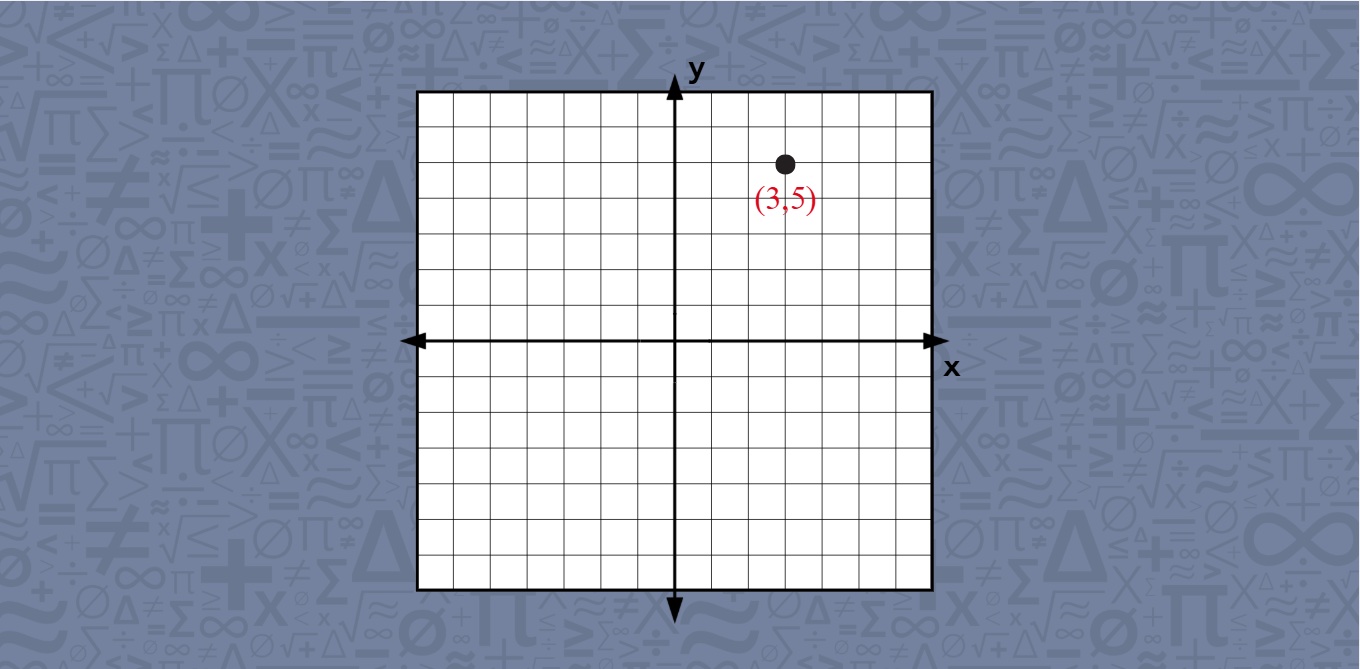
Here is how to plot (3, 5) step by step:
-
Start at the origin.
-
Move 3 units to the right along the x-axis.
-
From there, move 5 units up, parallel to the y-axis.
-
Mark the point where you land. That is (3, 5).
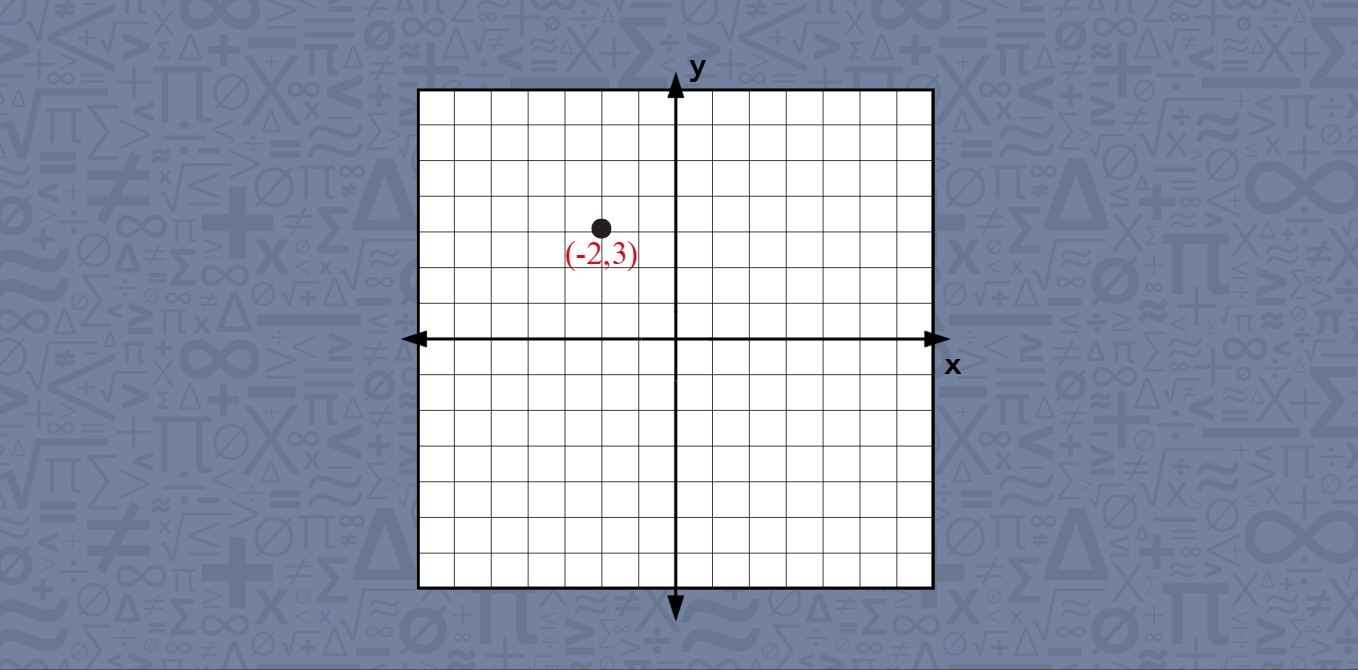
Now let’s try a point that includes a negative coordinate: (−2, 3).
-
Start at the origin.
-
Move 2 units to the left (because x is negative).
-
From there, move 3 units up.
-
Mark the point. That is (−2, 3), which sits in Quadrant II.
📕 You May Also Like: What Are Ordered Pairs? A Complete Overview
Common Coordinate Plane Mistakes and How to Avoid Them
At Mathnasium, we see that coordinate plane confusion is rarely about the whole concept being “too hard.” More often, students are missing one small rule or habit that keeps throwing off their work. These are the five mistakes to watch for first:
1. Reversing the X and Y Coordinates
When plotting (3, 5), a student may move 5 units right and 3 units up instead of 3 right and 5 up. They land in the wrong place every time.
A useful memory anchor: X comes before Y in the alphabet, and horizontal movement comes before vertical movement. Move sideways first, then up or down.
2. Confusing the X-Axis With the Y-Axis
The x-axis runs side to side: it is the horizontal one. The y-axis runs up and down: it is the vertical one.
A useful pairing to remember: To remember that the horizontal x-axis, your child can picture the horizon stretching left and right. The letter Y has a long vertical "leg" to help remember the vertical axis.
3. Treating the Origin as (1, 1) Instead of (0, 0)
The origin is the starting point, and it represents zero on both axes. A student who begins counting from the origin as if it were the number one will misplot every point by one unit in each direction.
The fix is to be explicit: before plotting any point, confirm that the starting position is (0, 0), not (1, 1).
4. Numbering Quadrants in the Wrong Direction
Your child may expect the quadrants to be numbered from left to right or clockwise, but the order moves counterclockwise.
A useful anchor: Quadrant I is always in the upper right, where both coordinates are positive. From there, the numbering continues counterclockwise.
5. Mishandling Negative Coordinates
A negative x-coordinate moves left from the origin, and a negative y-coordinate moves down from the origin. When both coordinates are negative, the point is in Quadrant III, the lower-left section of the plane.
Students who have mostly worked with positive numbers sometimes forget that the grid extends in all four directions.
A memory anchor: negative x means left, negative y means down.
How Coordinate Plane Skills Support Later Math
An ordered pair on the coordinate plane does more than mark a location. It shows how two quantities work together, which makes the coordinate plane useful beyond fifth and sixth grade.
Your child will use the coordinate plane skills when they work with:
When students graph a linear equation, every point on the line is an ordered pair that makes the equation true. The graph becomes a visual way to show all the number pairs that fit the relationship.
The same idea appears in functions. The x-coordinate acts as the input, and the y-coordinate acts as the output. The graph helps students see how one value changes with another, more clearly than a table or equation alone.
From our work with students, we see that the concepts above become much easier later when the coordinate plane skills are solid. A student who understands the coordinate plane as a way to show relationships, rather than only a set of plotting steps, is better prepared for algebra and geometry.
📕 You May Also Like: Building Math Success from a Strong Foundation

Mathnasium tutors support students through a personalized learning plan, helping them build the foundational understanding they need for coordinate plane concepts.
How Mathnasium Can Help Master Coordinate Plane Skills
The coordinate plane is one of the concepts where correct answers can hide shaky understanding. A student may plot (3, 5) correctly, but still miss what the 3 and the 5 represent, how each coordinate controls movement, or why the point belongs in that exact location.
That gap often appears later in algebra and geometry, where the meaning of each coordinate matters as much as the plotted point.
-
At Mathnasium, each student begins with a diagnostic assessment that helps us see what they truly understand and what they may only know as a set of steps. That includes concepts like the coordinate plane, where correct answers can sometimes hide shaky understanding.
-
From there, we build a personalized learning plan through the Mathnasium Method™, our proprietary teaching approach, that targets the specific gap underneath the mistake instead of reviewing material the student can already complete by following steps.
-
Our specially trained tutors work with students in a caring and fun small-group environment, using verbal, visual, and hands-on techniques to develop problem-solving skills and critical thinking.
Mathnasium operates over 1,100 learning centers across North America, bringing our proven method close to your community.
For families in Johns Creek and the surrounding north Atlanta communities, Mathnasium of Johns Creek is a trusted source of local math support tailored to each student’s needs.
Our results reflect what understanding-based support produces:
-
94% of parents report an improvement in their child’s math skills and understanding
-
93% of parents report their child’s improved attitude toward math after attending Mathnasium
-
90% of students saw an improvement in their school grades
If your child hits a wall with a coordinate plane or you want to make sure the foundation is solid before the next math unit builds on it, a free diagnostic assessment is where we start.
📅 Schedule a Free Assessment at Mathnasium of Johns Creek
Not near Johns Creek?
📍 Find a Mathnasium Learning Center Near You


 (770) 273-9697