Math tutoring prices can be hard to compare. Basic online help may start around $25 per hour, while experienced private tutors can charge $100 or more. Center-based programs are more likely to use monthly memberships, which changes the comparison entirely.
You can choose the right kind of support by starting with what your child needs, whether that is quick homework help, deeper skill gaps, fading math confidence, or test preparation.
Today, we will walk you through what affects math tutoring prices, how they differ across formats, and how to decide whether an option is the right fit.
What Affects the Price of Math Tutoring?
Here are the main factors that affect math tutoring prices. Some directly shape your child’s support, while others may raise the cost without changing the level of help your student receives.
-
Location: Tutors and centers in major metro areas typically charge more than those in smaller markets, sometimes by 20–30%.
-
Credentials and experience: Tutor rates can vary based on their degree, experience, and subject expertise. For math enrichment, advanced coursework, or selective test prep, families may pay more for a tutor who is able to deliver adequate support.
-
Session format: One-on-one tutoring usually costs more because your child gets the tutor’s full attention. Small-group instruction can offer solid learning support at a lower cost, especially when the group is well-structured and led by a trained instructor. Many center-based programs use this model to balance individual attention with a lower overall cost.
-
Program structure: Some centers include the assessment, trained instructors, planned materials, and progress updates in the monthly fee. That can make the price look higher at first, but you are paying for the full support system rather than only the session time.
-
Frequency: Programs with more frequent sessions may lower the cost per visit. More regular support also gives your learner steady time to practice, ask questions, and build skills before gaps grow wider.
📕 You May Also Like: What Is High Impact Math Tutoring & Why It Matters
Math Tutoring Formats and What They Cost
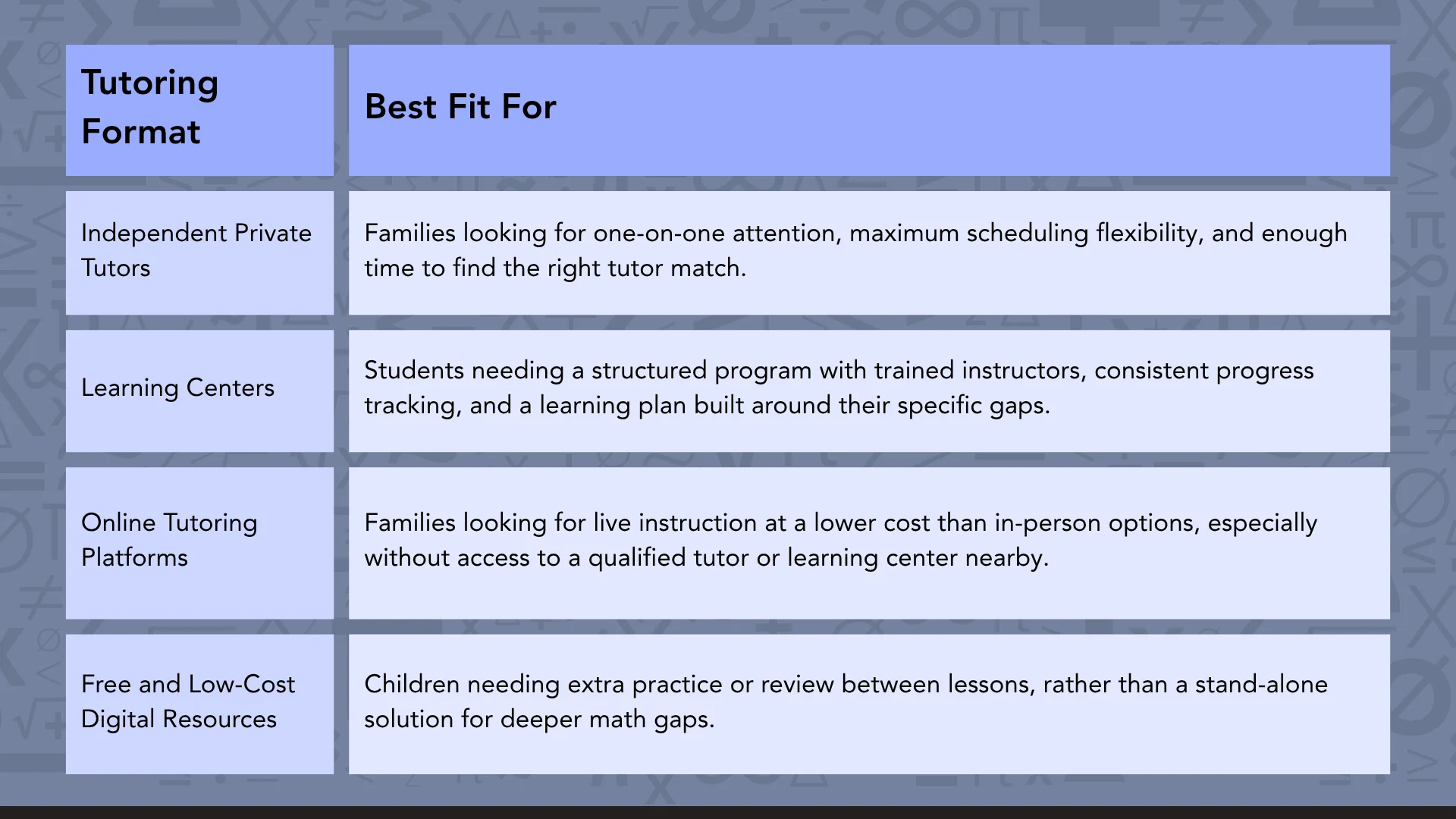
Math tutoring usually comes in four main formats, each with its own pricing model and level of support. A quick look at these options can help you compare programs more fairly and choose the format that fits your student’s needs.
1. Independent Private Tutors
Independent private tutors work one-on-one with your child, usually in 60-minute sessions scheduled around your family’s calendar. You can find them through referrals, tutoring marketplaces, or direct outreach.
For private tutoring, the price often depends on the level of support your child needs.
-
General math help usually falls around $35–$80 per hour.
-
Rates may reach $80–$150+ per hour, depending on credentials and experience.
The biggest advantage of private tutoring is direct, one-on-one support. Your child gets the tutor’s full attention, and sessions can often be scheduled around your family’s calendar.
The main challenge is consistency. Each tutor brings their own approach, so instruction, lesson structure, progress tracking, and communication with parents can vary widely. It may take time to find the right match.
📕 You May Also Like: How Face-to-Face Math Tutoring Builds Lasting Confidence
2. Learning Centers
In tutoring centers, your learner gets a more structured learning environment. Families usually get trained instructors, planned materials, and a consistent system for how lessons are taught.
Most centers charge through monthly enrollment or membership rather than a per-session rate, so the cost is harder to compare directly with hourly private tutoring. In general, tutoring center programs often cost about $150–$400+ per month. The final price depends on several factors:
-
How often your child attends
-
What kind of program they join
-
Where the center is located
For example, our math-only learning center, Mathnasium, operates on a flat monthly membership fee. Pricing varies by location and program structure, so you should contact your local center directly for current rates.
The main advantage of a tutoring center is structure. Your student works with trained instructors, follows a planned program, and has progress tracking built into the model.
The trade-off is flexibility. Centers may offer fewer scheduling options than private tutors, and monthly billing means families usually make a larger commitment upfront.
3. Online Tutoring Platforms
Online math tutoring gives your learner access to live instruction without commuting to a center or tutor’s home. Some platforms handle the tutor matching for you, while others let you compare profiles, rates, and specialties before choosing.
-
This tutoring format costs about $25–$70 per hour when you choose from standard tutoring platforms.
-
Managed services with vetted or credentialed tutors usually cost more, around $60–$120+ per hour.
For many parents, online sessions can feel more budget-friendly than in-person options since they’re not paying for a tutor’s travel time or extra location-related costs.
The key benefit of this option is that your family may choose from tutors beyond driving distance, typically at a more affordable cost than face-to-face sessions.
On the flip side, the fit still depends on the platform’s screening process and the tutor you choose. Elementary students may also need more hands-on structure than a video session can provide.
📕 You May Also Like: 4 Benefits of Hybrid Math Tutoring for Students & Parents
4. Free and Low-Cost Digital Resources
Your child may also use videos, self-paced lessons, and adaptive exercises on free or low-cost math platforms. Many premium subscription tiers can cost about $15–$20 per month.
They can work well for review or practice between lessons, but they may not be enough on their own if your learner has deeper math gaps.
The main limitation is that your student is working without a live instructor. A video or practice tool may show the steps, but it cannot notice where your child is confused, ask follow-up questions, or adjust the lesson in real time.
How to Tell Whether Tutoring Is Worth the Cost
To decide whether the tutoring cost is justified, consider your student’s specific learning needs, whether it’s a quick homework help, solid foundational skills, test preparation, or more confidence in class. Each calls for a different kind of support
These questions can help you compare options and check whether the tutoring matches your learner’s math goals and needs.
A. Does the Program Adapt to Your Child’s Needs?
Grade level alone does not always show why your student gets stuck in math. Your learner working on pre-algebra may still have gaps with fractions, multiplication facts, or number sense from earlier grades. The program should identify those gaps before building a learning plan.
Each student's journey at Mathnasium begins with a diagnostic assessment, which helps to identify the conceptual understanding behind grades. Then, we use those insights to build a personalized learning plan that targets each child’s specific learning needs.
📕 You May Also Like: Why Personalized Math Tutoring Makes All the Difference
B. How Is Progress Tracked?
You should have a clear picture of how your child is progressing. Before you commit, ask what improvement should look like, how progress will be measured, and how often you will receive updates.
A clear answer includes specific checkpoints, such as skill reviews, assessments, or progress reports. A less helpful answer focuses mostly on attendance or gives only general updates without showing what your student has learned.
📕 You May Also Like: The Unseen Benefits of Consistent Math Tutoring
C. Does the Instruction Build True Understanding?
Your learner may earn a higher score after a few practice sessions, but that does not always mean they understand the math well enough to use it later. Good tutoring should help your child explain the idea, solve different kinds of problems, and feel prepared for the next topic.
At Mathnasium, our tutors meet each student where they are and help them build true math understanding, one concept at a time. They use a mix of verbal, visual, tactile, and written techniques so students can make sense of each concept and apply it with confidence.
D. Is the Pricing Transparent and Flexible Enough?
Before you commit, make sure you understand what the cost includes and how flexible the program is. Ask about any extra fees, and how the program handles pauses, cancellations, or changes to your child’s plan.
📕 You May Also Like: What to Look for in a Math Tutoring Program - Expert Tips

At Mathnasium, we believe families should have as much clarity about a student's needs as they do about the cost of support. Both are important parts of a successful math plan.
How Mathnasium Approaches Math Tutoring
Mathnasium is a math-only learning center which helps K–12 students of all skill levels excel in math.
In our work with students, we do not rely on a one-size-fits-all approach, we use the Mathnasium Method™, our proprietary teaching approach, to meet each student at the right starting point and guide them toward math mastery, step by step.
Our method includes a diagnostic assessment, which lets us identify a child's current skills, knowledge gaps, and how they think about math, including the foundational skills that may be affecting their current progress. From there, we create a personalized learning plan focused on building the right skills in the right order.
Our specially trained tutors follow the plan closely, delivering face-to-face instruction in a supportive environment, both in-center and online. We teach through a mix of teaching techniques so each concept lands clearly.
Fun is a core part of our approach, too. We use game-based activities, let students earn rewards, and celebrate their progress together, so learning stays enjoyable and confidence grows with every session.
Families see the difference:
-
94% of parents report improvement in their child’s math skills and understanding
-
93% of parents report a more positive attitude toward math after attending Mathnasium
-
90% of students saw improvement in their school grades
With over 1,100 learning centers across North America, there is likely a Mathnasium close to you.
For families in Johns Creek and the surrounding communities, Mathnasium of Johns Creek brings that same approach close to home, with specially trained tutors who know how to identify what students need and build the skills that help them move forward.
If you’d like a clear picture of where your child stands and what kind of support would fit them best, a free diagnostic assessment is the right place to start.
📅 Schedule a Free Assessment at Mathnasium of Johns Creek
Not near Johns Creek?
📍 Find a Mathnasium Learning Center Near You


 (770) 273-9697