Try counting snacks, pencils, pages, or anything else without holding up fingers, saying “one, two, three” under your breath, or making tally marks on a scoreboard.
It's almost impossible. The numbers we use for that kind of counting are called natural numbers: 1, 2, 3, 4, 5, and so on. The name may sound formal, but you've been using the idea before you ever set foot in a classroom.
Today, we'll explain what natural numbers are, how they work, and how they compare with other number groups you meet in math class.
What Are Natural Numbers?
Natural numbers are the numbers we use for counting, starting at 1 and going up: 1, 2, 3, 4, and so on.
The numbers are called “natural” because these are the numbers we use naturally when we count real things: 1 snack, 2 pencils, 3 pages, and so on.
People used counting numbers long before they worked with ideas like 0, negative numbers, fractions, or decimals. They are called “natural” because they are usually the first numbers we reach for when we start counting.
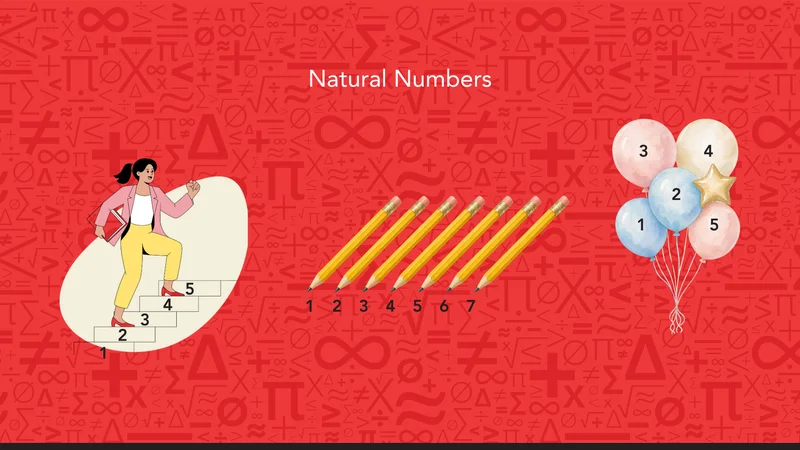
Each time we are using natural numbers, we answer the question: “How many?”
-
How many steps? 5
-
How many pencils? 7
-
How many balloons? 6
📕 You May Also Like: Finger Counting A Great Tool or a Hindering Habit
Natural Numbers Never End
We can count as high as we want, and there is always one more natural number after that. In a group of natural numbers (1, 2, 3, 4, 5, …), the three dots “...” mean we keep following the same counting pattern. After 5 comes 6, then 7, then 8, and we can always keep going one number higher.
Let’s test that idea with a few numbers:
-
Count to 100. One higher is 101.
-
Count to 1,000. One higher is 1,001.
-
Count to 1,000,000. One higher is 1,000,001.
That is why we call natural numbers infinite. The list has no last number.
📕 You May Also Like: How Number Sense Shapes Your Child's Problem-Solving Skills
How Natural Numbers Compare to Whole Numbers and Integers
Natural numbers help us understand the two other number groups, whole numbers and integers. Each new group adds something to the counting numbers we already know.
-
Natural numbers: 1, 2, 3, 4, … These are the numbers we use to count, starting at 1.
-
Whole numbers: 0, 1, 2, 3, 4, … These include all the natural numbers, plus zero.
-
Integers: ..., −3, −2, −1, 0, 1, 2, 3, … These include the whole numbers, plus negative numbers.
We can use a number line to see how these number groups fit together.
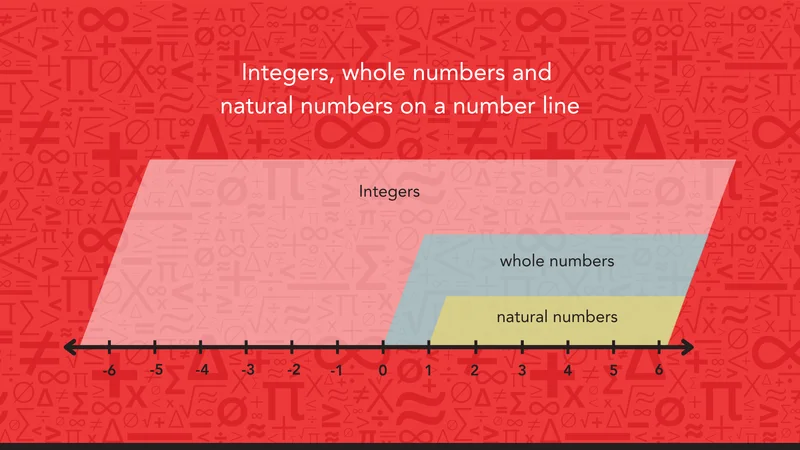
We can think of these number groups as building on one another:
|
Number group
|
What it includes
|
How it relates to the others
|
|
Natural numbers
|
1, 2, 3, 4, 5, …
|
The counting numbers
|
|
Whole numbers
|
0, 1, 2, 3, 4, 5, …
|
All natural numbers, plus 0
|
|
Integers
|
…, –3, –2, –1, 0, 1, 2, 3, …
|
All whole numbers, plus negative numbers
|
So every natural number is also a whole number and an integer. But 0 and negative numbers do not belong to the natural numbers.
📕 You May Also Like: How Number Lines Improve Math Understanding (Grades 1-5)
Your Turn! Which of These Are Natural Numbers?
Now it's your turn to decide whether each number below counts as a natural number. Check your answers at the bottom of the page once you're done.
-
Is 7 a natural number?
-
Is 0 a natural number?
-
Is −10 a natural number?

At Mathnasium, tutors help young learners understand natural numbers through hands-on counting activities and visual tools like number lines.
How Mathnasium Helps Students Understand Natural Numbers and Any Other Math Topic
Mathnasium is a math-only learning center dedicated to helping K–12 students of all skill levels excel in math. We work with students to build solid number sense and a true understanding of any K-12 math concept, including natural numbers.
Following our proprietary teaching approach, the Mathnasium Method™, we meet students where they are on their math journey and guide them toward math mastery, step by step.
Each student begins their Mathnasium journey with a diagnostic assessment, which helps us identify their current skills, knowledge gaps, and how they think about math.
Using these insights, we create a personalized learning plan focused on the skills the student needs most, whether that means comparing quantities, understanding place value, recognizing number patterns, or preparing for more advanced number concepts.
Our specially trained tutors follow the plan closely, delivering face-to-face instruction in a caring and supportive environment, both in-center and online. We teach through a mix of visual, verbal, tactile, written, and mental techniques so each concept lands clearly.
For topics like natural numbers, students may count objects, compare groups, place numbers in order, notice patterns, or explain why a number belongs in one category and not another. This helps them understand number categories as connected ideas rather than labels to memorize.
Our tutors also give students room to think through problems before stepping in. They guide students to explain their reasoning and check their thinking. This balance helps students build problem-solving skills, critical thinking, and greater independence in math.
Fun is a core part of our approach, too. We use hands-on and game-based activities, rewards, and consistent encouragement to keep students engaged as they build confidence with numbers, patterns, and mathematical reasoning.
And the results? True, measurable progress:
-
94% of parents report improvement in their child’s math skills and understanding
-
93% of parents report a more positive attitude toward math after attending Mathnasium
-
90% of students saw improvement in their school grades
Mathnasium has more than 1,100 learning centers nationwide, making our proven approach accessible in communities across the country.
For families in and near Johns Creek, GA, Mathnasium of Johns Creek brings that same approach close to home, with specially trained tutors, helping students build number sense, understand number systems, and develop the confidence they need for the math ahead.
If your child has a shaky foundation in math or finds it hard to understand natural numbers, whole numbers, integers, and how number categories fit together, a free diagnostic assessment is a great place to start. From there, we’ll create a personalized learning plan that helps your child master the skills they need next.
📅 Schedule a Free Assessment at Mathnasium of Johns Creek
Not near Johns Creek?
📍 Find a Mathnasium Learning Center Near You
Pssst! Check Your Answers Here
Ready to see how you did? Here's the reasoning behind each answer.
-
Is 7 a natural number? Yes. 7 is one of the counting numbers.
-
Is 0 a natural number? No. Natural numbers start at 1, so 0 doesn't make the list, though it is a whole number.
-
Is −10 a natural number? No. Natural numbers do not include negative numbers.


 (770) 273-9697