Octagons show up in middle school geometry right alongside polygon properties, interior angles, and symmetry.
Most of us recognize the shape from stop signs and floor tiles well before geometry class puts a name to it. What geometry class adds is the ability to describe it precisely, calculate its measurements, and understand why it works the way it does.
Today, our tutors break down what an octagon is, how to classify different types, what properties every octagon shares, and how to find its perimeter.

What Is an Octagon?
An octagon is a polygon with exactly eight straight sides and eight angles.
The word octagon comes from the Greek words okto, meaning eight, and gonia, meaning angle. The name tells us exactly what to count.
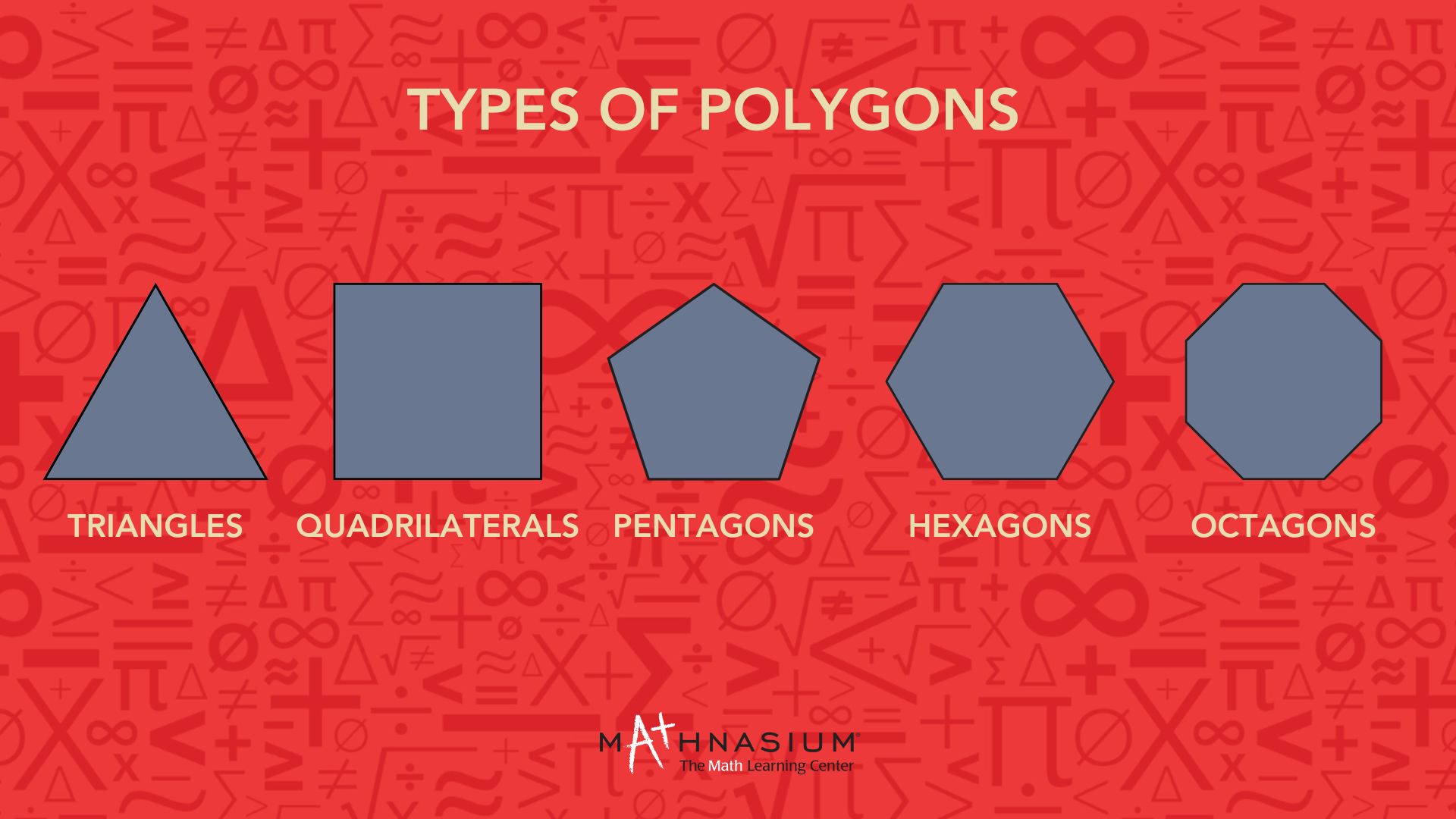
Octagons belong to the same polygon family as triangles, quadrilaterals, pentagons, and hexagons.
What sets them apart is the number of sides.
The Interior Angles of an Octagon
Eight sides of an octagon produce eight angles, and those eight angles always add up to the same total regardless of the shape of the octagon.
So what is that total? Let us work it out together using what we already know about polygons.
We start with the triangle because it is the simplest polygon, and its fixed angle sum of 180° serves as the foundation for finding the angle sum of every other polygon.
Any standard polygon can be split into triangles by drawing diagonals from one corner to every corner that is not directly next to it. That means we can always find the total angle sum of any polygon by counting its triangles and multiplying by 180°.
-
A quadrilateral splits into 2 triangles.
-
A pentagon splits into 3 triangles.
-
A hexagon splits into 4 triangles.
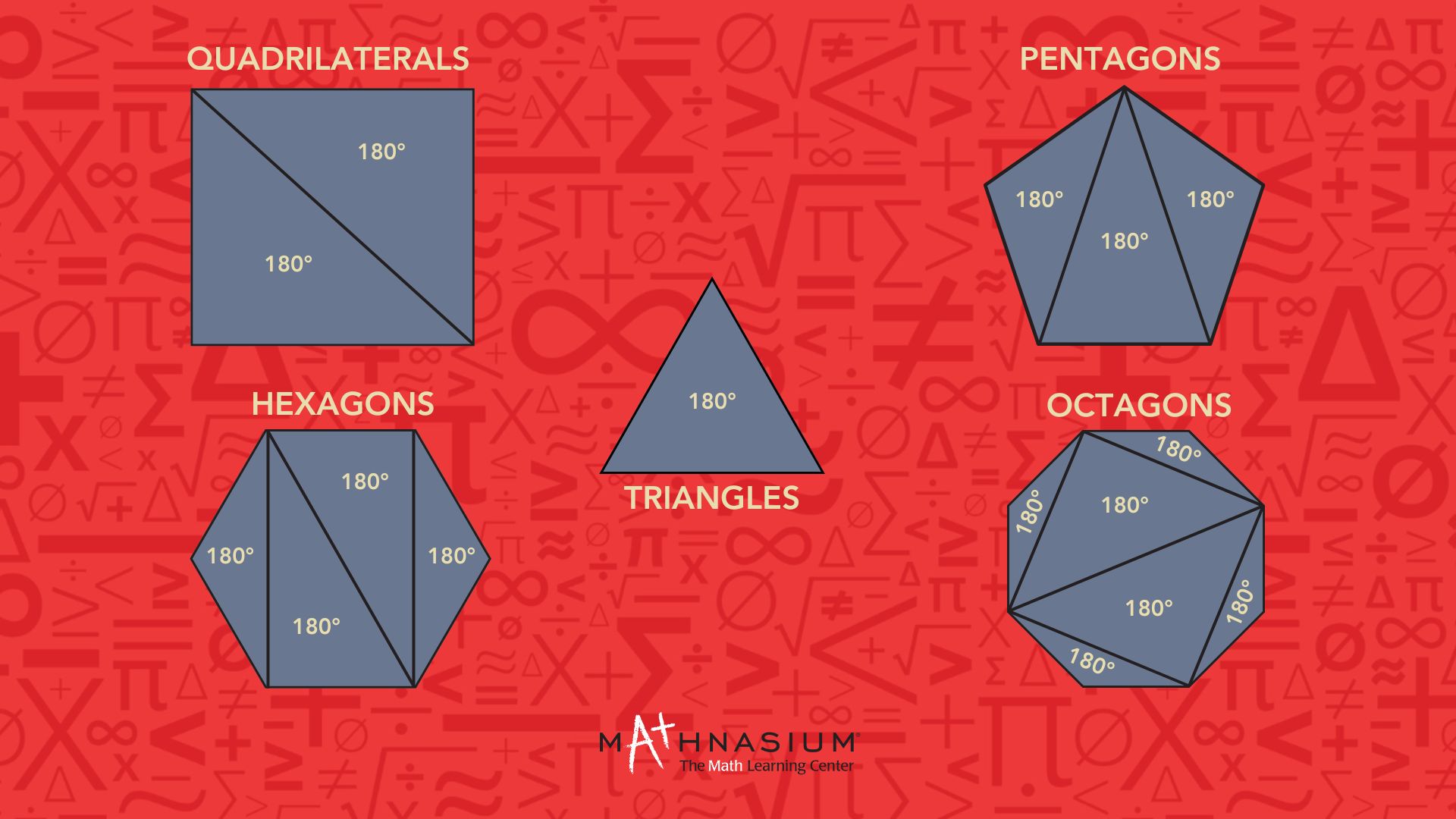
Do you notice a pattern? The number of triangles is always two less than the number of sides.
This is exactly what the interior angle sum formula captures:
Sum of interior angles = (n − 2) × 180°
Here n is the number of sides. For an octagon, we have n = 8. Let us work it out:
S = (8 − 2) × 180°
S = 6 × 180°
S = 1080°
So the interior angles of any octagon always add up to 1080°, regular or irregular.
📕 You May Also Like: Types of Angles: How to Identify Straight, Right, Acute, and Obtuse Angles?
Types of Octagons
Octagons come in different forms. We classify them based on two properties:
1. Regular Octagon
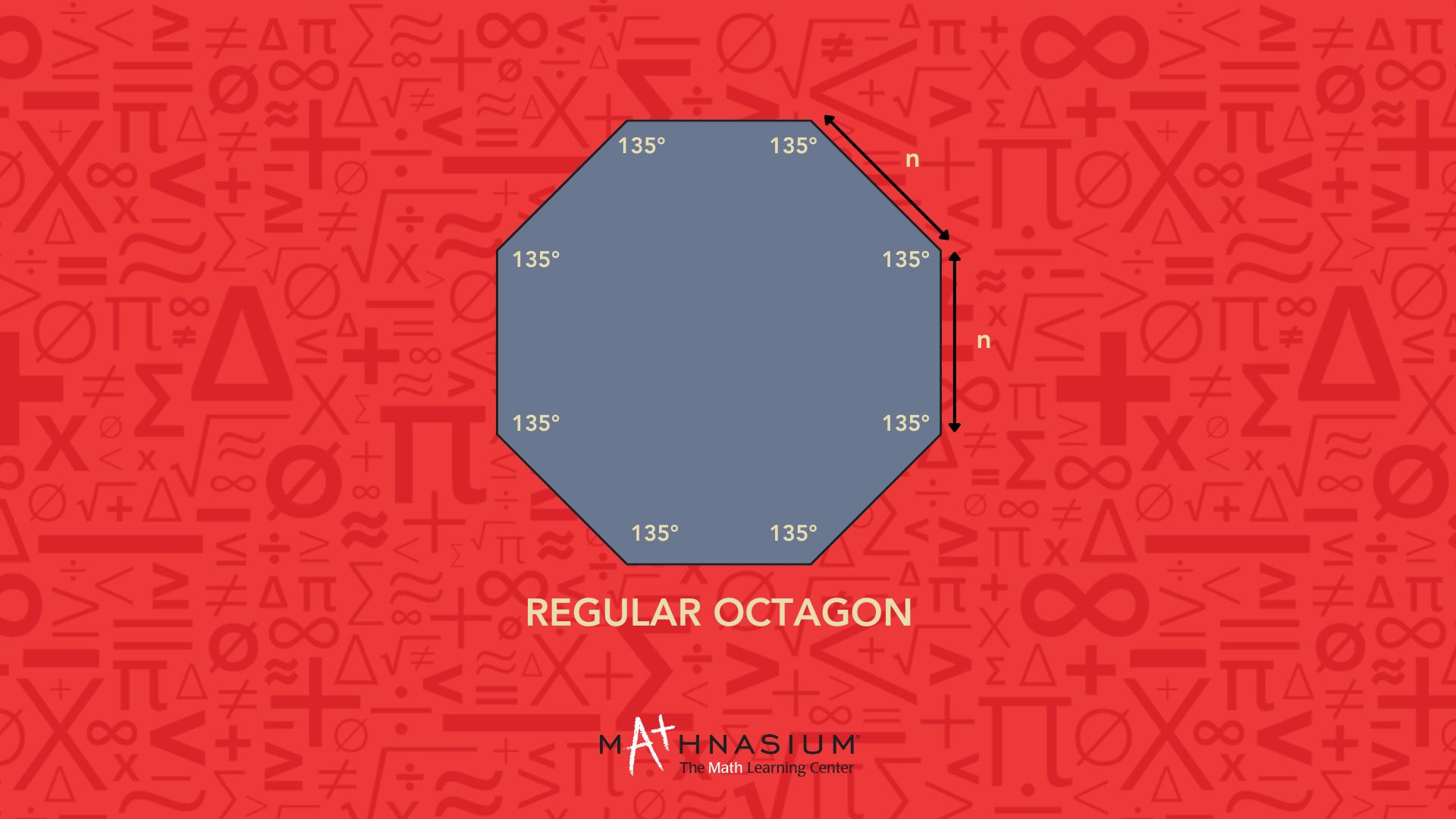
A regular octagon has eight equal sides and eight equal angles.
Both conditions must hold at the same time.
We already know that the interior angles of any octagon add up to 1080°. In a regular octagon, all eight angles are equal. So how do we find what each one measures?
We divide the total equally across all eight angles:
1080° ÷ 8 = 135°
Each interior angle of a regular octagon measures 135°.
Because all sides are equal and all angles are equal, a regular octagon is perfectly symmetrical.
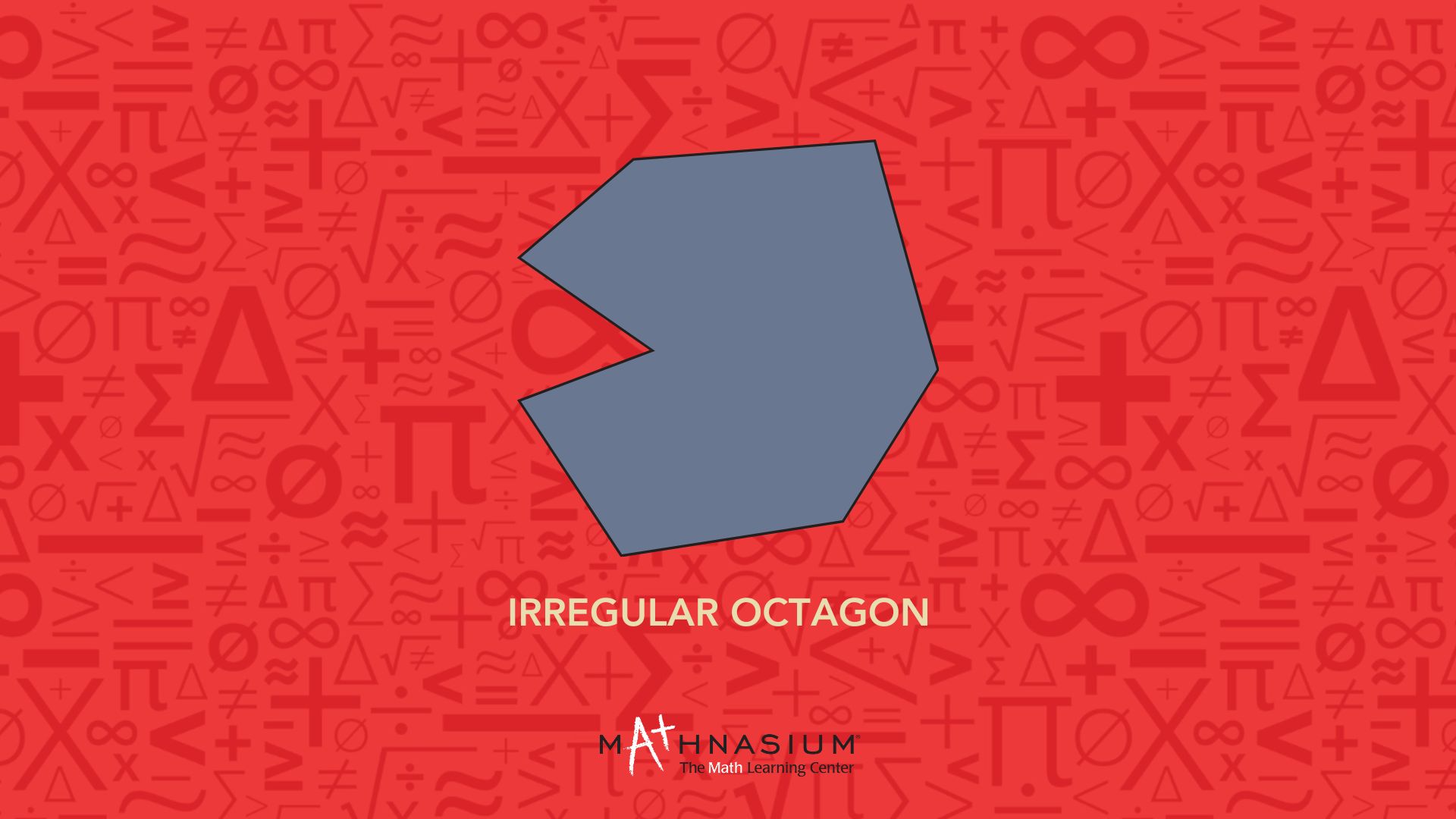
2. Irregular Octagon
We already know that a regular octagon must meet two conditions: all sides must be equal, and all angles must be equal.
So what happens when an octagon fails at least one of those conditions? It becomes an irregular octagon.
An octagon is irregular if:
-
The sides have different lengths.
-
The angles have different measures.
-
Both the sides and the angles are unequal.
No matter how uneven an irregular octagon looks, it still has eight sides and its interior angles still add up to exactly 1080°.
📕 You May Also Like: Regular vs. Irregular Polygons: What's the Difference?
3. Convex Octagon
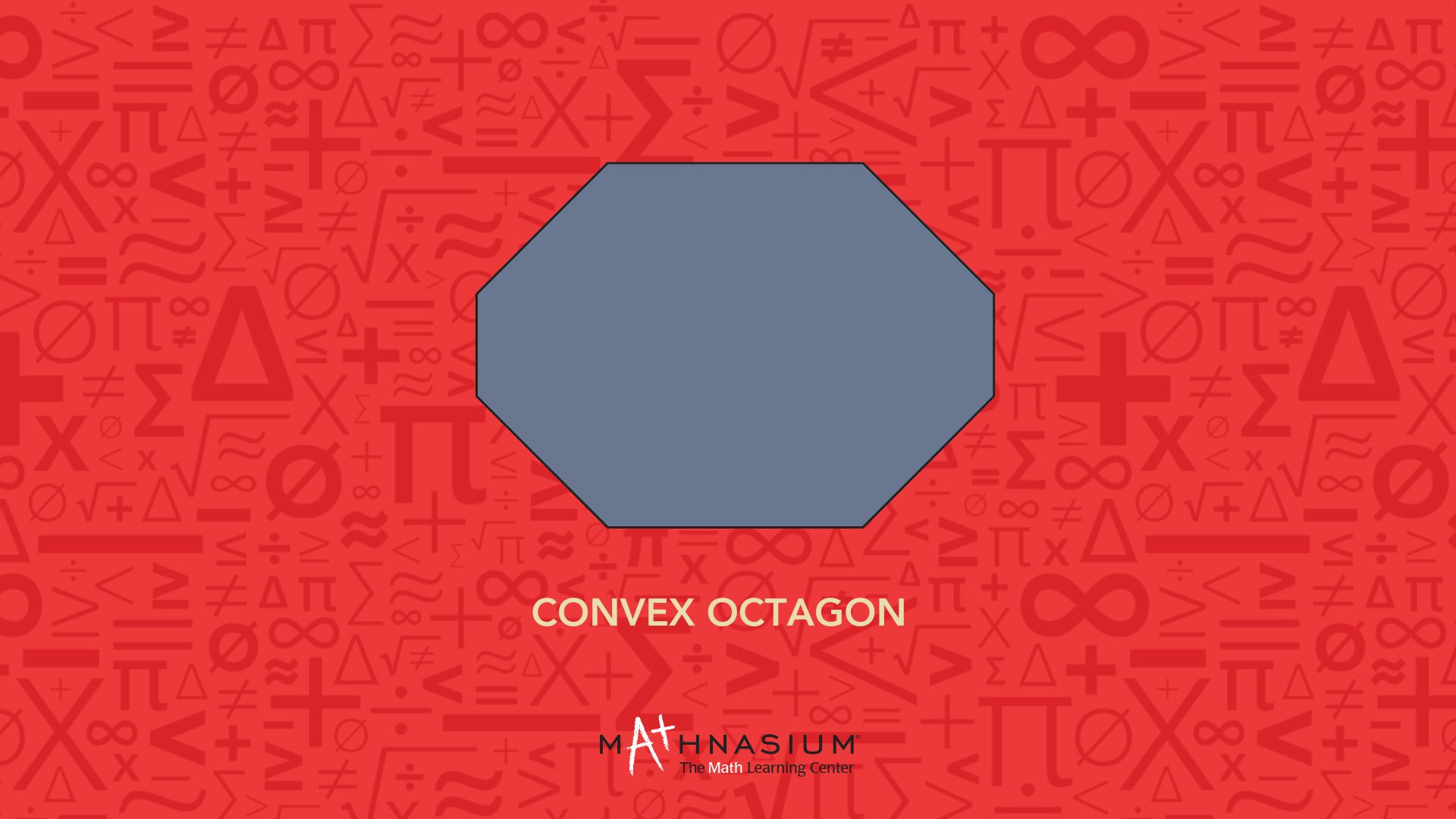
A convex octagon is one where every vertex points outward. No part of the outline caves inward, and every interior angle is less than 180°.
We can think of it as a shape that bulges outward at every point. If we were to pick any two points inside a convex octagon and connect them with a straight line, that line would stay completely inside the shape.
A regular octagon is always convex.
4. Concave Octagon
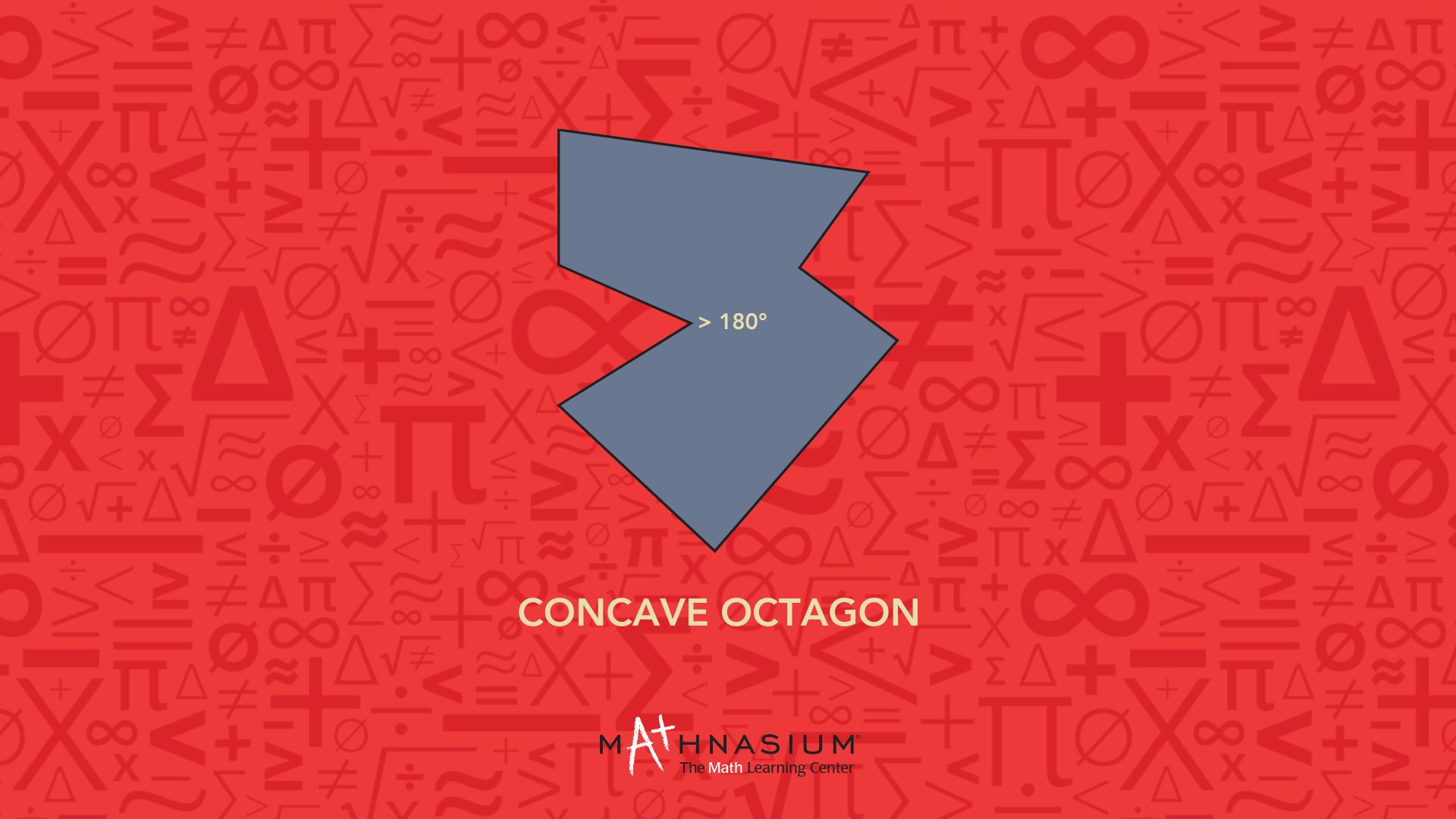
A concave octagon has at least one vertex that points inward instead of outward. We can think of it as a shape with a dent in it.
At the inward vertex, the interior angle measures more than 180°.
A concave octagon is always irregular.
📕 You May Also Like: Geometric Transformations – Definitions, Types, Examples, and Quiz
How to Find the Perimeter of an Octagon
The perimeter of any polygon is the total distance around the outside. For an octagon, that means adding up all eight side lengths.
In a regular octagon, all eight sides are equal, so every side shares the same length. We use s to represent that length.
Now, what is the simplest way to add the same value eight times? Multiplication, and with it, we have this formula:
P = 8 × s
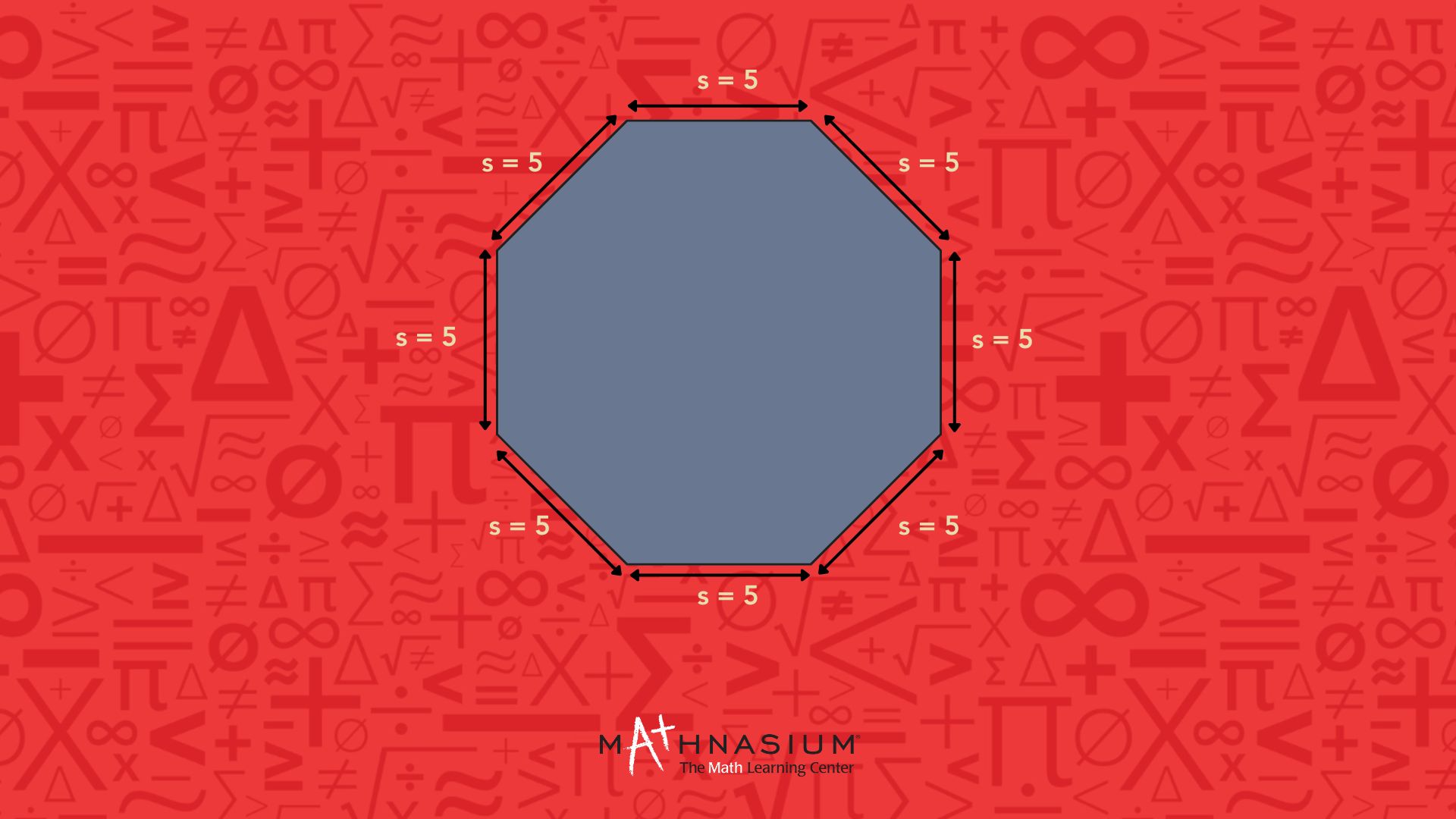
For a regular octagon with a side length of 5 inches:
P = 8 × 5 = 40 inches
The total distance around that octagon is 40 inches.
In an irregular octagon, the sides are different in size. So what do we do when multiplication no longer works as a shortcut?
We add each side separately by labeling them s1, s2, s3, and so on up to s8, where each number simply tells us which side we are referring to.
Adding all eight gives us:
P = s1 + s2 + s3 + s4 + s5 + s6 + s7 + s8
For an irregular octagon with sides measuring 3, 4, 5, 4, 6, 3, 5, and 4 inches, our formula would look like this:
P = 3 + 4 + 5 + 4 + 6 + 3 + 5 + 4 = 34 inches
The total distance around that octagon is 34 inches.
The same approach works for convex and concave octagons. Both can be irregular, and both follow the same addition formula as long as we know the length of each side.
📕 You May Also Like: What Is a Diameter & How to Measure It? A Beginner’s Guide
Where We See Octagons in Real Life
The octagon shape appears throughout everyday life, from road signs to architecture to the umbrella in our hands.
A. Stop Signs
At every intersection, there is an octagon waiting for us. The stop sign is the most familiar octagon in everyday life.
Its eight-sided shape was chosen for a specific reason. No other common road sign shares that shape, which means we can recognize it from a distance, at an angle, and even when it is partially covered by snow or dirt.

The stop sign is probably the most recognized octagon in everyday life.
B. Floor Tiles
In any bathroom, hotel lobby, or old public building, it is worth looking down at the floor. A classic floor tile pattern combines regular octagons with small square tiles to fill the gaps between them.
The two shapes fit together without any wasted space, which is why this pattern has appeared in homes and public buildings for centuries.
C. Architecture
Octagonal towers, rooms, and domes appear throughout history. The shape distributes structural load evenly across eight sides, which made it a practical choice for builders long before modern engineering tools existed.
The octagonal lantern of Ely Cathedral in England, built in the 14th century, is one of the most celebrated examples.
D. Umbrellas
On a rainy day, the umbrella we are holding is an octagon. The canopy is made of eight fabric panels that meet at the center and spread outward to form the shape.
The eight sides distribute tension evenly across the frame, which helps the umbrella hold its shape in the wind.
📕 You May Also Like: Real-Life Applications of Trigonometry
Quiz: How Well Do You Know Octagons?
Our tutors at Mathnasium put together six questions, each testing a different part of what we covered in this guide. Work through each one carefully.
Question 1: How many sides does an octagon have?
a) 6
b) 7
c) 8
d) 9
Question 2: What is the sum of the interior angles of any octagon?
a) 720°
b) 900°
c) 1080°
d) 1260°
Question 3: Each interior angle of a regular octagon measures:
a) 108°
b) 120°
c) 135°
d) 150°
Question 4: A regular octagon has how many lines of symmetry?
a) 4
b) 6
c) 8
d) 10
Question 5: Which of the following is a real-life example of a regular octagon?
a) A honeycomb cell
b) A stop sign
c) A yield sign
d) A brick
Question 6: What makes a concave octagon different from a convex octagon?
a) It has fewer sides
b) At least one interior angle measures more than 180°
c) Its sides are all equal
d) It is always regular

Mathnasium tutors bring geometry concepts to life through clear explanations, visual tools, and step-by-step instruction.
How Mathnasium Helps Students Build Real Confidence in Geometry
Mathnasium is a math-only learning center dedicated to helping K–12 students of all skill levels learn and master math.
Whether students need help classifying shapes like octagons, want to build a solid understanding of polygon properties and angle relationships, or are ready for a challenge beyond their current curriculum, Mathnasium offers a personalized path forward.
We build that path forward through the Mathnasium Method™, our proprietary teaching approach, designed around each student's individual learning needs and style. Here is how it works in practice:
-
Diagnostic Assessment and Personalized Learning Plans: Every student begins with a diagnostic assessment, a relaxed interaction that uncovers their strengths and knowledge gaps. From those insights, we build a personalized learning plan tailored to their needs and goals.
-
Teaching for Understanding: Our specially trained tutors follow that plan closely, teaching math face-to-face in a supportive and fun setting. We use plain, everyday language and a mix of verbal, visual, mental, tactile, and written techniques so the math makes sense.
-
Problem-Solving and Critical Thinking: If a concept feels challenging, we break it down into manageable parts and teach both the how and the why behind it. In time, students build problem-solving skills and critical thinking tools they can use in math and in life.
-
A Supportive and Fun Environment: Our sessions are often game-based, students earn rewards along the way, and we celebrate every bit of progress. Learning stays enjoyable, and confidence grows with every session.
Families see measurable results:
-
94% of parents report an improvement in their child's math skills and understanding
-
93% of parents report their child's improved attitude toward math after attending Mathnasium
-
90% of students saw an improvement in their school grades
We operate over 1,100 centers across North America, bringing our proven approach to communities everywhere.
For families in and around Pembroke Pines, FL, Mathnasium of Pembroke Pines is a trusted local center with years of experience helping students build confidence in geometry and every math concept that follows.
Whether your child needs to catch up, keep up, or get ahead, our team is happy to help.
📅 Schedule a Free Diagnostic Assessment at Mathnasium of Pembroke Pines
Not near Pembroke Pines?
📍 Find a Mathnasium Learning Center Near You
Pssst! Check Your Answers Here
Here is how each question breaks down.
Question 1: c) 8.
Question 2: c) 1080°.
Question 3: c) 135°.
Question 4: c) 8.
Question 5: b) A stop sign.
Question 6: b) At least one interior angle measures more than 180°.


 (954) 441-6284